UPS Cuts 30,000 More Jobs as Amazon Exodus Enters Final Phase
January 27, 2026 · by Fintool Agent


United Parcel Service announced it will eliminate up to 30,000 operational positions in 2026 as the world's largest package delivery company enters the final six months of its strategic retreat from Amazon. The cuts—coming via attrition and a second voluntary driver buyout—bring total job reductions to roughly 78,000 over two years as Ups executes one of the most dramatic network overhauls in corporate logistics history.
The announcement came alongside Q4 2025 results that beat Wall Street expectations, sending shares up 3-4% as investors digested the counterintuitive reality: Ups is shrinking its way to profitability.
The Numbers
Fourth quarter revenue came in at $24.5 billion with operating profit of $2.9 billion, yielding an 11.8% consolidated operating margin . For the full year, Ups generated $88.7 billion in revenue and $8.7 billion in operating profit .
| Metric | Q4 2025 | Q4 2024 | YoY Change |
|---|---|---|---|
| Revenue | $24.5B | $25.3B | -3.2% |
| Operating Profit | $2.9B | $2.1B | +38% |
| Operating Margin | 11.8% | 8.1% | +370 bps |
| Diluted EPS | $2.38 | $2.01 | +18% |
The company guided for 2026 revenue of approximately $89.7 billion—above analyst estimates of $87.9 billion—and a 9.6% consolidated operating margin .
 Ask Fintool AI Agent
The Amazon Unwind
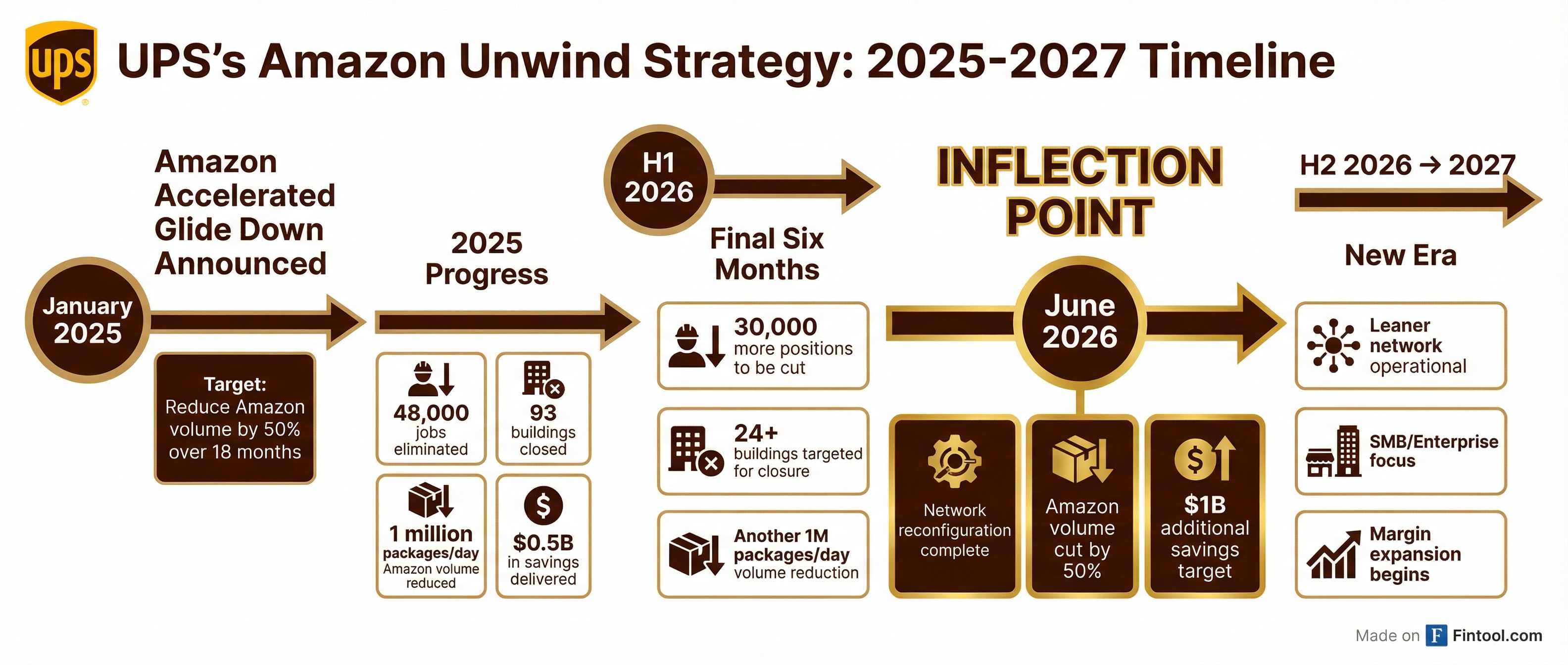
The job cuts are the latest phase of Ups's 18-month "Amazon Accelerated Glide Down" plan, announced in January 2025 when CEO Carol Tomé called Amazon deliveries "extraordinarily dilutive" to margins .
"We're in the final six months of our Amazon Accelerated Glide Down plan," Tomé said on Tuesday's earnings call. "For the full year 2026, we intend to glide down another 1 million pieces per day while continuing to reconfigure our network."
The scale of transformation is staggering:
2025 Actions:
- 48,000 positions eliminated (34,000 operational, 14,000 management)
- 93 buildings closed
- 1 million Amazon packages per day removed from network
- $3.5 billion in savings delivered
2026 Plan:
- Up to 30,000 more operational positions reduced
- 24+ buildings targeted for closure in H1, with more under evaluation
- Another 1 million packages per day volume reduction
- $3 billion additional savings target
CFO Brian Dykes emphasized the cuts would come through attrition and voluntary buyouts rather than forced layoffs: "We expect to offer a second voluntary separation program for full-time drivers."
The "Bathtub Effect"
Tomé used a memorable analogy to describe 2026's expected financial shape: "The way I think about the year is like a bathtub effect. The halves will look different. First half down, second half up."
The first half will be painful. Dykes projected U.S. domestic margins in the "mid-single digits" for Q1 2026, weighed down by three factors :
- Timing lag: Costs don't come out as fast as volume exits
- GroundSaver transition: Short-term expenses from shifting economy deliveries to USPS
- MD-11 fleet retirement: $100 million in lease costs to replace grounded aircraft
But by H2 2026, Ups expects "high single-digit operating profit growth" as the restructured network comes online .
The Pivot: From Amazon to Premium
Ups isn't just shrinking—it's fundamentally reorienting toward higher-margin customers. The results are already visible in Q4 data:
| Customer Mix Metric | Q4 2025 | Q4 2024 | Change |
|---|---|---|---|
| SMB penetration | 31.2% | 27.8% | +340 bps |
| B2B penetration | 37.5% | 35.3% | +220 bps |
| Revenue per piece growth | +8.3% | - | Highest in 4 years |
"This is the highest fourth quarter SMB penetration in our history," Dykes noted . The company's Digital Access Program—which connects small businesses to Ups through platforms like eBay and Shopify—grew revenue 25% to $4.1 billion globally .
Healthcare is another priority. The company's global healthcare logistics portfolio generated $11.2 billion in 2025 revenue, with acquisitions of Frigo-Trans and Andlauer Healthcare Group expanding cold chain capabilities .
Ask Fintool AI Agent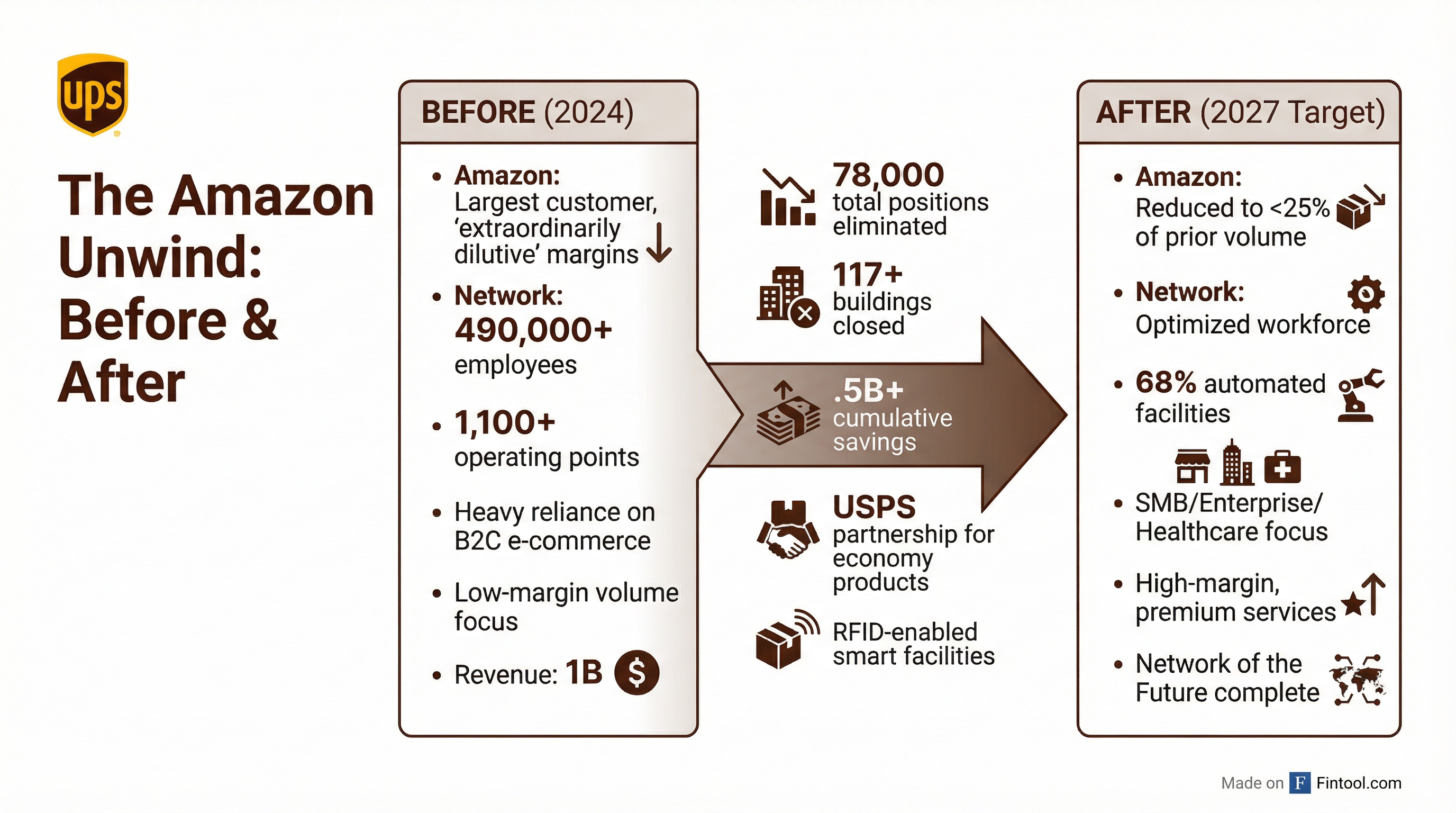
The Automation Advantage
Central to Ups's restructuring is aggressive automation. The company now operates 127 automated facilities and plans to add 24 more in 2026, bringing the percentage of U.S. volume processed through automated facilities to 68% by year-end .
The economics are compelling: "The cost per piece in these automated buildings is 28% less than the cost per piece in our conventional buildings," Tomé said .
The company is also deploying RFID technology across its network—"Smart Package, Smart Facility"—which has been rolled out to all 5,500 UPS Store locations and all U.S. package cars . This enables real-time tracking and reduced handling errors.
The USPS Partnership
In a strategic twist, Ups is outsourcing some of its economy deliveries back to the United States Postal Service. A new agreement formalized in Q4 allows USPS to handle last-mile delivery for GroundSaver products, with Ups using "density matching technology" to route packages optimally .
"We're going into the DDUs," Tomé explained, referring to USPS Delivery Distribution Units. "That opportunity was not presented to us a year ago. So we're very excited to be able to use the DDUs, because that will ensure our service levels stay high."
The economics should improve through 2026, though Tomé cautioned the full $400-$500 million benefit "won't materialize until 2027" .
The Teamsters Response
The International Brotherhood of Teamsters, which represents Ups's unionized workforce, issued a measured response: "We're perfectly happy for Ups to realize growth and cost savings on the backs of corporate managers so long as they uphold their contractual commitments to our members and reward the Teamsters who actually make the company run."
The 2023 Teamsters contract front-loaded wage increases, creating a cost structure that Ups is now absorbing through network efficiency gains rather than workforce expansion.
The Competitive Landscape
Ups's transformation comes as rival Fedex pursues its own restructuring. Both companies face the same fundamental challenge: Amazon has built a competing delivery network that now handles approximately 60% of its own packages, reducing its need for third-party logistics providers.
| Metric | UPS (Q4 2025) | FedEx (Q2 FY2026) |
|---|---|---|
| Revenue | $24.5B | $23.5B |
| Operating Margin | 11.8% | 7.1% |
| Market Cap | $91B | $72B |
Ups's margin advantage reflects its earlier start on restructuring and its stronger position in premium services.
The MD-11 Factor
One unexpected development: Ups accelerated the retirement of its entire MD-11 aircraft fleet following a fatal crash in November 2025 at Louisville's Worldport hub . The company took a $137 million after-tax charge to write off the fleet and is replacing capacity with 18 new Boeing 767 aircraft over the next 15 months .
"We believe these actions are consistent with building a more efficient global network positioned for growth, flexibility, and profitability," Dykes said .
What to Watch
June 2026: The "inflection point" when Ups completes its Amazon glide down and begins operating its reconfigured network. Tomé called it the moment Ups transitions from transformation to growth.
H2 2026 margins: Management expects a "healthy double-digit margin" exit rate heading into 2027 . That will be the first real test of whether the pain was worth it.
SMB and healthcare growth: Ups's bet on premium customers must materialize. The company is targeting mid-single-digit growth in enterprise and SMB revenue in H2 2026 .
Tariff policy: Ups's guidance "does not reflect any significant changes to the current tariff landscape" . Any policy shifts could upend international volume assumptions.
Ask Fintool AI AgentThe Bottom Line
Ups is executing a controlled demolition of its old business model. By cutting 78,000 jobs, closing 117+ facilities, and walking away from its largest customer, the company is betting it can emerge as a leaner, higher-margin logistics provider focused on healthcare, SMBs, and premium enterprise shipping.
The stock's positive reaction suggests investors believe the strategy can work. But the next 18 months will determine whether Ups's shrink-to-grow gambit becomes a logistics case study—or a cautionary tale.
Related