US Forces Board Tanker in Indian Ocean After 15,000 km Pursuit from Caribbean
February 9, 2026 · by Fintool Agent


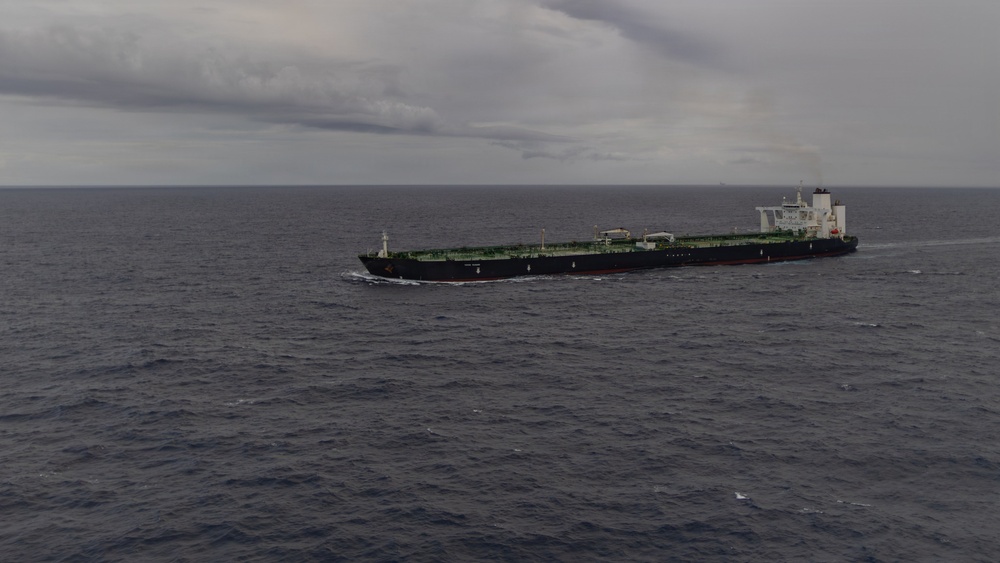
The Pentagon announced Monday that US military forces boarded the sanctioned oil tanker Aquila II in the Indian Ocean after tracking it from the Caribbean Sea in what has become the longest pursuit of a sanctioned vessel under President Trump's Venezuela oil blockade. The operation represents a dramatic expansion of the geographic scope of US sanctions enforcement—and a clear message to the global shadow fleet.
"It ran, and we followed," the Department of Defense declared on social media. "No other nation on planet Earth has the capability to enforce its will through any domain. By land, air, or sea, our Armed Forces will find you and deliver justice. You will run out of fuel long before you will outrun us."
The Aquila II is the eighth tanker seized or boarded since Trump announced a "complete blockade" of sanctioned vessels in mid-December 2025.
 Ask Fintool AI Agent
The Chase: 15,000 Kilometers Across Three Oceans
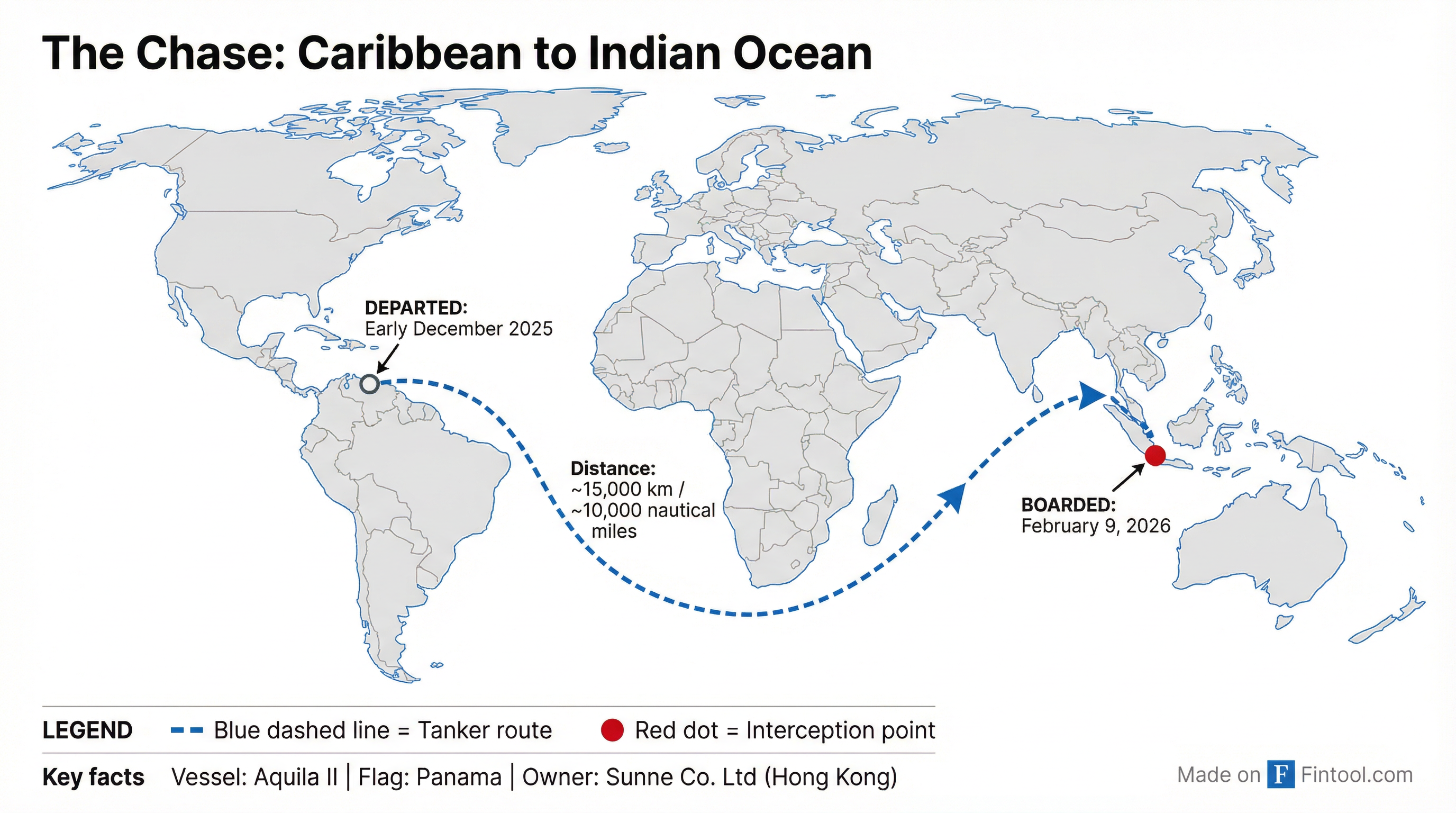
The Aquila II departed Venezuela's Jose terminal in early December 2025, carrying approximately 700,000 barrels of Venezuelan heavy crude bound for China, according to PDVSA schedules reported by Reuters. The vessel was operating under the alias "Cape Balder" with its transponder off—a practice known as "running dark" that is standard operating procedure for the shadow fleet.
US forces tracked the tanker as it rounded Africa's Cape and headed toward the Sunda Strait between Indonesia's Java and Sumatra islands. The overnight interdiction was carried out in the US Indo-Pacific Command's area of responsibility, with the destroyers USS Pinckney and USS John Finn, along with the mobile base ship USS Miguel Keith, operating in the region.
Key details of the pursuit:
| Aspect | Details |
|---|---|
| Origin | Jose Terminal, Venezuela |
| Departure | Early December 2025 (alias: Cape Balder) |
| Destination | China (intended) |
| Interception Point | Indian Ocean, near Sunda Strait |
| Distance Traveled | 15,000 km (10,000 nautical miles) |
| Cargo | 700,000 barrels Venezuelan heavy crude |
| Current Status | Boarded, not yet formally seized |
Unlike the seven prior seizures, the Aquila II has not been formally placed under US control. The defense official who spoke to the Associated Press said the ship is being held while its ultimate fate is decided.
The Eighth Seizure: A Blockade Intensifies
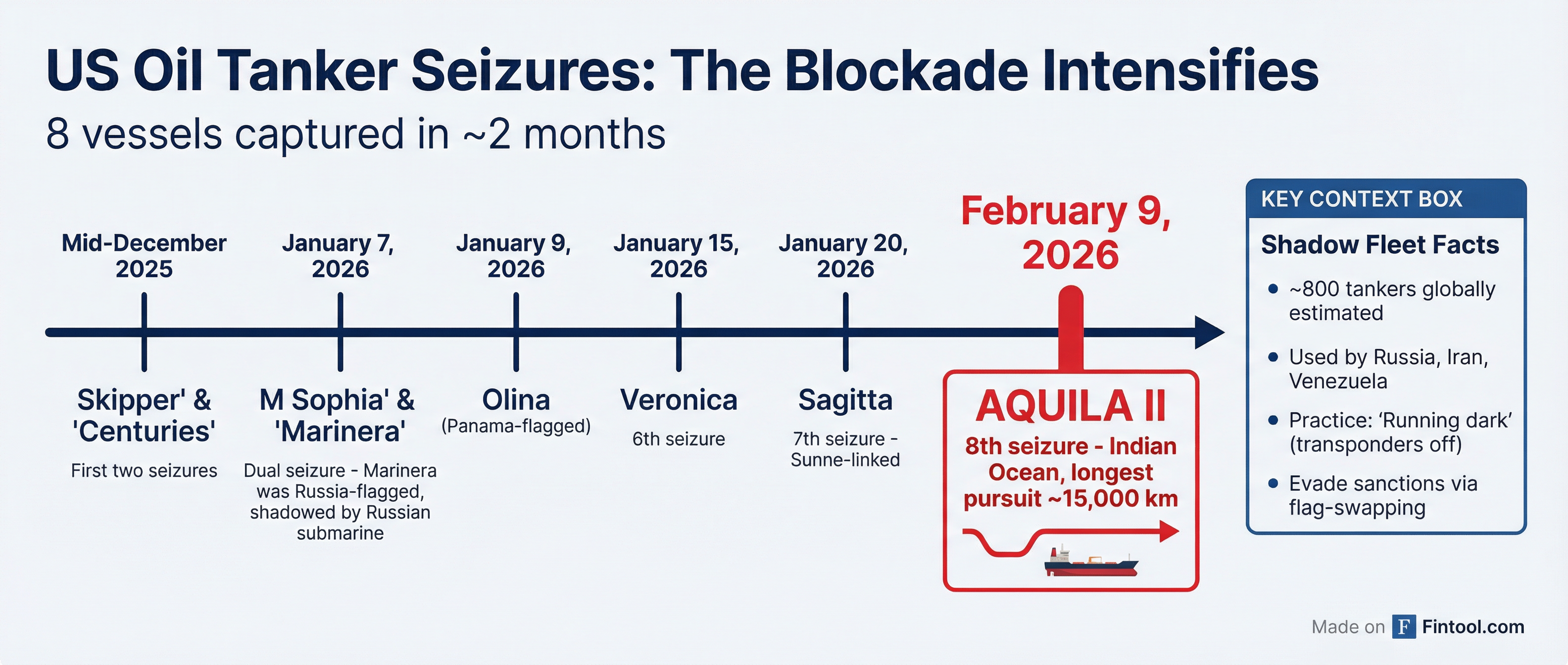
The Aquila II boarding comes amid an aggressive campaign to enforce the Venezuela oil blockade:
| Date | Vessel | Notes |
|---|---|---|
| Mid-Dec 2025 | Skipper, Centuries | First seizures after blockade announcement |
| Jan 7, 2026 | M Sophia, Marinera | Marinera was Russia-flagged; Russian submarine shadowed seizure near Iceland |
| Jan 9, 2026 | Olina | Panama-flagged |
| Jan 15, 2026 | Veronica | 6th seizure |
| Jan 20, 2026 | Sagitta | Sunne Co.-linked vessel |
| Feb 9, 2026 | Aquila II | Longest pursuit—Indian Ocean |
The acceleration began after US forces captured Venezuelan President Nicolás Maduro in a surprise nighttime raid on January 3. Since then, the Trump administration has sought to control the production, refining, and global distribution of Venezuela's petroleum products—the world's largest proven oil reserves at an estimated 300 billion barrels.
Defense Secretary Pete Hegseth vowed to pursue every fleeing tanker: "The only guidance I gave to my military commanders is none of those are getting away. I don't care if we got to go around the globe to get them; we're going to get them."
Ask Fintool AI AgentThe Shadow Fleet: 800 Tankers Running Dark
The Aquila II exemplifies the shadow fleet's evasion tactics. According to S&P Global, one in five oil tankers worldwide are now used to smuggle oil from sanctioned countries—roughly 800 vessels operating in a parallel maritime economy.
Shadow fleet tactics include:
- Running dark: Turning off AIS transponders to avoid tracking
- Flag-swapping: Changing vessel registration to obscure ownership
- Name changes: Frequent rebranding (Aquila II also operated as "Cape Balder")
- Shell ownership: Complex corporate structures across jurisdictions
- Ship-to-ship transfers: Transferring cargo at sea to break chain of custody
The Aquila II was Panamanian-flagged but owned by Sunne Co. Limited, a Hong Kong-registered company sanctioned by the US Treasury Department's Office of Foreign Assets Control (OFAC) in January 2025 for transporting Russian oil above the G7's $60-per-barrel price cap.
The Treasury has accused Sunne-controlled tankers of engaging in high-risk shipping practices, and US officials note the network has repeatedly shifted vessel names, flags, and ownership structures while continuing to move sanctioned Russian, Venezuelan, and Iranian crude.
What It Means for Markets
Energy Sector Implications
The intensifying blockade has created significant disruption:
- Supply bottleneck: Multiple tankers carrying Venezuelan crude remain stranded, with millions of barrels unable to reach buyers—primarily China
- Rerouting to US buyers: Trump announced a $2 billion deal to divert Venezuelan crude to the US, signaling new supply channels
- Insurance and shipping risks: The aggressive seizures raise the cost of doing business for anyone touching shadow fleet vessels
Defense and Shipping Companies
The operation highlights the expanding role of US naval and coast guard assets in sanctions enforcement, with implications for:
- Defense contractors supplying naval vessels and surveillance technology
- Maritime insurance providers reassessing exposure to sanctioned vessel coverage
- Shipping companies operating in gray-zone trades
Geopolitical Fallout
Russia has sharply criticized the interdictions, with Foreign Minister Sergey Lavrov accusing Washington of "piracy" and attempting to "dominate the energy sector." A senior Russian lawmaker called the Marinera seizure in January "an act of outright piracy."
The campaign is also tightening pressure on Cuba, which relies heavily on oil shipments from Venezuela, Mexico, and Russia. Airlines have reportedly stopped refueling on the island as Cuba's energy crisis deepens.
Ask Fintool AI AgentWhat to Watch
Short-term:
- Whether the Aquila II is formally seized or held pending diplomatic resolution
- Reaction from Russia and China to the expanded geographic scope of US enforcement
- Oil price movements as supply disruption narratives build
Medium-term:
- How the US handles the logistical burden of seized vessels (storage, maintenance, potential scrapping)
- Whether more tankers flee the region, potentially leading to additional globe-spanning pursuits
- Impact on shadow fleet operations and insurance costs
Policy implications:
- The administration's use of civil forfeiture laws rather than wartime authorities raises legal questions
- Only two seizure warrants have been unsealed to date, despite reports the US has filed warrants for dozens more
- The cost of maintaining seized vessels is substantial—the US spent $32 million maintaining a single Russian oligarch yacht in 2022
The Bottom Line
The Aquila II pursuit represents a new phase in US sanctions enforcement—one willing to chase targets across multiple ocean basins. With Defense Secretary Hegseth promising to capture every fleeing vessel regardless of distance, the shadow fleet faces an existential question: Is any route safe?
For investors, the episode underscores the growing intersection of geopolitics, energy markets, and military operations. The 800-vessel shadow fleet isn't disappearing, but the costs and risks of operating within it are rising rapidly.
Related: