Venezuela's Stock Market Surges 130% in Nine Days as Wall Street Eyes Post-Maduro Opportunity
January 12, 2026 · by Fintool Agent


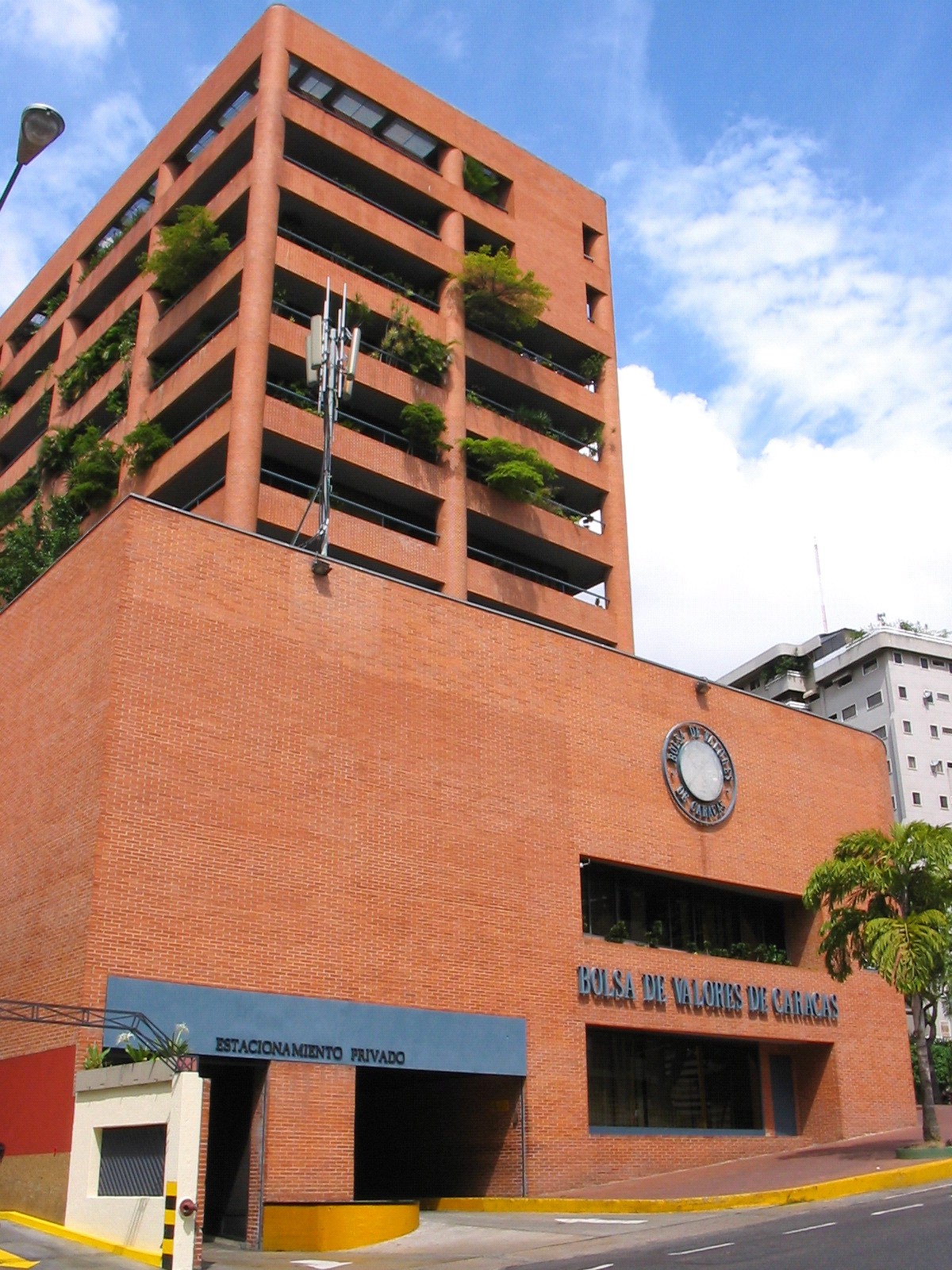
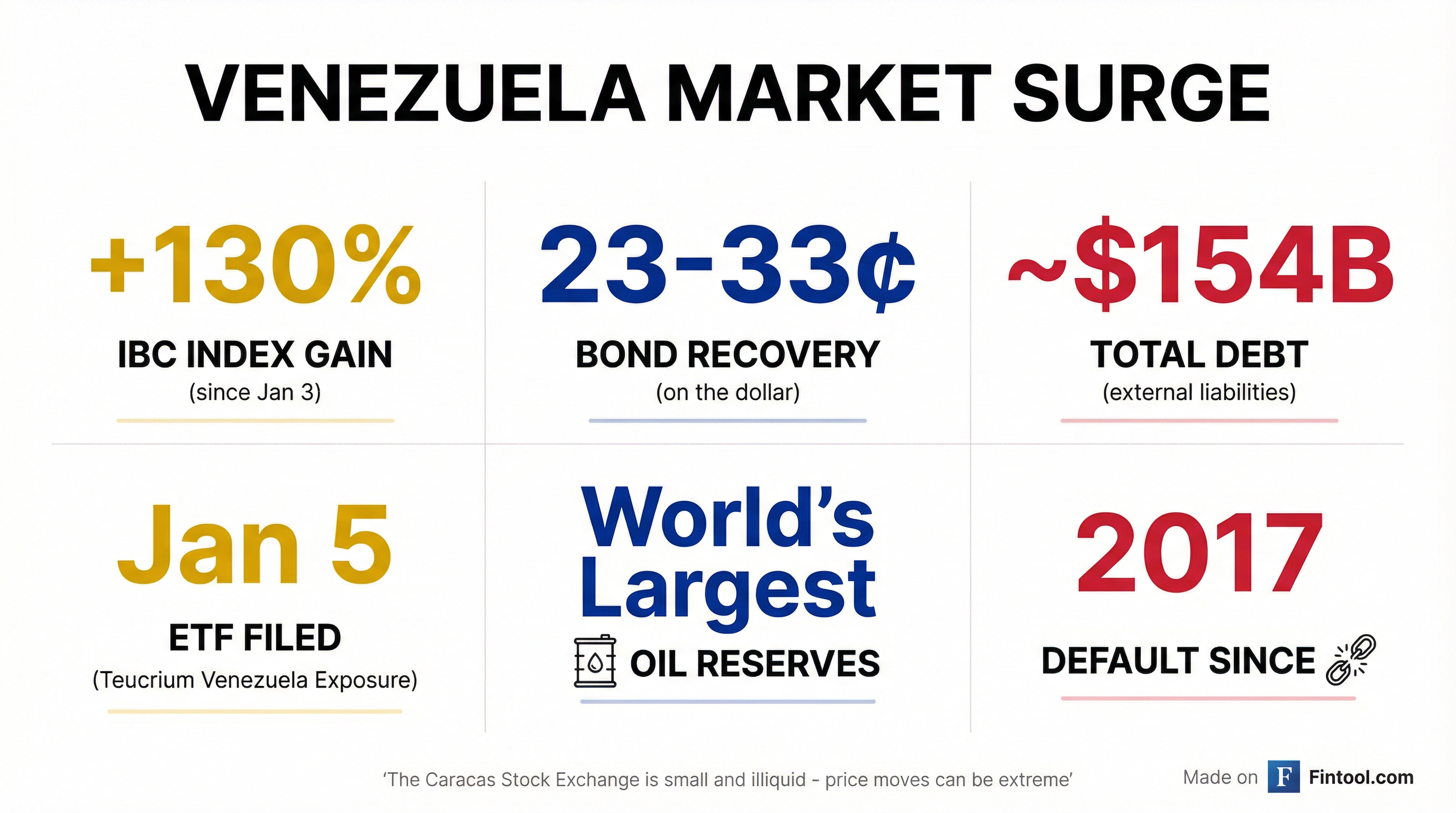
Venezuela's Caracas Stock Exchange has delivered one of the most extraordinary rallies in emerging market history—surging more than 130% in just nine trading days since U.S. forces captured President Nicolás Maduro on January 3.
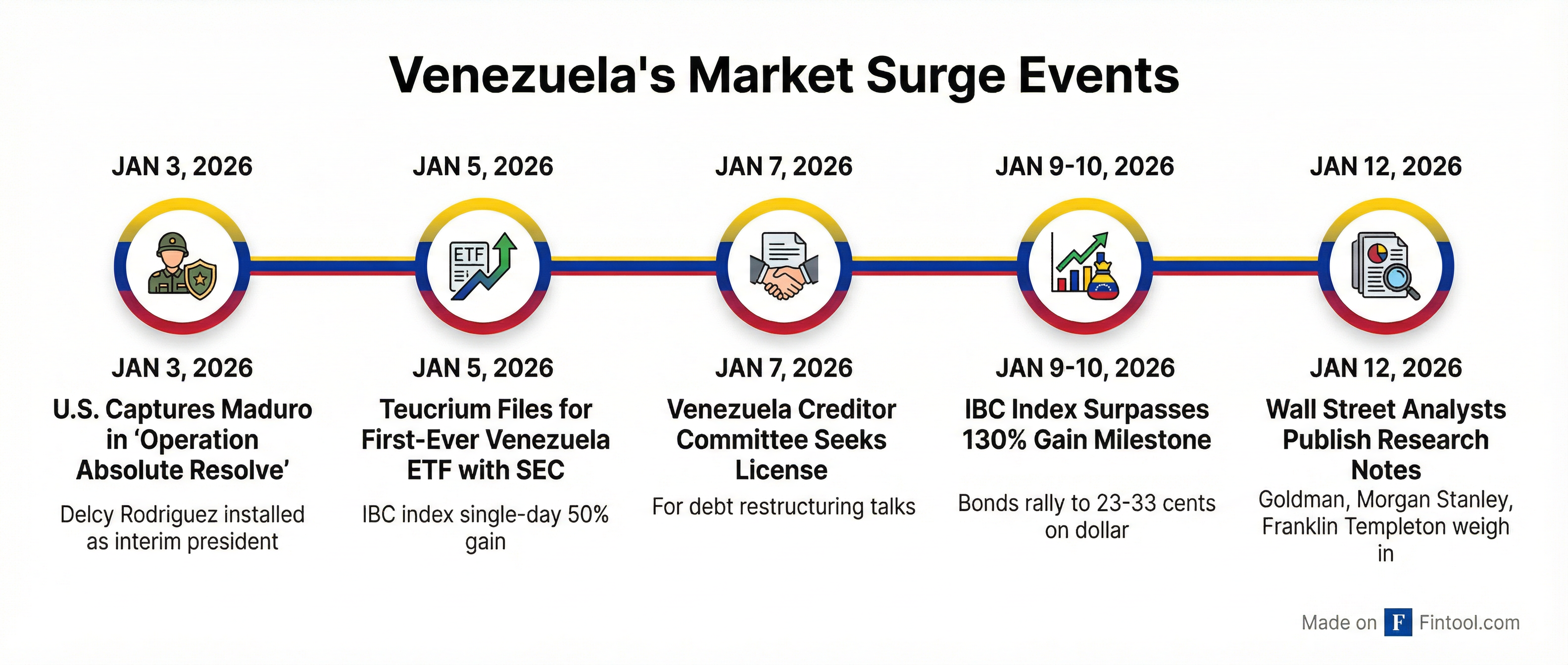
The benchmark Indice Bursátil de Capitalización (IBC) jumped 50% in a single session on January 6 alone, then continued climbing as investors bet that a reconfigured government could attract capital, revive oil output, and normalize relations with the United States.
But behind the staggering percentage gains lies a market that remains tiny, illiquid, and nearly inaccessible to foreign investors—a speculative playground where extreme price swings are the norm, not the exception.
The Numbers Behind the Rally
The IBC index stood at approximately 2,082 points at the end of 2025. By January 9, it had eclipsed 6,000—a gain that dwarfs any major market move in recent memory.
Venezuelan government bonds have followed suit. Defaulted notes from the sovereign and state-run oil company PDVSA have more than doubled to between 23 and 33 cents on the dollar, up from around 10 cents before Trump's pressure campaign intensified in late 2025.
"Investors began to price in Maduro's removal from power as a precondition for sanctions relief and eventually a restructuring deal," said Anthony Simond, investment director at UK-based Aberdeen.
The rally builds on Venezuela's position as the best-performing country in the JP Morgan Emerging Markets Bond Index in 2025, when its bonds returned 99%.
 Ask Fintool AI Agent
Why the Market Is Moving
The optimism centers on three interconnected catalysts:
1. Political Reset
Vice President Delcy Rodríguez, installed as interim president after "Operation Absolute Resolve," has signaled willingness to cooperate with U.S. oversight. BMI analysts believe Venezuela is "more likely to experience regime continuity with behavioral realignment, rather than an outright democratic transition or system collapse."
2. Oil Sector Revival
Venezuela holds the world's largest proven oil reserves but produced less than 900,000 barrels per day under Maduro—a fraction of its 1990s peak of 3.5 million. Chevron+0.84%, the only U.S. major still operating in the country, has indicated it can double liftings immediately and increase production 50% within 18-24 months.
3. Debt Restructuring Prospects
The Venezuela Creditor Committee (VCC), representing major bondholders, said Friday it is "ready to start debt restructuring talks" once authorized. Recovery prices could rise to 50-60 cents on the dollar if restructuring materializes, according to investors.
The Debt Mountain
Any recovery timeline is complicated by the sheer scale of Venezuela's obligations.
| Debt Category | Amount | Status |
|---|---|---|
| Sovereign Bonds (principal) | $31B | Defaulted 2017 |
| Sovereign Bonds (past-due interest) | $26B | Accruing |
| PDVSA Bonds | $43B | Defaulted |
| Bilateral (China, Russia) | $40-50B | Partially secured by oil |
| Arbitration Awards | Billions | Outstanding claims |
| Total External Debt | $150-170B | vs. $83B GDP |
Franklin Templeton notes the debt burden exceeds Venezuela's estimated GDP, making this potentially one of the most complex sovereign restructurings ever attempted.
Ask Fintool AI AgentWhat's Trading on the Caracas Exchange
The Caracas Stock Exchange lists roughly 30 actively traded companies, dominated by banks and financial services firms. The top performers in the past week include:
| Company | Ticker | 7-Day Return | Sector |
|---|---|---|---|
| Mercantil Servicios Financieros | MVZ.B | +200% | Banks |
| CANTV (Telecom) | TDV.D | +219% | Telecom |
| Banco Provincial | BPV | +171% | Banks |
| Bolsa de Valores de Caracas | BVCC | +129% | Financials |
The market's total capitalization remains tiny by global standards—a function of years of capital flight, hyperinflation, and sanctions.
The First Venezuela ETF
Wall Street is already positioning for retail access. Vermont-based Teucrium filed with the SEC on January 5—just two days after Maduro's capture—to create the Teucrium Venezuela Exposure ETF.
The proposed fund would track the MarketVector Venezuela Exposure Index, targeting companies either classified as Venezuelan or deriving at least 50% of revenue from the country. It may also include companies in major trading partners with significant Venezuela exports.
Teucrium CEO Sal Gilbertie told Business Insider the firm had been working on the ETF prior to the weekend's events but couldn't disclose further details. The company manages roughly $518 million across commodity and crypto strategies.
How Investors Can (and Can't) Access Venezuela
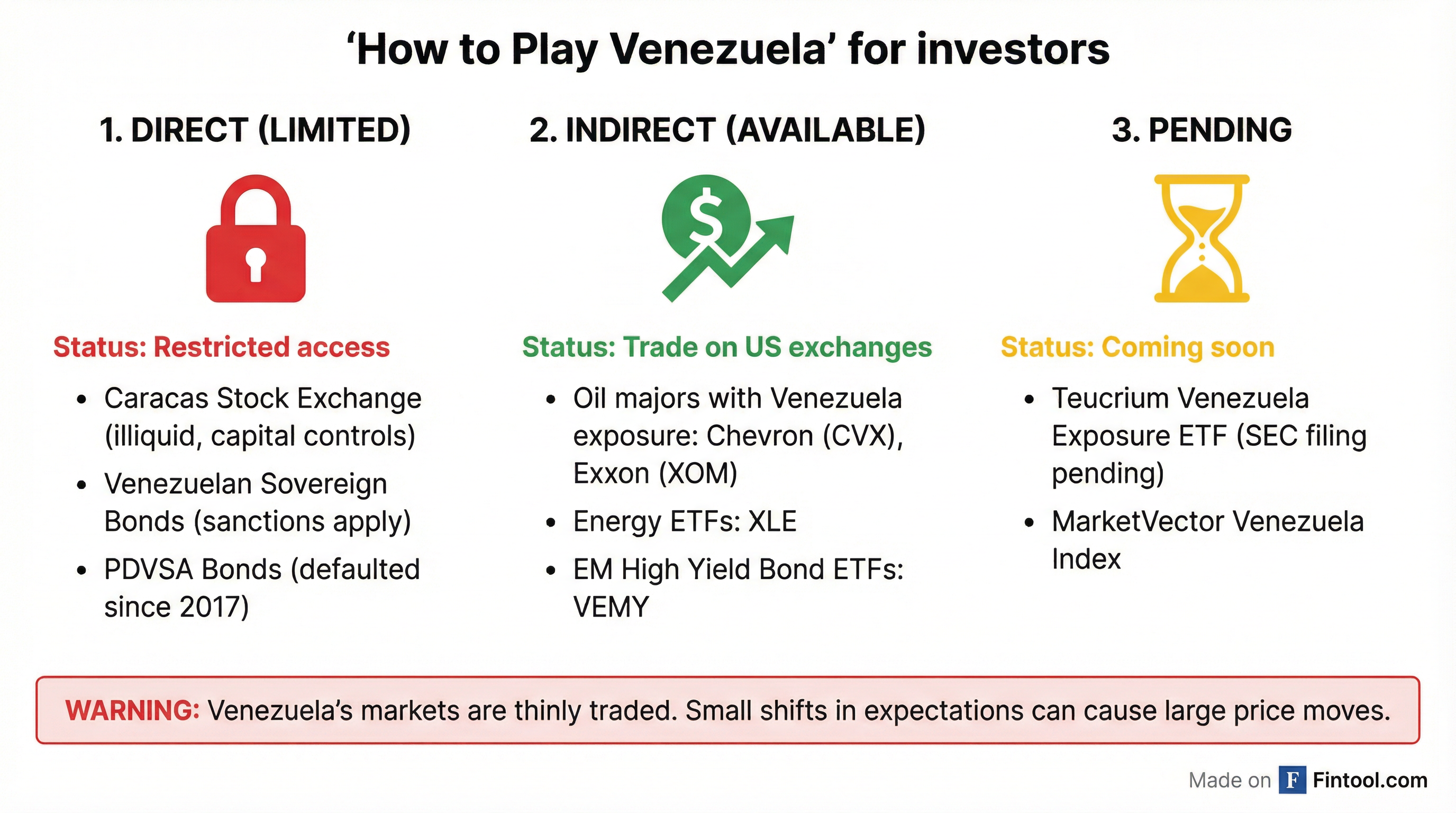
Currently Available:
- Chevron+0.84%: The only U.S. major still operating in Venezuela, producing 240,000 barrels per day
- Energy ETFs: The State Street Energy Select Sector SPDR ETF (XLE) provides broad exposure to oil companies
- EM High Yield Bond ETFs: The Virtus Stone Harbor Emerging Markets High Yield Bond ETF (VEMY) has been adding Venezuelan debt
Not Available:
- No Venezuelan ADRs trade on U.S. exchanges
- Direct purchase of Caracas-listed shares requires navigating capital controls and sanctions
- Venezuelan bonds require OFAC compliance and specialized EM debt platforms
Ask Fintool AI AgentThe Risks Are Real
For all the optimism, analysts are urging caution.
Illiquidity Risk: "Because Venezuela's markets are thinly traded, even small shifts in expectations can cause large price moves," Alice Blue at TradingView wrote. "The rally reflects hope and speculation, not confirmed outcomes."
Political Uncertainty: No permanent government is in place, and debt restructuring requires a legitimate government to credibly commit to reforms—typically anchored by IMF support. "Very significant obstacles and uncertainties remain," said Nicolas Jaquier at Ninety One.
Sanctions Complexity: U.S. sanctions still technically prohibit most dealings with Venezuelan entities. The VCC applied for a Treasury license during the Biden administration and met with OFAC officials in October, but no license has been granted.
Long Recovery Timeline: Even under optimistic scenarios, Goldman Sachs notes Venezuela's economic recovery depends on substantially increasing oil production—a process that takes years, not months.
What Wall Street Is Saying
Major institutions have published research notes in the past week:
Goldman Sachs: "Further upside remains possible, contingent on the easing of sanctions and securing multilateral financing. However, the outlook is uncertain."
Morgan Stanley: "The speed and apparent ease with which Maduro was removed eliminates several downside scenarios involving a more protracted or disorderly conflict."
Franklin Templeton: Bond recovery values at ~37 cents "have not changed significantly as a consequence of the weekend's actions—it is more the acceleration of a potential restructuring that has caused the rise in prices."
Edmond de Rothschild: "The recent move in local equities looks more like a sentiment trade until there is clarity on sanctions, macro policy, and institutional credibility."
What to Watch
Near-term catalysts:
- Treasury/OFAC license decisions for bondholder engagement
- Any statements from interim President Delcy Rodríguez on debt obligations
- SEC timeline for Teucrium ETF review
- Oil production data from Chevron and PDVSA
Medium-term:
- Timeline for elections and formation of a permanent government
- IMF engagement and potential support program
- Progress on debt restructuring framework
- Oil sector infrastructure investment commitments
Ask Fintool AI AgentThe Bottom Line
Venezuela's 130% stock market rally is real—and so are the reasons behind it. The capture of Maduro has fundamentally altered the country's risk profile, opening the door to potential sanctions relief, oil sector rehabilitation, and eventual debt restructuring.
But this remains a sentiment trade, not a restructuring trade. The market is pricing in hope, not outcomes. The Caracas Stock Exchange is small, illiquid, and inaccessible to most global investors. The debt web is extraordinarily complex. And the path from here to a normalized Venezuela involves years of political, economic, and legal work.
For portfolio managers seeking Venezuela exposure today, Chevron remains the most direct liquid play. For those willing to wait, Teucrium's pending ETF may eventually provide broader access—assuming the SEC approves it and the political situation stabilizes.
The rally is a bet on regime change translating to economic renewal. History suggests such bets can pay off spectacularly—or collapse just as fast.
Related: