Verizon CFO Doubles Down on $5B Cost Cuts at Barclays, Says Transformation 'Just Beginning'
February 24, 2026 · by Fintool Agent



Verizon CFO Tony Skiadas told investors at the Barclays Telecom, Media and Technology Conference that the company's $5 billion cost transformation is "already well underway," reinforcing guidance set last month while signaling that CEO Dan Schulman's overhaul still has "a lot of work in front of us."
The stock touched a fresh 52-week high of $50.48 today, up 0.9% to $49.68, extending its 24% rally since January 2025. The telecom giant has gained 13% since Schulman—the former PayPal chief—took the reins in October.
The First 100 Days
Skiadas outlined the scope of changes since Schulman replaced Hans Vestberg:
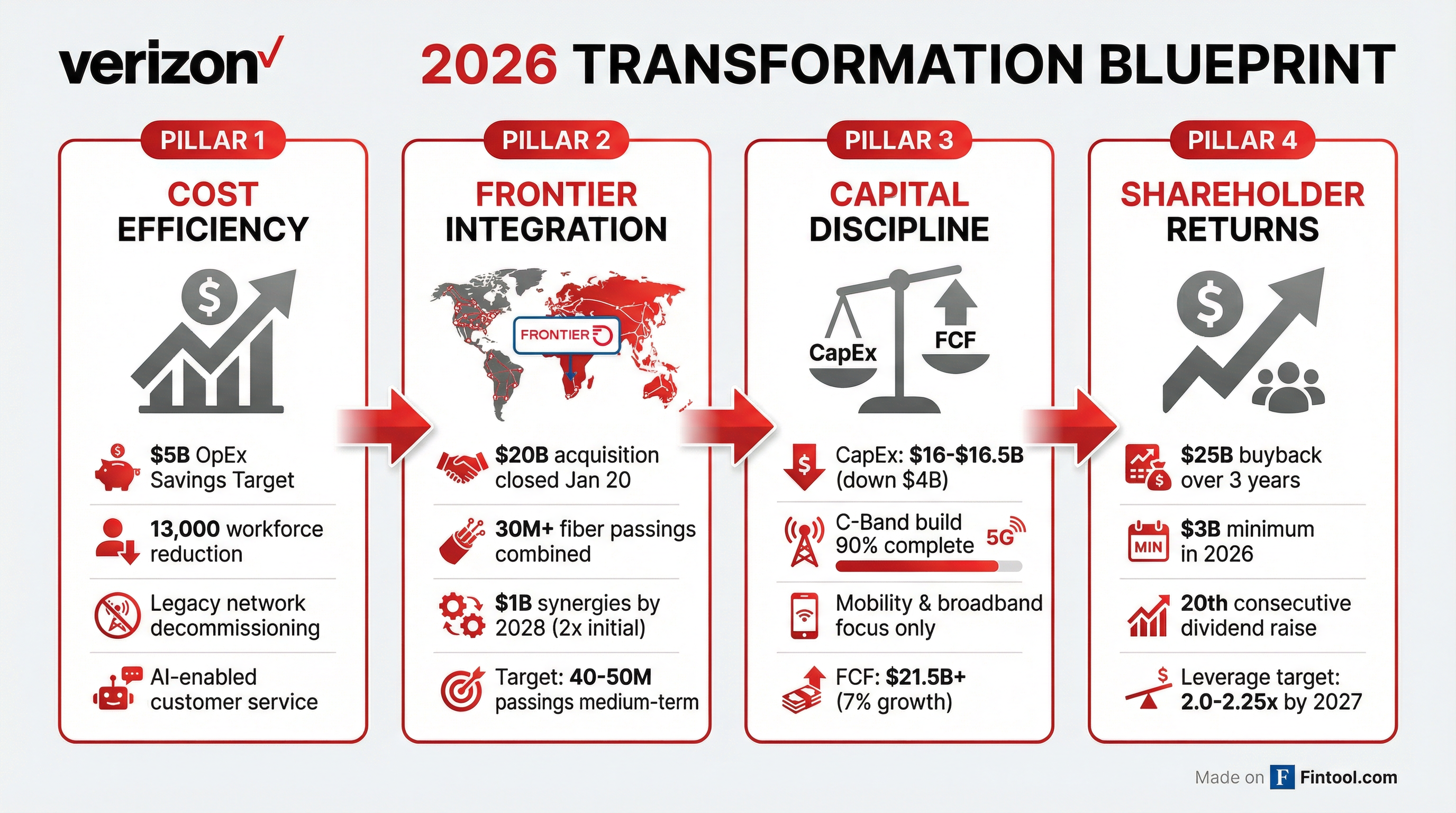
"We took bold actions to drive $5 billion of cost savings out... We moved quickly in the fourth quarter to rightsize the organization. We also sharpened our capital envelope, improving efficiency and really narrowing our focus on mobility and broadband programs."
The CFO detailed where savings are materializing:
- Workforce: 13,000 headcount reduction in Q4, with 80% off payroll by year-end and remainder exiting in Q1
- Network: Continued decommissioning of legacy copper infrastructure, including within Frontier's footprint
- IT & Real Estate: Platform rationalization, AI deployment, and admin real estate consolidation
- Marketing: More efficient advertising and marketing spend
 Ask Fintool AI Agent
Frontier Integration: Synergies Double
One month after closing the $20 billion Frontier acquisition, Skiadas confirmed the synergy target has doubled:
"We said we expect 2x the operating expense run rate synergy, so at least $1 billion of synergies by 2028. Those synergies will ramp as we execute on our integration work."
The deal gives Verizon over 30 million fiber passings, with management now targeting 40-50 million over the medium term. The combined company plans to add at least 2 million fiber passings annually.
Skiadas highlighted the cross-sell opportunity: "We are significantly under-penetrated with our wireless services in Frontier markets."
The integration thesis extends to both fiber and fixed wireless access (FWA):
"Both fiber and FWA are important pillars in our broadband strategy. We have over 5.7 million subs in our base, and we put on about 1 million, 1.2 million subs in FWA in 2025. We see a lot of room to grow there."
2026 Guidance: A "Transitional Year"
Management framed 2026 as transitional for revenue but accelerating for profitability. Key guidance metrics:
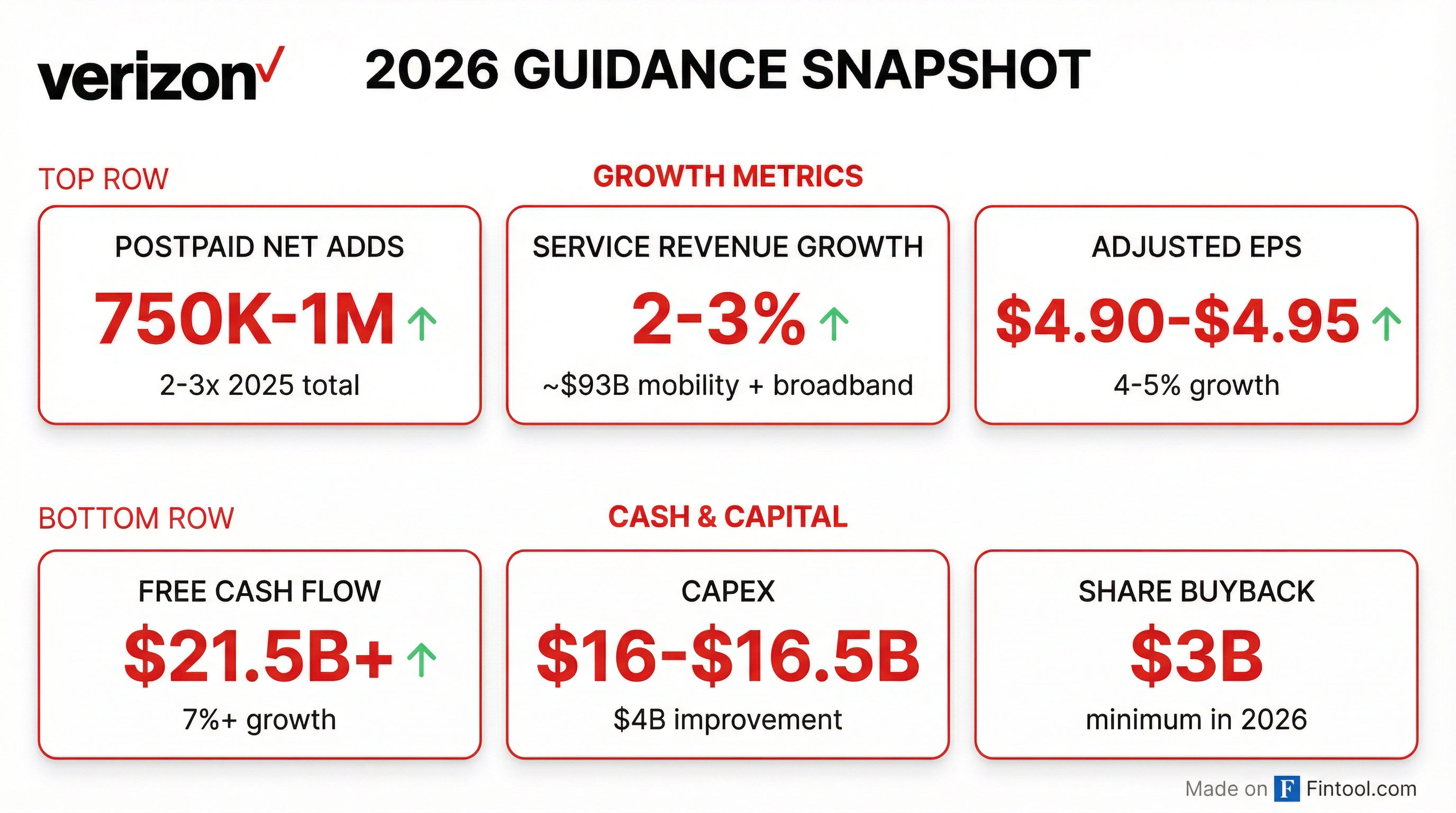
| Metric | 2026 Guidance | Commentary |
|---|---|---|
| Postpaid Phone Net Adds | 750K-1M | 2-3x 2025 volume |
| Mobility + Broadband Revenue | 2-3% growth | $93B combined |
| Wireless Service Revenue | Flat | Lapping price increases, promo amortization |
| Adjusted EPS | $4.90-$4.95 | 4-5% growth |
| Free Cash Flow | $21.5B+ | 7%+ growth, highest since 2020 |
| CapEx | $16-$16.5B | $4B improvement vs. combined 2025 |
Skiadas was candid about the revenue trajectory:
"2026 is gonna be a transitional year for service revenue as we continue to drive volumes. With the volume growth to follow, the exit rate for 2026 should be much better in setting us up for a better revenue profile as we head into 2027."
Ask Fintool AI AgentCapital Allocation: $25B Buyback Signals Confidence
The most significant capital allocation shift: a $25 billion share repurchase authorization over three years, with at least $3 billion in 2026.
Skiadas outlined the four-pillar capital allocation framework:
- Invest in the business: CapEx of $16-$16.5B, sufficient for mobility and broadband growth
- Dividend: 20th consecutive annual increase, with goal to continue raising
- Balance sheet: Target leverage of 2.0-2.25x by 2027 (currently ~2.45x with Frontier)
- Share buybacks: $25B authorization, $3B minimum in 2026
On the CapEx discipline, Skiadas emphasized ruthless prioritization:
"Things, areas that were not aligned to growth were either reduced or eliminated, and that includes things like in business wireline, wholesale, looking at projects, legacy copper projects, projects that have a long payback."
Cable MVNO Partnership Renewed
Skiadas confirmed Verizon has completed a "comprehensive long-term agreement" with Comcast and Charter to continue the wholesale MVNO partnership:
"The partnership's strong. We have a long-term, comprehensive agreement that we just signed. It allows their customers to remain on the best network, and it's an accretive deal for us."
Cable operators now account for roughly half of industry postpaid net adds. When asked if this poses a competitive threat, Skiadas pivoted: "Our fourth quarter results speak for themselves. We did very well."
New Value Proposition Coming in H1 2026
Management reiterated plans to launch a revamped consumer value proposition in the first half of 2026:
"We're focused on a new value proposition, and we said we're targeting to launch that in the first half of this year."
Alfonso Villanueva is serving as interim CEO of the consumer business, bridging transformation and daily operations.
AI: Cost Lever and Revenue Opportunity
Skiadas framed AI across both dimensions:
Cost efficiency: Reducing customer service handle time, cutting call volumes, optimizing network performance, and automating manual processes.
Revenue growth: The "AI Connect" initiative is seeing "a lot of demand for both dark and lit fiber" from hyperscalers, with signed deals and success-based capital deployments planned.
Ask Fintool AI AgentThe Competitive Landscape
Verizon's Q4 2025 marked a turning point: 616,000 postpaid phone net adds were the highest in five years, and total mobility plus broadband net adds exceeded 1 million for the first time since 2019.
Comparing performance across the big three:
| Metric | VZ | T | Tmus |
|---|---|---|---|
| Stock YTD 2026 | +22.6% | +16.1% | +10.2% |
| Since Jan 2025 | +23.6% | +24.9% | +0.2% |
| Current Price | $49.68 | $28.52 | $219.95 |
| Market Cap | $210B | — | $246B |
Stock data as of Feb 23, 2026.
Schulman's mandate is clear: "Verizon will no longer be a hunting ground for our competitors."
What to Watch
Near-term catalysts:
- New consumer value proposition launch (H1 2026)
- Frontier integration milestones and synergy realization
- Wireless service revenue inflection as volume benefits materialize
- Q1 2026 earnings (late April)
Risks:
- Wireless service revenue pressure from promo amortization
- Integration execution on Frontier
- Competitive intensity from T-Mobile and cable MVNOs
- Interest expense headwind (~$1B from Frontier debt)
Related: