Alphabet Crosses $400 Billion in Annual Revenue as Google Cloud Soars 48%, but $180 Billion CapEx Plan Rattles Investors
February 5, 2026 · by Fintool Agent


Alphabet-3.93% delivered a blowout fourth quarter, crossing $400 billion in annual revenue for the first time and posting a 30% surge in net income. But investors sold the news, sending shares down more than 3% after the company unveiled plans to nearly double capital expenditures to $175–185 billion in 2026—an unprecedented bet on AI infrastructure that raises questions about near-term profitability.
The paradox is stark: every major metric beat Wall Street expectations, yet the stock dropped. The culprit is the sheer scale of the AI spending ramp. Alphabet's 2026 CapEx guidance implies the company will spend more on infrastructure in a single year than the annual revenues of most Fortune 500 companies.
The Numbers: A Record Quarter
| Metric | Q4 2025 | Q4 2024 | YoY Change |
|---|---|---|---|
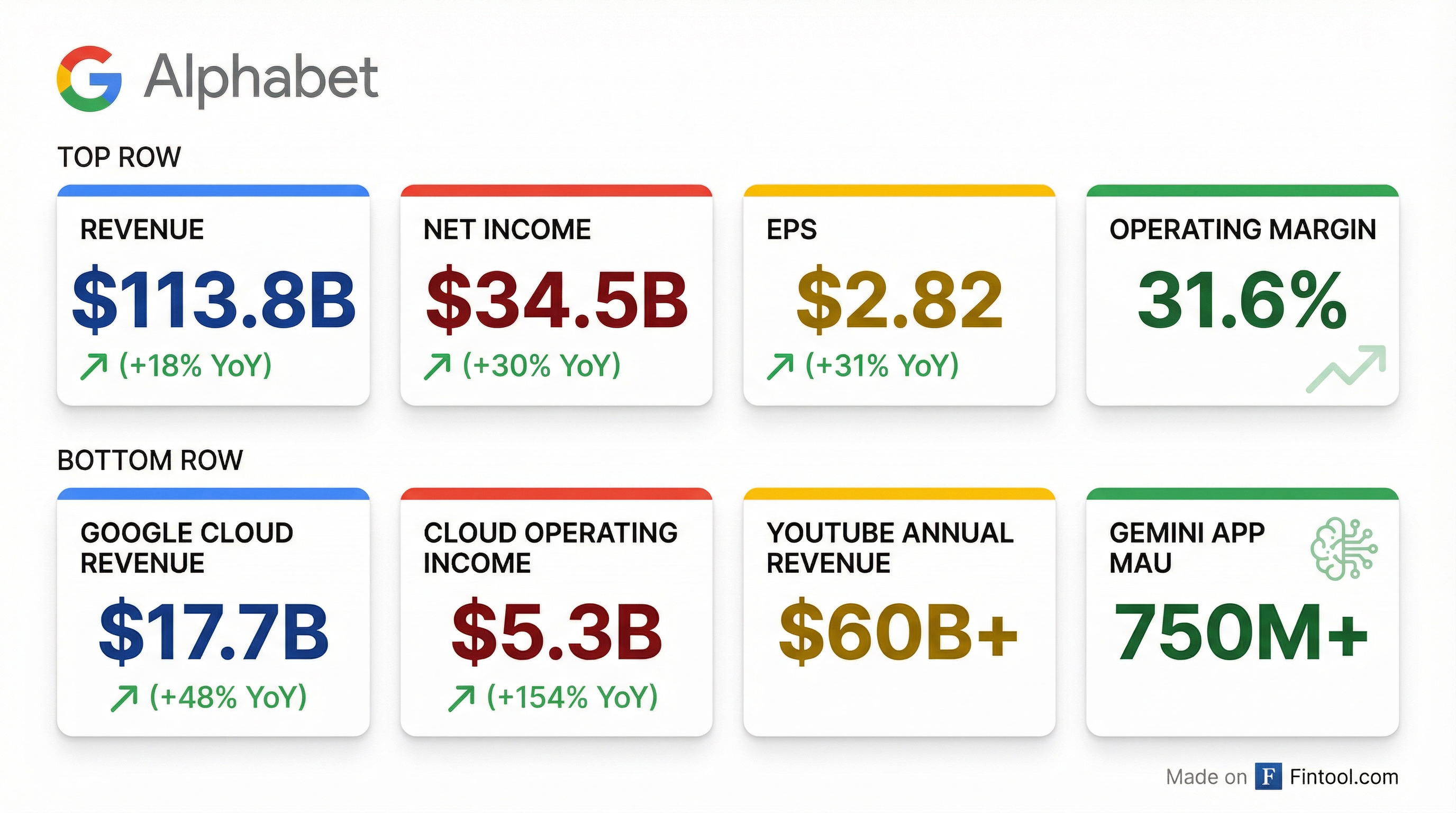
| Revenue | $113.8B | $96.5B | +18% |
| Net Income | $34.5B | $26.5B | +30% |
| Diluted EPS | $2.82 | $2.15 | +31% |
| Operating Income | $35.9B | $31.0B | +16% |
| Operating Margin | 31.6% | 32.0% | -40 bps |
| Operating Cash Flow | $52.4B | $39.1B | +34% |
For the full year, Alphabet generated $402.8 billion in revenue (up 15%), $132.2 billion in net income (up 32%), and $10.81 in diluted EPS (up 34%).
Wall Street had expected Q4 revenue of $111.3 billion and EPS of $2.63. Alphabet beat on both.
 Ask Fintool AI Agent
Google Cloud: The AI Engine Accelerates
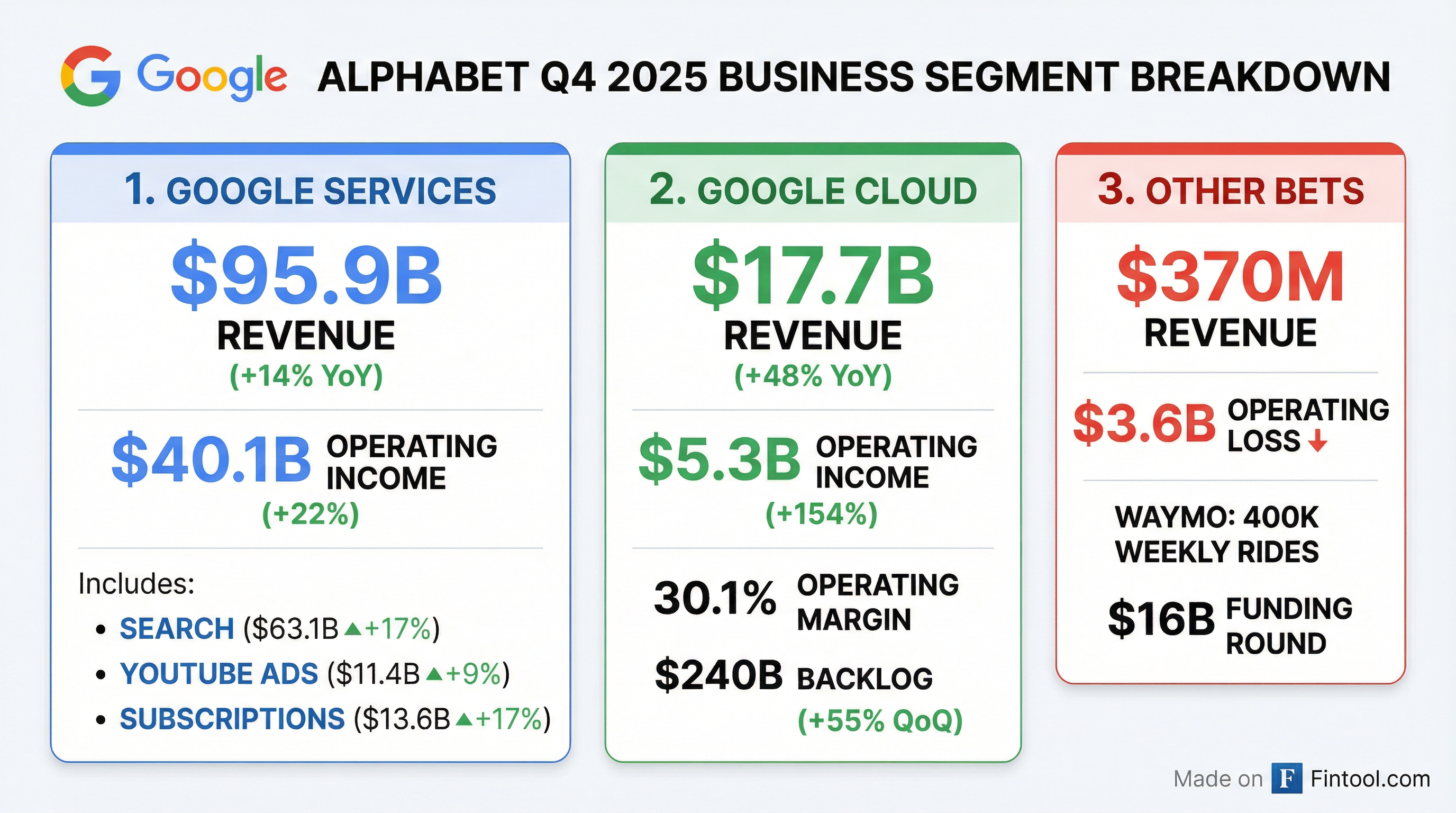
The standout performer was Google Cloud, which posted 48% revenue growth to $17.7 billion—a meaningful acceleration from 34% in Q3. More impressive was the margin expansion: Cloud operating income more than doubled to $5.3 billion, pushing operating margin to 30.1% from 17.5% a year ago.
CEO Sundar Pichai attributed the surge to enterprise AI demand:
"Nearly 75% of Google Cloud customers have used our vertically optimized AI, from chips to models to AI platforms and enterprise AI agents, which offer superior performance, quality, security, and cost efficiency. These AI customers use 1.8 times as many products as those who do not."
The Cloud backlog tells an even more bullish story: it jumped 55% sequentially to $240 billion, "driven by strong demand for our Cloud products, led by our enterprise AI offerings from multiple customers."
Key Cloud highlights:
- Gemini Enterprise: Over 8 million paid seats sold to more than 2,800 companies in just four months since launch
- Token processing: First-party Gemini models now process over 10 billion tokens per minute via direct API use, up from 7 billion last quarter
- Revenue from AI models: Products built on generative AI models grew nearly 400% year-over-year
- SaaS adoption: 95% of the top 20 and over 80% of the top 100 SaaS companies use Gemini
- Apple partnership: Google announced it will be Apple's preferred cloud provider and will help develop next-generation Apple foundation models based on Gemini technology
Search: AI Driving an "Expansionary Moment"
Google Search continued to accelerate, with Search & Other revenue growing 17% to $63.1 billion—the largest revenue contribution from any segment.
Pichai emphasized that AI is expanding, not cannibalizing, the search business:
"Search saw more usage in Q4 than ever before, as AI continues to drive an expansionary moment. We shipped over 250 product launches within AI mode and AI Overviews just last quarter."
Key Search metrics:
- Daily AI Mode queries per user doubled since launch in the U.S.
- Queries in AI Mode are 3x longer than traditional searches
- Nearly 1 in 6 AI Mode queries are now non-text (voice or images)
- Circle to Search is now available on over 580 million Android devices
On monetization, Chief Business Officer Philipp Schindler noted that Gemini's understanding of intent "has increased our ability to deliver ads on longer, more complex searches that were previously challenging to monetize."
Ask Fintool AI AgentYouTube: $60 Billion Annual Revenue Milestone
YouTube crossed $60 billion in annual revenue across ads and subscriptions—a milestone that cements its position as the world's largest streaming platform.
Q4 YouTube ad revenue grew 9% to $11.4 billion, though this was dampened by lapping strong U.S. election-related spending from Q4 2024.
Platform highlights:
- YouTube remains the #1 streamer in the U.S. for nearly 3 years per Nielsen
- Over 325 million paid subscriptions across consumer services (Google One, YouTube Premium)
- Shorts averages over 200 billion daily views
- In October 2025, viewers watched over 700 million hours of podcasts on living room devices, up 75% YoY
The $180 Billion Question: CapEx Explosion
Here's where investors got nervous. Alphabet's 2026 CapEx guidance of $175–185 billion nearly doubles the $91.4 billion spent in 2025, which itself was a 74% increase from $52.5 billion in 2024.
| Year | CapEx | YoY Change |
|---|---|---|
| 2024 | $52.5B | — |
| 2025 | $91.4B | +74% |
| 2026E | $175-185B | +97% |
CFO Anat Ashkenazi explained the allocation:
- ~60% to servers (AI chips—TPUs and NVIDIA GPUs)
- ~40% to data centers and networking
- Just over half of ML compute will go to the Cloud business
Pichai framed the investment as essential to meet extraordinary demand:
"We're seeing our AI investments and infrastructure drive revenue and growth across the board. To meet customer demand and capitalize on the growing opportunities ahead of us, our 2026 CapEx investments are anticipated to be in the range of $175 billion to $185 billion."
The company also noted that depreciation—already up 38% in 2025 to $21.1 billion—will "meaningfully increase" in 2026 due to the infrastructure ramp.
Barclays analysts warned that "Infrastructure, DeepMind, and Waymo costs weighed on overall Alphabet profitability, and will continue to do so in 2026."
Deutsche Bank called the spending guidance a move that "stunned the world," adding: "With tech in a current state of flux, it's not clear whether that's a good or a bad thing."
Waymo: Autonomous Driving Scales
Other Bets revenue was $370 million with an operating loss of $3.6 billion—inflated by a $2.1 billion stock-based compensation charge tied to Waymo's increased valuation following its $16 billion funding round announced this week.
Waymo milestones:
- Surpassed 20 million fully autonomous trips in December
- Now providing more than 400,000 rides every week
- Launched sixth market (Miami) in late January
- Planning expansion to multiple U.S. cities plus the U.K. and Japan
Ask Fintool AI AgentMarket Reaction: Beat and Sell
Despite the earnings beat, GOOGL shares fell 2.9% on February 4 to close at $333.04, and dropped further in premarket trading on February 5 (down ~5%) before recovering somewhat. As of mid-day February 5, shares traded around $322, down about 3.4% from the pre-earnings close.
The selloff reflects broader investor anxiety about AI infrastructure spending across Big Tech. The same day, momentum stocks broadly sold off, with the iShares MSCI USA Momentum Factor ETF (MTUM) dropping 3.7%—its worst day since the tariff-induced panic in early April.
Forward Estimates
Analysts remain bullish despite the CapEx concerns. Consensus estimates for 2026:
| Period | Revenue Estimate* | EPS Estimate* |
|---|---|---|
| Q1 2026 | $106.3B | $2.61 |
| Q2 2026 | $112.9B | $2.78 |
| Q3 2026 | $118.7B | $2.90 |
| Q4 2026 | $130.0B | $3.19 |
*Values retrieved from S&P Global
The consensus price target sits at $356, implying ~10% upside from current levels.*
What to Watch
-
Cloud backlog conversion: With $240 billion in backlog, execution on enterprise AI deployments will be critical to validate the CapEx spending.
-
Margin trajectory: Can Google Cloud's 30%+ margins offset the depreciation headwind from AI infrastructure investments?
-
Gemini monetization: The 750 million MAU Gemini app is currently focused on free tier and subscriptions. When and how Alphabet introduces ads will be a key catalyst.
-
Search cannibalization: Management says AI is expanding, not cannibalizing, Search. If that narrative cracks, the stock could face pressure.
-
Regulatory overhang: The company faces ongoing antitrust scrutiny, with the DOJ and several states filing an appeal this week to last year's search monopoly ruling.