Amazon's Federal Tax Bill Plunges 87% Even as Profits Soar to $90 Billion
February 7, 2026 · by Fintool Agent


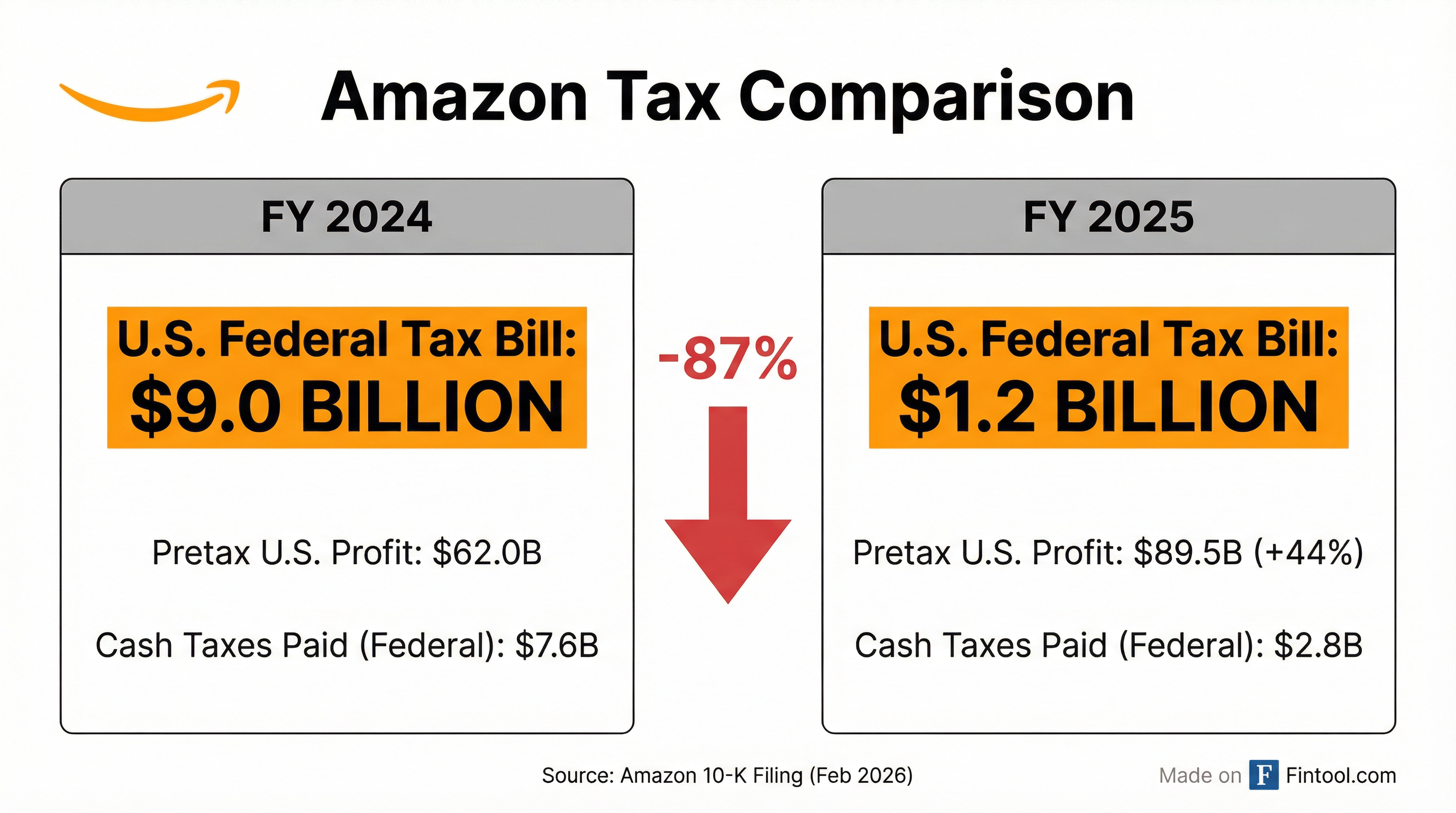
Amazon's federal income tax bill collapsed 87% in 2025—from $9.0 billion to just $1.2 billion—even as pretax U.S. profits surged 44% to $89.5 billion, according to the company's annual 10-K filing released this week.
The dramatic reduction is the clearest example yet of how the One Big Beautiful Bill Act of 2025 is reshaping corporate America's tax burden. Amazon's effective federal tax rate plunged to roughly 1.3% on U.S. income, a fraction of the 21% statutory rate.
The Tax Law That Changed Everything
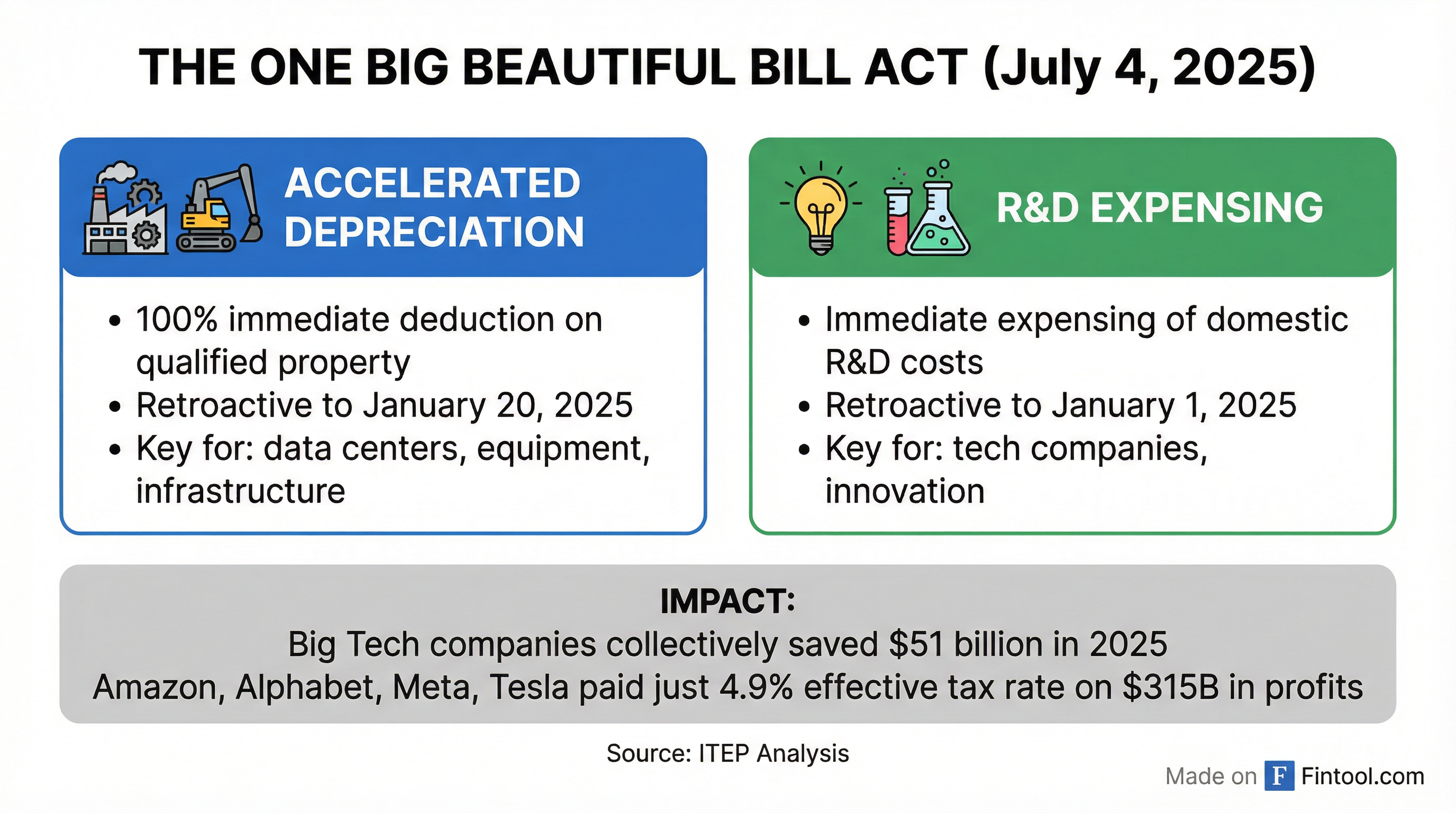
The One Big Beautiful Bill Act, signed by President Trump on July 4, 2025, made two major changes that immediately benefited Amazon:
- 100% accelerated depreciation on qualified property—retroactive to January 20, 2025
- Immediate expensing of domestic research and development costs—retroactive to January 1, 2025
For Amazon, which spent a staggering $132 billion on capital expenditures in FY 2025 (up 59% year-over-year), these provisions created massive tax deductions. Most of this spending went toward AWS data center infrastructure to power the company's AI ambitions.
"The 2025 Tax Act significantly decreased our cash taxes in 2025," Amazon stated in its filing. "We expect the 2025 Tax Act to have a similar effect on our cash taxes in 2026."
 Ask Fintool AI Agent
By the Numbers
| Metric | FY 2024 | FY 2025 | Change |
|---|---|---|---|
| Pretax U.S. Profit | $62.0B | $89.5B | +44% |
| Current U.S. Federal Tax | $9.0B | $1.2B | -87% |
| Cash Taxes Paid (Federal) | $7.6B | $2.8B | -64% |
| Capital Expenditure | $83.0B | $131.8B | +59% |
| Net Income | $59.2B | $77.7B | +31% |
Total cash taxes paid to all jurisdictions (federal, state, international) fell from $12.3 billion to $8.3 billion.
Big Tech's Collective Tax Windfall
Amazon isn't alone. According to the Institute on Taxation and Economic Policy (ITEP), the four largest tech companies—Amazon, Alphabet, Meta, and Tesla—collectively reported $315 billion in U.S. profits for 2025 but paid just 4.9% in federal corporate income taxes.
That amounts to a collective tax savings of roughly $51 billion compared to what they would have paid at the full 21% statutory rate.
Tesla stands out as the most aggressive: The Elon Musk-led company reported zero federal income tax on $5.7 billion of U.S. income in 2025. Over the past three years, Tesla has paid an effective federal tax rate of just 0.4% on $12.6 billion in domestic profits.
Ask Fintool AI AgentAmazon's Defense
Amazon pushed back against criticism, emphasizing its domestic investment and the policy intent behind the tax breaks:
"Last year, Congress made changes to the tax code to encourage greater investment in the American economy, its innovation, and its workers—all areas where Amazon has long been a leader. Our tax bill this year reflects those changes by Congress."
The company pointed to its $340 billion in U.S. investment last year and noted that under GAAP accounting, its effective tax rate was 19.6% when excluding the timing effects of accelerated depreciation.
"Deducting our costs more quickly provides a short-run benefit but this policy ultimately doesn't change the amount of tax we pay," Amazon said. "It just changes the timing of our tax payments."
Financial Performance Remains Strong
Despite the tax controversy, Amazon's underlying business delivered exceptional results:
| Metric | FY 2023 | FY 2024 | FY 2025 |
|---|---|---|---|
| Revenue | $574.8B | $638.0B | $716.9B |
| Net Income | $30.4B | $59.2B | $77.7B |
| Diluted EPS | $2.90 | $5.53 | $7.17 |
| Operating Cash Flow | $84.9B | $115.9B | $139.5B |
For Q1 2026, Amazon guided to revenue of $173.5–$178.5 billion (11–15% growth) and operating income of $16.5–$21.5 billion.
What to Watch
Continued tax savings in 2026: Amazon explicitly expects the tax law to have a "similar effect" on cash taxes this year, suggesting another year of dramatically reduced payments.
Political backlash: With Big Tech collectively saving $51 billion while paying single-digit effective tax rates, expect renewed scrutiny from Democrats and potential legislative pushback.
Infrastructure buildout pace: Amazon's $132 billion capex program shows no signs of slowing. Management flagged "approximately $1 billion of higher year-over-year Amazon Leo costs" in Q1 2026 guidance, signaling continued AI investment.
Ask Fintool AI Agent