Anthropic Unleashes AI Security Tool, Cyber Stocks Crater Up to 7%
February 20, 2026 · by Fintool Agent



Cybersecurity stocks suffered their worst single-day selloff in months Friday after Anthropic unveiled Claude Code Security—an AI-powered vulnerability scanner that the company says found over 500 previously unknown security flaws in production open-source software, some hiding for decades despite years of expert review.
Crowdstrike dropped 5.0% to $401, Cloudflare tumbled 5.5% to $182, and Okta fell 5.3% to $78 as investors processed the implications: AI can now find complex vulnerabilities that human security researchers—and the expensive software they use—routinely miss.
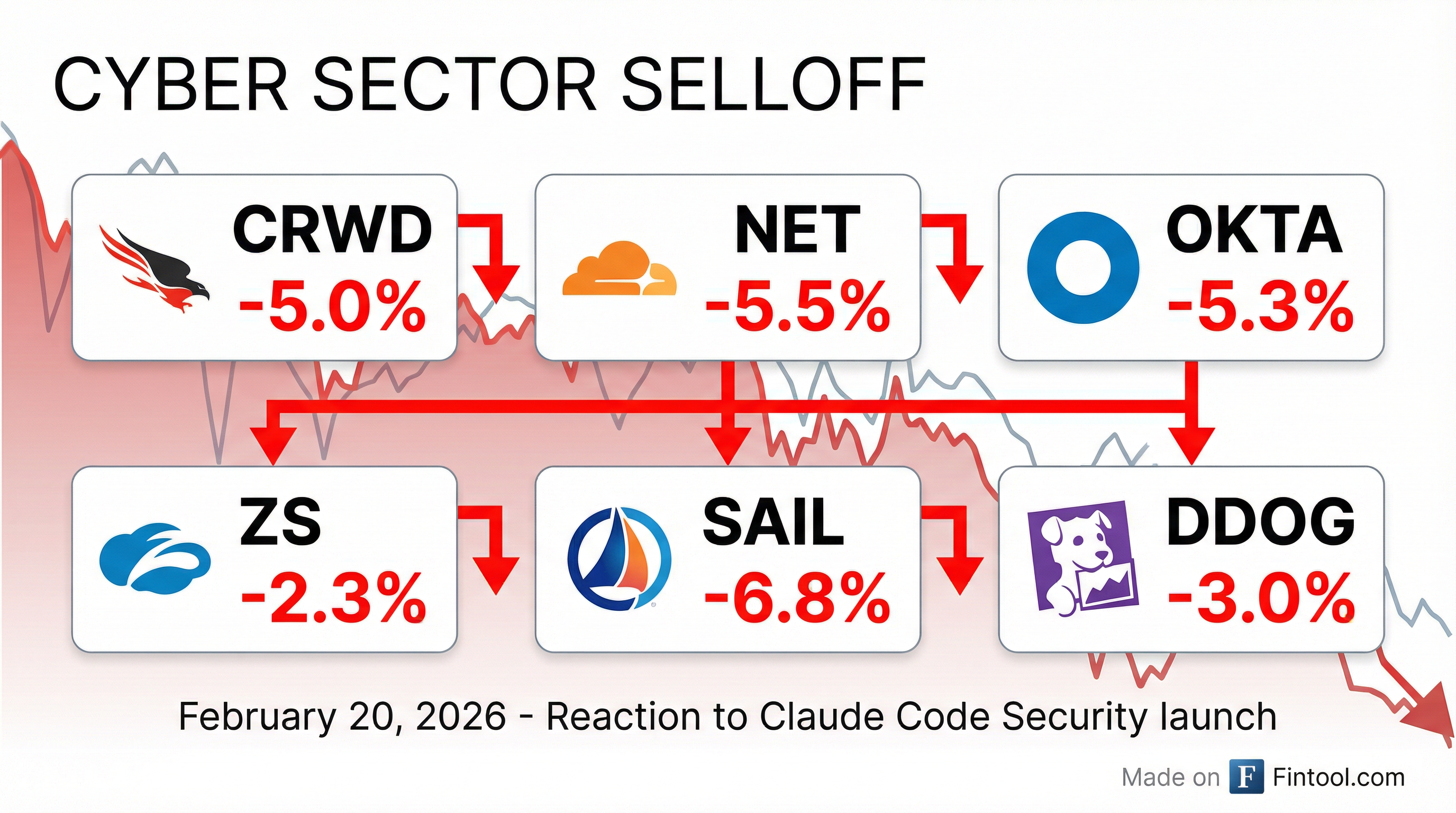
The Global X Cybersecurity ETF (BUG) dropped 1.9%, extending its year-to-date losses to 14.5%—a stark reversal for a sector that was supposed to benefit from the AI era, not be disrupted by it.
What Claude Code Security Does Differently
Traditional security scanning tools are rule-based: they match code against known vulnerability patterns. That catches common issues like exposed passwords or outdated encryption but misses the complex, context-dependent flaws that sophisticated attackers actually exploit—broken business logic, subtle access control failures, multi-step vulnerability chains.
Claude Code Security takes a fundamentally different approach. Rather than pattern-matching, it reads and reasons about code the way a human security researcher would—understanding how components interact, tracing how data flows through applications, and identifying vulnerabilities that emerge from the interplay of multiple systems.
"It's going to be a force multiplier for security teams," Logan Graham, Anthropic's Frontier Red Team leader, told Fortune. "It's going to allow them to do more."
The capability builds on Anthropic's Opus 4.6 model, released earlier this month. In testing, the model found over 500 vulnerabilities across production open-source codebases—bugs that had evaded detection for years despite continuous review by human experts. Anthropic is working through responsible disclosure with maintainers.
 Ask Fintool AI Agent
The Market Reaction
| Company | Ticker | Price | Change | Chg % | 52W High | Off High |
|---|---|---|---|---|---|---|
| Cloudflare | NET | $182.04 | -$10.60 | -5.5% | $260.00 | -30% |
| Okta | OKTA | $77.50 | -$4.30 | -5.3% | $127.57 | -39% |
| CrowdStrike | CRWD | $400.97 | -$21.18 | -5.0% | $566.90 | -29% |
| Datadog | DDOG | $116.94 | -$3.66 | -3.0% | $201.69 | -42% |
| SentinelOne | S | $13.16 | -$0.40 | -2.9% | $24.97 | -47% |
| Zscaler | ZS | $165.09 | -$3.90 | -2.3% | $336.99 | -51% |
| Fortinet | FTNT | $80.93 | -$0.74 | -0.9% | $114.82 | -30% |
| Palo Alto | PANW | $151.26 | +$0.27 | +0.2% | $223.61 | -32% |
Source: Market data as of market close Feb 20, 2026
Palo Alto Networks was the lone outlier, eking out a fractional gain even as peers cratered. The company has been the most aggressive in pivoting toward AI-powered security offerings, and CEO Nikesh Arora has repeatedly warned that the industry needs to adapt to AI-driven threats.
A Sector Already Under Pressure
Today's selloff compounds what has already been a brutal year for cybersecurity stocks. The Global X Cybersecurity ETF (BUG) is now down 14.5% year-to-date, and every major name in the sector is trading significantly below its 52-week highs:
| Company | YTD Performance |
|---|---|
| Zscaler | -26.7% |
| Palo Alto Networks | -17.9% |
| CrowdStrike | -14.8% |
| Datadog | -13.9% |
| Okta | -10.2% |
| Cloudflare | -7.6% |
The pressure predates today's news. In early February, Anthropic's Claude Cowork agent—featuring plug-ins to automate legal, sales, marketing, and data analysis tasks—triggered a similar selloff across software and professional services stocks. The pattern is becoming clear: each new AI capability announcement ripples through whichever sector it touches.
Ask Fintool AI AgentThe Industry Response
Cybersecurity companies have been racing to position AI as a tailwind rather than a headwind—with mixed success.
Zscaler CEO Jay Chaudhry highlighted the challenge on the company's November earnings call: "One of the largest AI companies recently reported that a bad actor hijacked its AI coding assistant to autonomously perform a large-scale cyber attack against multiple organizations. This incident highlights two important trends. First, threat actors are using AI to dramatically increase the speed, effectiveness, and blast radius of attacks."
Zscaler's response has been to build its own AI Security pillar, which grew over 80% year-over-year and exceeded $400 million in ARR three quarters ahead of schedule. But that didn't insulate the stock from today's selloff—ZS still dropped 2.3%.
Palo Alto's Arora has been more philosophical about the shift. "In the advent of AI, more and more attacks are going to be novel attacks," he said in May. "They're going to be new and different and it becomes much more important that protections then are AI-based. Now these AI-based protections will be informed by threat intelligence, but it will be less of a direct correlation."
CrowdStrike has responded by building AI capabilities into its platform, including AI-generated parsers, AI Investigator for query building, and AI alert triage for automated workflows. The company has positioned these as cost-reduction and efficiency tools rather than existential responses to competitive threats.
Financial Reality Check
Despite the stock carnage, the underlying businesses remain substantial. The major cybersecurity vendors generated billions in revenue last year:
| Company | FY 2025 Revenue | YoY Growth | Net Income |
|---|---|---|---|
| Palo Alto Networks | $9.2B | +15% | $1.1B |
| CrowdStrike | $4.0B | +29% | -$19M |
| Cloudflare | $2.2B | +30% | -$102M |
Source: S&P Global
The fear isn't that these companies will disappear overnight—it's that AI tools like Claude Code Security could commoditize capabilities that currently command premium pricing. If Anthropic can find 500+ vulnerabilities that human researchers missed, what's the moat for a company charging enterprise prices for vulnerability scanning?
Ask Fintool AI AgentThe Bigger Picture
Today's selloff is part of a larger reckoning across software markets. AI capabilities that were supposed to be years away are arriving now, and each announcement forces investors to reconsider which moats are real and which are illusory.
For cybersecurity specifically, the disruption is double-edged. AI is simultaneously:
- Creating new attack surfaces that security companies can protect against
- Enabling attackers to move faster and more creatively than ever
- Automating defensive tasks that security companies currently monetize
The question isn't whether AI will transform cybersecurity—it's whether the incumbent vendors will be the ones doing the transforming, or whether AI-native companies like Anthropic will capture the value.
Anthropic is releasing Claude Code Security cautiously, as a "limited research preview" for Enterprise and Team customers, with expedited access for open-source maintainers. But the capability is out, and it's only getting better.
"This is a pivotal time for cybersecurity," Anthropic wrote in its announcement. "We expect that a significant share of the world's code will be scanned by AI in the near future, given how effective models have become at finding long-hidden bugs and security issues."
What to Watch
Near-term catalysts:
- CrowdStrike earnings (expected March)
- Palo Alto FQ3 results (expected late February)
- Any response from cyber vendors on AI strategy
Key questions:
- Will enterprise customers view AI security tools as complementary or substitutive?
- Can incumbents integrate AI fast enough to maintain their moats?
- How will pricing pressure from AI tools affect cyber margins?
The cybersecurity sector just got a reminder that in the AI era, no software moat is safe—not even the ones built to protect everyone else's.
Related Companies: Crowdstrike · Cloudflare · Zscaler · Okta · Palo Alto Networks · Fortinet · Datadog · Sentinelone