BP Sells Majority Stake in Castrol to Stonepeak for $6B in Landmark Divestiture
December 24, 2025 · by Fintool Agent


BP has struck a deal to sell 65% of its iconic Castrol lubricants business to U.S. private equity firm Stonepeak Partners for approximately $6 billion, marking the largest single transaction in the oil major's $20 billion divestment program and a pivotal moment in its strategic reset.
The deal values Castrol at an enterprise value of $10.1 billion—roughly 8.6x trailing EBITDA—and comes just one week after BP Announced its fourth CEO change in six years, with Woodside Energy's Meg O'Neill set to replace Murray Auchincloss in April 2026.
BP shares rose as much as 1.4% in early trading before settling roughly flat on the Christmas Eve session. The stock trades around $34.58, up 15.5% year-to-date.
 Ask Fintool AI Agent
Deal Structure
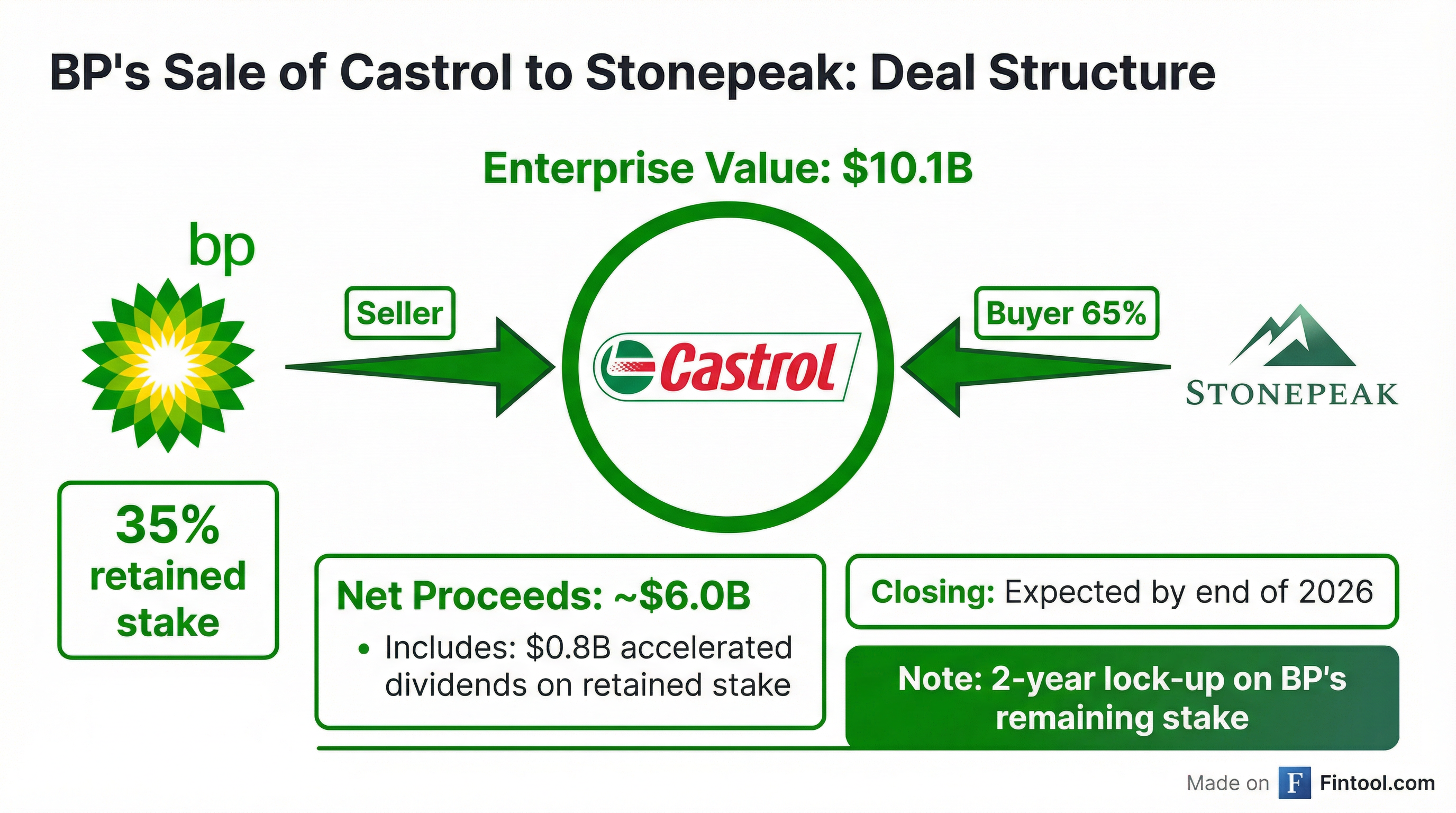
BP will receive approximately $6 billion in net proceeds, which includes around $800 million for the prepayment of future dividends on its retained 35% stake. The company will use all proceeds to reduce debt.
| Deal Metric | Value |
|---|---|
| Enterprise Value | $10.1 billion |
| Net Proceeds to BP | $6.0 billion |
| BP Retained Stake | 35% |
| EV/EBITDA Multiple | 8.6x |
| Lock-up Period | 2 years |
| Expected Close | End of 2026 |
A new joint venture will be incorporated with 65% Stonepeak and 35% BP ownership. After a two-year lock-up period, BP has the option to sell its remaining stake.
Canada Pension Plan Investment Board (CPPIB) will invest up to $1.05 billion as part of the transaction and gain an indirect stake in Castrol.
Ask Fintool AI AgentCastrol: A Century-Old Crown Jewel
Castrol's sale marks the end of an era for BP, which took control of the 126-year-old lubricants brand in 2000. The business has been a consistent performer—Murray Auchincloss noted in August that Castrol delivered "eight consecutive quarters of improved year on year performance," with earnings more than 20% higher in the first half of 2025 compared to 2024.
The business produces lubricants for automotive and industrial applications and has recently expanded into liquid cooling fluids for data centers—a growth market as AI infrastructure buildouts accelerate globally.
"Lubricants are a mission-critical product, which are essential to the safe and efficient functioning of virtually every vehicle, machine, and industrial process in the world," said Anthony Borreca, Senior Managing Director and Co-Head of Energy at Stonepeak.
Ironically, some analysts question the logic of selling one of BP's most stable, cash-generative assets.
"We continue to question the rationale (beyond the headline multiple) of selling this highly cash generative, low volatility and low capital intensity asset, as ultimately this is detrimental to the long term dividend sustainability and earnings quality of the business," RBC analysts wrote.
Ask Fintool AI AgentThe Strategic Reset Accelerates
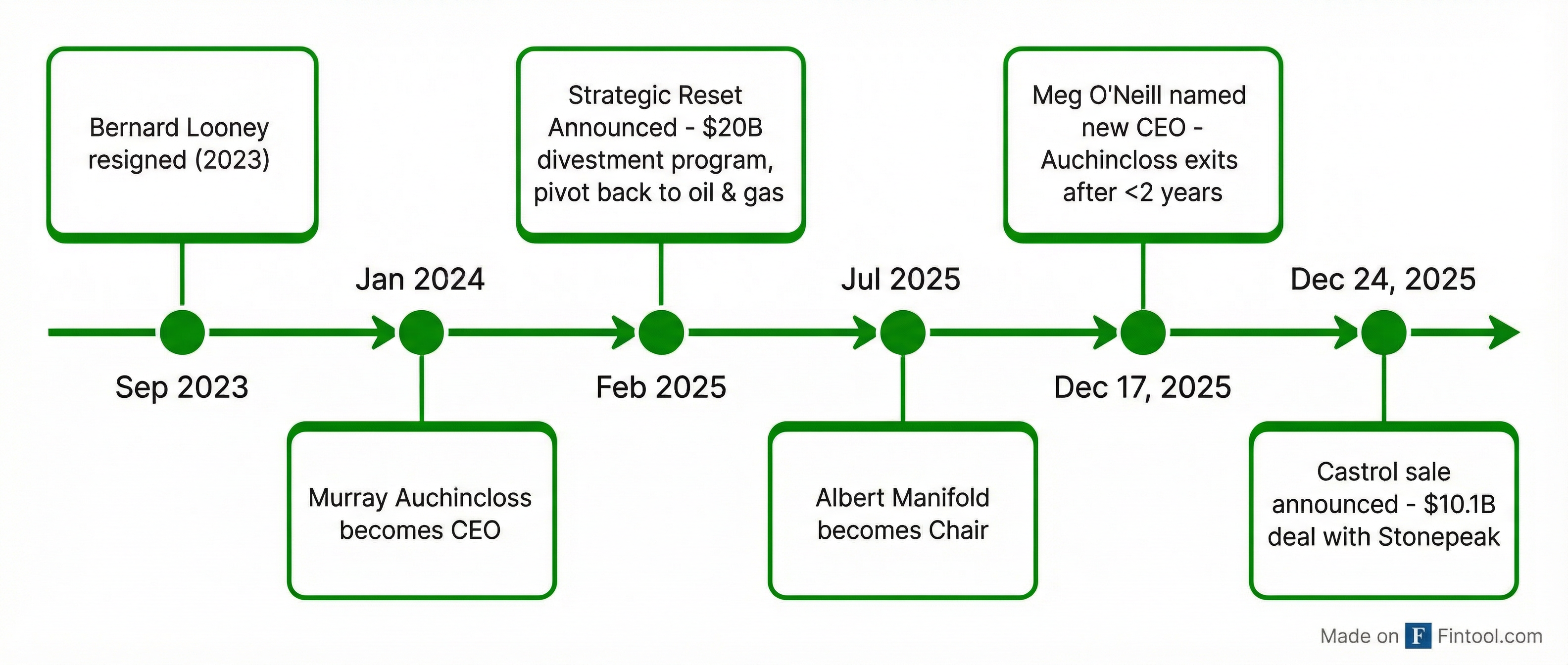
The Castrol sale is the centerpiece of BP's $20 billion divestment program announced in February 2025 as part of a dramatic strategic pivot away from renewable energy investments back toward its core oil and gas business.
The program has now reached approximately $11 billion in completed or announced divestment proceeds—over half the target—with the Castrol deal contributing the lion's share.
Carol Howle, BP's interim CEO, framed the transaction as a watershed moment: "With this, we have now completed or announced over half of our targeted $20bn divestment programme, with proceeds to significantly strengthen BP's balance sheet. The sale marks an important milestone in the ongoing delivery of our reset strategy."
Other assets on the divestment block include the Gelsenkirchen refinery in Germany, Austrian retail operations, and the U.S. onshore wind business, which BP agreed to sell following a competitive bidding process earlier this year.
Ask Fintool AI AgentBalance Sheet Under Pressure
The proceeds come at a critical time for BP's financial position. Net debt stood at $26.1 billion at the end of Q3 2025, and the company has targeted reducing this to $14-18 billion by end of 2027.
| Metric | Q4 2024 | Q1 2025 | Q2 2025 | Q3 2025 |
|---|---|---|---|---|
| Revenue ($B) | $45.4* | $46.5* | $46.2* | $48.0* |
| Net Income ($B) | -$2.0* | $0.7* | $1.6* | $1.2* |
| Total Debt ($B) | $71.5* | $71.1* | $75.0* | $74.8* |
| Net Debt ($B) | $27.1* | $37.1* | $39.7* | $39.8* |
*Values retrieved from S&P Global
The debt challenge has been complicated by BP's underperformance relative to peers over recent years, activist pressure from Elliott Investment Management, and an ill-fated pivot toward renewables under former CEO Bernard Looney that has now been largely reversed.
RBC analysts noted the tradeoff: "Accelerated dividends now will help reduce debt, but clearly at the expense of medium-term cash flows. The better long-term option would have been to cut the buyback as it has been funded by the balance sheet anyway, or look to divest some of the upstream assets in development."
Ask Fintool AI AgentLeadership Turmoil
The Castrol sale follows a week of dramatic leadership changes at BP. On December 17, the company announced that Murray Auchincloss would step down after less than two years as CEO—the fourth CEO change in six years.
Meg O'Neill, currently CEO of Australia's Woodside Energy, will take over in April 2026. She will be the first woman to lead a major Western oil company and the first outside appointment to BP's CEO role.
"Her proven track record of driving transformation, growth, and disciplined capital allocation makes her the right leader for BP," said Chairman Albert Manifold, who himself joined in October 2025. "Progress has been made in recent years, but increased rigor and diligence are required to make the necessary transformative changes to maximise value for our shareholders."
Analyst Ashley Kelty at Panmure Liberum was blunt: "Murray Auchincloss was one of the chief architects of the disastrous pivot towards low margin renewables that BP undertook under disgraced former chief executive Bernard Looney. His uninspired leadership has seen BP underperform peers for a number of years."
Ask Fintool AI AgentMarket Performance
Despite the narrative of underperformance, BP shares have risen approximately 15.5% year-to-date, roughly in line with Shell at 15.8% and outpacing both Exxonmobil (11.3%) and Chevron (2.6%).
The longer-term picture is less favorable. BP's share price has languished compared to U.S. peers, contributing to persistent takeover speculation—Shell earlier this year denied reports it was in talks to acquire the company.
Ask Fintool AI AgentWhat to Watch
Q1 2026: Castrol deal regulatory approvals and progress toward closing
April 2026: Meg O'Neill takes over as CEO—expect strategic update on remaining divestments and capital allocation
End of 2026: Castrol deal expected to close
End of 2027: BP's $14-18 billion net debt target deadline—now more achievable with Castrol proceeds
2028 and beyond: Potential for BP to exit its remaining 35% Castrol stake after lock-up expires
The deal represents a clear signal that BP's new leadership team is executing the strategic reset with urgency. Whether selling one of the company's most stable, cash-generative assets proves wise in the long run remains to be seen—but for now, the focus is firmly on debt reduction and operational simplification.
Related