Clearway CEO at Jefferies Conference: Google PPA Cements Path to $3.10 CAFD by 2030
January 27, 2026 · by Fintool Agent


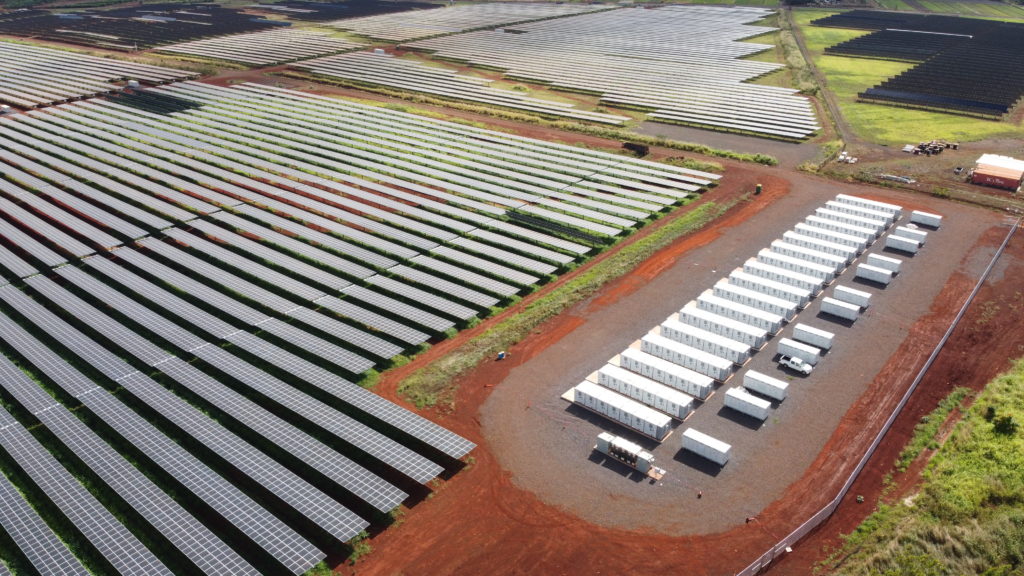
Clearway Energy CEO Craig Cornelius laid out an aggressive vision for sustainable 8%+ growth at the Jefferies Power, Utilities & Clean Energy Conference on January 27, declaring the company has "commercialized substantially all" projects needed through 2027 and is "mostly done" on the roadmap through 2030.
The remarks, made in an interview with Jefferies analyst Julian Dumoulin-Smith, come just 12 days after Clearway announced a transformative 1.2 GW portfolio of power purchase agreements with Alphabet's Google—part of a wave of hyperscaler energy deals reshaping the clean energy landscape.
Shares of CWEN are trading at $36.82, up 1.8% on the day and hitting a fresh 52-week high of $36.93 intraday. The stock has rallied approximately 13% since the Google announcement on January 15.
The Google Deal: A Template for What's Next
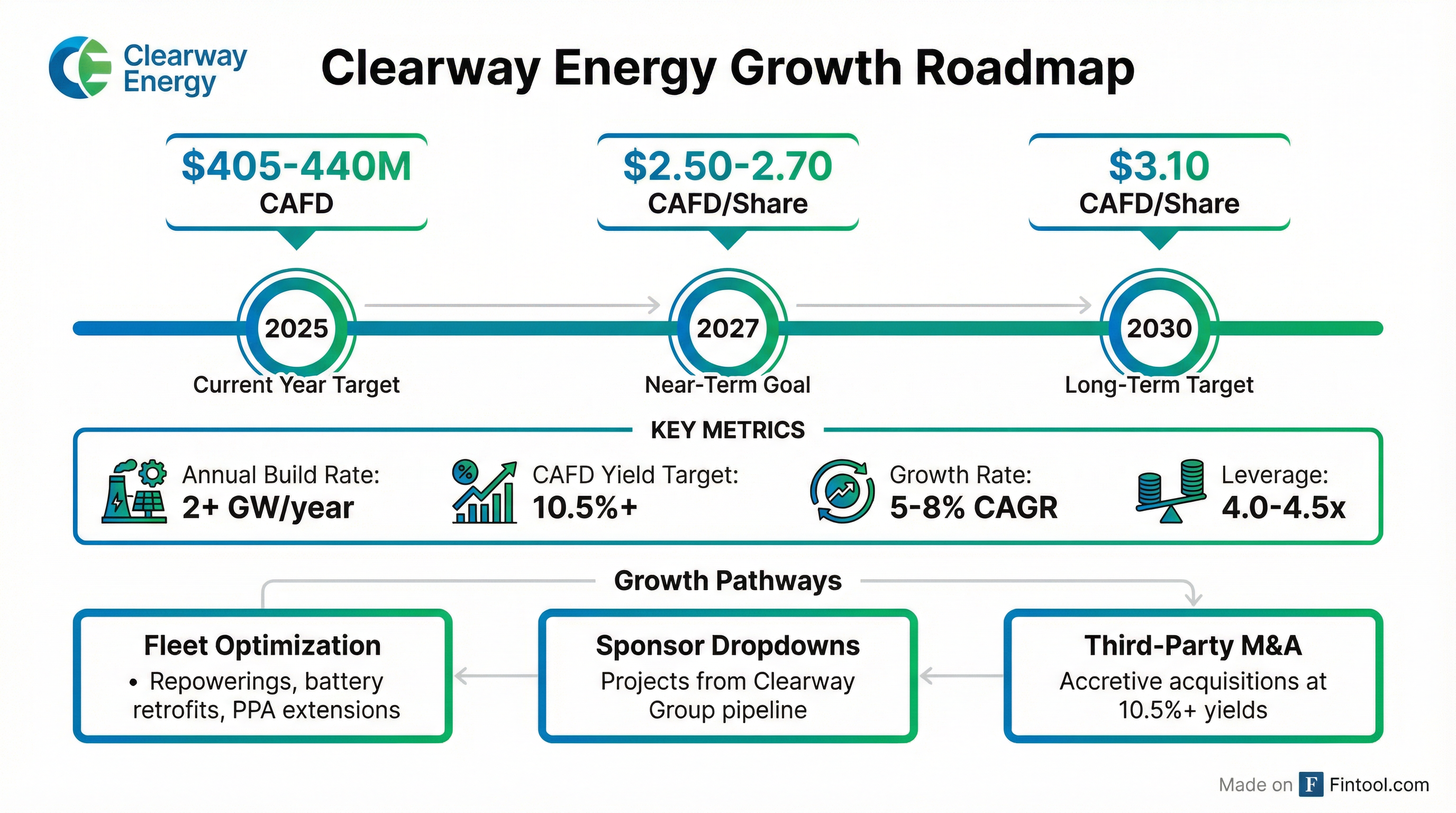
The 1.17 GW of PPAs with Google span three states—Missouri, Texas, and West Virginia—with projects delivering carbon-free energy to Google's data centers across SPP, ERCOT, and PJM for up to 20 years. Together, the projects represent over $2.4 billion in energy infrastructure investment, with construction beginning this year and first projects coming online in 2027-2028.
But Cornelius made clear this is just the beginning.
"Those weren't the first PPAs signed with commercial industrial off-takers, but they did represent a great moment in our enterprise's business," Cornelius said. "The duration of the contracts were super long. The size of the commitment was substantial. The geography was diverse... They are just the beginning of what is likely to be a pretty substantial wedge of incremental contracting."
 Ask Fintool AI Agent
The Math on Data Center Power
Cornelius provided rare specificity on the economics of powering hyperscale data centers. A simple rule of thumb: 1.5 GW of computation load requires roughly 4 GW of cost-optimized wind, solar, battery, and gas resources.
"The demand for new compute radically exceeds 200 GW at least as you think ahead over the course of the 10-year planning horizon that we think about as a developer," Cornelius said. "So when we think about the opportunity set that we're serving, any project we think we can successfully permit and interconnect, we are developing in the fortunate situation where there's a customer who's ready to buy from that resource."
The company's technology-agnostic approach—blending renewables, storage, and gas—positions it to serve data centers seeking reliability above all else. Cornelius described an optimal mix: roughly 70% of megawatt hours from zero-marginal-cost renewables and 30% from battery and gas dispatch.
Growth Roadmap: 2027 to 2030 and Beyond
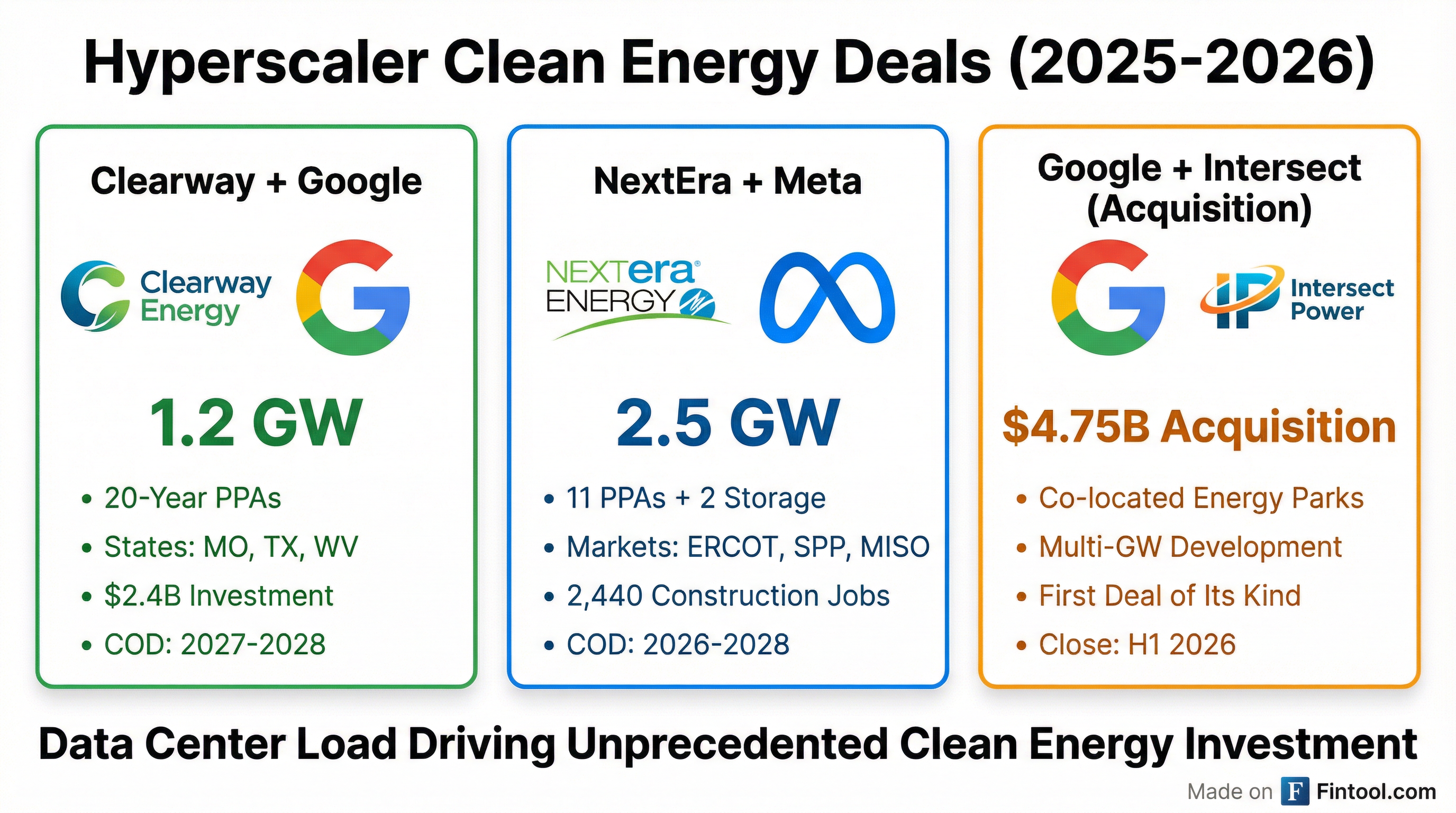
Clearway has methodically raised its 2027 CAFD per share target from an initial $2.40-$2.60 range to $2.50-$2.70, with line of sight to the "top end or better." The company is now firmly targeting $3.10 in CAFD per share by 2030.
"We've commercialized substantially all of what we'd planned to build through 2027. We've now commercialized a majority of what we'd planned to build into 2028," Cornelius said. "We are in late stages of commercializing and developing the family of projects we would construct in 2029, which would allow us to build in sufficient volume to hit the top end or better of our 2030 goals."
The capital allocation framework remains disciplined:
- Leverage ratio: 4.0-4.5x debt to EBITDA
- CAFD yield target: 10.5% or better on acquisitions
- Annual construction pace: 2+ GW per year
- Payout ratio target: 70-80%, trending toward the lower end
| Metric | Q4 2024 | Q1 2025 | Q2 2025 | Q3 2025 |
|---|---|---|---|---|
| Revenue ($M) | $256 | $298 | $392 | $429 |
| EBITDA ($M) | $168* | $209* | $295* | $340* |
| Cash from Operations ($M) | $192 | $95 | $191 | $225 |
*Values retrieved from S&P Global
Ask Fintool AI AgentBattery Storage: "The Most Predictable Source of Cash Flow"
Cornelius reserved his strongest praise for battery storage assets, which he called "the most predictable source of cash flow in our fleet."
"There's nothing that moves as fast as a lithium-ion battery when a grid operator calls on us to dispatch it. They are incredibly predictable in the way we plan for their maintenance," he said. "The data that you can see in ERCOT in particular over the course of the last couple of years is really stunning... we should appreciate the ways that as an industry we've been able to deliver a technology that has made the ERCOT grid see sustained lower wholesale prices and sustained enhanced reliability."
Battery storage now represents over 40% of all project capacity in Clearway Group's development pipeline. Importantly, standalone batteries remain eligible for tax credits through projects commencing construction in 2033-2034, providing long runway for continued growth even as renewable credits phase down.
Post-IRA Outlook: "Stand on Its Own Two Feet"
Addressing concerns about the post-2030 tax credit landscape, Cornelius expressed confidence that renewables will remain economically viable.
"The mix in 2031 and beyond probably doesn't look that much different than the sprint we're running over the next 3 or 4 years," he said. "The roadmap that's been created that gives that industry to get further to scale into cost effectiveness and then stand on its own two feet in 2031 and beyond should give it enough time to be really industrializing the scale economies that are necessary."
Clearway's equipment procurement has been thoughtfully sourced domestically or through suppliers committed to FIOC compliance, positioning projects to qualify for domestic content adders while insulating against policy risk.
Competitive Positioning in the Hyperscaler Race
Clearway joins an intensifying competition among IPPs for hyperscaler business. Nextera Energy announced 2.5 GW of clean energy contracts with Meta in December 2025, alongside a landmark partnership with Google to develop multi-GW data center campuses.
Google's $4.75 billion acquisition of Intersect Power in December 2025—the first instance of a hyperscaler directly acquiring a major renewable energy developer—has raised questions about whether traditional PPA structures will remain the dominant model.
Cornelius addressed this competitive dynamic directly: "The new norm is bigger. The new norm is also one where there is increasingly, amongst customers, equipment suppliers, financing sources, a recognition that the scale of what we are trying to do together is significant. And it requires the whole industry to focus its resources and attention on the most capable large enterprises that are capable of building large projects and capable of sustaining a construction tempo at size."
| Company | Deal | Capacity | Customer | Structure |
|---|---|---|---|---|
| Clearway Energy | Jan 2026 | 1.2 GW | 20-year PPAs | |
| NextEra Energy | Dec 2025 | 2.5 GW | Meta | 11 PPAs + 2 ESAs |
| NextEra Energy | Dec 2025 | Multi-GW | Campus Development | |
| Intersect Power | Dec 2025 | Multi-GW | $4.75B Acquisition |
Ask Fintool AI AgentWhat to Watch
Q4 2025 Earnings (February 23, 2026): Clearway will report fourth quarter results and provide updated 2026 guidance, with potential for further visibility into the data center opportunity.
Construction Progress: The Google projects totaling 1+ GW are scheduled to begin construction in 2026, with investors watching for updates on execution and any cost pressures.
Additional Hyperscaler Deals: Cornelius indicated that "big announcements may become more routine" as the pace of growth accelerates, suggesting additional contracts could be announced in coming quarters.
Capital Raising: The company has indicated it will "opportunistically and predictably issue modest amounts of equity" through ATM or direct stock purchase programs to fund growth, with filings expected in the near future.
The Bottom Line
Clearway's Jefferies presentation painted a picture of a company firing on all cylinders—with substantially all projects commercialized through 2028, a growing hyperscaler customer base, and a capital allocation framework that has proven repeatable. The Google deal isn't just a one-off; it's a template for the "pretty substantial wedge of incremental contracting" Cornelius sees ahead.
For investors, the key question is whether the 5-8% annual CAFD growth target adequately captures the upside from what management clearly views as an unprecedented opportunity in data center power. With shares hitting new highs and the company signaling confidence in reaching the top end of all its targets, the market appears to be betting that it does.