Coty's Turnaround Architect Exits as Stock Collapses 53%—P&G Veteran Takes the Helm
December 22, 2025 · by Fintool Agent



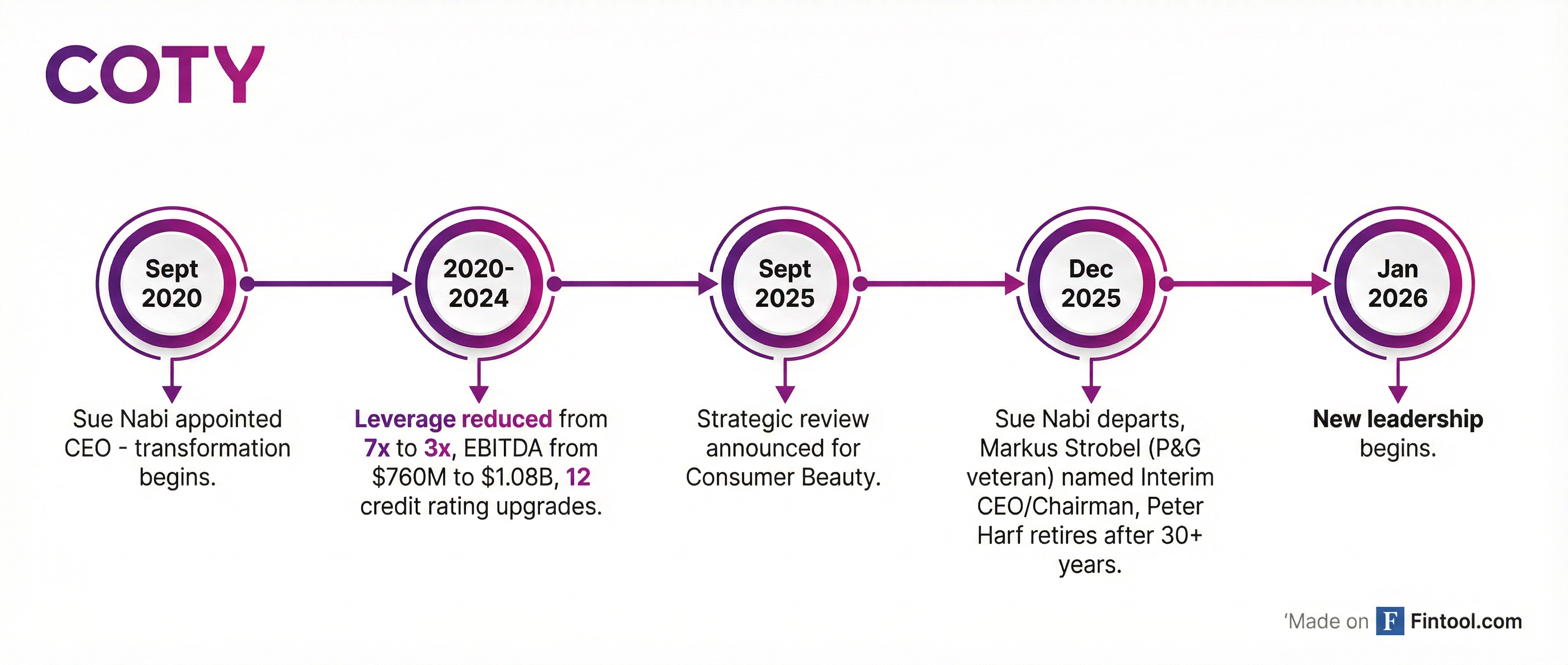
Coty-15.42%'s five-year transformation under Sue Nabi has come to an abrupt end. The beauty conglomerate announced Monday that Nabi will step down as CEO effective December 31, with Procter & Gamble+0.35% veteran Markus Strobel taking over as interim CEO and executive chairman as the CoverGirl owner battles a stock price that has cratered more than 53% this year.
The leadership overhaul also marks the departure of Peter Harf, who is retiring from Coty's board after more than three decades—a move reportedly orchestrated by majority owner JAB Holdings, which controls 52% of the company.
The Numbers Tell the Story
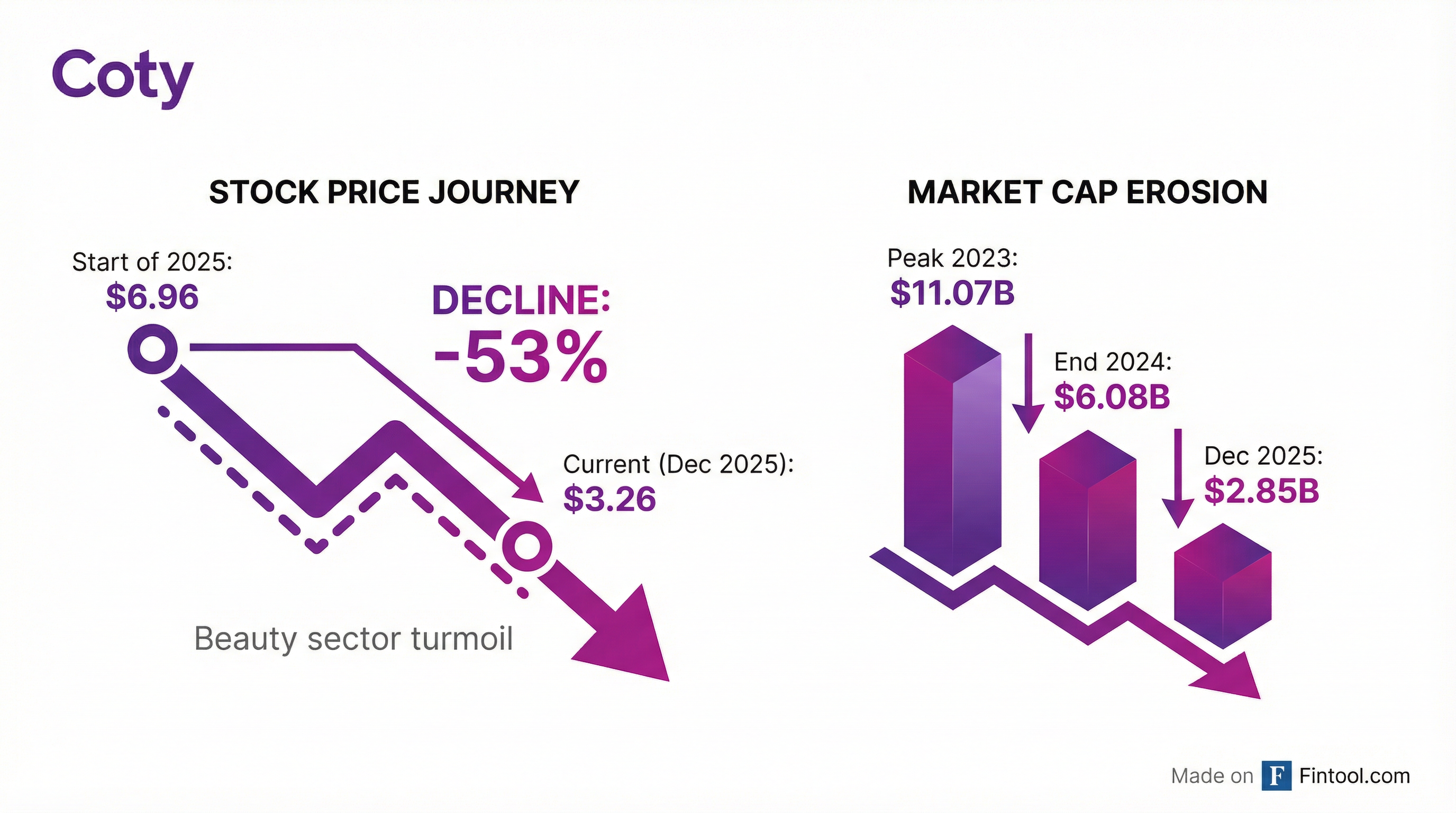
Coty's market capitalization has evaporated from $11 billion in late 2023 to under $3 billion today—a destruction of shareholder value that has accelerated dramatically in 2025.
| Metric | FY 2023 | FY 2024 | FY 2025 |
|---|---|---|---|
| Revenue | $5.55B | $6.12B | $5.89B |
| Net Income | $508M | $89M | -$368M |
| EBITDA | $965M | $1.00B | $950M |
| Gross Margin | 63.9% | 64.4% | 64.8% |
The fiscal 2025 loss represents a jarring reversal from years of profitability under Nabi's leadership, when the company had navigated challenges including Russia's invasion of Ukraine and supply chain disruptions while steadily deleveraging its balance sheet.
Nabi's Mixed Legacy
Sue Nabi arrived at Coty in September 2020 with a mandate to transform a struggling beauty giant. On several metrics, she delivered:
- Leverage reduction: Net debt to EBITDA fell from approximately 6.8x to 3.5x
- Credit upgrades: 12 consecutive rating improvements since fiscal 2020
- EBITDA growth: From $760 million in FY21 to over $1 billion by FY24
- Prestige fragrance dominance: Built a $3.5 billion business with +10% CAGR
"Over the past five years, Coty transformed, refining our strategy, strengthening our portfolio and consistently delivering results," CFO Laurent Mercier said during the August earnings call, noting the company had "consistently outperformed global peers, particularly in Prestige, delivering like-for-like growth ahead of global peers like L'Oreal, Estee Lauder+2.91%, Shiseido and LVMH's Perfume and Cosmetics division."
But the cracks that emerged in 2025 proved fatal to her tenure. Management acknowledged they were "delayed in identifying weaknesses in our execution, retailer inventory buildup and headwinds from lapping fiscal year 2024 innovation."
The Strategic Pivot Underway
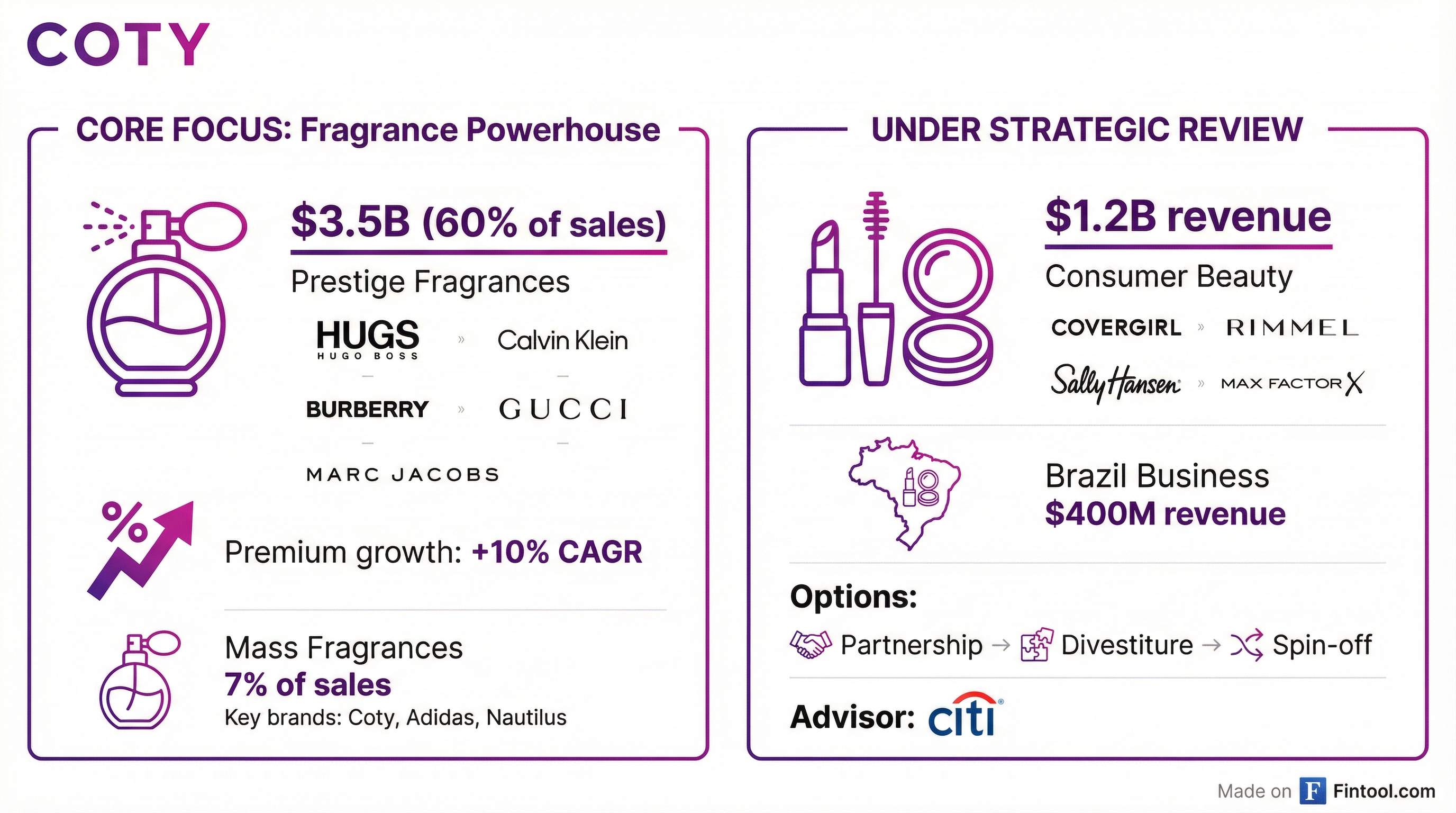
Coty announced in September a comprehensive strategic review of its mass color cosmetics business—including iconic brands CoverGirl, Rimmel, Sally Hansen, and Max Factor—which generates approximately $1.2 billion in annual revenue, plus its distinct Brazil business contributing close to $400 million.
The review, with Citi as advisor, is assessing "a full range of alternatives including partnerships, divestitures, spin-offs, and other potential strategic actions, with the objective of maximizing long-term value and strengthening the balance sheet."
This represents a fundamental reshaping of Coty's identity. The company is doubling down on what it calls its "heritage and core strengths"—fragrances across the full price spectrum from $5 to $500—while potentially exiting the mass cosmetics business that has struggled against nimble indie competitors.
"By more closely integrating all our fragrance and scenting brands, we unlock the full power of our scale," Nabi said when announcing the strategic review. "The fragrance category continues to outperform the global beauty market and already drives the majority of our revenues and profits."
The Strobel Playbook
Markus Strobel brings over three decades of experience at Procter & Gamble+0.35%, where he most recently led the global skin and personal care division. Notably, he has direct experience with several brands Coty acquired from P&G in a $12.5 billion deal around a decade ago, including work with Gucci, Dolce & Gabbana, Valentino, and Hugo Boss.
"I see tremendous potential to accelerate growth, strengthen our position in prestige and mass beauty, and deliver sustainable value for shareholders, partners, and consumers worldwide," Strobel said in the company's announcement.
The new leader inherits immediate challenges:
- Gucci license expiration: Coty will lose its exclusive license for Gucci fragrances and beauty products in 2028 after Kering agreed to sell its beauty division to L'Oréal
- Ongoing deleveraging: Total debt remains approximately $4.2 billion
- U.S. market weakness: Coty has lost market share in prestige fragrances in the critical U.S. market
- Consumer Beauty struggles: The mass cosmetics business faces intense competition from indie brands, particularly in the U.S.
Leadership Timeline
Friday's announcement that Coty completed the sale of its remaining 25.8% stake in hair care brand Wella to KKR+4.06% for $750 million marked the final step of a portfolio streamlining plan initiated in 2020.
Part of a Broader Reckoning
Coty's leadership shake-up reflects a broader trend across consumer goods. Companies from Kraft Heinz to Coca-cola+0.66% to Lululemon+1.62% have all appointed new chiefs in recent months, joining peers like Unilever+0.77% and Nestlé in revamping leadership as boards grow impatient with weak growth, tariff uncertainty, and the challenge of attracting younger consumers.
CFRA Research analyst Ana Garcia has noted that increased competition and a recent slowdown in the beauty market—rather than leadership alone—are largely responsible for Coty's troubles, adding that "sales would remain under pressure."
What to Watch
Near-term catalysts:
- Q2 FY26 results expected in early February
- Progress on Consumer Beauty strategic review
- Any announcements on permanent CEO search
Medium-term risks:
- Execution of fragrance-focused strategy
- Consumer Beauty divestiture terms and timing
- Gucci license transition planning
- Deleveraging progress toward investment-grade profile
The market's verdict is clear: Coty's stock traded at $3.26 as of Friday's close, down from nearly $7 at the start of 2025. Whether Strobel's P&G playbook can restore investor confidence in a company that once commanded an $11 billion valuation remains the defining question for 2026.
Related: