Ford Takes $19.5 Billion Hit—The Biggest EV Retreat in Auto Industry History
December 15, 2025 · by Fintool Agent


The End of the EV Moonshot
Ford Motor Company announced Monday the largest single EV-related writedown in auto industry history: $19.5 billion in special charges as it kills its next-generation electric truck, ends production of the F-150 Lightning, and pivots hard toward hybrids and gas-powered vehicles.
The decision marks a watershed moment for America's oldest automaker—and potentially for the entire EV industry. Just four years ago, Ford's "Ford+" plan was a bullish bet on an electric future. Today, CEO Jim Farley is calling it "a customer-driven shift" in response to market realities.
"The operating reality has changed," Farley said Monday. "We are redeploying capital into higher-return growth opportunities: Ford Pro, our market-leading trucks and vans, hybrids and high-margin opportunities like our new battery energy storage business."
The pivot comes as Trump administration policies have gutted federal support for EVs—including the early termination of the $7,500 consumer tax credit in September—while simultaneously rolling back emissions standards that once forced automakers toward electrification.
Breaking Down the $19.5 Billion Charge
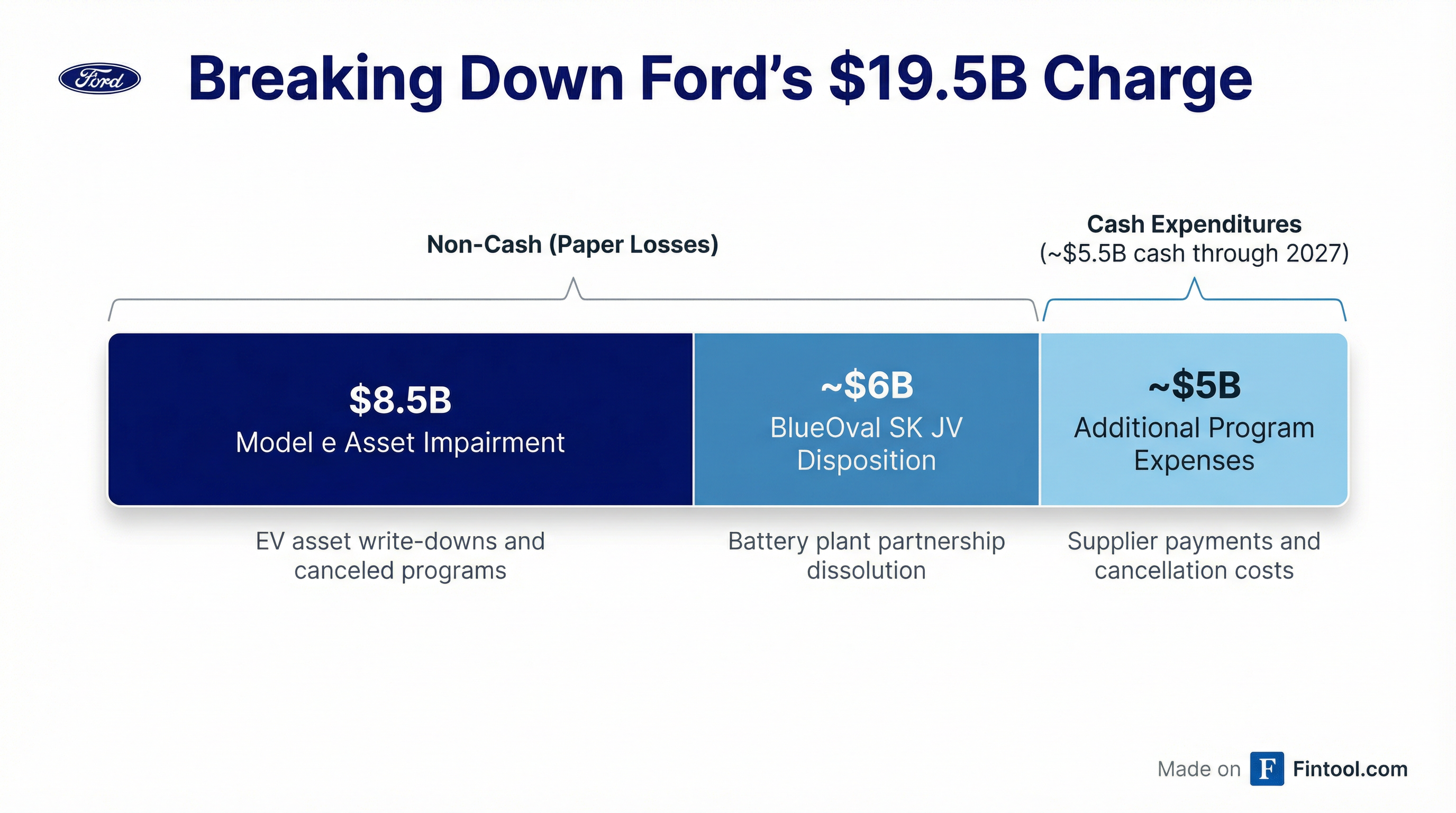
Ford's writedown is comprised of three major components:
| Component | Charge | Timing | Cash Impact |
|---|---|---|---|
| Model e Asset Impairment / Program Cancellations | $8.5B | Q4 2025 | None (non-cash) |
| BlueOval SK JV Disposition | $6.0B | Q4 2025 + H1 2026 | $0.5B |
| Additional Program-Related Expenses | $5.0B | Q4 2025 through 2027 | $5.0B |
| Total | ~$19.5B | 2025-2027 | ~$5.5B |
The $8.5 billion Model e impairment represents the largest piece—a write-down of Ford's entire second-generation EV platform and the assets tied to three canceled vehicles: a full-size electric pickup (codenamed T3), an electric commercial van for North America, and an electric commercial van for Europe.
The BlueOval SK charges stem from the dissolution of Ford's battery manufacturing joint venture with South Korea's SK On, announced last week. Under the new agreement, Ford takes full ownership of two Kentucky battery plants while SK On takes the Tennessee plant.
What's Being Killed, What's Changing, What's Coming
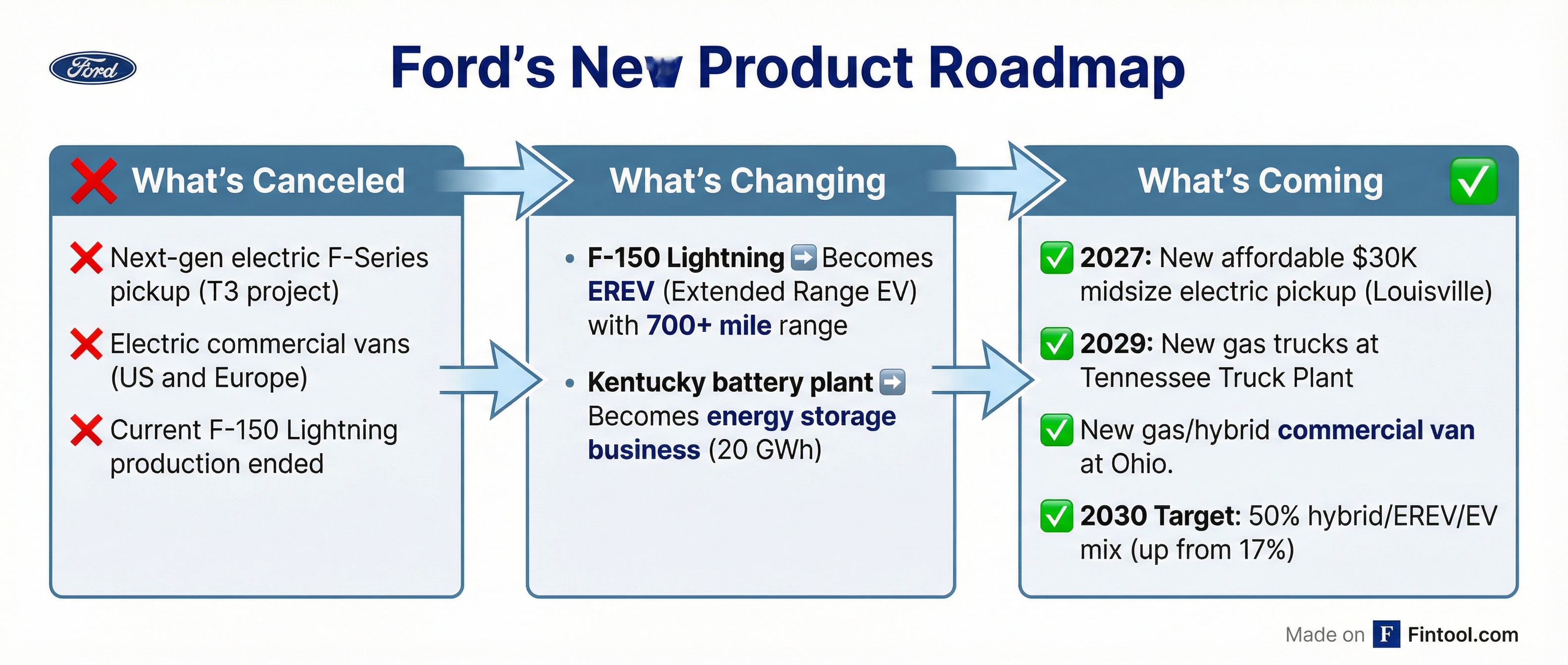
Killed Programs
- T3 Electric Pickup: Ford's planned next-generation electric truck was to be built at Tennessee Electric Vehicle Center (now renamed Tennessee Truck Plant). The facility will instead produce gas-powered trucks starting in 2029.
- Electric Commercial Vans: Canceled for both North America and Europe, replaced by gas and hybrid alternatives.
- Current F-150 Lightning: Production has concluded. Workers are being redeployed to support F-150 gas and hybrid truck production at Dearborn Truck Plant.
Major Strategic Shifts
- F-150 Lightning → Extended-Range EV (EREV): The next-generation Lightning won't be a pure EV. It will use an extended-range architecture with an electric motor paired with a gas generator—delivering 700+ miles of range.
- Kentucky Battery Plants → Energy Storage Business: Ford is pivoting underutilized EV battery capacity to manufacture battery energy storage systems for data centers and utilities. The company plans 20 GWh of annual capacity by late 2027 and expects to invest $2 billion over two years to scale the business.
What's Still Coming
- 2027: New affordable midsize electric pickup (~$30,000 starting price) at Louisville Assembly Plant—Ford's first vehicle on the new Universal EV Platform
- 2029: New gas trucks at Tennessee Truck Plant; new gas/hybrid commercial van at Ohio Assembly Plant
- 2030 Target: 50% of global volume in hybrids, EREVs, and full EVs (up from 17% today)
The Model e Money Pit
Ford's EV division has been bleeding money at an extraordinary rate. The Model e segment has lost more than $13 billion in cumulative operating losses since Ford created the unit in 2022—including roughly $3.6 billion in the first three quarters of 2025 alone.
| Metric | Q4 2023 | Q1 2024 | Q2 2024 | Q3 2024 | Q4 2024 | Q1 2025 | Q2 2025 | Q3 2025 |
|---|---|---|---|---|---|---|---|---|
| Revenues ($B) | $43.2 | $39.9 | $44.8 | $43.1 | $44.9 | $37.4 | $46.9 | $47.2 |
| Net Income ($B) | -$0.5 | $1.3 | $1.8 | $0.9 | $1.8 | $0.5 | -$0.04 | $2.4 |
| EBIT Margin % | 0.6% | 2.8% | 4.2% | 1.2% | 3.0% | 1.0% | 1.1% | 3.1% |
*Values retrieved from S&P Global
Despite the writedown, Ford raised its 2025 adjusted EBIT guidance to approximately $7 billion—up from the $6-6.5 billion range it guided to in October—citing "continued underlying business strength, including cost improvement."
The company now expects Model e to reach profitability by 2029, with annual improvements beginning in 2026. That's three years later than Ford's original 2026 profitability target set in early 2023.
Why This Happened: Trump Policy Meets Market Reality
Ford explicitly cited "legal and policy changes" as a driver of its decision—a direct reference to the Trump administration's aggressive rollback of EV incentives and emissions regulations.
Policy Headwinds:
- Tax Credit Elimination: The $7,500 federal EV tax credit was terminated in September 2025, immediately cooling demand. Ford's November EV sales plunged 61% year-over-year, with F-150 Lightning sales on hold.
- Emissions Standards Rollback: The Trump administration weakened fuel economy standards in December, reducing automakers' regulatory incentive to sell EVs.
- State Authority Stripped: Federal legislation eliminated California's (and other states') authority to enforce stricter emissions and zero-emission vehicle mandates.
"The recent termination of U.S. tax credits intended to incentivize the purchase of EVs has also negatively affected EV adoption rates," Ford stated in its 8-K filing.
Structural Market Challenges:
Beyond policy, Ford pointed to fundamental market issues that made large EVs uneconomical:
- Battery costs remain stubbornly high, keeping EV price premiums intact
- Consumer demand has shifted toward affordability—large $70,000+ EVs aren't selling
- Competition from Chinese EV makers threatens with much lower-cost vehicles
"The very high-end EVs—the $50,000, $70,000, $80,000 vehicles—they just weren't selling," Farley told CNBC.
Industry Implications: Who Wins, Who Loses?
Ford's retreat is the most dramatic example of a broader industry pullback, but it's not alone:
| Company | Recent EV Actions |
|---|---|
| GM | $1.6B charge in October; adjusted factory plans; expects more charges |
| Stellantis | Canceled electric Ram pickup; pivoting to hybrids |
| Toyota | Vindicated—maintained hybrid-first strategy through EV euphoria |
Potential Winners:
- Tesla and Rivian: Pure-play EV makers could capture market share as traditional automakers retreat, though the overall EV pie may shrink.
- Toyota: The hybrid pioneer's strategy—long mocked by EV bulls—now looks prescient.
- Chinese EV makers: The retreat by U.S. automakers opens long-term opportunities, though tariffs provide near-term protection.
Potential Losers:
- EV Charging Networks: Slower EV adoption means slower infrastructure buildout
- Battery Suppliers: Overcapacity looms as automakers scale back EV plans
- Clean Energy Goals: U.S. transportation decarbonization targets face significant setbacks
What to Watch
Near-Term Catalysts:
- Q4 2025 Earnings (Feb 10, 2026): First full accounting of writedown impact; expect substantial net loss
- Universal EV Platform Progress: Updates on the $30,000 midsize electric pickup slated for 2027
- Energy Storage Business: Details on customer contracts and revenue potential
Longer-Term Questions:
- China Risk: Ford claims the pivot makes it "more China-proof," but some analysts disagree. If Chinese manufacturers learn the American truck market the way Japanese automakers mastered sedans and SUVs, Ford's retreat could prove shortsighted.
- Policy Reversals: A future administration could reinstate EV incentives—would Ford be positioned to respond?
- Model e Profitability: Can Ford actually reach EV profitability by 2029, or is this target destined to slip again?
Related Companies: Ford | General Motors | Tesla | Rivian | Stellantis | Toyota