IEA Warns of 4.25 Million Barrel Daily Surplus in Q1 2026 — Largest in Years
January 21, 2026 · by Fintool Agent


The International Energy Agency delivered a stark warning to oil markets Wednesday: global supply is set to exceed demand by 4.25 million barrels per day in the first quarter of 2026 — a surplus equivalent to roughly 4% of world consumption.
The Paris-based agency's January Oil Market Report painted a picture of persistent oversupply, even as it raised its demand growth forecast. Oil prices have already responded — WTI crude trades at roughly $59/barrel, down 19% from January 2025 levels. The IEA warned that "further reductions in crude production will be needed" to balance the market.
The Numbers: Supply Overwhelms Demand
The IEA revised up its 2026 demand growth forecast to 930,000 barrels per day (from 860,000 bpd previously), citing what it called "a normalisation of economic conditions after last year's tariff turmoil and lower oil prices than a year ago."
But supply growth continues to outpace demand:
| Metric | 2025 | 2026 (Forecast) | Change |
|---|---|---|---|
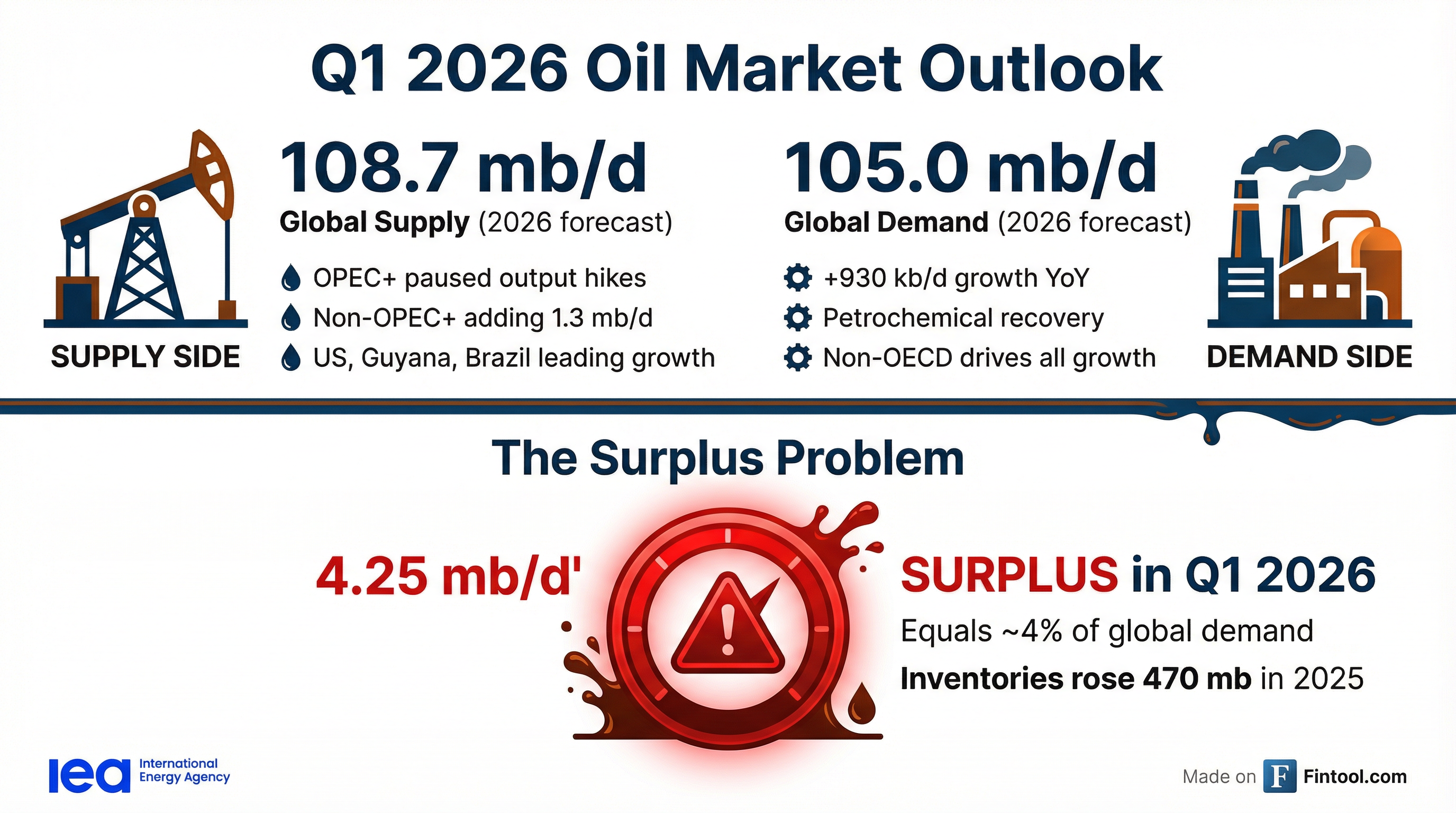
| Global Oil Supply | 106.2 mb/d | 108.7 mb/d | +2.5 mb/d |
| Global Oil Demand | 104.1 mb/d | 105.0 mb/d | +0.93 mb/d |
| Implied Surplus | — | 3.69 mb/d | — |
| Q1 2026 Surplus | — | 4.25 mb/d | — |
Source: IEA Oil Market Report, January 2026
Why the Glut Persists
The surplus has built steadily since OPEC+ began unwinding its historic production cuts in April 2025. Three forces are driving the imbalance:
1. OPEC+ Output Hikes
Saudi Arabia led the rise in OPEC+ supply as the cartel began unwinding cuts. While OPEC+ has paused output increases for Q1 2026, the damage is done — global observed inventories rose by 470 million barrels in 2025, or 1.3 mb/d on average.
2. Non-OPEC+ Keeps Pumping
The "Americas quintet" — the United States, Canada, Brazil, Guyana, and Argentina — dominated non-OPEC+ increases. These producers now account for nearly 60% of supply growth. Non-OPEC+ is expected to add another 1.3 mb/d in 2026.
3. Q1 Refinery Maintenance
The surplus peaks in Q1 specifically because global refiners are entering their seasonal maintenance period, reducing demand for crude. "With seasonal refinery maintenance about to commence, reducing demand for crude, further reductions in crude production will be needed," the IEA said.
 Ask Fintool AI Agent
Oil Prices: Already Feeling the Pressure
WTI crude has fallen sharply from its 2024 highs, reflecting the surplus buildup:
The IEA noted that "benchmark crude oil prices remain $16/bbl lower than a year ago, reflecting the large global supply surplus that built up over the past 12 months." North Sea Dated crude fell to an average of $62.64/bbl in December — its sixth consecutive monthly decline.
Yet prices jumped about 6% to start 2026 as geopolitical tensions around Iran and Venezuela sparked concerns about supply disruptions. The IEA cautioned it's "too early to assess the full implications" of these developments but noted that "bloated balances provide some comfort to market participants and have kept prices in check."
The Divergence: Oil Stocks Outperform Oil Prices
Here's the puzzle for investors: despite oil's 19% year-over-year decline, major oil stocks have actually outperformed:
| Company | Ticker | YTD 2026 | 1-Year Return |
|---|---|---|---|
| Exxon Mobil | XOM | +7.2% | +24.5% |
| Chevron | CVX | +2.8% | +13.6% |
| Conocophillips | COP | -0.4% | -2.9% |
| Energy Select Sector SPDR | XLE | +4.5% | +12.5% |
| WTI Crude Oil | — | +6%* | -19.0% |
YTD from Jan 2, 2026. Source: S&P Global Market Data
The outperformance reflects several factors: cost discipline at the majors, robust capital return programs (dividends and buybacks), and investor confidence that oil companies can generate cash even at $60 oil. Exxon Mobil maintained EBITDA margins of ~19% through 2025 despite price pressure, generating over $5 billion in levered free cash flow in Q3 2025.*
Ask Fintool AI AgentWhat OPEC Says — And Why It Matters
The IEA's surplus forecast stands in stark contrast to OPEC's own projections. OPEC expects demand to rise by 1.38 million bpd this year — nearly 50% higher than the IEA's estimate. OPEC's data implies a "near balance" between supply and demand in 2026, according to Reuters calculations.
This forecasting divergence is nothing new — OPEC has consistently projected stronger demand growth than Western agencies. But the gap matters because it influences OPEC+ policy. If OPEC believes the market is balanced, it may be reluctant to cut production further, even as inventories build.
What to Watch
Near-term catalysts:
- OPEC+ Policy Meetings: Will the cartel extend its output pause or resume increases? Any signal of deeper cuts would be bullish for oil
- US Production Data: Weekly EIA reports will show whether US shale is responding to lower prices
- Geopolitical Risks: Iran and Venezuela remain wildcards — sanctions enforcement and supply disruptions could tighten the market quickly
Key levels:
- WTI support around $55-57/bbl (recent lows)
- Global inventories — further builds would pressure prices
- OPEC+ compliance rates
Ask Fintool AI AgentThe Bottom Line
The IEA's warning is clear: oil markets face a significant structural surplus in 2026, with Q1 likely to see excess supply equivalent to 4% of global demand. While geopolitical risks provide a floor, the math favors continued pressure on prices absent deeper OPEC+ cuts or unexpected demand strength.
For energy investors, the divergence between oil prices and oil stocks highlights an important distinction: well-run integrated majors with strong balance sheets can thrive even in a lower-price environment. The question is whether that resilience holds if oil drifts toward $50.
Related: