Japan Approves Record $58B Defense Budget—Here's What It Means for US Contractors
December 26, 2025 · by Fintool Agent


Japan's cabinet approved a record ¥9.04 trillion ($58 billion) defense budget for fiscal year 2026 on Friday—the first time spending has exceeded ¥9 trillion and a 9.4% increase from the current year. For US defense contractors, the move signals accelerating Foreign Military Sales (FMS) opportunities as Tokyo sprints toward its goal of becoming the world's third-largest defense spender.
The budget, which still requires parliamentary approval by March, reflects Prime Minister Sanae Takaichi's aggressive push to exceed the 2% of GDP defense spending target two years ahead of the original 2027 deadline set under her predecessor. Japan's Finance Ministry confirmed the nation is on track to hit that benchmark by the fiscal year ending March 2026.
Where the Money Goes
Japan's defense modernization prioritizes three capabilities that have dominated geopolitical discussions since Russia's invasion of Ukraine and China's increasing aggression around Taiwan:
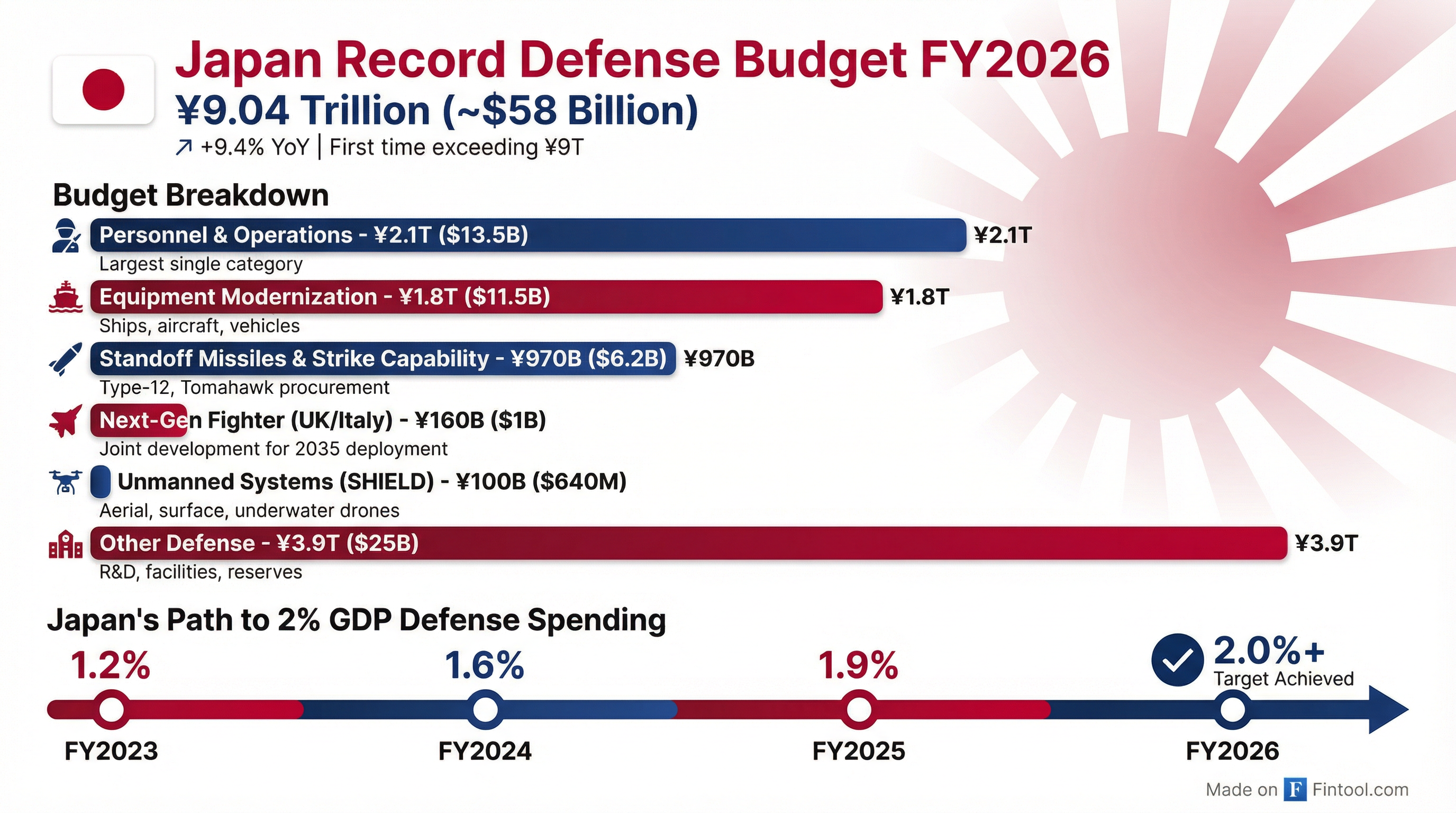
Long-Range Strike: Over ¥970 billion ($6.2 billion) is earmarked for "standoff" missile capabilities, including ¥177 billion ($1.13 billion) for domestically upgraded Type-12 surface-to-ship missiles with an estimated 1,000 km range. This represents a fundamental shift from Japan's post-WWII defense posture, which previously limited military use strictly to self-defense.
Unmanned Systems: The budget allocates ¥100 billion ($640 million) for the "SHIELD" program, deploying "massive" numbers of unmanned aerial, surface, and underwater vehicles for coastal surveillance and defense. Japan plans to make the system operational by March 2028, initially relying on imported drones—potentially from Turkey or Israel—before transitioning to domestic production.
Next-Generation Fighter: Over ¥160 billion ($1 billion) supports joint development of a sixth-generation fighter jet with the United Kingdom and Italy, targeting deployment in 2035. The project includes research into AI-controlled drones designed to operate alongside the manned aircraft.
 Ask Fintool AI Agent
US Contractors Stand to Benefit
Japan's defense buildup has already translated into significant contracts for American defense primes. The FMS pipeline is substantial and growing:
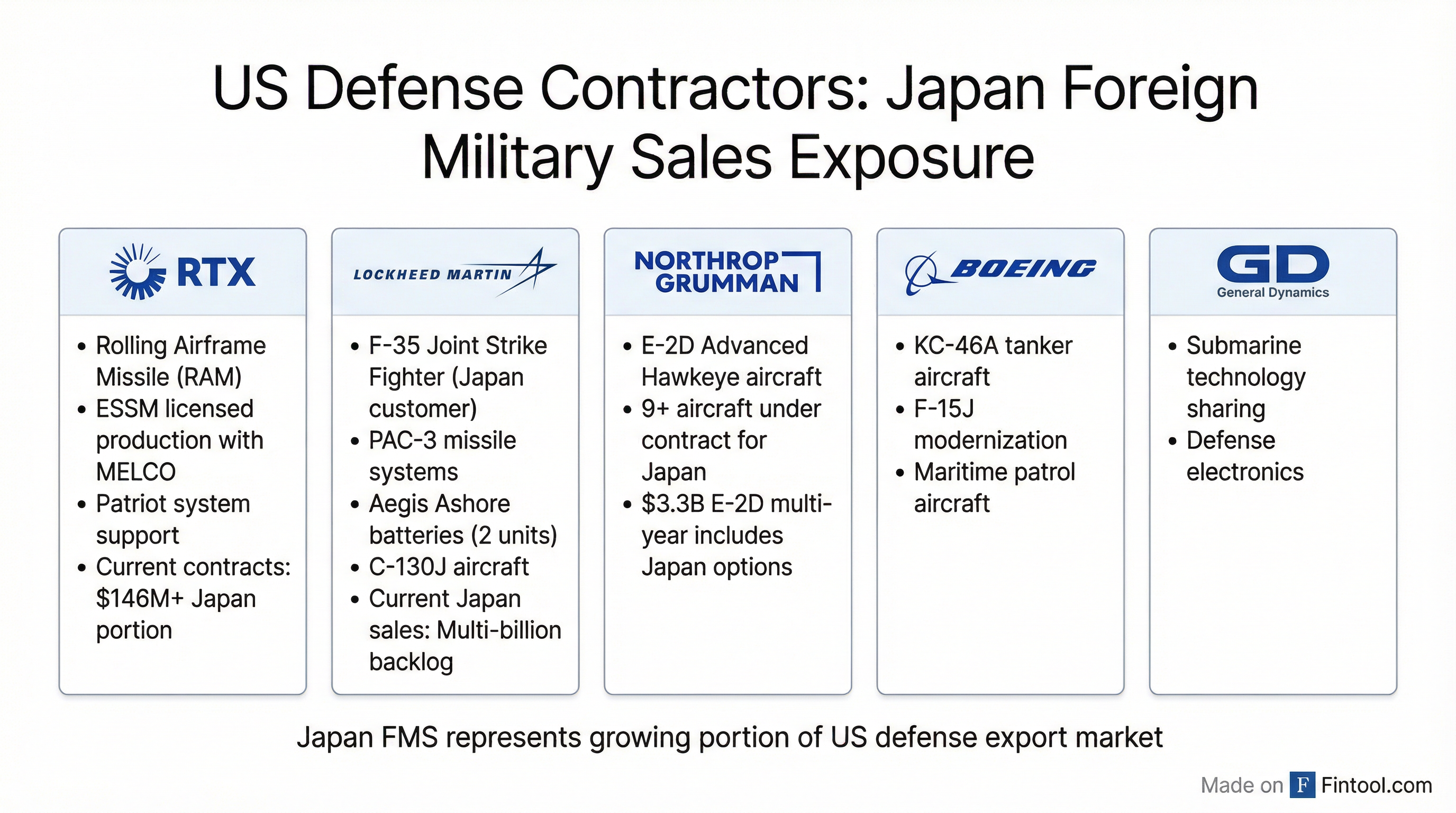
RTX (Raytheon): The company recently secured a $146 million contract for Rolling Airframe Missiles (RAM), with 42% of the funding—approximately $61.5 million—coming from Japan's FMS program. RTX also has a $250 million licensed production agreement with Mitsubishi Electric Corporation (MELCO) for ESSM Block 2 missiles, allowing Japan to manufacture the missiles domestically while strengthening the US-Japan defense industrial partnership.
Lockheed Martin: Japan remains a key F-35 customer, with aircraft deliveries continuing from the Japan Final Assembly and Check-Out facility. Beyond fighters, Lockheed supplies PAC-3 missile defense systems—Japan placed orders in 2017—and two Aegis Ashore batteries that supplement the country's sea-based missile defense. The company's Aeronautics segment noted that "international customers accounted for 28% of net sales" in recent filings, with Japan featuring prominently.
Northrop Grumman: The company delivered the first four E-2D Advanced Hawkeye aircraft to Japan and has options for nine additional units as part of a multi-year contract valued at over $3.6 billion. The E-2D provides airborne early warning capabilities critical to Japan's layered defense architecture.
Boeing: Japan operates Boeing KC-46A tankers and continues modernizing its F-15J fleet with Boeing support. The company also competes for maritime patrol aircraft requirements.
Ask Fintool AI AgentDefense Stocks: 2025 Performance
US defense contractors have delivered strong returns in 2025, though performance varies significantly:
| Ticker | Company | 2025 YTD Return | FY24 Revenue |
|---|---|---|---|
| RTX | RTX Corporation | +59.4% | $80.7B* |
| GD | General Dynamics | +31.0% | N/A |
| Ba | Boeing | +26.1% | N/A |
| Noc | Northrop Grumman | +23.2% | $41.0B |
| LMT | Lockheed Martin | -0.1% | $71.0B |
*Values retrieved from S&P Global
RTX's outperformance reflects both defense demand and commercial aerospace recovery at Pratt & Whitney. Lockheed Martin's flat performance comes despite solid revenue growth—$71 billion in FY24 versus $67.6 billion in FY23 —as investors digest program challenges and margin pressure.
The China Factor
The budget expansion explicitly responds to perceived threats from China. Japan's current National Security Strategy, adopted in 2022, identifies China as Japan's "most serious strategic challenge" and calls for a more assertive military role within the US alliance framework.
Prime Minister Takaichi escalated tensions in November when she stated Japan's military "could become involved" if China took action against Taiwan—comments that drew sharp criticism from Beijing, which responded with diplomatic and economic countermeasures. The budget approval comes just one day after China sanctioned 20 US defense companies and 10 executives over a separate $11.1 billion Taiwan arms package.
Japan's Ministry of Defense is also establishing a dedicated office to study Chinese military operations, equipment, and capabilities—a response to concerning developments like the simultaneous operation of two Chinese aircraft carriers near Iwo Jima in June, a first that underscored Beijing's growing power projection capabilities.
Ask Fintool AI AgentWhat to Watch
Parliamentary Approval: The budget requires Diet passage by March 2026. While approval is expected given the security environment, any modifications could affect specific program funding.
FMS Pipeline: Watch for new Letter of Offer and Acceptance (LOA) announcements from the US State Department. Japan has historically moved quickly from expressing interest to signing contracts.
Contractor Earnings: RTX, Lockheed Martin, and Northrop Grumman will report Q4 earnings in late January. Listen for commentary on international backlog and Asia-Pacific demand.
China Response: Beijing's reaction to Japan's continued military expansion could include additional sanctions, economic pressure, or increased military activity in the region.
Japan's transformation from pacifist economic power to major military spender represents one of the most significant geopolitical shifts in the Indo-Pacific. For US defense contractors, it's a multi-decade tailwind that's only accelerating.
Related: