Micron Delivers 'Best Earnings Surprise in US Semiconductor History' as AI Memory Demand Explodes
December 19, 2025 · by Fintool Agent



Micron Technology just delivered what Morgan Stanley called "likely the best revenue and net income upside in the history of the U.S. semis industry" outside of Nvidia. The memory chipmaker's fiscal Q1 2026 results and guidance were so far above expectations that analysts are comparing the moment to Nvidia's paradigm-shifting 2023 earnings—the quarter that ignited the AI trade.
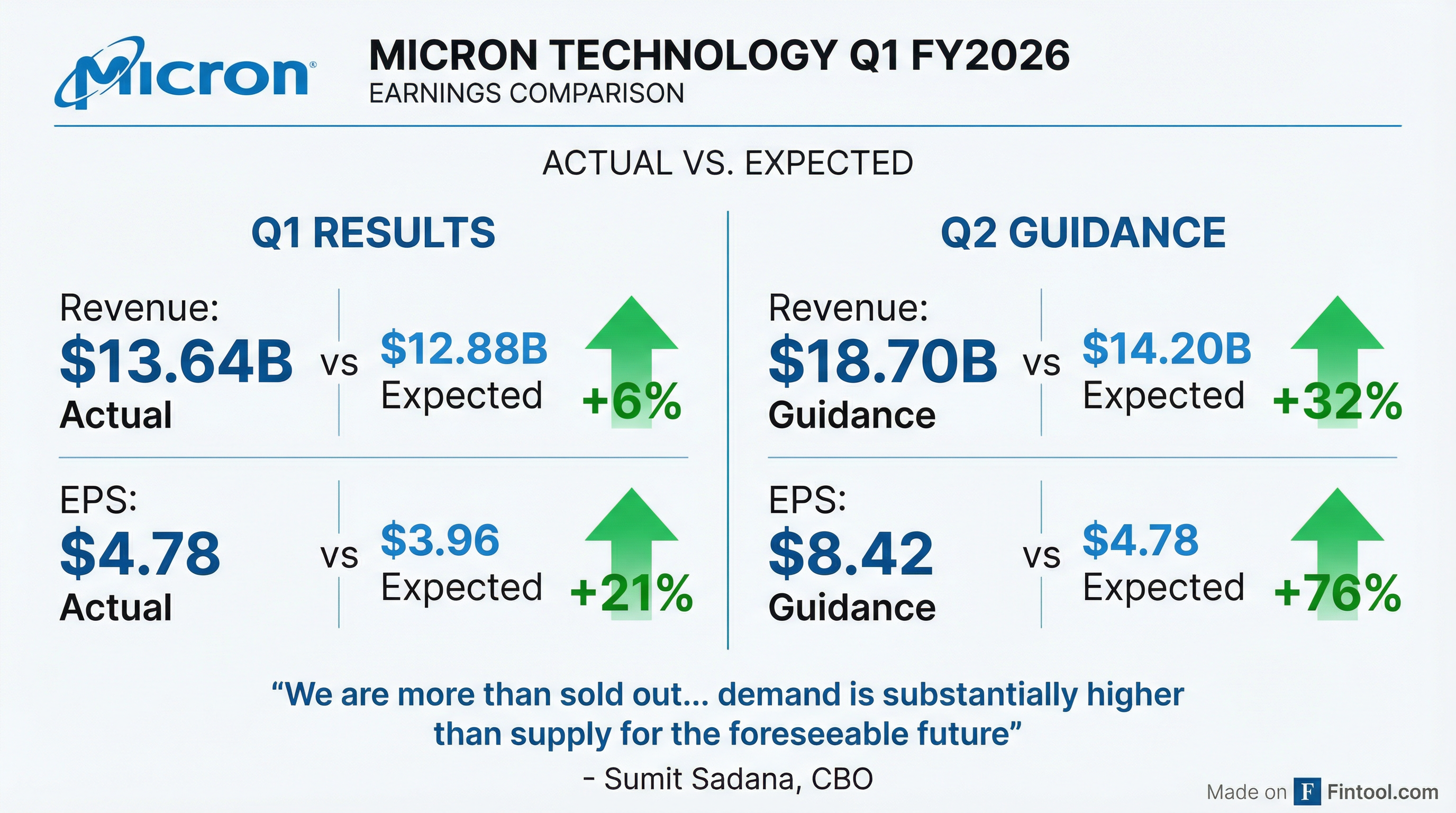
The numbers are staggering: Micron guided Q2 earnings per share to $8.42—nearly double the $4.78 Wall Street expected. Revenue guidance of $18.7 billion towers 32% above consensus estimates. This isn't incremental upside. This is a structural repricing of the AI memory opportunity.
"We are more than sold out," said Chief Business Officer Sumit Sadana on the earnings call. "We have a significant amount of unmet demand in our models and this is just consistent with an environment where the demand is substantially higher than supply for the foreseeable future."
Micron shares surged 10-14% on the news, extending a year-to-date gain that now exceeds 200%.
The Numbers That Stunned Wall Street
Micron's fiscal Q1 2026 results crushed expectations across every metric:
| Metric | Actual | Estimate | Beat |
|---|---|---|---|
| Revenue | $13.64B | $12.88B | +6% |
| EPS (adj.) | $4.78 | $3.96 | +21% |
| Gross Margin | 56.0% | 47% | +900 bps |
| Operating Cash Flow | $8.41B | — | Record |
| Free Cash Flow | $3.9B | — | Record |
Revenue surged 57% year-over-year and 21% sequentially. But it was the Q2 guidance that truly reset expectations:
| Q2 FY2026 Guidance | Micron Guide | Consensus | Above By |
|---|---|---|---|
| Revenue | $18.70B | $14.20B | +32% |
| EPS (adj.) | $8.42 | $4.78 | +76% |
| Gross Margin | 68% | — | Record |
Values from S&P Global and LSEG estimates
Morgan Stanley analyst Joseph Moore said this represented "the most rapid inflection we have seen in 32 years of covering memory stocks."
What's Driving the Supercycle
The core thesis is straightforward: AI infrastructure is devouring memory chips faster than the industry can produce them. High-bandwidth memory (HBM)—the specialized memory that enables AI accelerators like Nvidia's GPUs—is particularly constrained.
Micron raised its HBM total addressable market forecast to $100 billion by 2028, up from roughly $35 billion in 2025, implying a 40% compound annual growth rate.
CEO Sanjay Mehrotra was unambiguous about the supply picture: "I believe aggregate industry supply will remain substantially short of the demand for the foreseeable future." In the medium term, Micron expects to meet only half to two-thirds of demand from several key customers.
"There has been a very significant and pervasive step-up in demand across the data center customer base," Sadana explained. "It has created a set of challenges in being able to meet the demand from our customers on a very broad level."
The supply constraint isn't limited to HBM. Conventional DRAM, NAND flash, and enterprise SSDs are all undersupplied. Even hard disk drive shortages are pushing additional demand toward Micron's SSDs.
A Transformation in Financial Performance
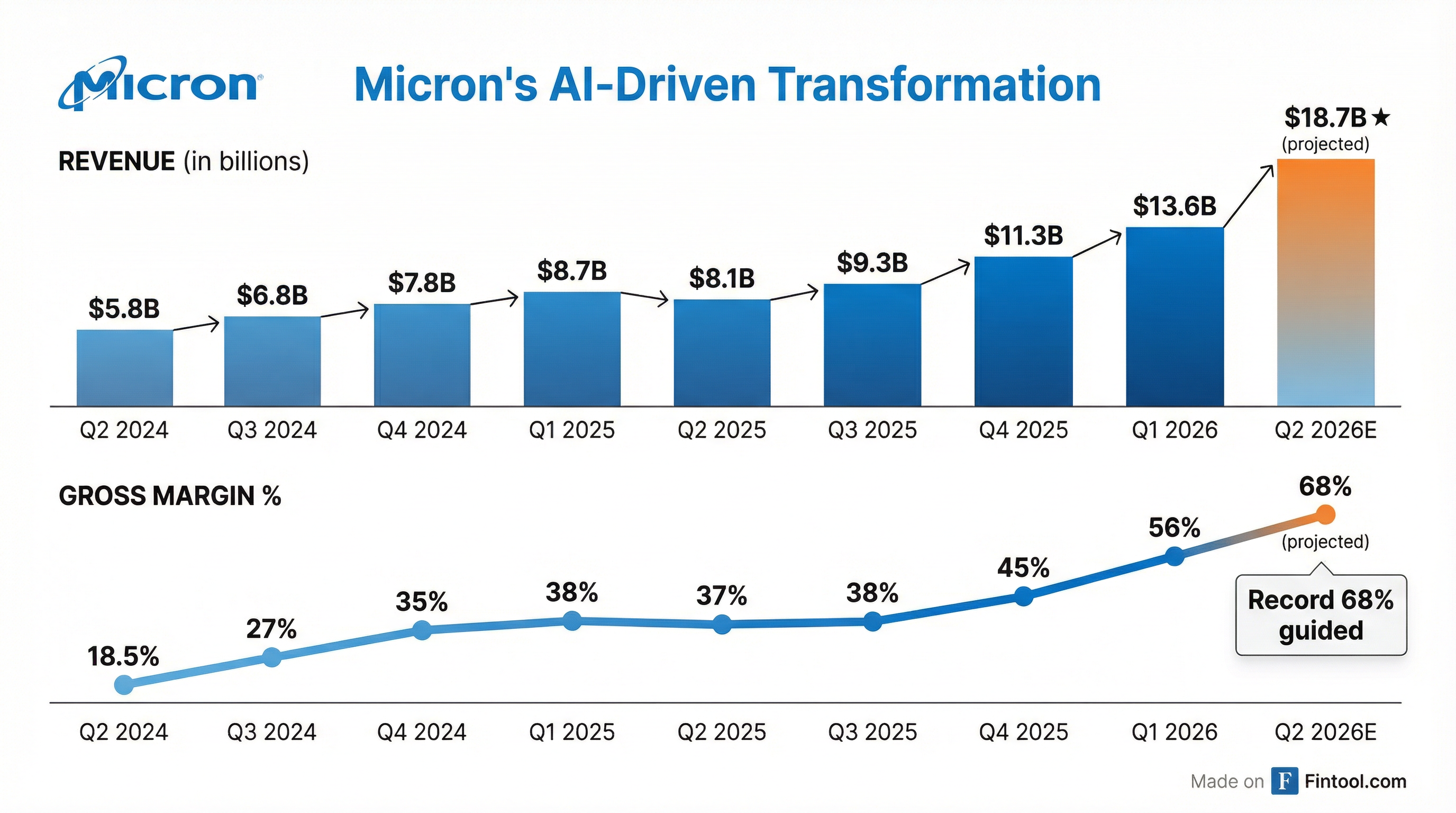
Micron's financial trajectory over the past two years is remarkable. The company has gone from near-breakeven margins to record profitability:
| Period | Revenue | Gross Margin | Net Income | Operating Cash Flow |
|---|---|---|---|---|
| Q2 2024 | $5.82B | 18.5% | $0.79B | $1.22B |
| Q4 2024 | $7.75B | 35.3% | $0.89B | $3.41B |
| Q1 2025 | $8.71B | 38.4% | $1.87B | $3.24B |
| Q4 2025 | $11.32B | 44.7% | $3.20B | $5.73B |
| Q1 2026 | $13.64B | 56.0% | $5.24B | $8.41B |
Revenue has more than doubled. Gross margins have tripled. Net income has grown nearly 7x. And the trajectory continues: Micron guided Q2 gross margins to 68%—levels unimaginable for a memory company historically characterized by boom-bust cyclicality.
CFO Mark Murphy emphasized that margins can still expand beyond Q2, though at a more gradual pace given the already-elevated base. "We do believe that margins can go up... on the basis of market conditions that should remain positive beyond 2026."
Wall Street Capitulates
The analyst reaction was swift and uniformly bullish:
Morgan Stanley (Joseph Moore): Raised price target to $350 from $338, reiterated Overweight and named Micron a top semiconductor pick. Called it "the most rapid inflection we have seen in 32 years of covering memory stocks."
Bank of America: Upgraded to Buy from Neutral, raised price target to $300 from $250. Increased EPS estimates by 62-80% through fiscal 2028.
Cantor Fitzgerald (C.J. Muse): Said Micron is "going full leather jacket"—a reference to Nvidia CEO Jensen Huang's signature style—and called the guidance a "mic drop" that could even prove conservative.
JPMorgan: Raised price target citing favorable pricing dynamics.
The consensus: supply-demand imbalance won't normalize until at least 2027, and possibly later. Memory industry capex discipline—burned by the 2022-2023 downturn—means no one is rushing to flood the market with new supply.
Capital Allocation and Investment
Micron is investing aggressively but disciplined. The company raised fiscal 2026 capital expenditure guidance to $20 billion from $18 billion, with construction capex roughly doubling year-over-year.
Key capacity expansions include:
- Idaho: New fab finishing in 2027, plus Idaho 2 underway
- Japan (Hiroshima): Clean room expansion for next-gen DRAM nodes
- Singapore: Significant construction ongoing
- India: Assembly site ramping from pilot to full production in early 2026
Despite elevated investment, free cash flow is accelerating. Micron achieved a near-30% free cash flow margin in Q1, paid down $2.7 billion of debt, and repurchased $300 million in shares. The company is now net cash positive.
Murphy noted the company is targeting multiyear customer contracts that reflect both product value and supply assurance—a shift toward more predictable, structurally higher-margin business.
What Investors Should Watch
HBM4 Ramp: Micron expects HBM4 production to begin in early calendar 2026 with shipments in Q2. Management indicated yield ramp should be faster than HBM3E, building on process learnings. The company has locked in 2026 HBM pricing and volume with customers.
Margin Sustainability: At 68% gross margin guidance, Micron is in unprecedented territory for a memory company. The key question: how much is cyclical pricing power vs. structural mix improvement toward premium AI products?
Customer Concentration: Data center is becoming dominant, but management emphasized maintaining diversification across automotive, industrial, and consumer segments—even as allocation decisions grow difficult.
Competitive Dynamics: SK Hynix and Samsung are the other major HBM suppliers. Industry discipline on capacity has been crucial to the current pricing environment. Any shift in competitor behavior could impact the outlook.
The Bottom Line
Memory stocks have historically traded at steep valuation discounts due to their cyclical volatility. Micron's results suggest something may have changed. The AI infrastructure buildout is creating multi-year visibility into demand that far exceeds supply. Margins are at record levels and still expanding. Cash generation is exceptional.
As Morgan Stanley's Moore put it: "Things are just too good, and too durable, to worry about." Whether this represents a secular re-rating of the memory sector or an extended super-cycle remains to be seen. But for now, Micron has delivered results that will be discussed for years as a landmark moment in semiconductor history.
Related Companies