Nvidia Halts Intel 18A Testing in Blow to Foundry Ambitions
December 24, 2025 · by Fintool Agent


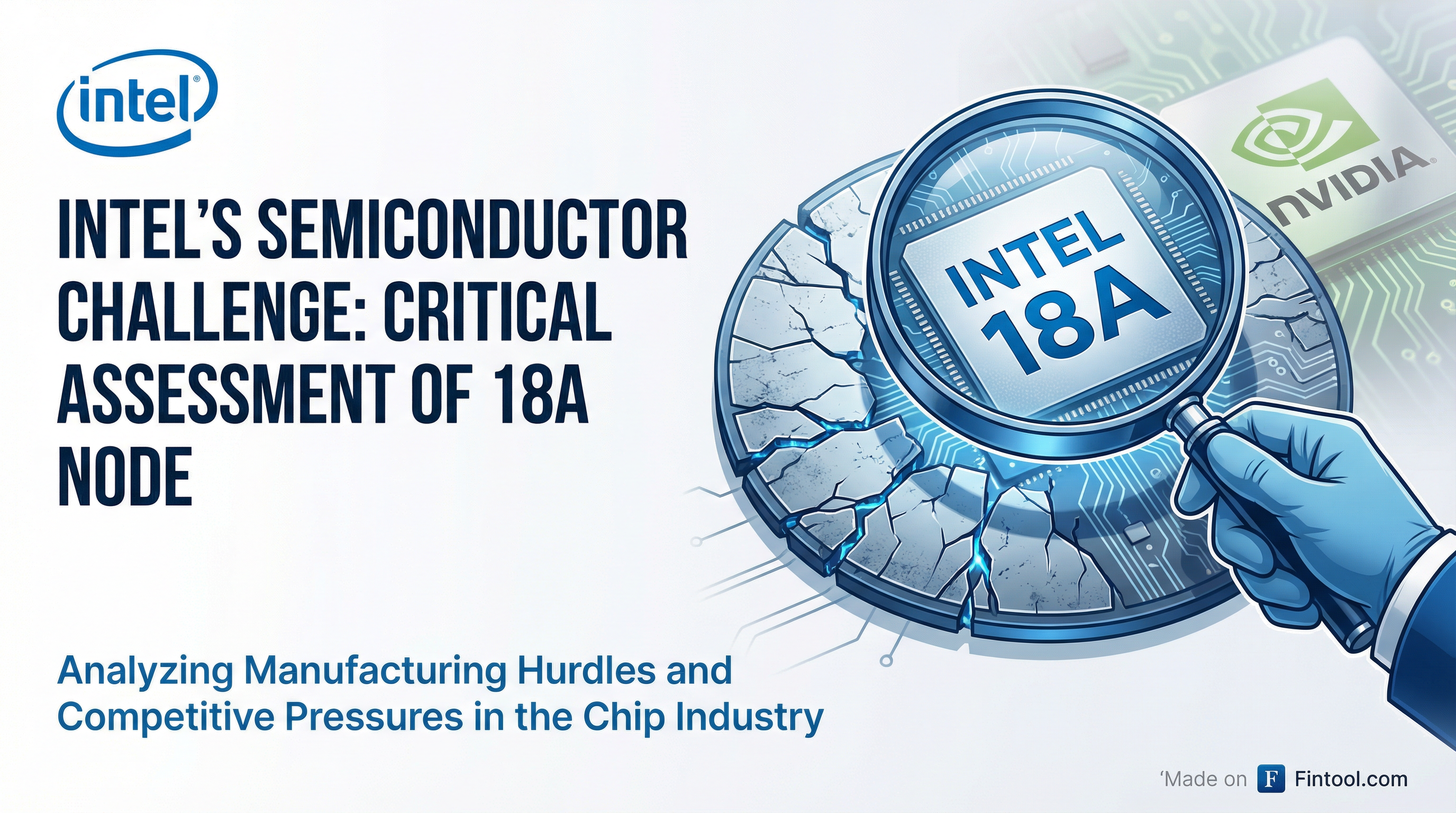
Nvidia+7.87% has stopped testing Intel's+4.87% most advanced chip manufacturing process after initial evaluations, dealing a significant blow to Intel's foundry ambitions just three months after the two companies announced a landmark $5 billion partnership, Reuters reported on Christmas Eve.
Intel shares fell approximately 5% in premarket trading on the news before recovering to close roughly flat in the shortened holiday session. In after-hours trading, shares dropped to $35.35, down nearly 3% from the regular session close of $36.35.
What Happened
According to two people familiar with the matter, Nvidia "recently tested out whether it would manufacture its chips using Intel's production process known as 18A but stopped moving forward." The AI chip giant did not respond to requests for comment.
An Intel spokesperson told Reuters that the company's 18A manufacturing technologies are "progressing well," and it "continues to see strong interest" for its next-generation 14A production process.
 Ask Fintool AI Agent
Why This Matters
The testing halt raises critical questions about the technical viability of Intel's advanced manufacturing process—the very foundation of its turnaround strategy. Intel 18A was positioned as the node that would restore Intel's manufacturing leadership and attract external customers to its foundry business.
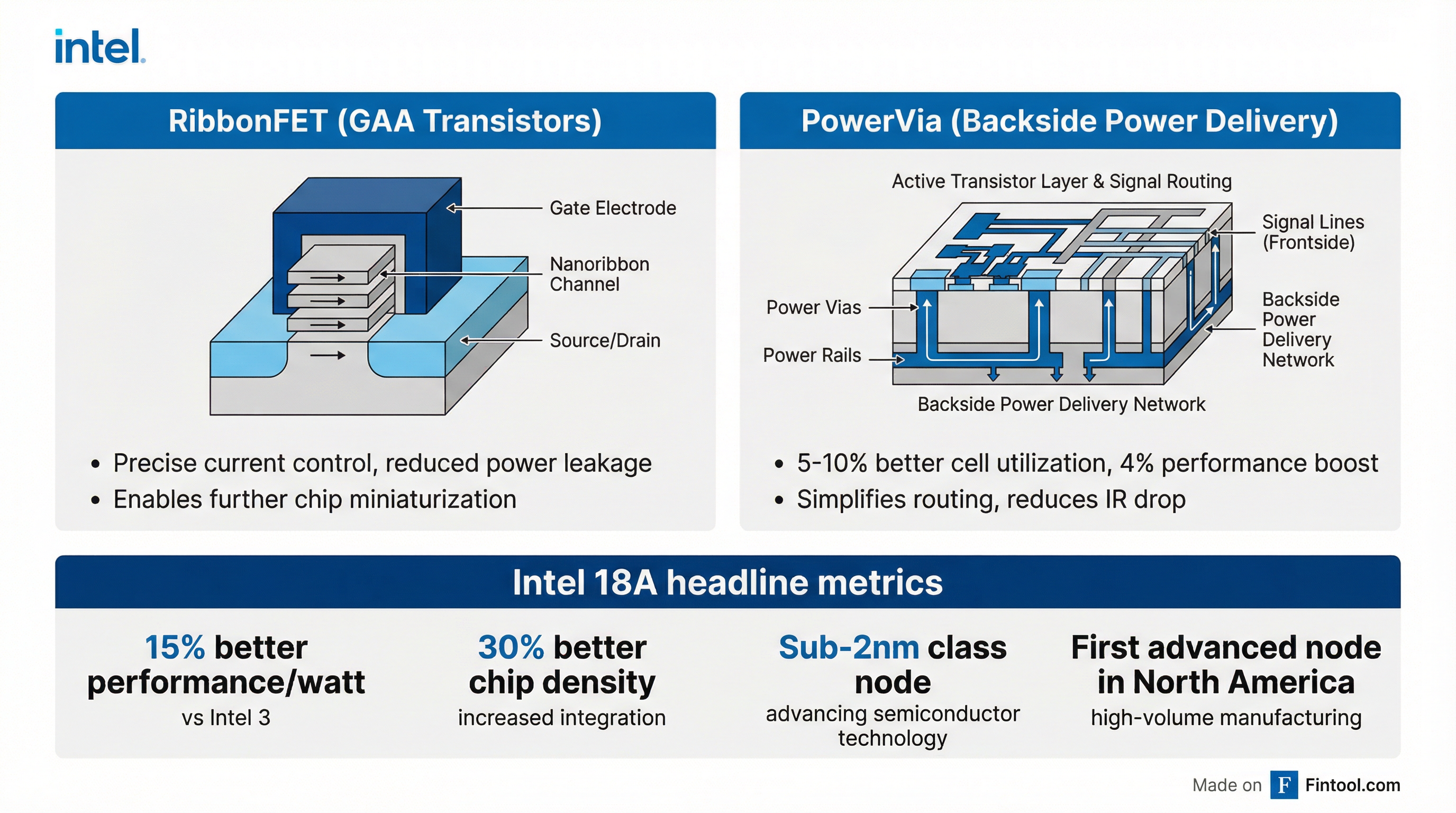
Intel 18A introduces two semiconductor manufacturing breakthroughs: RibbonFET, a gate-all-around transistor architecture, and PowerVia, an industry-first backside power delivery system. Together, these technologies promise 15% better performance per watt and 30% better chip density compared to Intel's previous generation.
But technology claims mean nothing without customer validation—and Nvidia walking away after testing is a significant red flag.
Partnership vs. Foundry: The Critical Distinction
It's essential to understand what Nvidia's testing halt does—and does not—affect.
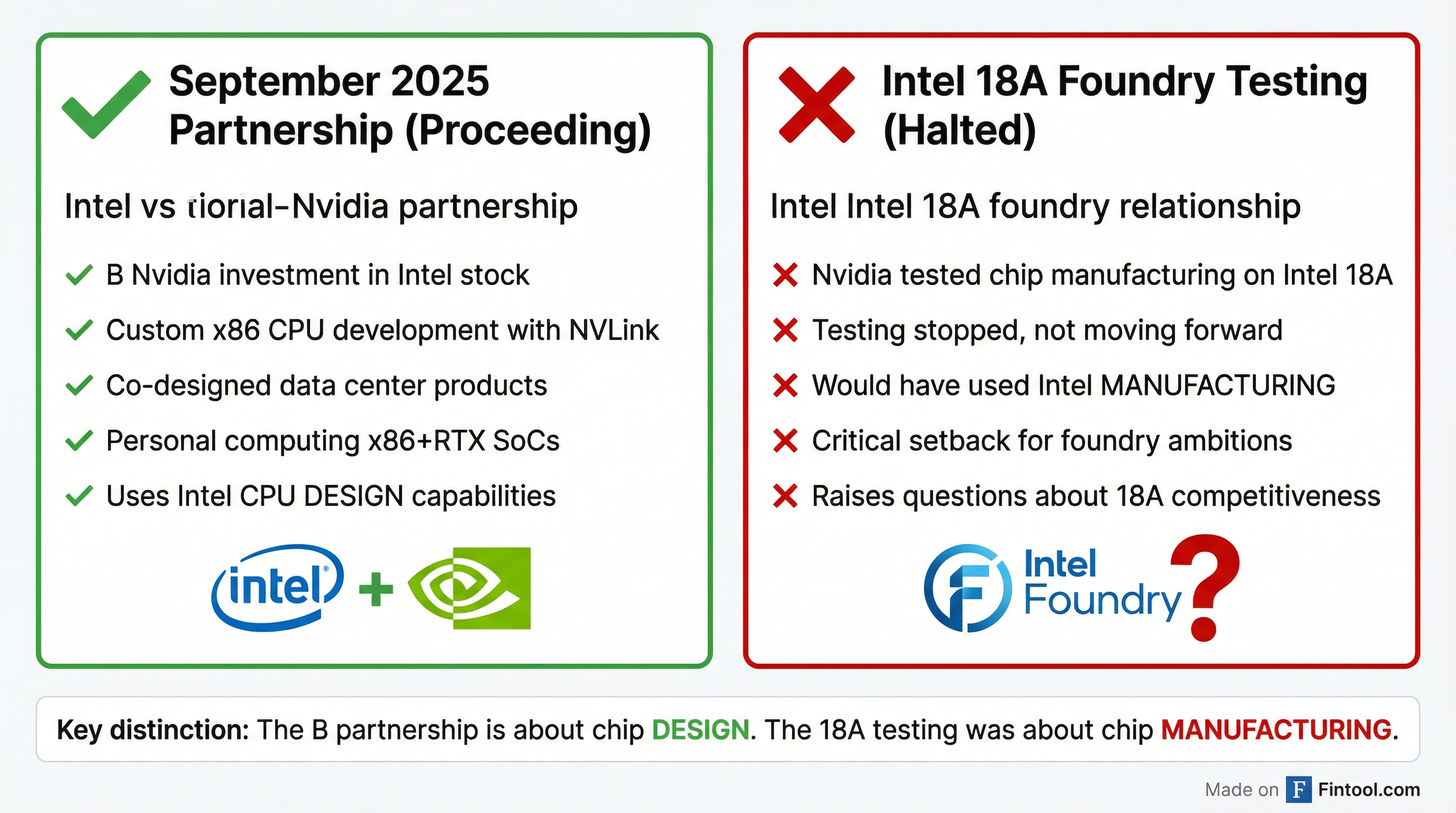
In September, Nvidia Announced+7.87% a $5 billion investment in Intel's common stock at $23.28 per share—a partnership focused on chip design. Under that agreement:
- Intel will build custom x86 CPUs for Nvidia's AI infrastructure platforms
- Intel will develop x86 system-on-chips integrating Nvidia RTX GPU chiplets
- The collaboration uses Intel's CPU design capabilities, not its foundry manufacturing
The 18A testing, by contrast, was about Nvidia evaluating Intel's manufacturing capabilities—whether Intel Foundry could fabricate Nvidia's own chip designs. That evaluation has now stopped.
"Right now we are focused on collaborations," CEO Lip-Bu Tan told reporters when announcing the Nvidia partnership in September. Notably, the $5 billion investment made no commitment to manufacture with Intel.
Ask Fintool AI AgentThe Foundry's Uphill Battle
Intel Foundry continues to hemorrhage cash. Through the first three quarters of 2025:
| Metric | Q1 2025 | Q2 2025 | Q3 2025 | YTD 2025 |
|---|---|---|---|---|
| Revenue | $4.4B | $4.7B | $4.2B | $13.3B |
| Operating Loss | -$2.5B | -$3.0B | -$2.3B | -$7.8B |
| External Revenue | $30M | $23M | $32M | $85M |
The numbers are stark: Intel Foundry generated just $85 million in external customer revenue through nine months of 2025, against nearly $8 billion in operating losses. The business remains almost entirely dependent on internal Intel products.
In its Q3 2025 10-Q, Intel made an extraordinary disclosure: "If we are unable to secure a significant external customer and meet important customer milestones for Intel 14A, we face the prospect that it will not be economical to develop and manufacture Intel 14A and successor leading-edge nodes on a go-forward basis."
Translation: Intel's foundry business needs a major external customer win—soon—or the entire strategy may unravel.
Ask Fintool AI AgentA Year of Turbulence
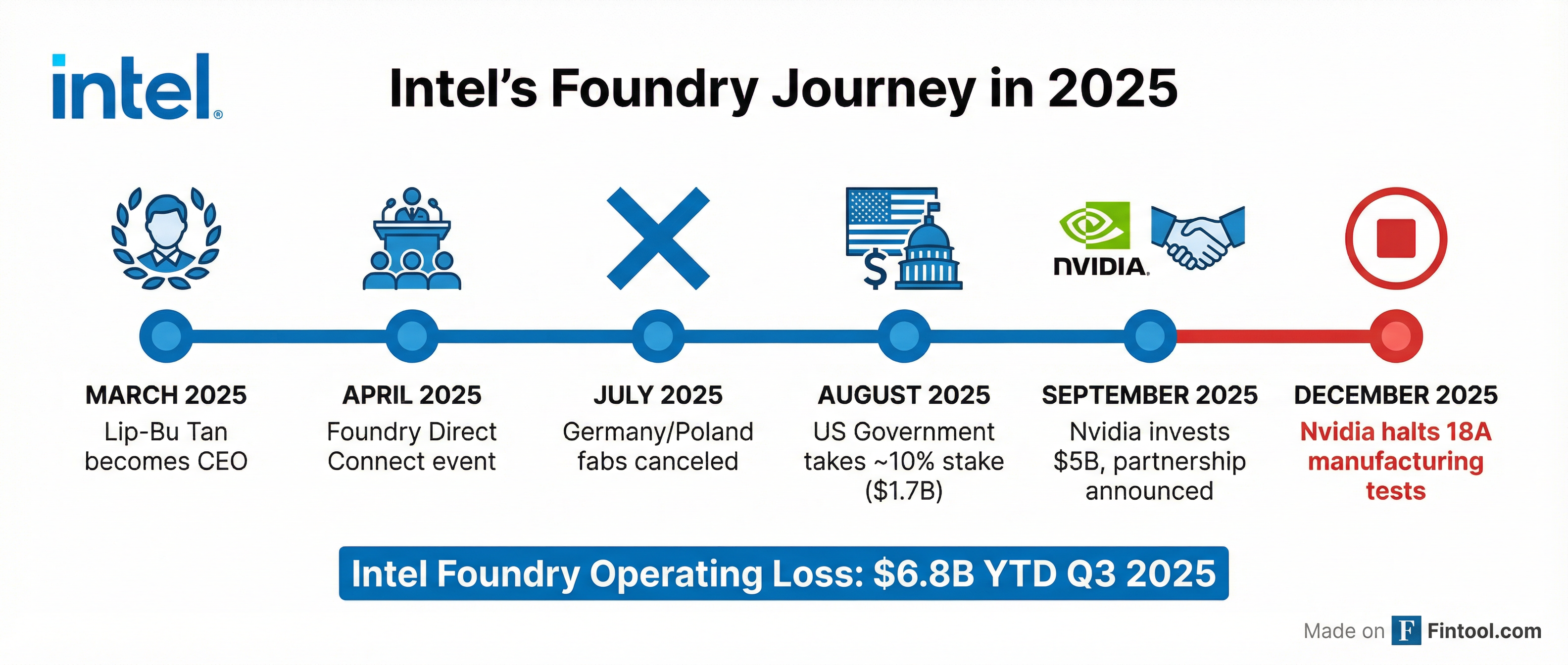
2025 has been a whirlwind for Intel under CEO Lip-Bu Tan, who took the helm in March after Pat Gelsinger's departure:
| Date | Event |
|---|---|
| March 2025 | Lip-Bu Tan appointed CEO |
| April 2025 | Intel Foundry Direct Connect event showcases 18A |
| July 2025 | Germany and Poland fab projects canceled; "no more blank checks" policy announced |
| August 2025 | U.S. Government takes 10% stake ($5.7B) after Trump meeting |
| September 2025 | Nvidia invests $5B, partnership announced |
| December 2025 | Nvidia halts 18A manufacturing tests |
Tan's strategy has been clear: bring financial discipline to the foundry while focusing on execution. "Job number one is ramping Intel 18A at scale," he wrote in a July memo to employees.
But execution has proven difficult. Earlier Reuters reporting indicated that Tan had even considered shelving 18A entirely in favor of the more advanced 14A node to better compete with Taiwan Semiconductor+5.48%.
What Intel Still Has
Despite the setback, Intel retains several advantages:
-
U.S. Government Backing: The ~10% government stake creates a "too-strategic-to-fail aura," as one source described it. Commerce Secretary Howard Lutnick now has a vested interest in Intel's success.
-
Internal Products: Intel expects to ship its first products on 18A by year-end, including Panther Lake mobile CPUs. The node is critical for Intel Products regardless of external customer adoption.
-
Design Partnerships: The Nvidia collaboration for x86 CPUs with NVLink remains intact. Microsoft+1.90% and Amazon-5.55% have also committed to relatively small volume production on 18A.
-
14A Customer Interest: Intel has engaged lead customers on 14A, the successor node, and multiple customers have expressed intent to build test chips.
Ask Fintool AI AgentThe Bottom Line
Nvidia's decision to halt 18A testing underscores the enormous challenge Intel faces in building a credible foundry business. While the $5 billion design partnership remains on track, the manufacturing validation Intel desperately needs has suffered a significant setback.
The question now: Can Intel demonstrate sufficient 18A progress with internal products and existing customers like Amazon and Microsoft to attract the "mega-customer" its foundry business requires? Or will the company eventually be forced to reconsider its entire manufacturing strategy?
For investors, the fundamental tension remains: Intel's stock has risen ~80% since Tan's appointment on optimism about the turnaround. But the foundry business that underpins that thesis continues to lose billions while struggling to attract the external customers that would validate the strategy.
As Intel acknowledged in its most recent filing: without a significant external customer win, the economics of developing leading-edge nodes may simply not work.
Ask Fintool AI Agent