Jensen Huang at Cisco AI Summit: Physical AI Unlocks $100 Trillion Economy
February 3, 2026 · by Fintool Agent


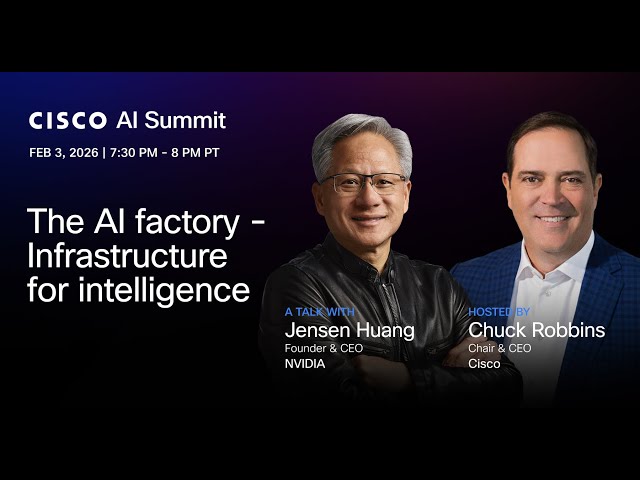
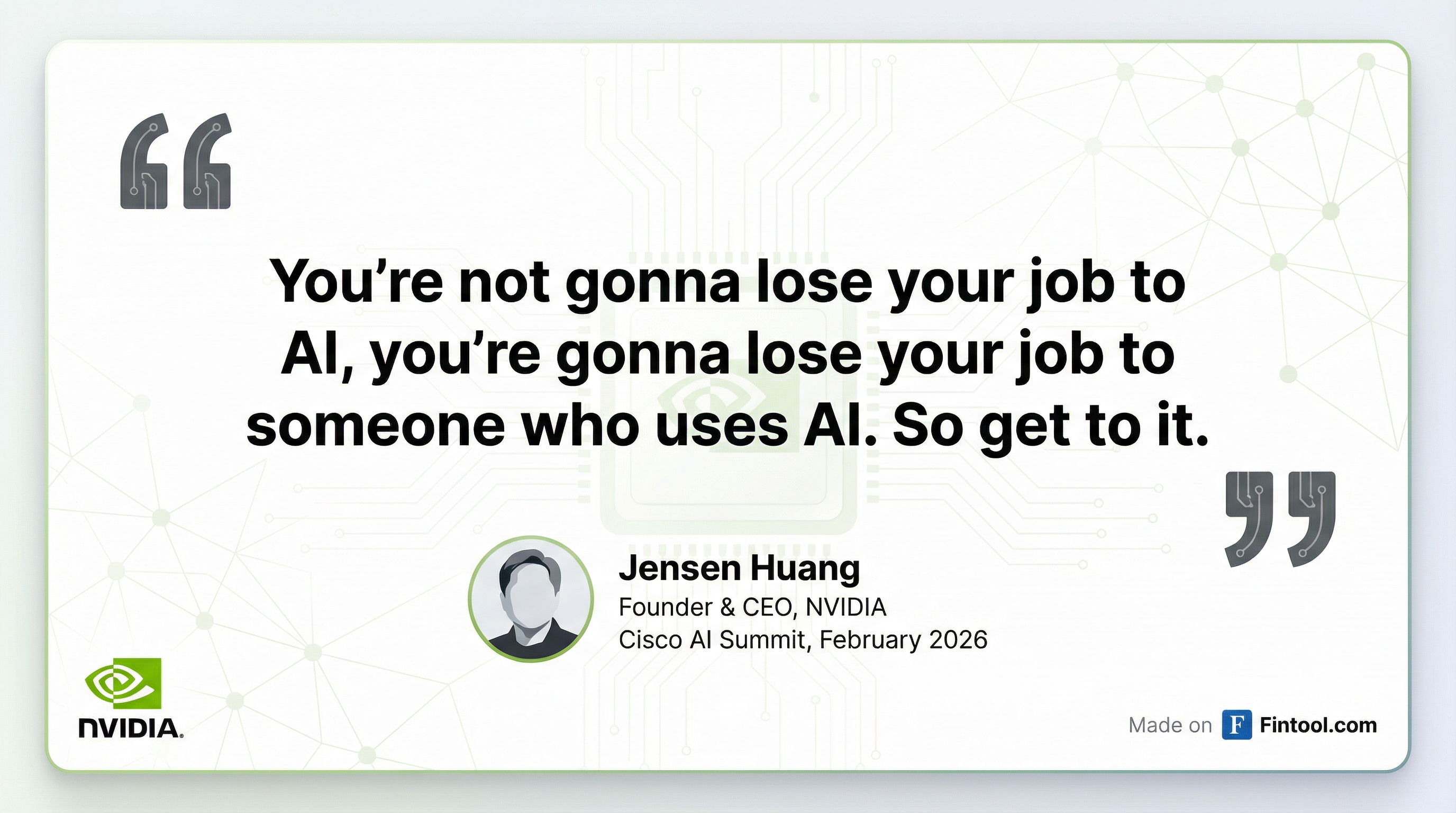
Nvidia CEO Jensen Huang delivered a sweeping vision of the AI future at Cisco's second annual AI Summit on Monday, declaring that physical AI will give technology companies access to a $100 trillion total addressable market—100 times larger than today's IT industry. Speaking in a fireside chat with Cisco Chair and CEO Chuck Robbins, Huang unveiled deeper integration between NVIDIA's next-generation Vera Rubin platform and Cisco's enterprise networking stack, while urging companies to embrace AI with a singular message: "You're not gonna lose your job to AI, you're gonna lose your job to someone who uses AI. So get to it."
Cisco shares surged 3% to close at $83.11, an all-time high, on volume 50% above average. NVIDIA fell 2.8% to $180.34 amid broader semiconductor weakness following AMD's mixed guidance.
The 100x Opportunity: From Tools to Labor
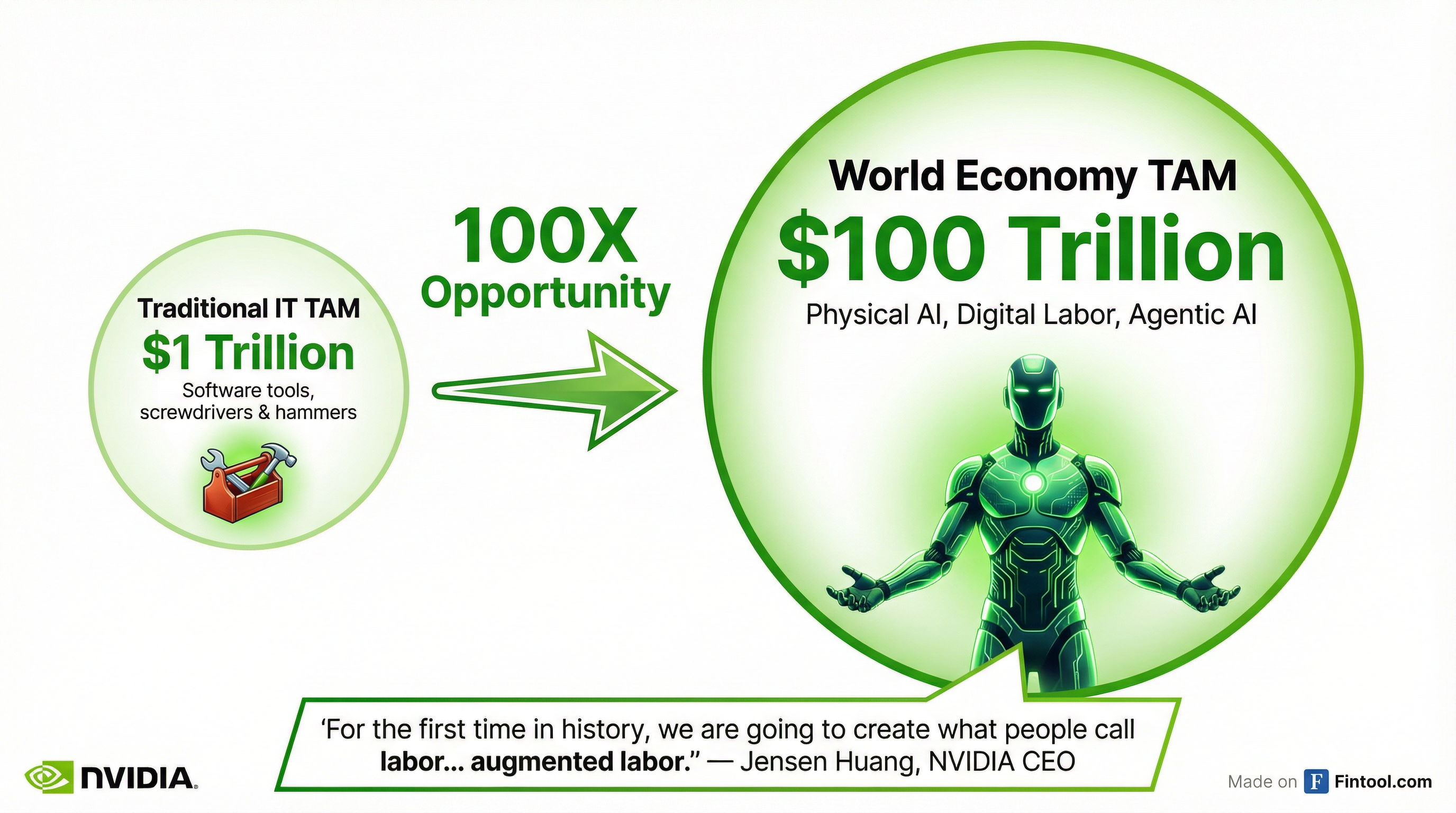
The most striking claim of the evening came when Huang described the fundamental shift from creating software tools to creating "augmented labor."
"Our entire life has been about creating screwdrivers and hammers," Huang said, referring to the IT industry's focus on productivity tools. "For the first time in history, we are gonna create what people call labor, but augmented labor."
Huang framed this as a generational expansion of the addressable market: "The IT industry is about $1 trillion. Yet the economy of the world is about $100 trillion. For the very first time, we're gonna be exposed to all of that."
The example he returned to repeatedly: autonomous vehicles as "digital chauffeurs." A self-driving car isn't just a car—it's a labor service worth "a lot more than the car" over its lifetime.
 Ask Fintool AI Agent
Vera Rubin + Cisco: The Full-Stack AI Factory
Huang confirmed that NVIDIA's next-generation computing platform, Vera Rubin, will be deeply integrated with Cisco's enterprise infrastructure. "We have a new, whole computing stack coming out, Vera Rubin," Huang said. "Cisco is gonna be in the market with us on that."
The partnership spans three pillars:
| Layer | NVIDIA Contribution | Cisco Contribution |
|---|---|---|
| Compute | Vera Rubin GPU, Vera CPU, NVLink 6 | Cisco UCS servers with NVIDIA HGX/MGX |
| Networking | Spectrum-X Ethernet, AI networking | Cisco Nexus control plane, N9100 switches |
| Security | BlueField-4 DPU, Confidential Computing | Cisco Hypershield, AI Defense, Splunk |
"Cisco is gonna integrate AI networking technology from us, but put it into the Cisco Nexus control plane, so that from your perspective, you're gonna get all the performance of AI, but in the controllability, and security, and the manageability of Cisco," Huang explained.
This is a significant expansion of the partnership announced in February 2025, when the companies first revealed plans to combine Cisco Silicon One and NVIDIA Spectrum-X into a unified architecture. The Vera Rubin integration now extends that collaboration to NVIDIA's most advanced computing platform, announced at CES 2026.
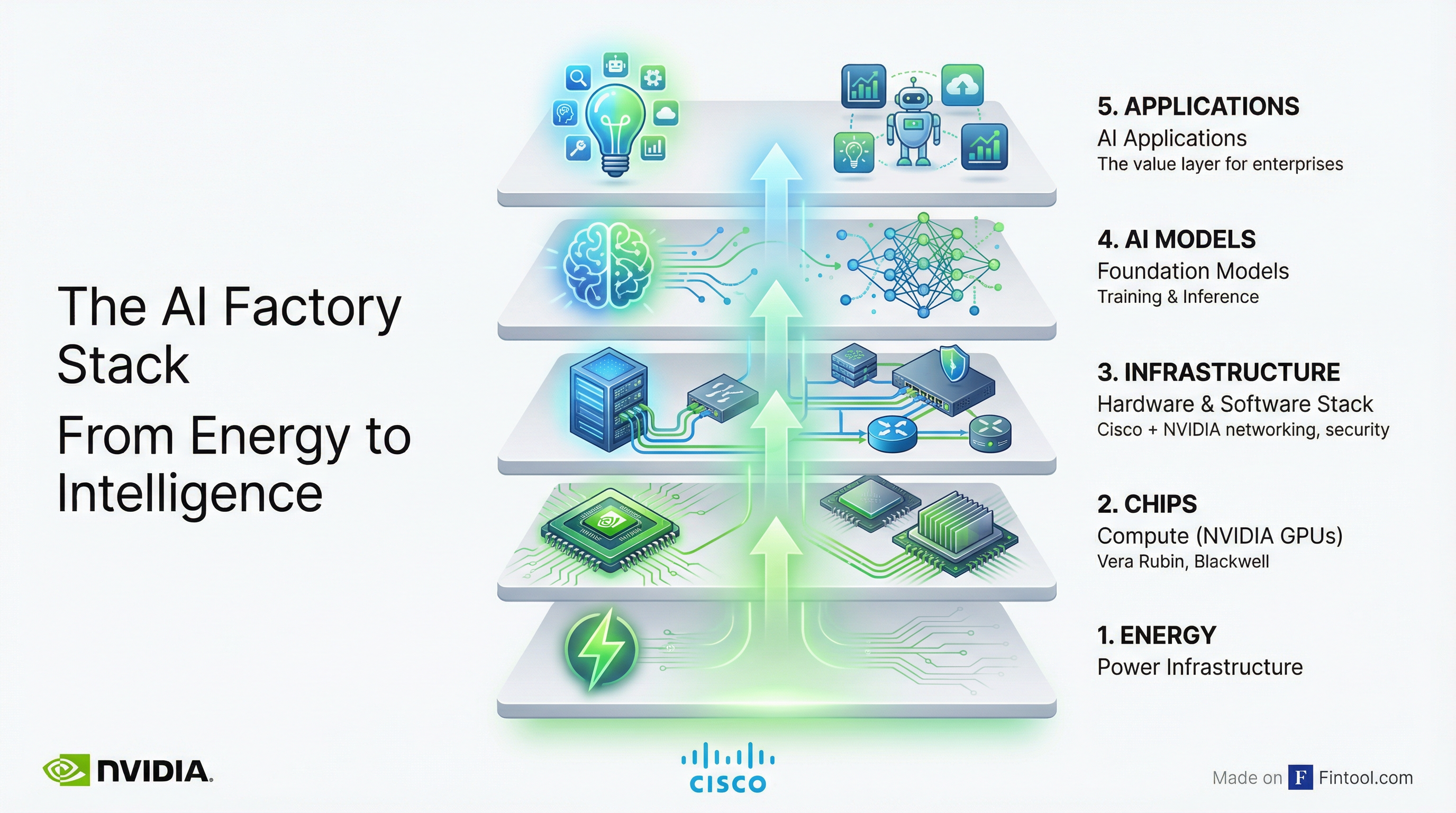
The Vera Rubin platform, now in full production, delivers up to 10x reduction in inference token cost and requires 4x fewer GPUs to train mixture-of-experts models compared to Blackwell. The flagship Vera Rubin NVL72 rack combines 72 Rubin GPUs, 36 Vera CPUs, NVLink 6, and BlueField-4 DPUs in a cable-free design enabling 18x faster assembly than previous generations.
Ask Fintool AI Agent"Let a Thousand Flowers Bloom"
When Robbins asked what advice Huang would give enterprises on AI adoption, the NVIDIA CEO pushed back against traditional ROI-driven approaches.
"I get questions like things like ROI, and I wouldn't go there," Huang said. "With all technology deployments in the beginning, it's hard to put into a spreadsheet the ROI of a new tool, a new technology."
Instead, he advocated for widespread experimentation: "Let a thousand flowers bloom, let people experiment, let the people experiment safely." NVIDIA itself uses tools from Anthropic, OpenAI, Google, and others across the organization. When an employee wants to try a new AI tool, Huang's first response is "yes," followed by "why?" rather than demanding justification upfront.
"We never do that at home, but we do it at work," Huang observed, drawing a parallel to parenting. "They say they wanna try something, the answer is 'Yes,' and then I say, 'How come?' You don't go, 'Prove it to me.'"
However, he emphasized the importance of focusing the most resources on "the most impactful work" in the company. At NVIDIA, that means chip design, software engineering, and system engineering—areas where the company has partnered with Synopsys, Cadence, Siemens, and Dassault to infuse AI into its core design tools.
The Abundance Mindset: "Apply Infinity to It"
Huang articulated a framework for how enterprises should approach AI transformation: assume infinite compute, zero latency, and weightless data movement.
"If speed matters not at all, you're at the speed of light. If mass is, you're at zero weight, zero gravity. If you're not applying that logic, if there's something that's not—it's insanely hard to you in the past, and you go, 'Eh, doesn't matter,' if you're not applying that logic, you're not doing it right."
The pace of improvement justifies this mindset. While Moore's Law delivered 2x performance every 18 months, AI computing has advanced 1 million times in the past decade. "Engineers said, 'Hey, guess what? Why don't we just train an AI model on all of the world's data?' They didn't mean, 'Let's just collect all of the data from my disk drive.' Let's pull down all of the world's data, and let's train an AI model. That's the definition of abundance."
For enterprises, Huang offered a competitive framing: "If you're not thinking that way, just imagine your competitor's thinking that way. If you're not thinking that way, just imagine a company who's about to get founded is thinking that way. It changes everything."
Physical AI: Understanding Causality
The fireside chat explored what separates current large language models from the next frontier of physical AI—systems that understand the real world.
"A child understands if you tip that over, ba, ba, ba, bum. The concept of the domino is extremely—it's like, deeply profound. The causality, contact, gravity, mass, all of that is integrated into a domino, tipping dominoes over," Huang explained. "A large language model will have no idea, and so we have to teach. We have to create a new type of physical AI."
This is where the $100 trillion opportunity emerges. Rather than building better tools, AI companies will create digital workers that understand physical constraints—from autonomous vehicles to industrial robots to medical assistants.
Huang offered pointed observations about legacy companies: "I love Disney, and I love working with Disney. I'm pretty sure they'd rather be Netflix. I love Mercedes. I am certain they'd rather be Tesla. I love Walmart. I am certain they'd rather be Amazon."
The common thread: technology-first companies operate in electrons rather than atoms. "Atoms, you're limited by mass, which is the reason why the moment they went from CD-ROMs to electrons, the value of the company exploded by 1,000 times. You need to be like us, an electronics company, electron company, which is another way of saying a technology company."
Ask Fintool AI AgentAI in the Loop, Not Human in the Loop
In his closing remarks, Huang inverted a common AI safety concept. Rather than keeping "humans in the loop" to supervise AI, he argued companies should put "AI in the loop" to capture institutional knowledge.
"Every company should have AI in the loop, and the reason for that is because we want our company to be better and more valuable and more knowledgeable every single day. We never want to go backwards. We never want to go flat. We never want to start from the beginning."
He described a future where "every single employee will have AI, lots of AIs, in the loop, and those AIs will become the company's intellectual property."
Build, Don't Just Rent
Despite the cloud's convenience, Huang encouraged enterprises to build their own AI infrastructure—at least in part.
"I would advise you to do exactly the same thing I advise my children: build a computer," he said. "For God's sakes, build one. Know why all the components exist... Lift the hood, change the oil, understand all the components."
The rationale goes beyond learning. Huang noted that NVIDIA builds AI systems on-premises specifically to protect its questions—not its answers. "My questions are the most valuable IP to me. What I'm thinking about are my questions. The answers are a commodity. If I simply knew what to ask, I'm identifying what's important, and I don't want people to know what I think is important."
Market Reaction
Cisco hit all-time highs on the back of the AI Summit, with shares closing at $83.11, up 3.0% on the day. The stock has gained 8.2% over the past week as anticipation built for the partnership announcements.
NVIDIA shares fell 2.8% to $180.34, underperforming the broader semiconductor sector. The decline came despite positive reception of Jensen's remarks, as investors digested AMD's weaker-than-expected data center guidance released the same day.
| Metric | NVDA | CSCO |
|---|---|---|
| Price (Feb 3 close) | $180.34 | $83.11 |
| Change | -2.8% | +3.0% |
| 52-Week High | $212.19 | $83.25 |
| Market Cap | $4.4T | $328B |
| Volume | 202M (1.1x avg) | 35M (1.5x avg) |
Data: S&P Global
What to Watch
The Vera Rubin platform begins shipping later this year, with Microsoft already committed to deploying "hundreds of thousands" of NVIDIA Vera Rubin Superchips in its next-generation Fairwater AI superfactories. CoreWeave will be among the first cloud providers to offer Rubin access.
NVIDIA's GTC conference in March will provide the next major catalyst, with detailed Vera Rubin specifications and additional partner announcements expected. For Cisco, the enterprise AI factory opportunity represents a path to higher-growth, higher-margin business as traditional networking growth moderates.
Ask Fintool AI Agent