Nvidia's $100 Billion OpenAI Megadeal Collapses as Jensen Huang Raises Concerns
January 30, 2026 · by Fintool Agent


What was billed as "the biggest AI infrastructure project in history" is now on ice. Nvidia-0.72%'s plan to invest up to $100 billion in OpenAI has stalled after internal concerns emerged at the chip giant, the Wall Street Journal reported Friday—a stunning reversal that exposes fractures in the relationship between two companies at the center of the AI revolution.
The breakdown reveals something more significant than a failed deal: Jensen Huang, the CEO who has turned Nvidia into the most valuable company on Earth through the AI boom, appears to have grown skeptical of his biggest customer's business model.
 Ask Fintool AI Agent
The $100 Billion Promise That Wasn't
In September 2025, Nvidia and OpenAI stood side by side at Nvidia's Santa Clara headquarters to announce what seemed like an unbreakable alliance. The terms were staggering: Nvidia would invest up to $100 billion to help OpenAI build 10 gigawatts of AI data centers—enough power to run millions of GPUs, equivalent to what New York City consumes at peak demand.
"This is a giant project," Huang declared at the time, calling it "the next leap forward—deploying 10 gigawatts to power the next era of intelligence."
Sam Altman, OpenAI's CEO, was equally effusive: "Everything starts with compute. Compute infrastructure will be the basis for the economy of the future."
The deal was structured to be self-reinforcing: Nvidia would invest in $10 billion tranches as each gigawatt came online, with OpenAI using the cash to buy Nvidia's chips. The first phase was supposed to deploy in the second half of 2026 using Nvidia's next-generation Vera Rubin platform.
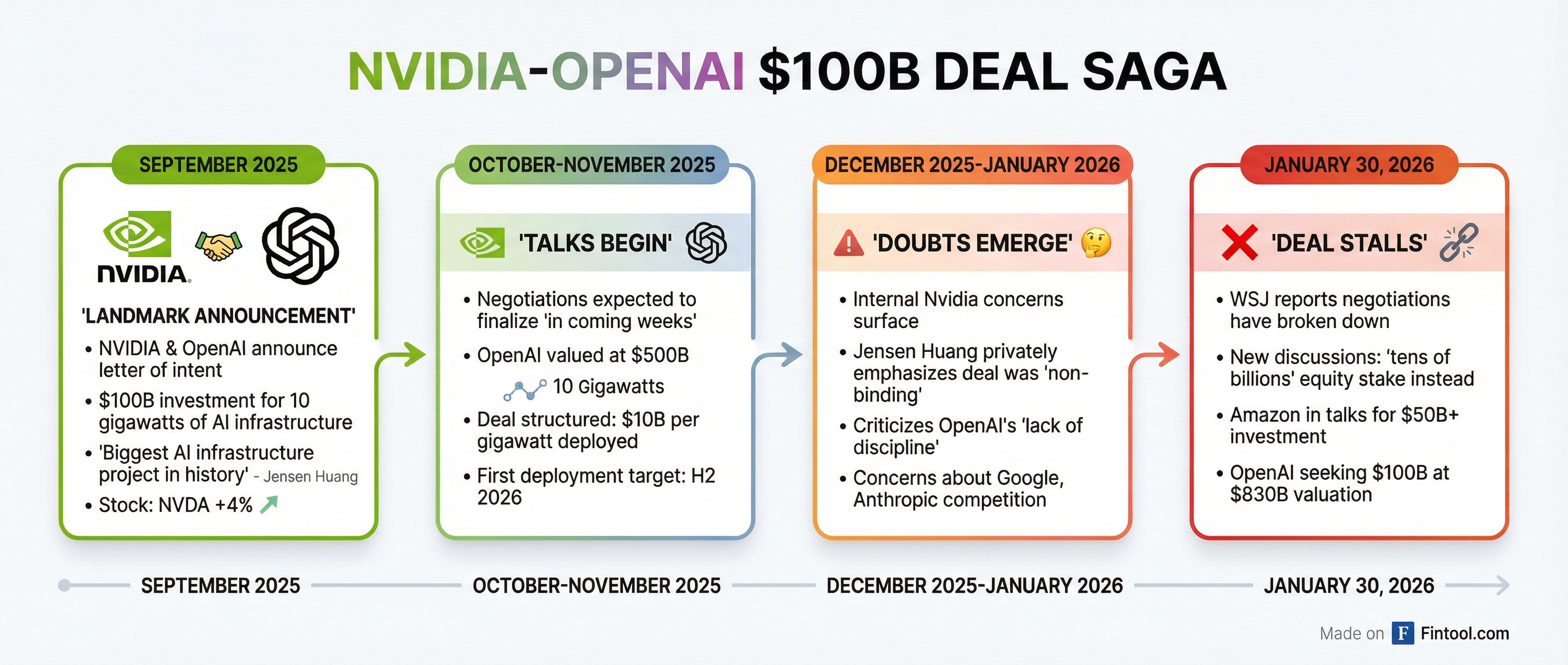
But four months later, the deal hasn't progressed beyond "early stages," according to the WSJ.
Huang's Private Concerns
The most striking revelation: Huang has been privately distancing himself from the deal for months. According to people familiar with the matter, Nvidia's CEO has emphasized to industry associates that the original $100 billion agreement was "non-binding and not finalized"—a far cry from the triumphant announcement last fall.
More pointedly, Huang has criticized what he describes as a "lack of discipline" in OpenAI's business approach. For a company that has committed to spending $1.4 trillion over the next eight years on AI infrastructure, that criticism carries weight.
Huang has also expressed concern about the competition OpenAI faces from Alphabet-0.07%'s Google and Anthropic—a notable admission from someone whose company supplies chips to all the major AI labs. The subtext: Nvidia may be betting that OpenAI's lead isn't as durable as it appears.
Ask Fintool AI AgentThe "Circular Financing" Question
The collapse resurrects a debate that has dogged AI investments: the circularity problem. When Nvidia invests in a company that uses those funds to buy Nvidia chips, critics argue the chip giant is essentially propping up demand for its own products.
"The action will clearly fuel 'circular' concerns," Bernstein analyst Stacy Rasgon warned when the deal was first announced. Jay Goldberg of Seaport Global Securities called it "bubble-like behavior."
Nvidia has pushed back aggressively. Just this week, Huang dismissed criticism of the company's $2 billion additional investment in cloud provider CoreWeave as "completely ridiculous," arguing that Nvidia's investments represent only "a small percentage of the overall amount of infrastructure, capital they're going to have to raise."
But the OpenAI situation is different in scale and visibility. A $100 billion commitment—even phased over years—would have dwarfed every other AI infrastructure investment combined.
The Race to Fill the Void
OpenAI isn't standing still. The company is now seeking up to $100 billion in funding at an $830 billion valuation, and other tech giants are circling:
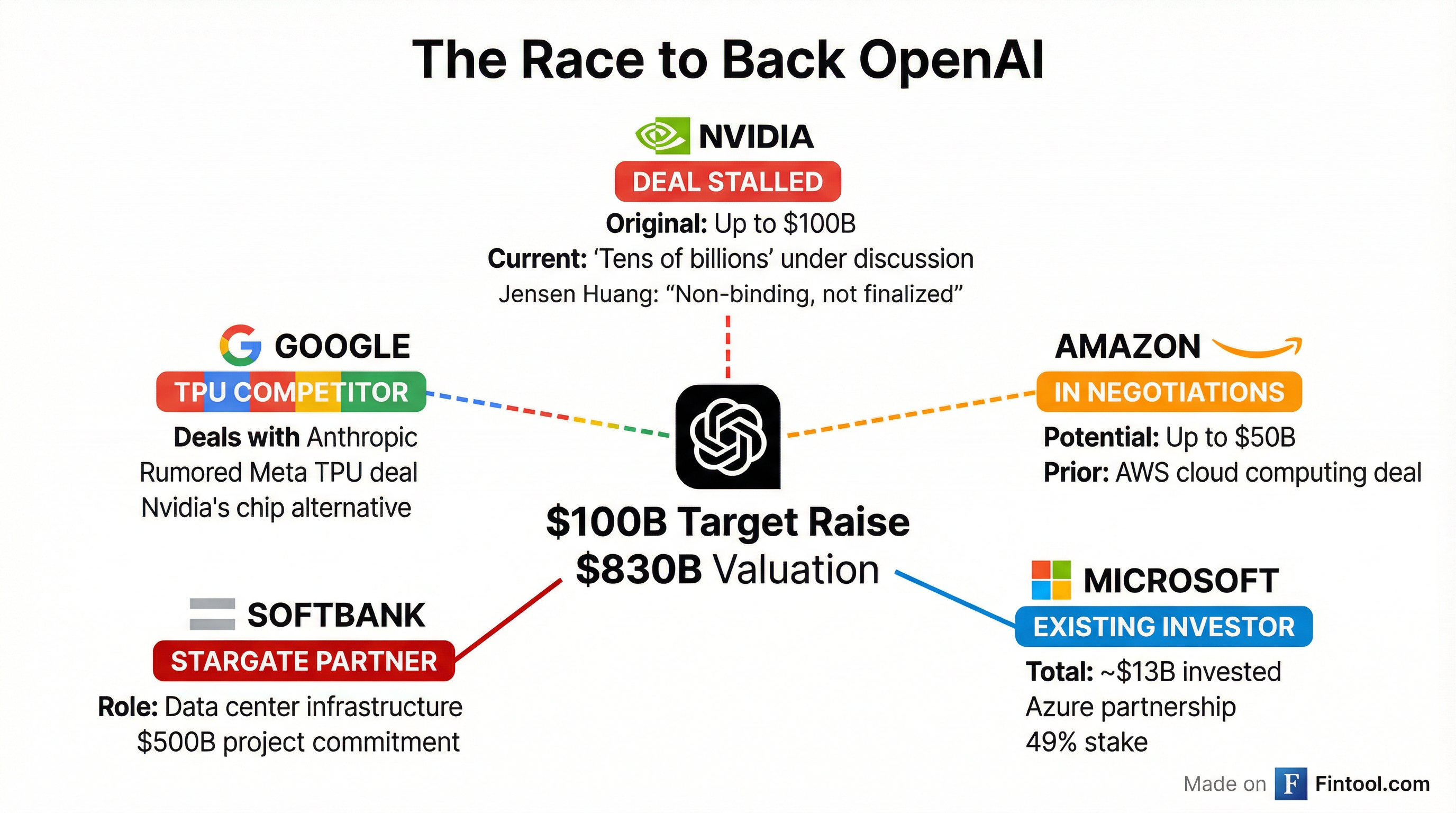
Amazon-1.01% is in talks to invest up to $50 billion in OpenAI, Reuters reported Thursday. That would expand the e-commerce giant's existing cloud computing arrangement with the AI lab.
Microsoft-0.74% remains OpenAI's largest backer with approximately $13 billion invested and a 49% stake. The companies recently signed a non-binding agreement to restructure OpenAI into a for-profit entity.
SoftBank is a partner in the $500 billion Stargate project, which aims to build massive AI data centers globally alongside Microsoft and Oracle.
Meanwhile, Nvidia and OpenAI are discussing a scaled-back arrangement: an equity investment of "tens of billions of dollars" as part of OpenAI's current funding round—substantial, but a fraction of the original vision.
Ask Fintool AI AgentWhat It Means for Investors
The deal's collapse doesn't change Nvidia's fundamental position: it still dominates the market for AI chips, with revenue and profits that dwarf competitors. But it does signal several important shifts:
1. Nvidia is diversifying its bets. Rather than going all-in on OpenAI, Nvidia has been spreading investments across the AI ecosystem—CoreWeave, Applied Digital, and others. The company appears to be hedging against any single customer becoming too dominant.
2. The AI competitive landscape is real. Huang's concerns about Google and Anthropic suggest Nvidia sees genuine threats to OpenAI's position. Google's TPU chips offer an alternative to Nvidia's hardware, and the search giant has been aggressively striking deals with Anthropic and potentially Meta.
3. Valuation discipline matters. OpenAI's $830 billion target valuation—roughly 8x its $100 billion funding target—apparently gave Nvidia pause. For all the hype around AI, even the industry's biggest beneficiary is questioning whether prices match fundamentals.
| Company | Market Cap | Position | Status |
|---|---|---|---|
| Nvidia-0.72% | $4.68T | AI chip supplier | Deal stalled |
| Microsoft-0.74% | $3.22T | 49% stake | Existing investor |
| Alphabet-0.07% | $4.08T | TPU competitor | Backing rivals |
| Amazon-1.01% | $2.56T | Cloud partner | Negotiating $50B |
Market cap data as of January 30, 2026
The Bigger Picture
The Nvidia-OpenAI breakdown may mark an inflection point in AI's infrastructure buildout. For the past two years, the narrative has been simple: AI requires compute, compute requires Nvidia chips, therefore capital flows to anyone with access to Nvidia hardware.
But Huang's hesitation suggests even the biggest winner from this dynamic is questioning its sustainability. If Nvidia—the company with the most to gain from unlimited AI spending—is pulling back from a $100 billion commitment, what does that say about the market's appetite for increasingly speculative AI bets?
OpenAI remains the most prominent AI company in the world, with 700 million weekly active users and deep enterprise adoption. It will almost certainly raise the capital it needs, whether from Amazon, sovereign wealth funds, or other sources.
But the era of AI deals being signed on ambition alone may be ending. Nvidia's retreat suggests that even in the hottest market on Earth, discipline still matters.
Related Companies: Nvidia-0.72% · Microsoft-0.74% · Alphabet-0.07% · Amazon-1.01% · Amd-6.13%