OpenAI Pursues $50 Billion from Middle East at $800 Billion Valuation
January 21, 2026 · by Fintool Agent


Sam Altman is chasing what would be the largest private funding round in history. OpenAI's CEO has been meeting with leading state-backed funds in Abu Dhabi to secure at least $50 billion in new capital, according to Bloomberg.
The funding round would value the ChatGPT maker at approximately $800 billion—a figure that exceeds the market capitalization of all but a handful of public companies globally.
The Numbers Behind the Ambition
OpenAI's financial trajectory tells a story of unprecedented growth paired with equally unprecedented cash consumption.
The company's annualized revenue reached $20 billion in 2025, a 10x increase from $2 billion in 2023. That growth tracked almost perfectly with compute expansion—from 0.2 gigawatts in 2023 to 1.9 gigawatts in 2025.
But the burn rate is staggering. OpenAI projects losses of approximately $14 billion in 2026, roughly triple its 2025 losses. Internal documents suggest cumulative losses of $44 billion from 2023 through 2028, with the company not expecting profitability until 2029.
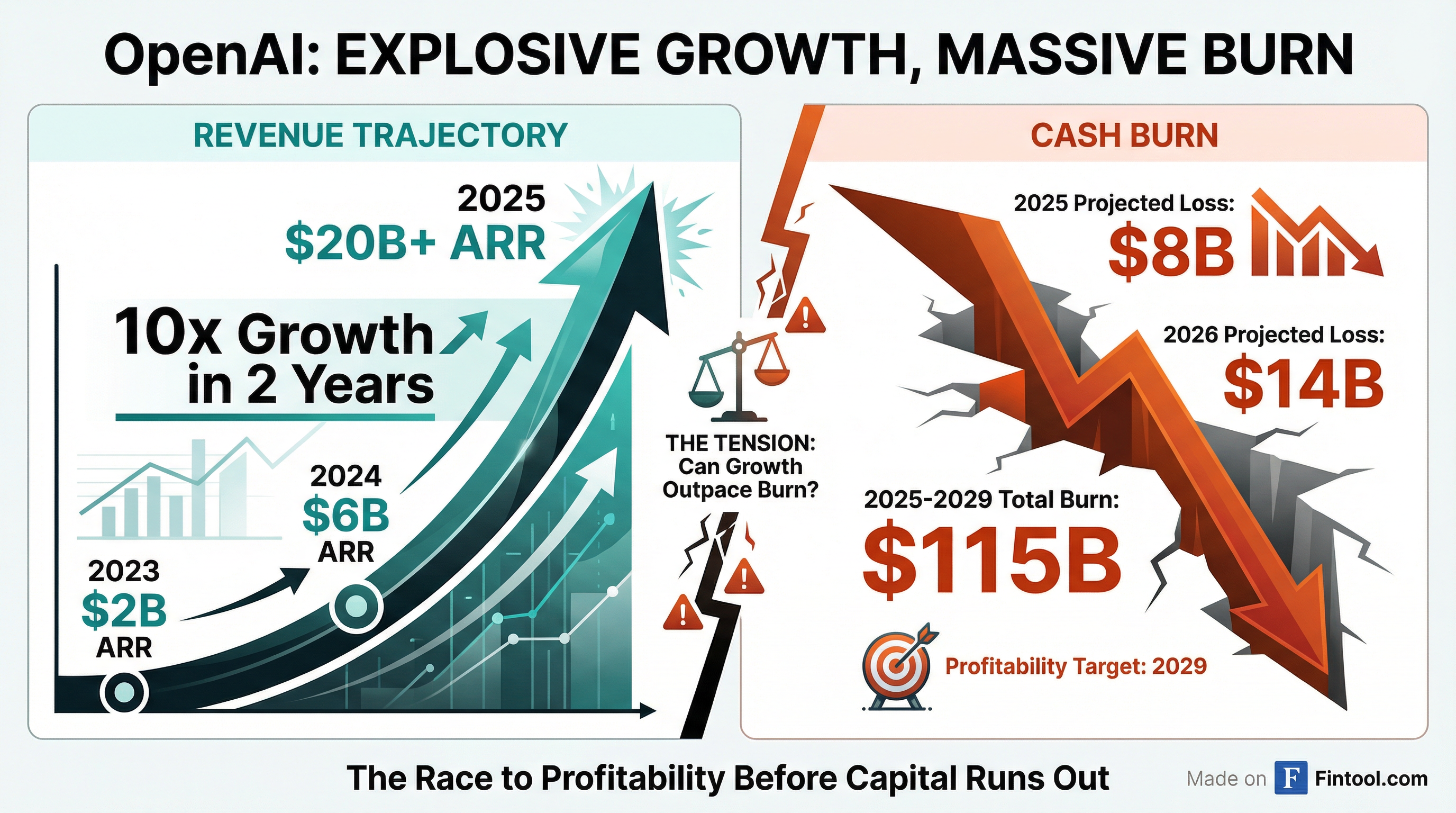
The company plans to spend $200 billion through the end of the decade, with 60-80% going toward training and running AI models. OpenAI has already committed to over $1 trillion in infrastructure deals, including a $300 billion contract with Oracle-3.41% and a $90 billion partnership with Amd-1.69%.
 Ask Fintool AI Agent
The AI Valuation Arms Race
At $800 billion, OpenAI would be the most valuable private company in the world, though it's a tight race at the top.
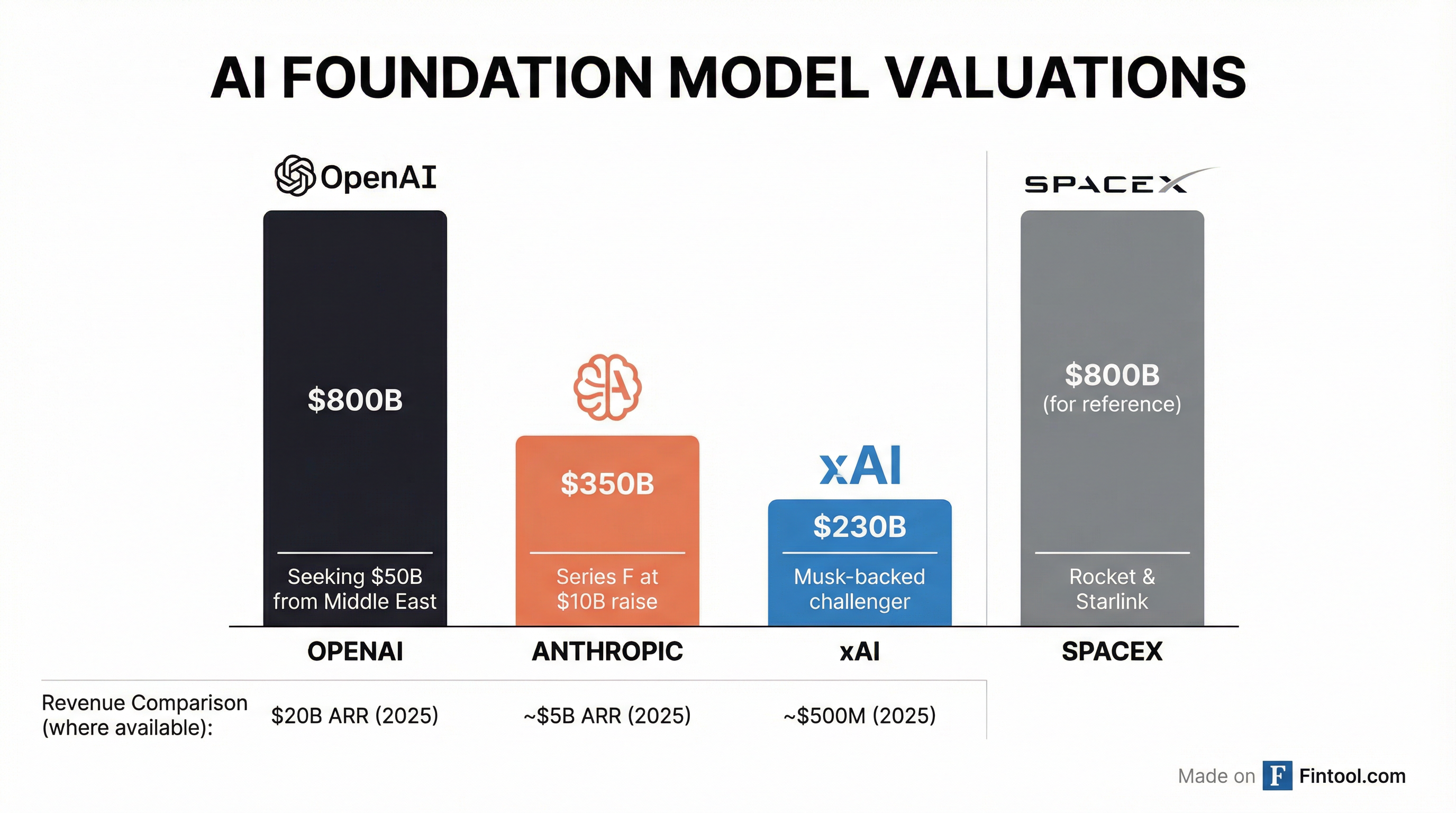
Anthropic, founded by former OpenAI executives, is closing its own mega-round. The Claude developer is raising $10 billion at a $350 billion valuation—nearly double its September 2025 valuation of $183 billion. Coatue and Singapore's GIC are leading that financing.
Elon Musk's xAI is reportedly seeking funding at approximately $230 billion, while SpaceX—increasingly pitching AI data centers in space—was last valued at $800 billion.
The valuations stretch traditional frameworks. OpenAI at $800 billion on $20 billion of revenue implies a 40x revenue multiple—aggressive by any measure but rationalized by investors who believe AI will transform the global economy.
Why the Middle East?
Altman's pivot to sovereign wealth funds reflects the scale of capital required. Traditional venture capital, even at the largest funds, can't write checks this size.
Abu Dhabi's investment vehicles—including Mubadala and ADQ—have emerged as key players in AI funding, viewing foundation model companies as critical infrastructure for economic diversification.
The geopolitical angle is notable. These discussions come as Western governments grapple with AI sovereignty concerns and as China accelerates its own AI development. OpenAI's talks with Middle Eastern capital could help the company maintain its independence from any single hyperscaler while funding the compute buildout needed to stay ahead.
Ask Fintool AI AgentThe IPO Backdrop
This funding push comes as OpenAI prepares for what could be a landmark public offering. The company is reportedly gearing up for an IPO as early as late 2026, with some estimates placing valuations approaching $1 trillion.
The New York Times reported that both OpenAI and Anthropic have taken early steps toward going public, potentially creating the year of "mega I.P.O.s" that could reshape how investors view AI company economics.
"There is such a big information gap right now," said Jeff Richards, an investor at Notable Capital, which has backed Anthropic. "The biggest positive for this entire market would be if a bunch of these companies went public and people could actually see the numbers."
Monetization Under Pressure
OpenAI isn't sitting still on the revenue side. Last week, the company announced it would begin testing advertisements within ChatGPT's free tier—a move that signals mounting financial pressure despite the headline revenue growth.
The company also published a detailed blog post from CFO Sara Friar outlining its "flywheel" business model: compute powers research, research improves products, products drive adoption, adoption generates revenue, and revenue funds more compute.
"This is never-before-seen growth at such scale," Friar wrote. "And we firmly believe that more compute in these periods would have led to faster customer adoption and monetization."
The math is simple in concept, if daunting in scale: every gigawatt of additional compute capacity has translated almost linearly to revenue growth. The question is whether OpenAI can raise enough capital to maintain that relationship—and whether the market will eventually grow large enough to support profitability.
Ask Fintool AI AgentWhat to Watch
Deal closure timeline: Bloomberg sources suggest discussions are ongoing but didn't indicate when a round might close. Given the scale, expect extended due diligence.
IPO timing: A successful mega-round could push the IPO timeline later, giving OpenAI more runway to improve unit economics. Alternatively, the funding could be structured as a bridge to a public offering.
Competitive response: Anthropic's $10 billion raise and Google's continued investment in Gemini infrastructure suggest the AI arms race is far from cooling. Microsoft-2.87%'s deep OpenAI partnership and Google's-1.16% Gemini push make this a high-stakes game of capital deployment.
Regulatory scrutiny: A foreign sovereign wealth fund taking a major stake in America's leading AI company will likely draw attention from CFIUS and other regulatory bodies, particularly given AI's national security implications.
Related
- Microsoft (msft)-2.87% — Primary cloud and investment partner
- Nvidia (nvda)-2.84% — Key GPU supplier
- Oracle (orcl)-3.41% — Cloud infrastructure partner
- Alphabet (googl)-1.16% — Anthropic backer, Gemini developer
- Amazon (amzn)-1.79% — Anthropic backer via AWS
- Amd (amd)-1.69% — Strategic AI chip partner