Pinnacle and Synovus Complete $8.6 Billion Merger, Creating $117B Regional Banking Giant
January 02, 2026 · by Fintool Agent


The largest U.S. bank merger since 2021 closed this morning as Pinnacle Financial Partners and Synovus Financial Corp. officially combined into a $117.2 billion regional banking powerhouse. The deal, structured as an all-stock merger of equals, creates the most significant Southeast-focused bank to emerge from the current wave of regional bank consolidation.
Shares of the new Pinnacle Financial Partners began trading on the New York Stock Exchange under ticker "PNFP" this morning after both legacy companies were delisted—Pinnacle from Nasdaq and Synovus from NYSE.
The Deal at a Glance
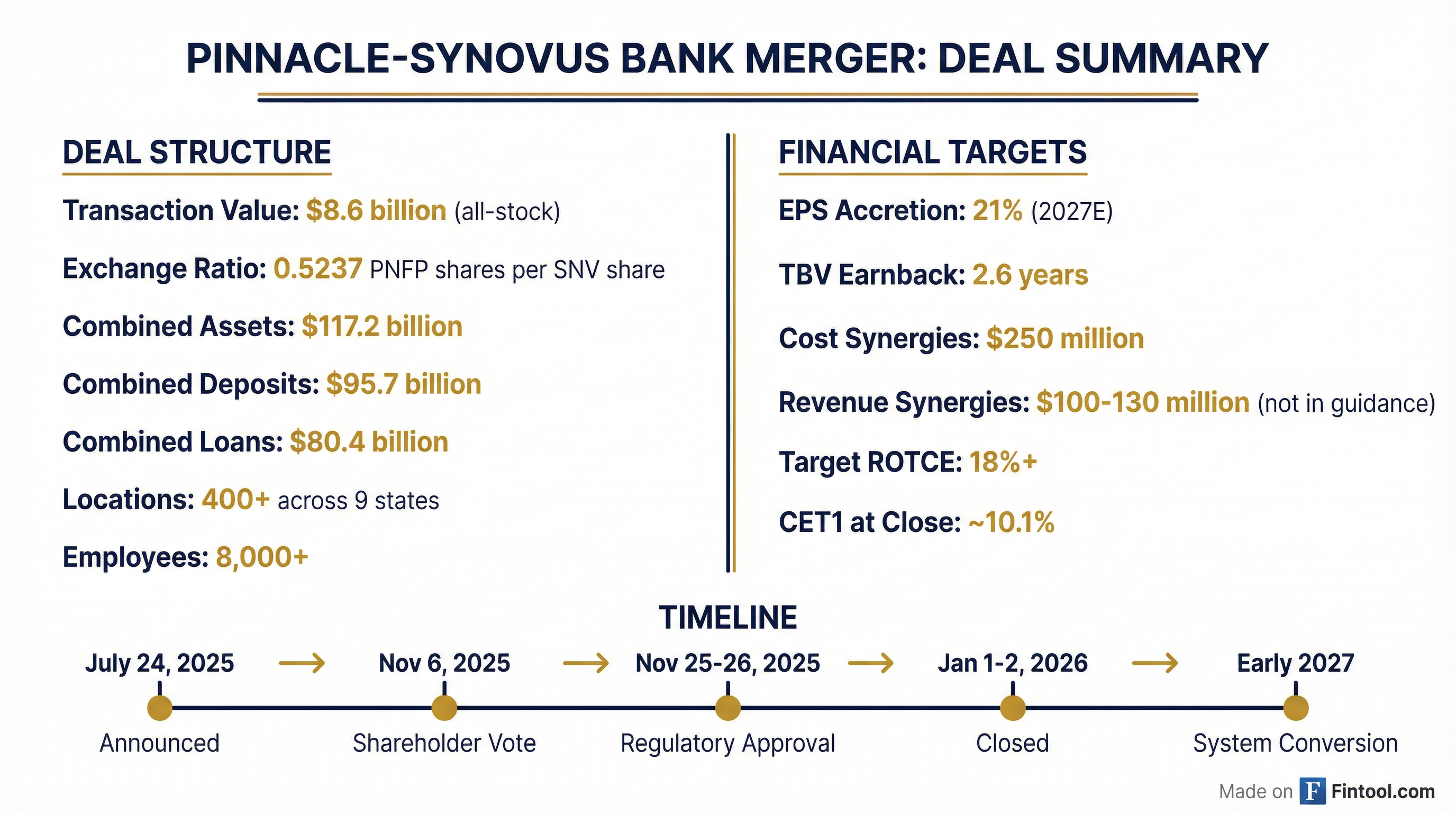
The combined entity boasts $95.7 billion in deposits, $80.4 billion in loans, and operates more than 400 locations across nine states throughout the Southeast and Atlantic coast. The merged bank now employs over 8,000 people and positions itself as what CEO Kevin Blair calls "the fastest-growing, most profitable regional bank in the nation."
Under the merger terms, each share of legacy Pinnacle common stock converted into one share of new Pinnacle, while Synovus shareholders received 0.5237 shares of new Pinnacle for each share held.
 Ask Fintool AI Agent
Leadership: Synovus CEO Takes the Helm
The new leadership structure represents a true merger of equals in name, but tilts toward Synovus operationally. Kevin Blair, formerly Synovus's CEO, now leads the combined company as President and CEO. Pinnacle co-founder Terry Turner assumes the role of non-executive Board Chair, bringing what he describes as "a founder's mentality and 25 years of experience as CEO" to support Blair's leadership team.
Rob McCabe, the other Pinnacle co-founder, serves as Chief Banking Officer, responsible for leading all bank teams under Pinnacle's intensive recruiting model. The board comprises seven directors from each legacy institution.
The holding company headquarters will be in Atlanta, Georgia, while the bank headquarters remains in Nashville, Tennessee—a geographic split that preserves both companies' legacy footprints.
Southeast Footprint: Scale With Strategy
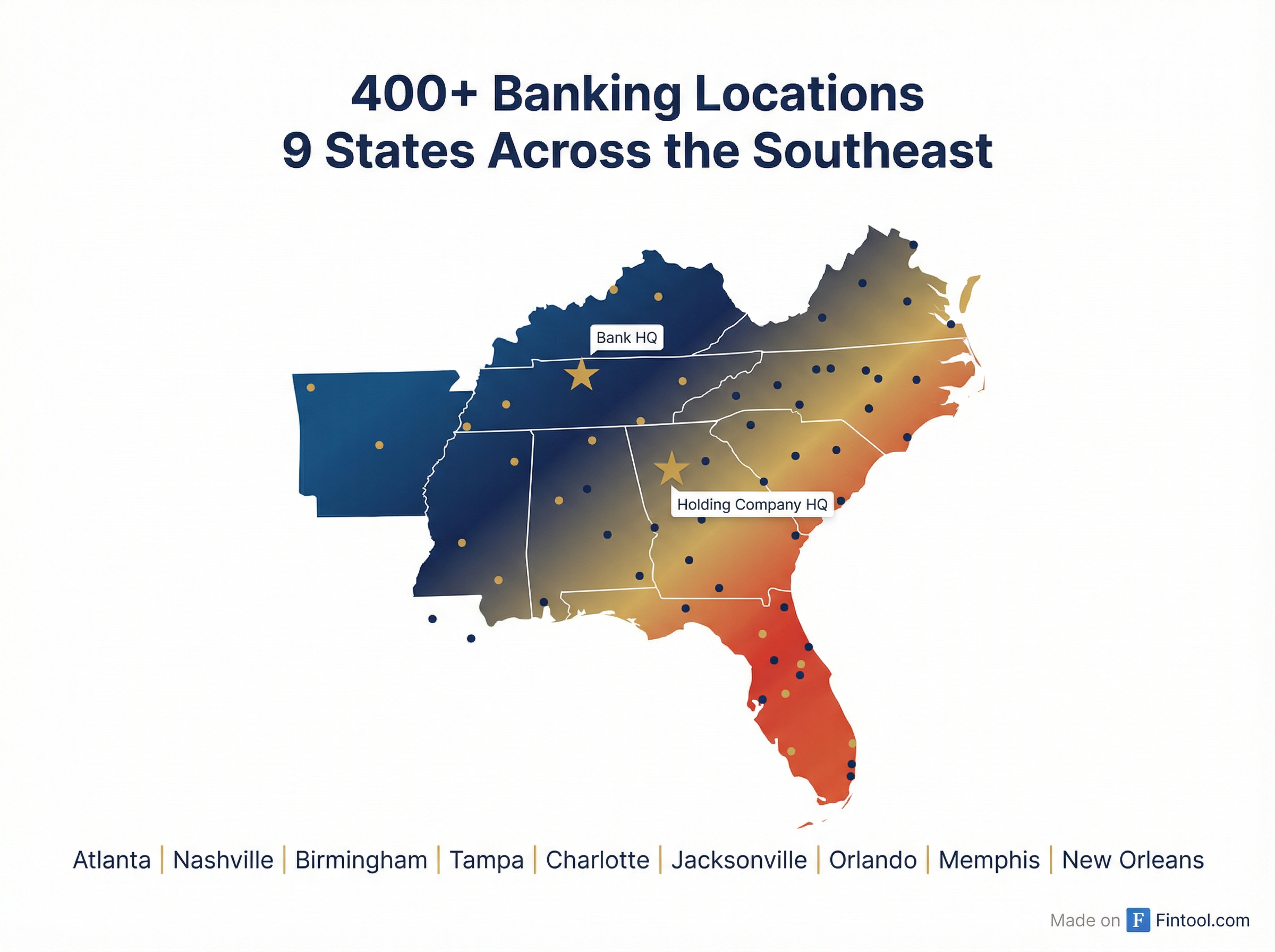
The merger creates dominant positioning in the Southeast's high-growth markets. The combined footprint spans Tennessee, Georgia, Alabama, Florida, South Carolina, North Carolina, Virginia, Mississippi, and Arkansas.
"By bringing our organizations together, we gain scale while staying true to what matters most—creating long-term, trusted relationships," Blair said in the merger announcement. "This merger is about growth with purpose, combining strength and heart to deliver scale with a soul."
Both the Pinnacle and Synovus brands will continue operating through early 2027, when systems and brand conversions are expected to be complete.
Ask Fintool AI AgentFinancial Targets: Aggressive But Achievable?
Management has outlined an ambitious financial roadmap:
| Metric | Target |
|---|---|
| EPS Accretion (2027) | 21% |
| Tangible Book Value Earnback | 2.6 years |
| Cost Synergies | $250 million |
| Revenue Synergies | $100-130 million (not in guidance) |
| Target ROTCE | 18%+ |
| CET1 at Close | 10.1% |
The $250 million cost synergy target represents approximately 9% of the combined expense base, with a 5-6% headcount reduction expected. Management expects to realize 50% of synergies in 2026, 75% by 2027, and the remainder by 2028.
The integration carries substantial one-time costs: $675 million in pre-tax merger expenses plus an estimated $45 million in one-time costs related to the company's new status as a "large financial institution" for regulatory purposes.
Ask Fintool AI AgentStock Performance: Skepticism Ahead of Close
Both stocks have underperformed since the deal announcement in July 2025. Pinnacle closed at $95.41 on December 31, down 16.5% from its July 1 level of $114.27. Synovus fared slightly better, closing at $50.05, down 7.0% from $53.79.
The market's lukewarm reception reflects broader concerns about regional bank consolidation execution risk. Core system integration presents a particular challenge: Pinnacle operates on Jack Henry's platform while Synovus uses FIS—a conversion that industry observers describe as among the most complex aspects of any bank merger.
The combined entity's market capitalization of approximately $7.4 billion* positions it between First Horizon ($11.8 billion) and Wintrust Financial ($9.4 billion) among regional banking peers.
A Bellwether for Regional Bank M&A
The Pinnacle-Synovus deal doesn't exist in isolation. It's part of an accelerating consolidation wave reshaping regional banking:
- Fifth Third-Comerica: At $10.85 billion, announced October 2025, this became the largest bank deal since 2021—overtaking Pinnacle-Synovus for that distinction
- Huntington-Cadence: $7.59 billion, announced October 2025
- Huntington-Veritex: $1.87 billion, closed October 2025
- PNC-FirstBank: $4 billion acquisition expanding into Rocky Mountain markets
The driver? Scale economics. As regulatory costs rise and technology investments accelerate, mid-sized regional banks increasingly find themselves squeezed between community banks (nimble and relationship-driven) and mega-banks (scale and technology advantages).
"The leadership team we've assembled is built to lead Pinnacle into the future as the fastest-growing, most profitable regional bank in the nation," Blair said.
Ask Fintool AI AgentPre-Merger Financials: Combining Two Healthy Banks
Both banks entered the merger from positions of strength:
| Metric | Pinnacle (Q3 2025) | Synovus (Q3 2025) |
|---|---|---|
| Total Assets | $56.0B | $60.5B |
| Net Income | $173.1M | $197.0M |
| Return on Equity | 10.3% | 13.7%* |
*Values retrieved from S&P Global
Synovus's stronger ROE reflects its higher-yielding loan portfolio and more established Southeast market position, while Pinnacle has demonstrated exceptional organic growth driven by its aggressive banker recruiting model.
Ask Fintool AI AgentWhat to Watch
Near-term (Q1 2026):
- Initial trading dynamics as legacy shareholders adjust positions
- Any early integration hiccups or customer attrition signals
- Regulatory scrutiny of the combined entity's "large financial institution" status
Medium-term (2026-2027):
- Progress toward 50% cost synergy realization in 2026
- Core system conversion timeline (scheduled for early 2027)
- Employee retention metrics, particularly among revenue-producing bankers
- Brand consolidation under Pinnacle name
Long-term:
- Achievement of 18%+ ROTCE target
- Revenue synergy capture from cross-selling and expanded capabilities
- Whether the combined entity becomes an acquirer or acquisition target itself
The merger completion marks the end of a five-month sprint from announcement to close—remarkably fast for a deal of this magnitude. But the real test begins now: can two proud banking cultures blend into something greater than the sum of their parts?
For investors in regional bank consolidation plays, Pinnacle-Synovus provides a real-time case study. The 2.6-year tangible book value earnback is aggressive but not unrealistic. The path to 21% EPS accretion depends on flawless execution of a complex integration.
As Blair put it: "This merger unites two trusted legacies to create one bright future." Whether that future materializes will depend on what happens in the next 18 months.
Related Companies: Pinnacle Financial Partners | Truist Financial | Regions Financial | Fifth Third Bancorp | Huntington Bancshares | Keycorp | Citizens Financial | First Horizon