Honeywell's Quantum Spinoff Quantinuum Files for IPO, Eyes $20 Billion Valuation
January 14, 2026 · by Fintool Agent


Honeywell International announced Wednesday that its majority-owned quantum computing subsidiary Quantinuum has confidentially filed draft IPO papers with the SEC, a move that could value the company at more than $20 billion and mark the largest quantum computing public offering to date.
Honeywell shares rose 1.2% to $212.82 on the news, adding to a strong January as the industrial conglomerate advances its portfolio transformation strategy.
The Deal
Quantinuum submitted a confidential Form S-1 registration statement to the Securities and Exchange Commission, initiating the regulatory review process required for a public listing. The company has not disclosed timing, share count, or pricing details.
Sources close to the IPO process indicate the deal could value Quantinuum at approximately $20 billion-plus, with the offering potentially raising around $1 billion. That would represent a significant premium to the $10 billion valuation established just four months ago, when Quantinuum raised $600 million from investors including Nvidia's venture capital arm.
The confidential filing approach—enabled by the 2012 JOBS Act—allows Quantinuum to begin SEC discussions while delaying public disclosure of detailed financial information. This has become standard practice among technology firms navigating volatile capital markets.
 Ask Fintool AI Agent
The Company
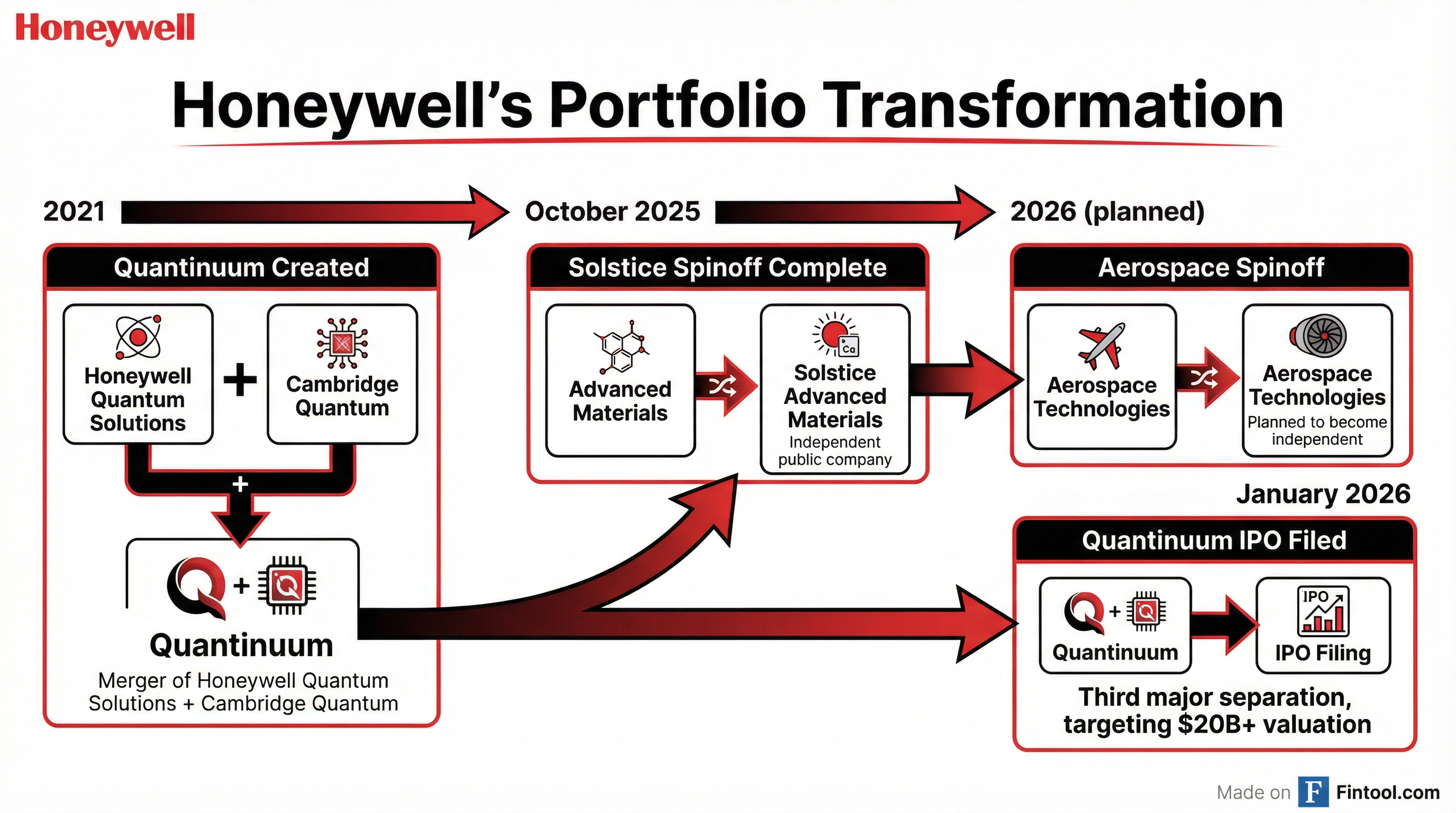
Quantinuum was formed in 2021 through the merger of Honeywell Quantum Solutions and Cambridge Quantum, combining Honeywell's trapped-ion hardware expertise with Cambridge's quantum software capabilities.
The company operates as a full-stack quantum computing provider, offering integrated hardware and software solutions built on trapped-ion qubit technology. Its current systems include commercially available access to a 32-qubit processor, and the company recently launched its Helios quantum computing platform.
Key Quantinuum metrics:
- Employees: 630+ total, including 370+ scientists and engineers
- Geographic footprint: US, UK, Germany, Japan
- Enterprise customers: Airbus, BMW Group, HSBC, JPMorgan Chase
- Recent valuation: $10 billion (September 2025)
Quantinuum's technologies are being used to solve complex problems in areas like hydrogen cell battery design, drug discovery, and financial modeling—applications that could unlock significant commercial value as quantum systems mature.
Honeywell's Portfolio Transformation
The Quantinuum IPO represents Honeywell's third major portfolio action in roughly 15 months, as the $135 billion industrial conglomerate continues to simplify its structure.
In October 2025, Honeywell completed the spinoff of its Advanced Materials business as Solstice Advanced Materials, an independent publicly traded company. The company also plans to complete the spinoff of its Aerospace Technologies arm later this year, leaving a more focused industrial automation and building technology business.
Quantinuum currently resides within Honeywell's "Corporate and All Other" segment, which reported just $24 million in revenue through the first nine months of 2025 and carries backlog of $21 million. While small relative to Honeywell's $38.5 billion in annual revenue, the quantum unit's strategic value far exceeds its current financial contribution.
| Metric | FY 2022 | FY 2023 | FY 2024 |
|---|---|---|---|
| Revenues ($B) | $35.5 | $36.7 | $38.5 |
| Net Income ($B) | $5.0 | $5.7 | $5.7 |
| EBITDA ($B) | $8.3* | $8.7* | $9.6* |
*Values retrieved from S&P Global
Honeywell's approach mirrors a broader trend among industrial conglomerates seeking to unlock shareholder value through focused structures. By taking Quantinuum public while retaining majority ownership, Honeywell gains direct access to public market capital for its quantum business while maintaining strategic control.
Ask Fintool AI AgentThe Competitive Landscape
Quantinuum's IPO arrives amid a quantum computing stock boom that has lifted pure-play valuations to extraordinary levels—and left investors debating whether current prices reflect genuine commercial potential or speculative excess.
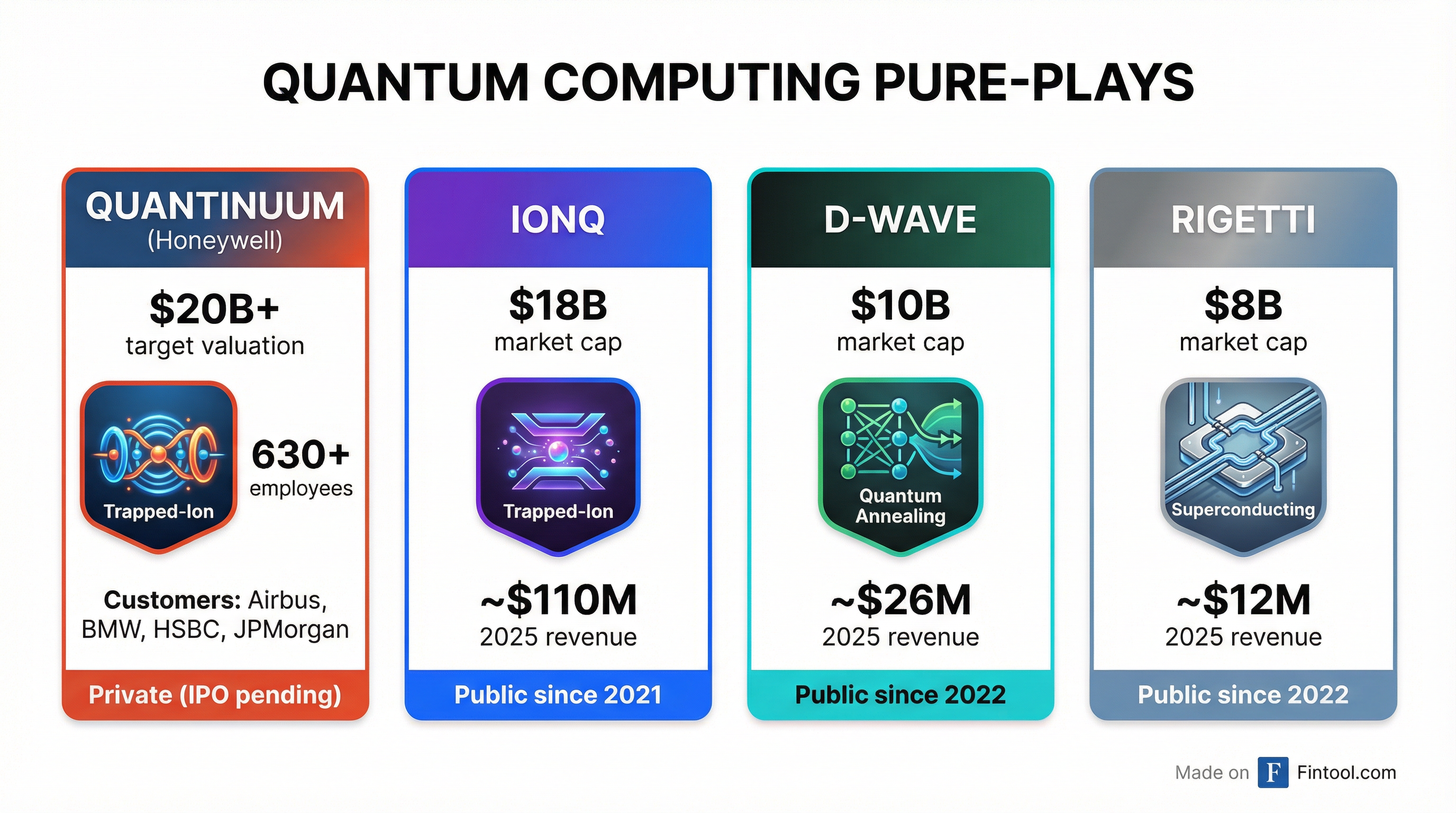
Public quantum pure-plays:
| Company | Market Cap | 2025 Revenue (Est.) | Technology | P/S Ratio |
|---|---|---|---|---|
| Ionq | $17.8B | $110M | Trapped-Ion | 160x |
| D-wave | $9.8B | $26M | Quantum Annealing | 350x+ |
| Rigetti | $8.2B | $12M | Superconducting | 680x+ |
At a potential $20 billion valuation, Quantinuum would enter the public market as the largest quantum computing pure-play by market capitalization—despite generating minimal revenue. The premium reflects Quantinuum's technological differentiation (trapped-ion systems with high-fidelity qubits), blue-chip customer base, and Honeywell's backing.
IonQ, the closest comparable, has seen its stock rise roughly 25% year-to-date in 2025 after more than tripling in 2024. The company achieved a technical milestone of #AQ 64 in Q3 2025 and projects $200 million in revenue by 2026.
D-Wave Quantum surged over 200% in 2025 following its Advantage2 system launch and plans to acquire rival Quantum Circuits for $550 million. Yet the company remains deeply unprofitable with a price-to-sales ratio exceeding 350x.
Big Tech players—including Alphabet, Microsoft, Ibm, and Amazon through AWS Braket—continue investing heavily in quantum R&D, representing both potential competitors and partners for Quantinuum's enterprise solutions.
What to Watch
Near-term catalysts:
- SEC review timeline and public S-1 filing
- IPO pricing and allocation details
- Honeywell's retained ownership stake
Key questions:
- Will Quantinuum's valuation hold in a potentially volatile IPO market?
- How quickly can the company scale revenue from its blue-chip customer base?
- Does the trapped-ion approach maintain its technical advantage as competitors advance?
The IPO also arrives as investors reassess the quantum computing narrative. After explosive gains in 2025, several pure-plays have pulled back from October highs as profit-taking sets in. Quantinuum's entry could either validate elevated sector valuations or test whether institutional demand exists at $20 billion-plus pricing.
Ask Fintool AI AgentThe Bottom Line
Quantinuum's IPO filing marks a watershed moment for quantum computing's transition from research curiosity to investable industry. Backed by Honeywell's industrial credibility and a roster of enterprise customers, the company enters public markets as the sector's largest pure-play—but also faces the burden of justifying a premium valuation in a market where quantum revenue remains nascent and profitability remains years away.
For Honeywell shareholders, the spinoff represents another step in CEO Vimal Kapur's portfolio transformation, unlocking value from a hidden asset while maintaining strategic optionality. For quantum enthusiasts, it's validation that the technology has reached a scale warranting public market scrutiny.
The real test begins when the S-1 goes public—and investors see the financials behind the $20 billion price tag.
Related