Supreme Court Strikes Down Trump Tariffs in 6-3 Ruling; President Responds with New 15% Global Levy
February 22, 2026 · by Fintool Agent


The Supreme Court delivered its most consequential ruling on executive power in decades Friday, striking down President Trump's sweeping tariff program in a 6-3 decision that opens the door to $175 billion in potential refunds—only for the president to immediately announce a new 15% global tariff under different legal authority.
Markets rallied modestly on the news, with the S&P 500 gaining 0.69% and the Nasdaq adding 0.9%, though investors remained cautious about what comes next.
What the Court Decided
In Learning Resources, Inc. v. Trump, the Court held that the International Emergency Economic Powers Act (IEEPA) "does not authorize the President to impose tariffs."
Chief Justice John Roberts, writing for the majority, emphasized the constitutional stakes: "Article I, Section 8, of the Constitution specifies that 'The Congress shall have Power To lay and collect Taxes, Duties, Imposts and Excises.' The Framers did not vest any part of the taxing power in the Executive Branch."
The majority applied the "major questions" doctrine, requiring clear congressional authorization for presidential actions with vast economic implications. Roberts noted that "until now no President has read IEEPA to confer such power" to impose tariffs.
The Coalition:
- Majority (6): Roberts, Sotomayor, Kagan, Gorsuch, Barrett, Jackson
- Dissent (3): Thomas, Alito, Kavanaugh
Justice Kavanaugh's dissent warned the ruling "could generate uncertainty regarding various trade agreements" and predicted the refund process would be a "mess."
 Ask Fintool AI Agent
Trump's Immediate Response
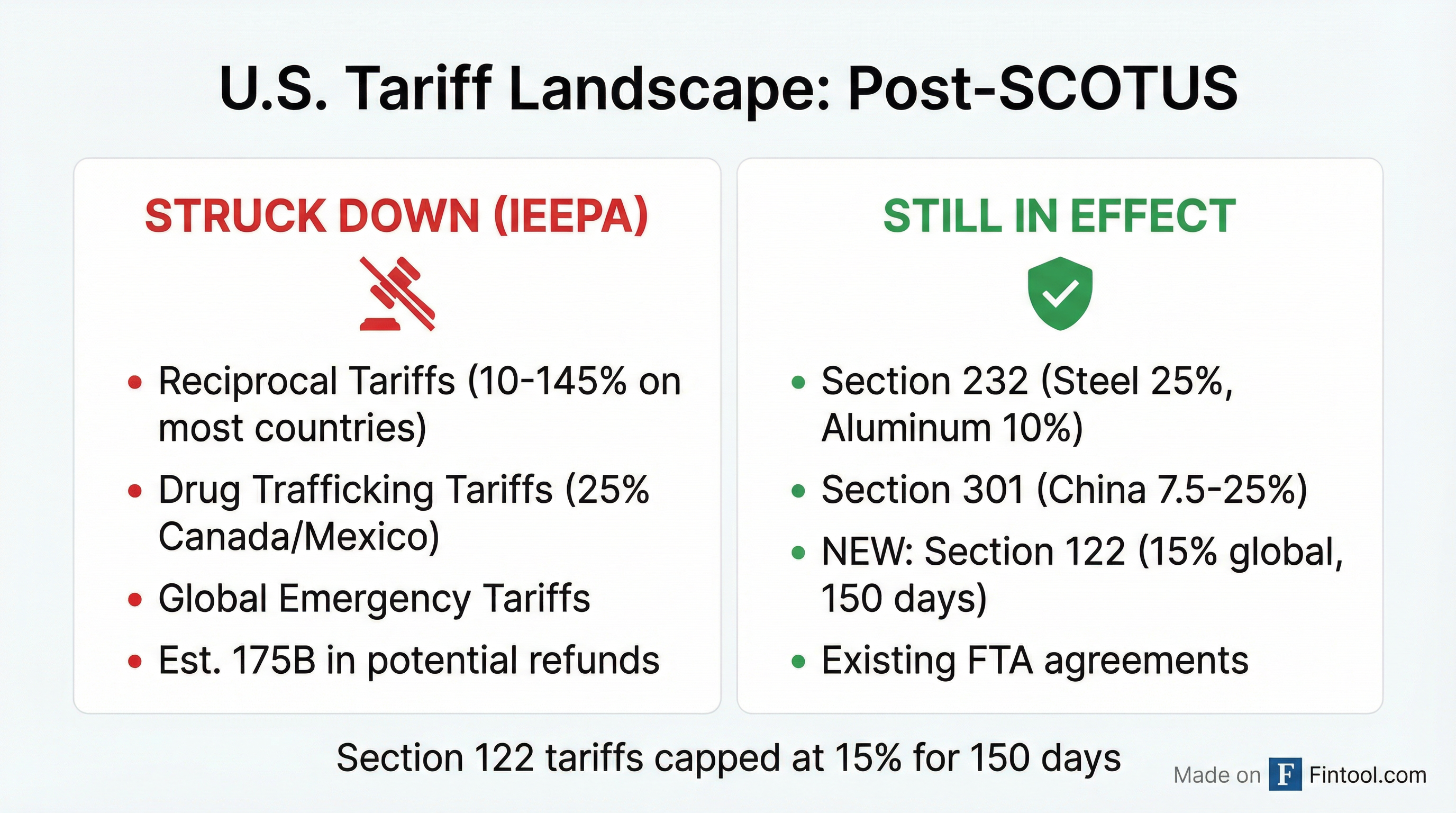
Within hours of the ruling, Trump announced a new 10% "global tariff" under Section 122 of the Trade Act of 1974—a statute never before invoked by a president. On Saturday, he raised that rate to the statutory maximum of 15%.
"I, as President of the United States of America, will be, effective immediately, raising the 10% Worldwide Tariff on Countries, many of which have been 'ripping' the U.S. off for decades, without retribution (until I came along!), to the fully allowed, and legally tested, 15% level," Trump wrote on Truth Social.
U.S. Trade Representative Jamieson Greer defended the administration's ability to "reconstruct" its tariff policy, calling the new global duties "very durable tools" legally.
Key Section 122 Limitations:
- Maximum rate: 15% (already reached)
- Duration: 150 days unless Congress extends
- Purpose: Address trade deficits or dollar crises
- Cannot be increased without new congressional action
The $175 Billion Refund Question
The Penn Wharton Budget Model estimates importers may be entitled to up to $175 billion in refunds for IEEPA tariffs paid since April 2025.
Importers generally have 180 days after goods are "liquidated" to protest and request refunds from U.S. Customs and Border Protection. However, the mechanics remain deeply uncertain:
- The Court did not mandate refunds or specify procedures
- Many importers passed costs to consumers, complicating recovery
- Companies posted bonds and collateral that may factor into claims
- Trump predicted the issue would be "tied up in court for years"
"If we assume that roughly 60% of tariffs are paid by the consumer, that could benefit consumer stocks to some degree," said Jurrien Timmer, director of global macro at Fidelity. "But I don't think the inflationary burden of tariffs on the consumer has been as significant as we may have thought a year ago."
Ask Fintool AI AgentCorporate Impact: The Real-World Toll
The ruling comes after nearly a year of documented corporate pain. Helen of Troy (HELE) provides a case study in the tariff burden borne by import-dependent companies.
In its Q3 2026 earnings call, CFO Brian Grass detailed the damage: "Year to date, gross unmitigated tariffs had a $31.3 million impact on gross profit, with the full year impact expected to be in the range of $50-$55 million."
The company saw gross profit margins contract 200 basis points "primarily due to the net unfavorable impact of higher tariffs." Inventory swelled to $505 million, including "$35 million in incremental tariff-related costs."
Beyond direct costs, tariffs triggered second-order disruptions: "Approximately 3.3 percentage points or $17.3 million of the organic revenue decline was driven by tariff-related revenue disruption, which includes the pause or cancellation of direct import orders from China."
| Impact Category | Amount |
|---|---|
| FY Gross Profit Impact | $50-55M |
| Operating Income Impact (net of mitigation) | <$30M |
| Inventory Tariff Costs | $35M |
| Tariff-Related Revenue Disruption | $17.3M |
| Cash Outflows (tariffs + supplier transitions) | $58M YTD |
What Remains in Effect
The Supreme Court ruling only addressed IEEPA-based tariffs. Several major tariff programs remain untouched:
Section 232 (National Security):
- Steel: 25%
- Aluminum: 10%
- Auto parts: Various rates
Section 301 (Unfair Trade Practices):
- China: 7.5% to 25% on various goods
- Covers electronics, machinery, consumer products
New Section 122 (Balance of Payments):
- 15% on all countries (effective ~Feb 24, 2026)
- 150-day duration unless Congress extends
The Yale Budget Lab estimates that even with IEEPA tariffs struck down, consumers and businesses face an average effective tariff rate of at least 9.1%—the highest since 1946.
Global Ripple Effects
The ruling has already disrupted international trade diplomacy. India postponed a scheduled trade delegation to Washington to finalize an interim trade pact, citing uncertainty over U.S. tariff policy.
The European Commission demanded the U.S. honor existing trade agreements: "A deal is a deal," officials said, warning they would not accept the new tariff escalation.
Indonesia, which signed a zero-tariff deal just two days before the ruling, faces renewed uncertainty.
Hong Kong's Hang Seng Index surged 1.5% Monday as investors rotated out of U.S. assets amid what analysts called a "sell America" trade.
Ask Fintool AI AgentWhat to Watch Next
This Week:
- Nvidia earnings (Wednesday): Test of AI sector confidence amid trade uncertainty
- U.S.-Iran nuclear talks (Thursday, Geneva): Oil prices remain elevated on conflict risk
- Section 122 tariff implementation (~Feb 24): Watch for CBP enforcement guidance
Longer-Term:
- Refund claims and litigation process unfolds
- Congressional action on Section 122 extension
- Administration's next moves using other trade authorities
- Q1 2026 earnings season tariff commentary
"Although bringing an end to most tariffs will undoubtedly benefit Main Street, we know that tariffs have already caused significant and irreparable harm to many small businesses," said John Arensmeyer, CEO of the Small Business Majority.
Related Companies: Helen of Troy (hele) · Target (tgt) · Walmart (wmt) · Nike (nke) · Apple (aapl)