Teva's Duvakitug Delivers 58% Remission in IBD Maintenance Trial, Stock Jumps 4% After Hours
February 17, 2026 · by Fintool Agent


Teva Pharmaceutical Industries stock surged 4.4% in after-hours trading Monday following positive Phase 2b maintenance data for duvakitug, the company's investigational TL1A inhibitor developed in partnership with Sanofi. The data demonstrated durable efficacy over 44 weeks in patients with ulcerative colitis and Crohn's disease, positioning Teva as a serious contender in the increasingly competitive $38 billion inflammatory bowel disease market.
The Numbers That Matter
The RELIEVE UCCD long-term extension study delivered what investors have been waiting for: proof that duvakitug's initial response holds up over time.
| Endpoint | 450mg Dose | 900mg Dose |
|---|---|---|
| Ulcerative Colitis - Clinical Remission (Week 44) | 47% | 58% |
| Crohn's Disease - Endoscopic Response (Week 44) | 41% | 55% |
The study enrolled 130 patients who had initially responded to duvakitug during the 14-week induction phase, then re-randomized them to either 450mg or 900mg subcutaneous doses every four weeks.
"One of the persistent challenges in treating ulcerative colitis and Crohn's disease isn't just achieving an initial response, but sustaining it," said Eric Hughes, MD, PhD, Executive Vice President, Global R&D and Chief Medical Officer at Teva. "These Phase 2b results further reinforce TL1A as a compelling target and clearly strengthen the case that duvakitug has the potential to be a best-in-class therapy."
The safety profile remained consistent with the induction study. Most common adverse events (≥5% of patients) were nasopharyngitis, upper respiratory tract infection, and hypertension—none showing dose dependency or requiring intervention.
 Ask Fintool AI Agent
A Three-Way Race Worth $30 Billion in Acquisitions
Today's data drops Teva squarely into a high-stakes competition that has already generated nearly $30 billion in M&A activity over the past three years.
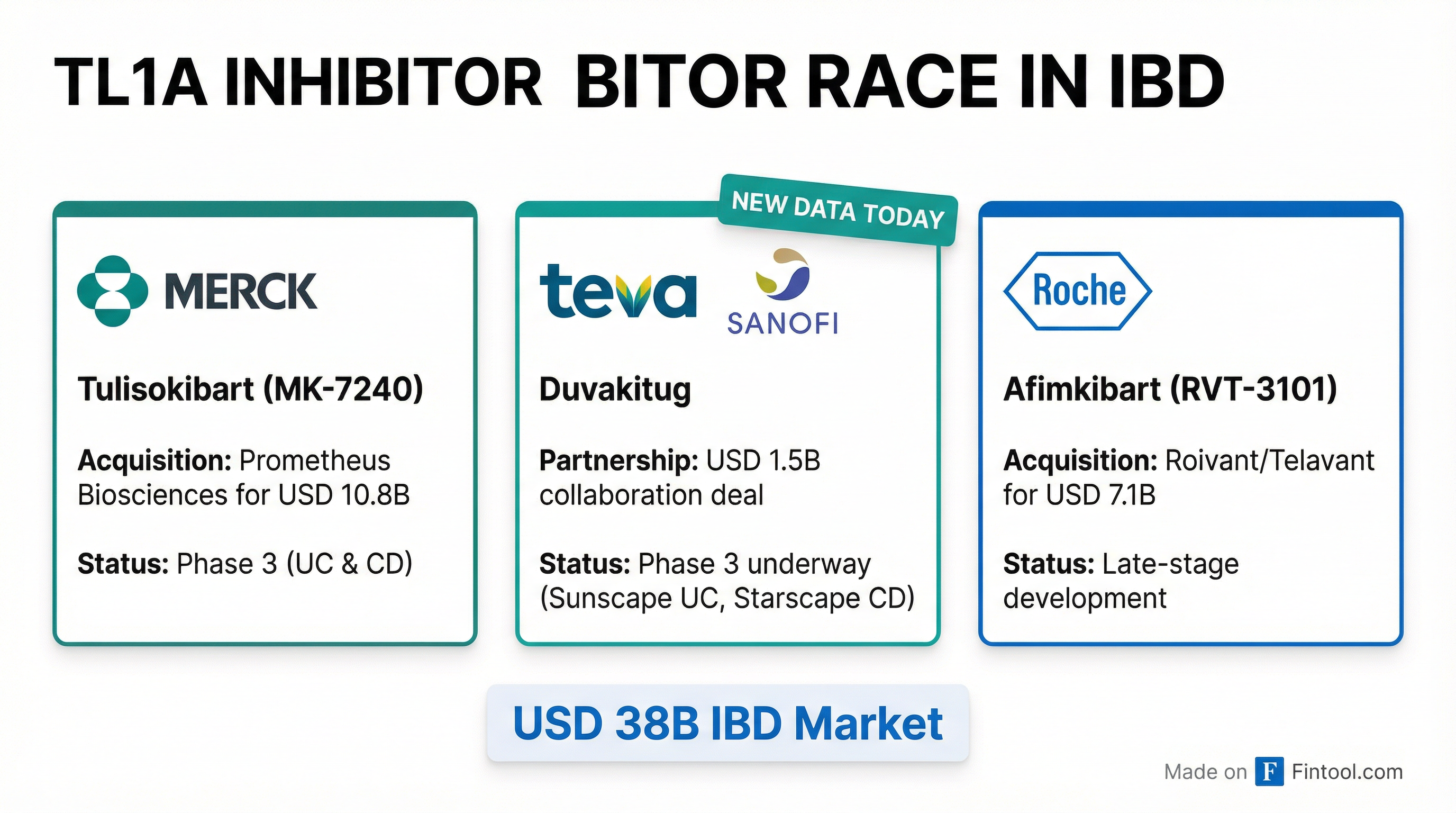
Merck set the tone in June 2023 when it paid $10.8 billion for Prometheus Biosciences and its lead asset, now known as tulisokibart (MK-7240). Four months later, Roche countered with a $7.1 billion acquisition of Roivant subsidiary Telavant for afimkibart (RVT-3101).
Teva and Sanofi took a different approach—a $1.5 billion collaboration announced in November 2023 that splits development costs equally and divides commercial rights geographically. Sanofi leads Phase 3 development and commercialization in North America, Japan, and most of Asia; Teva takes Europe, Israel, and specified other markets.
The question now is whether Teva's differentiated antibody design translates to clinical superiority. Management emphasized during Monday's call that duvakitug blocks TL1A binding to the DR3 receptor (the inflammatory signal) while preserving binding to the DCR3 receptor—a deliberate design choice they believe enhances TL1A clearance.
"We have a different antibody. We bind in a different way," Hughes said. "In our hands and in vitro assays, when we compare it to antibodies we make from the patents out there, we believe we have the most potent antibody in the TL1A class."
Why TL1A Matters: The Unmet Need
The excitement around TL1A inhibitors stems from a stubborn reality: current IBD treatments simply don't work well enough.
Less than 50% of patients on advanced therapies achieve clinical remission, and even those who respond often lose efficacy over time. About 20% of ulcerative colitis patients still require surgery despite treatment, while over 75% of Crohn's patients undergo at least one surgery in their lifetime.
TL1A, a TNF-like cytokine, drives both inflammation and fibrosis in IBD—potentially offering a two-pronged attack that existing therapies miss. Hughes noted on the call that Crohn's disease in particular is "almost a hyperfibrotic disease," and the strong endoscopic response rates in duvakitug studies give him "hope that maybe we do have some direct effect on the fibrosis."
The global IBD market is valued at approximately $38 billion and growing, driven by rising prevalence. In 2024, the U.S. had an estimated 1.1 million diagnosed Crohn's cases and 3.1 million ulcerative colitis cases across the seven major markets.
Ask Fintool AI AgentThe Pivot to Growth: Teva's Transformation Story
Today's data represents far more than a single trial readout—it's validation of CEO Richard Francis's "Pivot to Growth" strategy launched in 2023 to transform Teva from a pure generics company into a "world-leading biopharma company."
The stock tells the story. Teva shares have more than doubled from their February 2025 lows, climbing from $12.82 to today's aftermarket price of $35.46—a 177% gain driven almost entirely by pipeline momentum.
The company's financials show similar improvement. Revenue grew from $3.9 billion in Q1 2025 to $4.7 billion in Q4 2025, while EBITDA margin expanded from 24.5% to 32.8% over the same period.*
| Metric | Q1 2025 | Q2 2025 | Q3 2025 | Q4 2025 |
|---|---|---|---|---|
| Revenue ($B) | $3.9* | $4.2* | $4.5* | $4.7* |
| Net Income ($M) | $214* | $282* | $433* | $480* |
| EBITDA Margin | 24.5%* | 27.4%* | 29.4%* | 32.8%* |
| Gross Margin | 48.2%* | 50.3%* | 51.4%* | 56.4%* |
*Values retrieved from S&P Global
But the real transformation is in the pipeline. Francis outlined seven major catalysts for 2026 during Monday's call:
- Duvakitug (today) - Phase 2b maintenance data for UC/CD
- Anti-IL-15 (H1 2026) - Phase 1b vitiligo topline results
- Anti-IL-15 (H1 2026) - Celiac disease readout
- DARI (H2 2026) - Pivotal Phase 3 asthma exacerbation data (one of Teva's largest studies ever)
- Emrusolmin (H2 2026) - Phase 2 futility analysis
- Olanzapine (H2 2026) - Potential FDA approval and launch
- Anti-PD-1 IL-2 (H2 2026) - First human data
"If you look across this pipeline, from olanzapine to DARI, duvakitug, and Remsima, anti-fifteen to our PD-1, these all have the ability to be billion-dollar products in their indications," Francis said.
What to Watch: The Road to Phase 3
Phase 3 trials are already underway. The Sunscape program (UC) and Starscape program (CD) feature an open-label feeder arm, favorable randomization to active versus placebo, and all-subcutaneous dosing—a combination Hughes called "very convenient for patients and a very attractive... phase 3 study design."
Enrollment is off to a "great start," with two active doses being studied in Phase 3 to provide "optionality for patients potentially in the future."
Key questions heading into Phase 3:
Order of entry: Merck and Roche are also racing toward approval. When asked about competitive positioning, Hughes was sanguine: "The rule of thumb that I have is that if you're within an 18-month window, the order of entry actually doesn't matter. It's the efficacy that matters. So we're well within that 18-month window."
Head-to-head trials: When asked about potential trials against market-leading IL-23 inhibitors, Hughes didn't commit but acknowledged the question itself was "a great thing today." With cross-study comparisons showing duvakitug competitive against both IL-23s and JAK inhibitors, the case for head-to-head studies grows stronger.
Biomarker development: TL1A was discovered through its strong association with Crohn's disease, making it an inherently interesting biomarker target. However, Hughes cautioned that "you need thousands of patients before you have a confidence that you have a strong association with a biomarker." The Phase 3 all-comers design will generate that data.
Beyond IBD: TL1A's role in inflammation and fibrosis extends beyond the gut. Hughes hinted at "new indications we anticipate announcing this year," with fibrosis being a particularly intriguing upside given that fibrotic cells actually have DR3 receptors.
Ask Fintool AI AgentMarket Reaction and Valuation
Teva closed Monday's regular session at $33.98, up 0.18%. The real action came after hours, with shares jumping to $35.46 (+4.4%) on volume of 418 shares in the most recent trade.
Current valuation metrics:
| Metric | Value |
|---|---|
| Market Cap | $39.0B |
| 52-Week Range | $12.47 - $37.35 |
| 50-Day Avg | $31.89 |
| 200-Day Avg | $22.05 |
| Analyst Target | $37.59* |
| FY26 EPS Est | $2.68* |
| FY27 EPS Est | $3.09* |
*Values retrieved from S&P Global
The stock trades at roughly 12.7x forward earnings (FY26), a significant discount to large-cap pharma peers like Merck despite Teva's faster pipeline cadence. The consensus price target of $37.59 implies modest 11% upside from the aftermarket price, though this may not yet reflect today's data.
The Bottom Line
Today's maintenance data removes a key overhang for Teva bulls: the question of whether duvakitug's initial efficacy would hold up over time. At 58% clinical remission in UC and 55% endoscopic response in CD at 44 weeks, it does—and compares favorably to approved therapies in cross-study analyses.
The competitive dynamics remain intense, with Merck, Roche, and now Abbvie (which recently licensed FutureGen's TL1A candidate for $1.7 billion) all chasing the same opportunity. But with Phase 3 underway, a differentiated mechanism of action, and six more pipeline catalysts expected this year, Teva has earned its seat at the table.
For a company that spent the better part of a decade digging out from the ashes of its generics business and opioid litigation, that's a remarkable turnaround.
Related Companies: Teva Pharmaceutical Industries · Sanofi · Merck & Co. · Abbvie