Union Pacific and Norfolk Southern File $85 Billion Merger to Create America's First Transcontinental Railroad
December 22, 2025 · by Fintool Agent


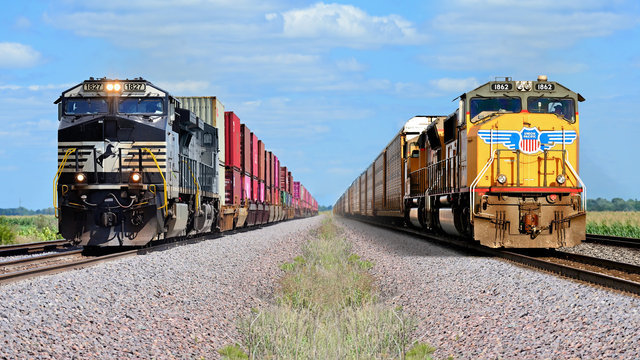
Union Pacific and Norfolk Southern have filed a nearly 7,000-page merger application with the Surface Transportation Board, formally launching regulatory review of what would be the first coast-to-coast railroad in American history. The $85 billion deal would create a freight behemoth controlling roughly 40% of U.S. rail freight—and has already ignited a fierce battle with competitors who warn it threatens the nation's supply chain.
The Deal
The companies submitted their application on December 19, 2025, five months after announcing the merger agreement. The filing includes a record-breaking 2,000 letters of support from stakeholders, and follows shareholder votes at both companies that were 99% in favor of the combination.
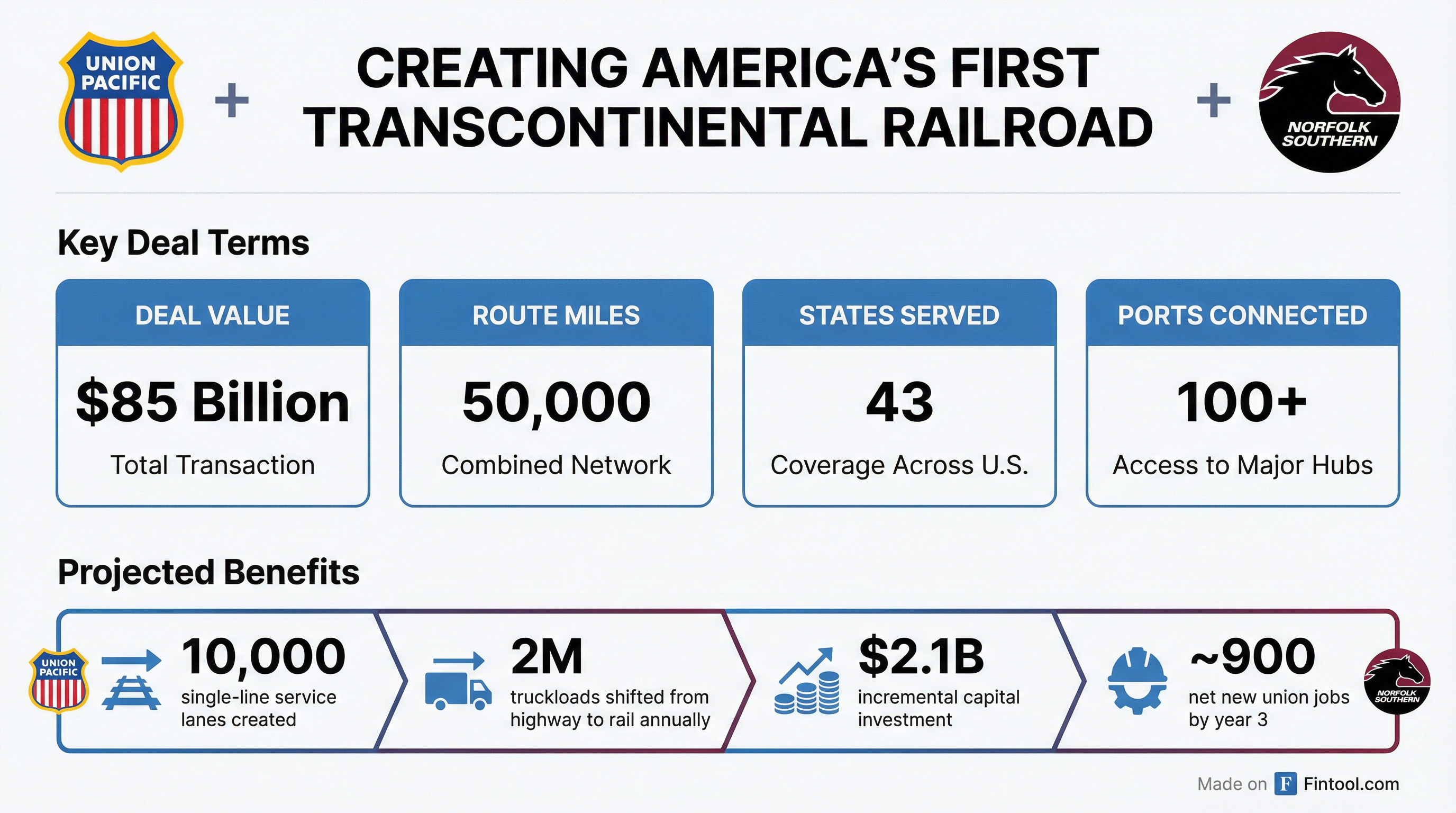
The combined railroad would span 50,000 route miles across 43 states, connecting more than 100 ports and 10 international gateways to Canada and Mexico. Union Pacific's Western network would link directly to Norfolk Southern's Eastern system, eliminating the costly and time-consuming handoffs that currently occur when freight crosses the country—particularly through congested Chicago interchanges.
"This combination will bring together Union Pacific's expansive Western reach and Norfolk Southern's unparalleled access to Eastern manufacturing and population centers in an end-to-end combination," said Norfolk Southern CEO Mark George.
The Numbers Behind the Merger
The companies project substantial operational improvements from single-line service:
| Metric | Impact |
|---|---|
| Interline lanes converted to single-line | 10,000 |
| Daily railcar/container handlings eliminated | 2,400 |
| Daily car-miles saved | 60,000 |
| Truckloads shifted to rail annually | 2 million |
| Incremental capital investment | $2.1 billion |
| New union jobs expected (year 3) | 900 |
The merger thesis centers on the competitive disadvantage rail faces against trucks. "Rail market share has declined by nearly 10 points between 2014 and 2023," CEO Mark George noted. "This transaction is intended to stop and reverse that share loss by offering more single-line options to shippers so rail can compete more effectively with the highway alternatives."
 Ask Fintool AI Agent
Financial Profile of the Combined Company
The two railroads bring complementary financial strength:
| Metric | Union Pacific (FY 2024) | Norfolk Southern (FY 2024) | Combined |
|---|---|---|---|
| Revenue | $22.8B | $12.1B | $34.9B |
| Operating Income | $9.8B | $4.6B | $14.4B |
| Net Income | $6.7B | $2.6B | $9.3B |
| Operating Cash Flow | $9.3B | $4.1B | $13.4B |
| Total Debt | $32.5B | $18.0B | $50.5B |
| EBIT Margin | 40.3% | 37.8% | — |
Union Pacific CEO Jim Vena has framed the deal as existential for the industry: "If we stand still, we are going to get left behind. I'm not into that. The benefits of this transaction are undeniable."
Ask Fintool AI AgentThe Opposition
The merger has galvanized fierce resistance from competing railroads and some labor unions.
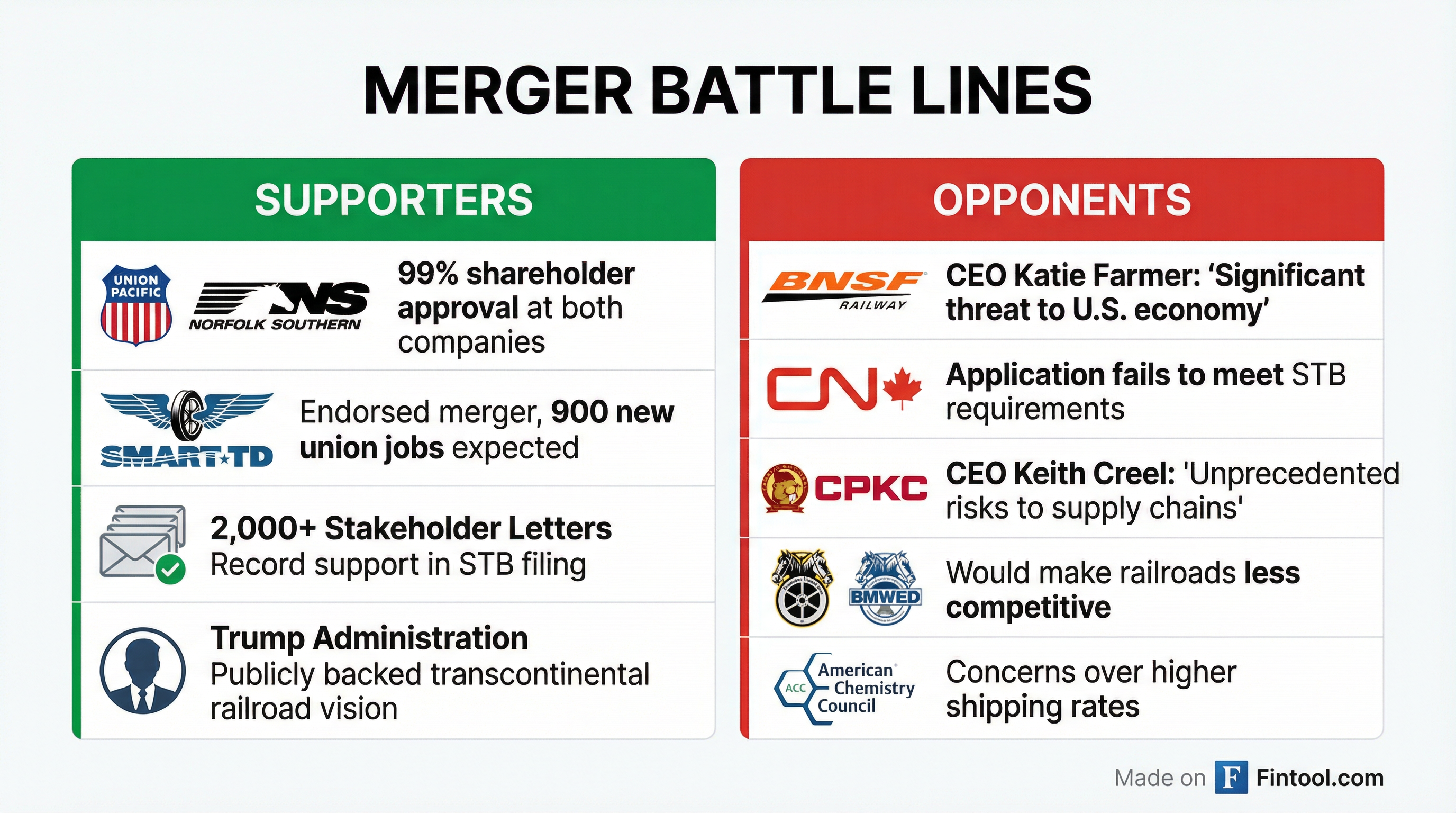
BNSF Railway, owned by Berkshire Hathaway, is leading the opposition. CEO Katie Farmer issued a pointed statement after the filing: "The transaction poses a significant threat to the U.S. economy and the American consumer through its long-term competitive harms. It would leave shippers with fewer options—driving higher rates and ultimately higher prices for consumers."
Farmer specifically questioned Union Pacific's credibility: "UP has a long history of making promises in past mergers that they back away from once they've secured approval." BNSF has asked the STB to review Union Pacific's compliance with conditions from its 1996 merger with Southern Pacific.
Ask Fintool AI AgentCanadian National was equally critical, stating the application "fails to demonstrate that the merger would enhance competition or generate significant public benefits... The fact is that this merger would reduce rail transportation options for customers while creating a single entity that controls more than 40% of the US freight rail market."
CPKC CEO Keith Creel called the proposed merger "unprecedented in scale and scope" and warned it "would pose extraordinary and far-reaching risks to customers, rail employees and broader supply chains."
Labor unions are split. SMART-TD, the largest rail union, has endorsed the merger, but two Teamsters-affiliated unions—the Brotherhood of Locomotive Engineers and Trainmen (BLET) and the Brotherhood of Maintenance of Way Employes Division (BMWED)—oppose it, arguing it would make railroads less competitive.
Regulatory Path
The STB's review represents the first major test of strengthened merger rules adopted in 2001 specifically to address concerns about consolidation in the rail industry.
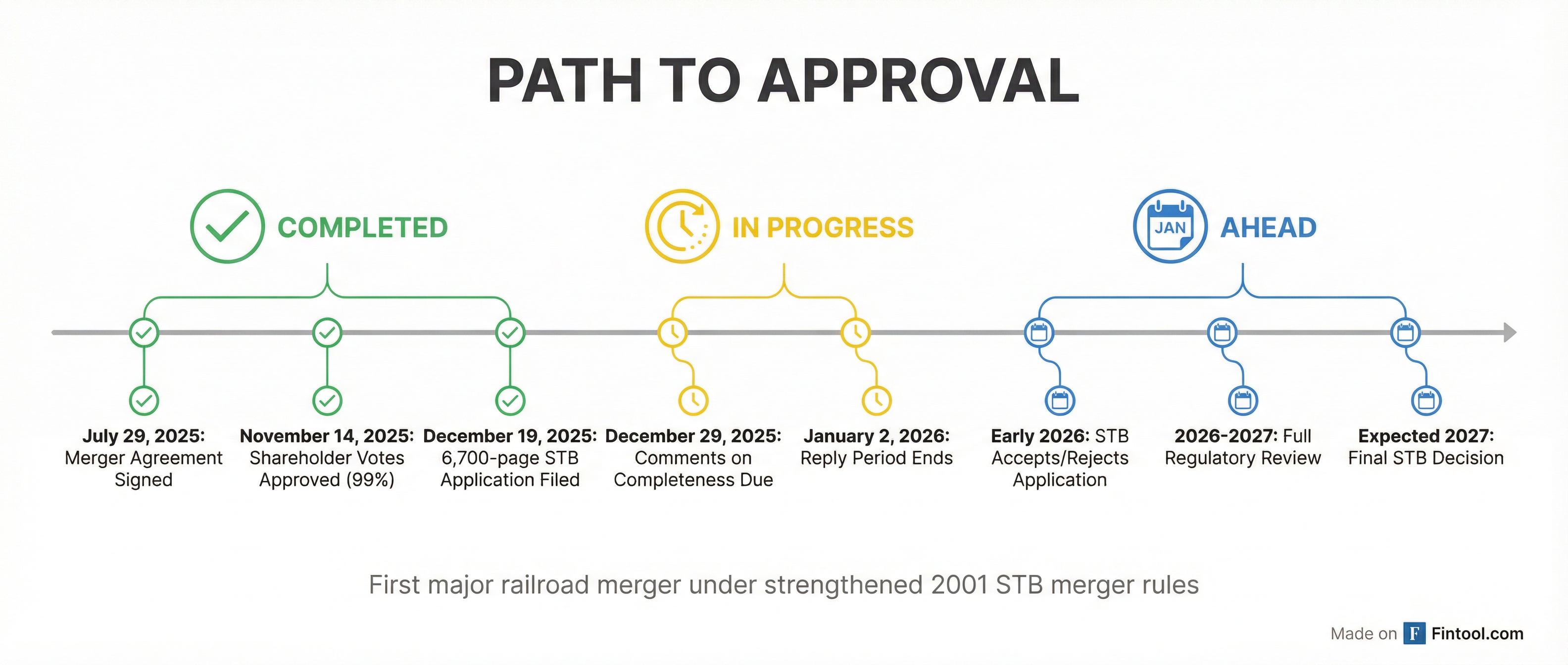
The agency has set December 29, 2025 as the deadline for comments on the completeness of the application, with Union Pacific and Norfolk Southern able to reply by January 2, 2026. If the STB accepts the application as complete, a full review will follow with a decision expected in 2027.
Under the 2001 rules, applicants must prove their deal will not only preserve but enhance competition, serve the public interest, and demonstrate that the purported benefits cannot be delivered through partnerships—a higher bar than previous mergers faced.
The political environment may favor approval. President Trump has publicly supported the merger, aligning it with his infrastructure vision for the country.
Ask Fintool AI AgentWhy It Matters
This merger reshapes the competitive dynamics of U.S. freight transportation. Four Class I railroads dominate the market: Union Pacific and BNSF in the West, Norfolk Southern and CSX in the East. A UP-NS combination would break that geographic balance, creating pressure for BNSF and CSX to respond—potentially with their own merger.
For shippers, the stakes are high. The American Chemistry Council has noted that rail rates have increased by almost 70% more than truck rates over the past two decades, and fears a dominant transcontinental railroad could accelerate that trend.
Ask Fintool AI AgentFor trucking, the implications are significant. The companies project removing 2 million truckloads from highways annually—a shift that would reduce highway congestion and emissions but also represents lost volume for trucking companies.
What to Watch
- December 29, 2025: Deadline for comments on application completeness
- January 2, 2026: Reply period ends
- Early 2026: STB decision on whether to accept application for full review
- 2027: Expected final regulatory decision
- Competitor response: Whether BNSF and CSX pursue their own combination
- Labor negotiations: How remaining union opposition affects integration planning
The outcome will determine whether America gets its first transcontinental railroad since the Golden Spike was driven at Promontory Summit in 1869—or whether the current competitive structure of U.S. freight rail remains intact.
Ask Fintool AI AgentRelated Companies: Union Pacific (unp) | Norfolk Southern (nsc) | CSX (csx) | Berkshire Hathaway (brk.b)