Waymo Raises $16 Billion at $126 Billion Valuation in Largest Autonomous Vehicle Investment Ever
February 2, 2026 · by Fintool Agent


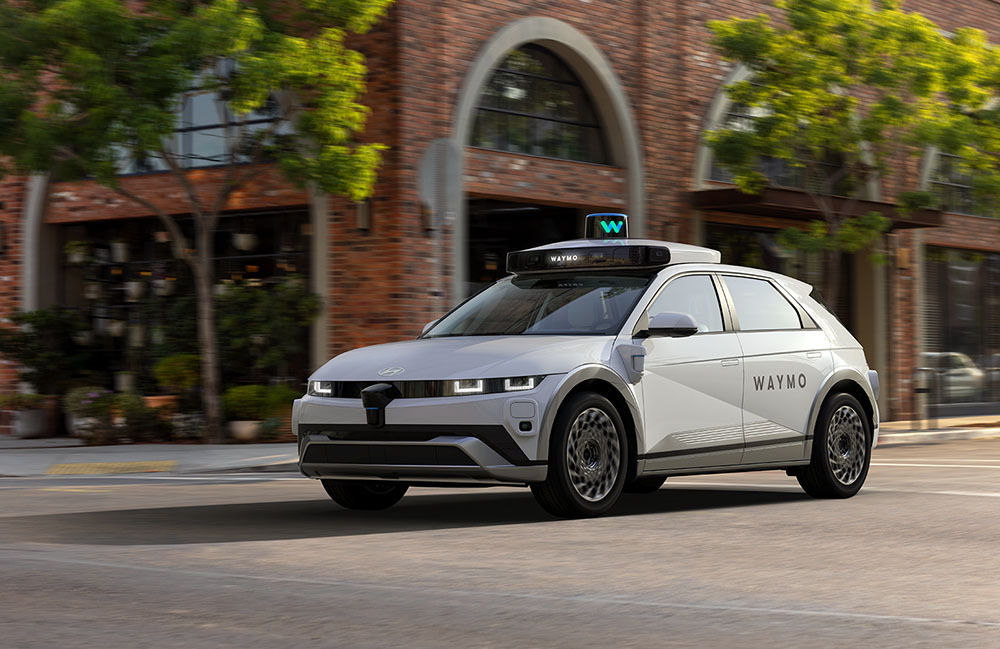
Alphabet's autonomous vehicle unit Waymo announced Monday it has raised $16 billion in a Series D funding round, valuing the company at $126 billion post-money—nearly tripling its valuation in just 16 months and cementing its position as the undisputed leader in the robotaxi race.
The investment represents the largest single funding round ever for an autonomous vehicle company, dwarfing the $5.6 billion Waymo raised at a $45 billion valuation in October 2024.
"This capital underscores that the age of autonomous mobility at scale has arrived, and Waymo is leading the way," co-CEOs Tekedra Mawakana and Dmitri Dolgov wrote in a blog post. "We are no longer proving a concept; we are scaling a commercial reality."
The Investor Roster
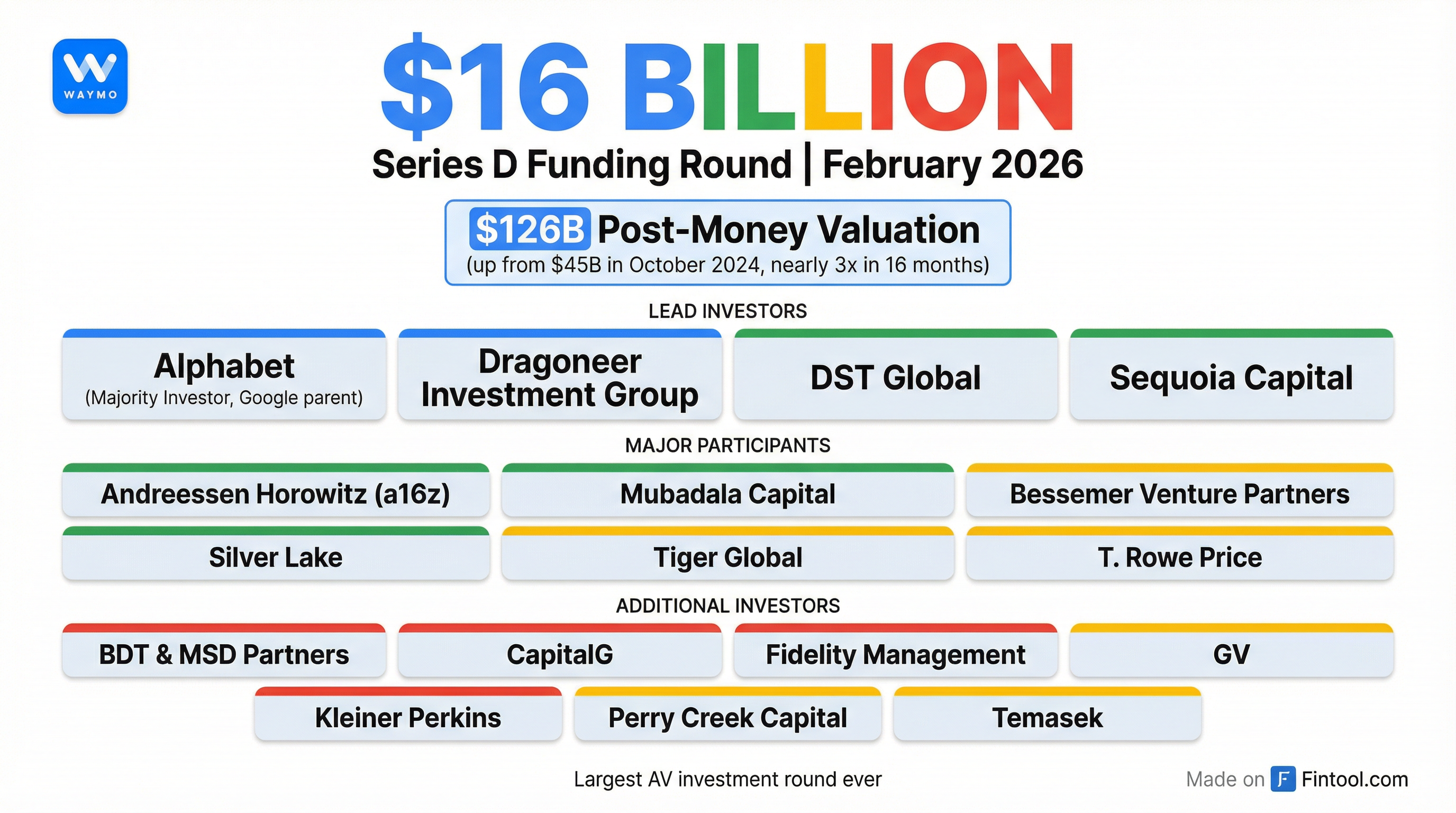
The round drew participation from a who's-who of institutional technology investors. Dragoneer Investment Group, DST Global, and Sequoia Capital led the round alongside Alphabet, which remains the majority investor.
Additional investors included Andreessen Horowitz, Mubadala Capital, Bessemer Venture Partners, Silver Lake, Tiger Global, and T. Rowe Price. BDT & MSD Partners, CapitalG, Fidelity Management & Research Company, GV, Kleiner Perkins, Perry Creek Capital, and Temasek also participated.
"Waymo has brought autonomous driving from science fiction to reality," said DST Global co-founder Saurabh Gupta. "As it scales in 2026 and beyond, Waymo will boost productivity and accessibility for millions while improving road safety worldwide."
 Ask Fintool AI Agent
Safety Record Underpins Investor Confidence
The funding comes as Waymo has compiled a safety record that the company says is "statistically superior to human driving." Across 127 million miles of fully autonomous operation—the equivalent of traveling to the moon and back over 260 times—Waymo has achieved a 90% reduction in serious injury crashes.
"The thing that excites me is I think we've been laser focused and will continue to be on building the world's best driver," Alphabet CEO Sundar Pichai said on the Q1 2025 earnings call. "Doing that well really gives you a variety of optionality in business models across geographies."
Waymo is now serving over 250,000 paid passenger trips each week—up 5x from a year ago, according to Pichai.
Aggressive Global Expansion Plans
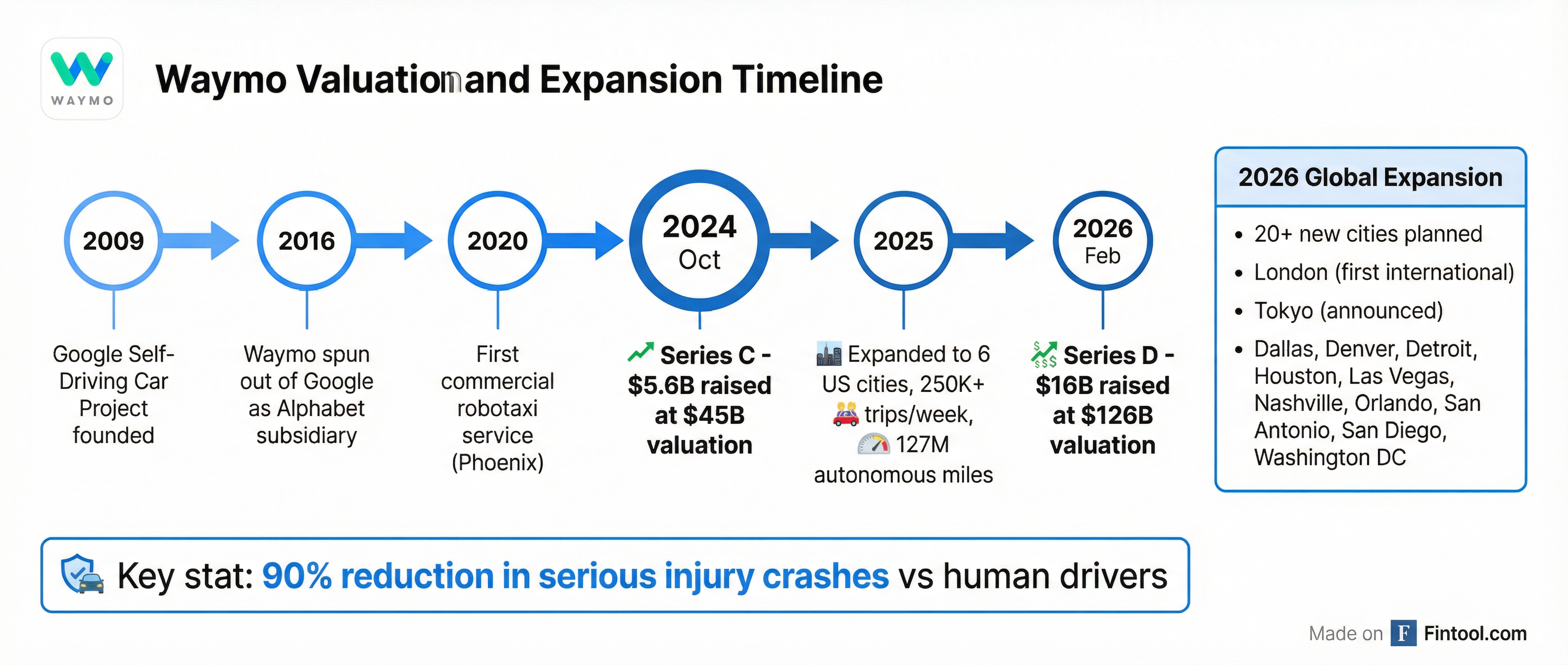
The capital infusion will fund an aggressive expansion strategy. Waymo currently operates fully driverless robotaxi services in Austin, the San Francisco Bay Area, Phoenix, Atlanta, Los Angeles, and Miami, where it began offering service in January.
In 2026, Waymo plans to expand to Dallas, Denver, Detroit, Houston, Las Vegas, Nashville, Orlando, San Antonio, San Diego, and Washington, D.C. The company will also launch in London and Tokyo—its first international markets—marking a major milestone for autonomous vehicle deployment outside the United States.
"Our focus is now on global scale, bringing the safety and magic of the Waymo Driver to even more cities this year across the United States and internationally," the company said.
Competitive Landscape: Waymo Widens Its Lead
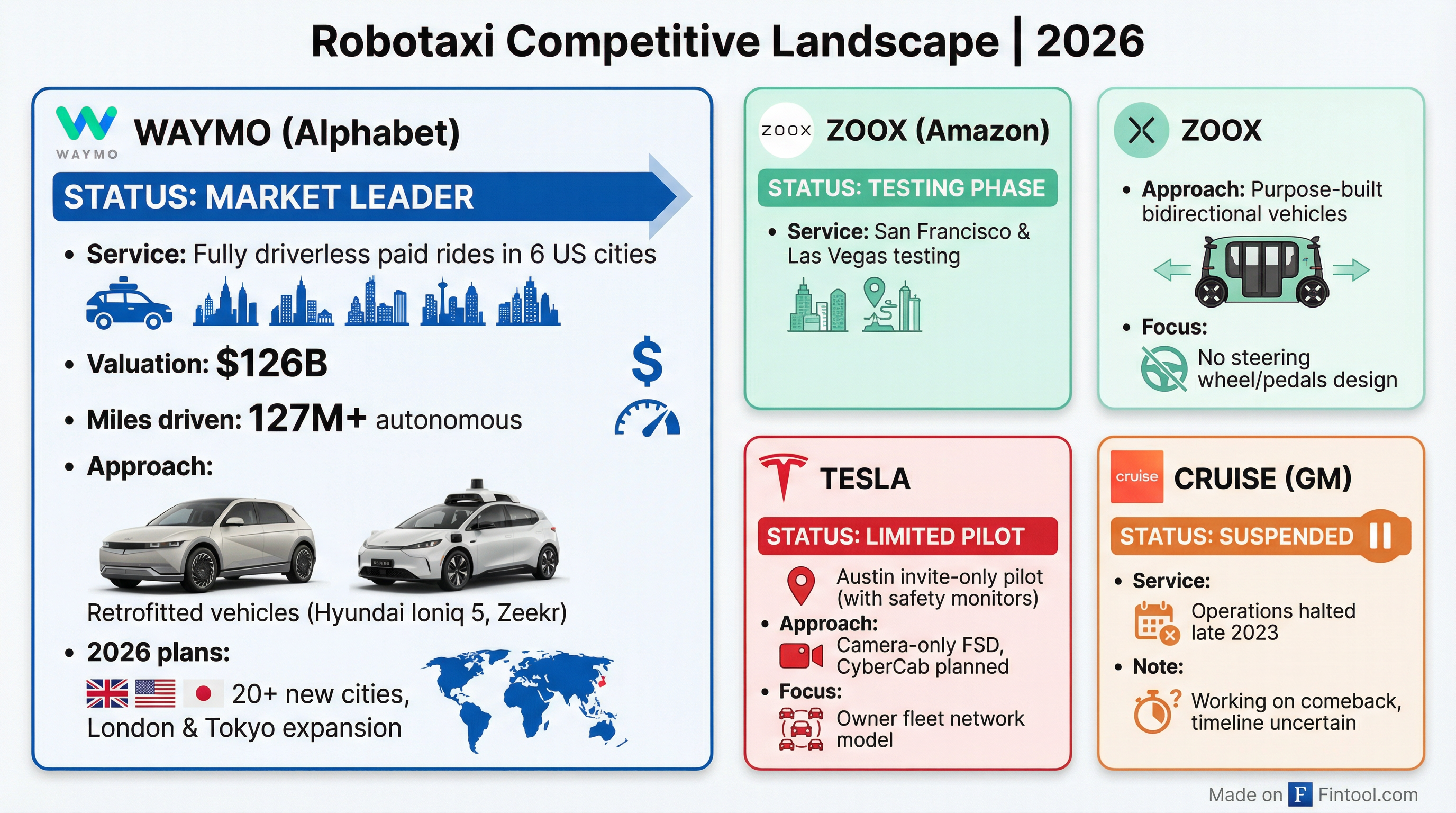
The massive funding round underscores Waymo's commanding lead in an industry that has seen several high-profile setbacks. General Motors shut down its Cruise robotaxi venture in December 2024 after a pedestrian incident the previous year, eliminating a major domestic competitor.
That leaves Amazon-owned Zoox and Tesla as the primary U.S. challengers:
-
Zoox is developing purpose-built bidirectional robotaxis without traditional driver controls, testing in San Francisco and Las Vegas.
-
Tesla launched an invite-only robotaxi pilot in Austin using modified Model Y SUVs with safety monitors. The company has announced plans for a purpose-built "CyberCab" with no steering wheel or pedals, targeted for production in 2026.
The global robotaxi market, valued at approximately $789 million in 2024, is projected to reach $97-105 billion by 2032-2035, representing a compound annual growth rate of over 80%, according to industry analysts.
Ask Fintool AI AgentWhat It Means for Alphabet Shareholders
At $126 billion, Waymo represents approximately 3% of Alphabet's $4.1 trillion market capitalization.* For context, Alphabet generated $350 billion in revenue and $100 billion in net income in FY 2024, with YouTube and Cloud exiting the year at a combined annual run rate of $110 billion.
| Metric | FY 2022 | FY 2023 | FY 2024 |
|---|---|---|---|
| Revenue ($B) | $282.8 | $307.4 | $350.0* |
| Net Income ($B) | $60.0 | $73.8 | $100.1 |
| EBIT Margin | 26.5% | 27.4% | 32.6%* |
*Values retrieved from S&P Global
The funding validates a long-term bet Alphabet has nurtured since the Google Self-Driving Car Project was founded in 2009. Waymo was spun out as a separate Alphabet subsidiary in 2016 and has gradually built toward commercial viability.
"We have a strong track record of incubating and then building these offerings into new profitable businesses for Alphabet," CFO Anat Ashkenazi said on the Q1 2025 call. "Waymo has continued to progress in building on its impressive technological achievements to scale rapidly and develop a sustainable business model."
Challenges Remain
The expansion has not been without incident. Waymo issued a software recall in December after Texas officials said the robotaxis illegally passed school buses at least 19 times since the start of the school year. In January, a Waymo vehicle struck a child near an elementary school in Santa Monica, California—an incident now under investigation by the National Highway Traffic Safety Administration.
Partnerships remain critical to scaling operations. Waymo has expanded through its alliance with Uber, launching rides through the Uber app in Austin and Atlanta, with plans to expand that partnership. The company is also building partnerships with OEMs like Hyundai and partners like Move for fleet maintenance operations in Phoenix and Miami.
Ask Fintool AI AgentWhat to Watch
The path to profitability remains unclear. Waymo completed approximately 14 million fully driverless trips in 2025, generating over $286 million in revenue at an average fare of $20.43 per ride, according to industry estimates. Whether the economics can scale to justify the $126 billion valuation will depend on continued expansion, regulatory approvals in new markets, and sustained safety performance.
Key catalysts to monitor:
- Q1 2026: Expansion progress in announced U.S. cities
- H1 2026: London regulatory approval and launch timing
- 2026: Tokyo market entry details and OEM partnerships
- Ongoing: Safety incident trends and NHTSA investigations
- Alphabet earnings: Management commentary on Waymo trip volumes and unit economics
For ride-hailing incumbents Uber and LYFT, Waymo's expansion represents both opportunity and threat—partner today, compete tomorrow. The $16 billion war chest ensures Waymo can play the long game.
Related