Waymo's $16 Billion Funding Round Values Alphabet's Robotaxi Unit at $110 Billion
February 1, 2026 · by Fintool Agent


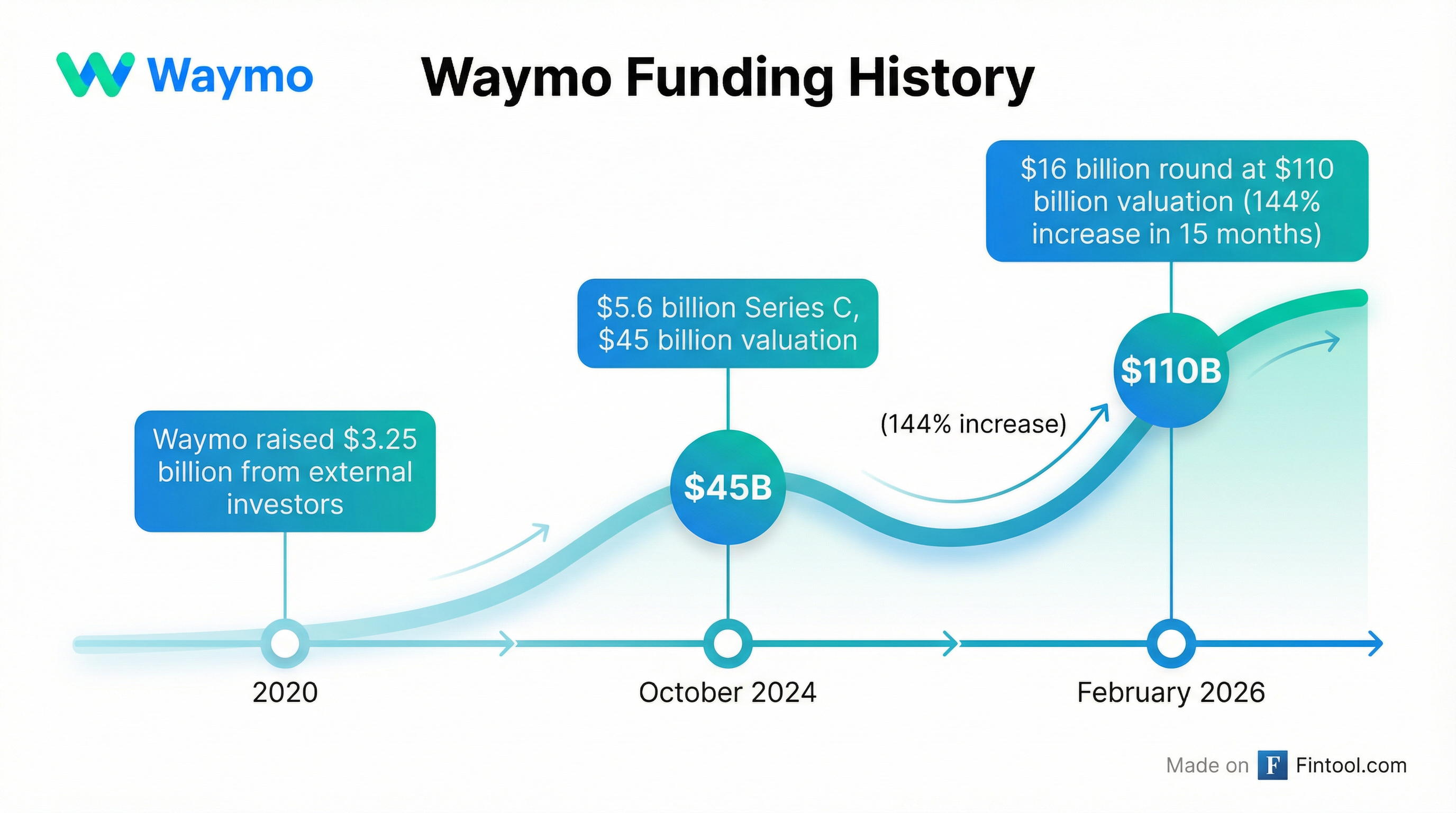
Alphabet's autonomous driving unit Waymo is finalizing a massive $16 billion funding round that values the robotaxi pioneer at nearly $110 billion—more than double its $45 billion valuation from just 15 months ago. The round, expected to close in February, marks one of the largest private tech financings in history and signals Wall Street's growing conviction that autonomous vehicles are ready for commercial scale.
Alphabet will provide approximately $13 billion, or 81% of the round, with the remaining $3 billion coming from a roster of blue-chip investors including new backers Sequoia Capital, DST Global, and Dragoneer Investment Group. Existing investors Andreessen Horowitz and Abu Dhabi sovereign fund Mubadala are also participating.
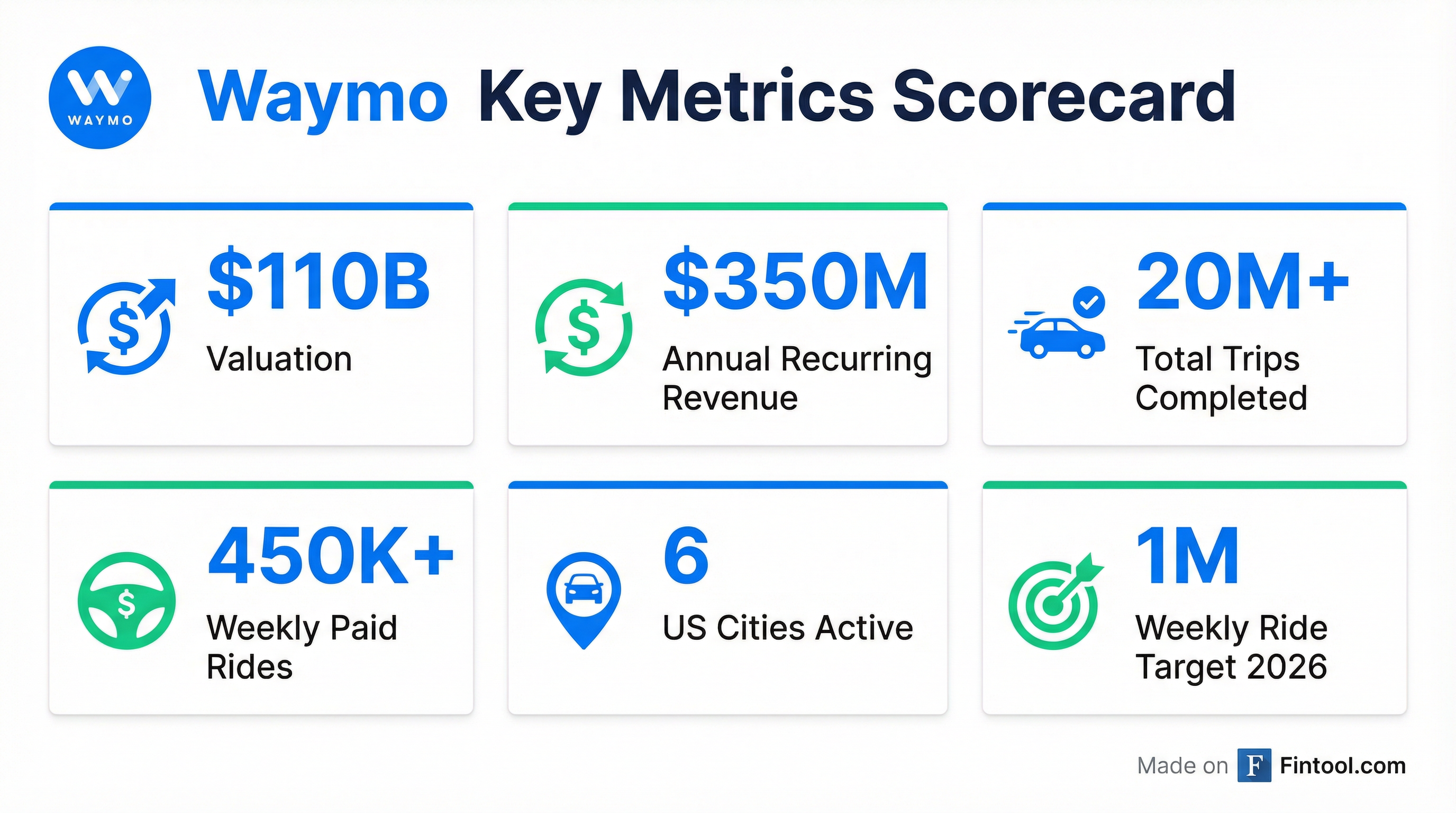
"While we don't comment on private financial matters, our trajectory is clear: with over 20 million trips completed, we are focused on the safety-led operational excellence and technological leadership required to meet the vast demand for autonomous mobility," a Waymo spokesperson said.
 Ask Fintool AI Agent
A 144% Valuation Surge in 15 Months
The new valuation represents a remarkable ascent for Waymo. In October 2024, the company raised $5.6 billion in its Series C round at a $45 billion valuation. The 144% increase since then reflects investor confidence in Waymo's operational progress and the expanding robotaxi market.
Waymo now generates more than $350 million in annual recurring revenue and provides over 450,000 paid rides weekly—a 5x increase from a year ago, according to Alphabet CEO Sundar Pichai's comments on the company's Q1 2025 earnings call. The company targets 1 million weekly rides by the end of 2026.
The funding round was reportedly three times oversubscribed, underscoring the appetite from institutional investors to gain exposure to autonomous vehicle technology. When investors of the caliber of Sequoia Capital—the firm behind Apple, Google, and countless unicorns—line up for a late-stage round, it typically signals a clear path to either IPO or massive strategic value.
Alphabet's Biggest Bet
Alphabet's willingness to commit $13 billion—the vast majority of the round—signals that the parent company views Waymo as a core growth driver rather than a peripheral moonshot experiment. The investment dwarfs Alphabet's typical venture commitments and positions Waymo as potentially the company's most valuable subsidiary after Google.
For context, Alphabet's market capitalization currently exceeds $4 trillion. At a $110 billion valuation, Waymo would represent roughly 2.7% of the parent company's total value—a meaningful contribution from a unit that was incubated in Alphabet's "X" moonshot factory.
During Alphabet's Q1 2025 earnings call, Pichai noted that "YouTube and cloud exited 2024 at a combined annual run rate of $110 billion" and highlighted Waymo's progress in building a sustainable business model. The robotaxi unit now operates in six US cities—San Francisco, Los Angeles, Phoenix, Austin (through Uber), Atlanta (through Uber), and Miami—with plans to launch in Washington, D.C. and the UK later in 2026.
Ask Fintool AI AgentThe Robotaxi Race Heats Up
The funding comes as competition in the autonomous vehicle space intensifies. Tesla's robotaxi service, launched in June 2025, has aggressively undercut competitors on pricing—averaging $8.17 per ride compared to Waymo's $19.69—but trails significantly on convenience and autonomy.

According to a recent study by rideshare comparison app Obi, Tesla's robotaxis still require human safety drivers and have average wait times of 15.3 minutes compared to Waymo's 5.7 minutes. Tesla's strategy appears reminiscent of early Uber—using aggressive pricing subsidized by capital to capture market share.
Despite the pricing disadvantage, Waymo remains the preferred robotaxi brand. In Obi's survey, 39.8% of respondents selected Waymo as their favorite robotaxi service, compared to 31.1% for Tesla. Consumer comfort with autonomous vehicles has also surged—63% of respondents now say they are comfortable with robotaxis, up from 35% in January 2025.
"I think that the novelty of riding a robotaxi or an autonomous vehicle has started to wear off in the San Francisco market, and I think that's a good thing," said Ashwini Anburajan, CEO of Obi. "More people trust the cars now."
Amazon's Zoox represents another competitor, having recently unveiled its Ojai robotaxi minivan at CES 2026. However, Zoox operates at a smaller scale and remains focused on Las Vegas.
Risks and Regulatory Hurdles
The $110 billion valuation implies significant execution risk. Waymo must continue expanding its geographic footprint while maintaining its safety record—a challenge that has tripped up competitors. General Motors abandoned its Cruise robotaxi unit in 2024 after safety incidents, and Waymo itself has faced scrutiny.
During a San Francisco blackout in late 2025, multiple Waymo robotaxis stalled at traffic lights, blocking intersections. More recently, a Waymo vehicle operated by a human driver (during testing of its new Ojai model) crashed into parked cars in Los Angeles, prompting an NHTSA investigation.
Prominent Tesla investor Gary Black warned on X that safety incidents at any autonomous vehicle company could slow the entire industry: "When competitors' unsupervised autonomous vehicles inflict injury or damage, it slows down Tesla's efforts to scale up its autonomous business as regulators hit the pause button."
The robotaxi market itself is projected to reach $1.2 trillion by 2030, with nearly 10% of all cars worldwide expected to be self-driving models. That massive addressable market helps justify Waymo's premium valuation despite its current $350 million revenue run rate.
Ask Fintool AI AgentWhat to Watch
The funding round is expected to close in February 2026, providing Waymo with substantial capital for fleet expansion and new market entry. Key catalysts to monitor:
- Geographic expansion: Waymo plans aggressive rollouts to Washington, D.C. and UK markets, plus deeper penetration in existing cities
- Ride volume growth: Progress toward the 1 million weekly rides target will validate the company's scalability thesis
- Uber partnership dynamics: Waymo's integration with Uber in Austin and Atlanta could accelerate adoption and provide a template for future city launches
- Tesla's FSD Gen 3: Elon Musk has hinted at unveiling Tesla's next-generation Full Self-Driving system in early 2026, which could reshape competitive dynamics
- Path to profitability: As Alphabet prepares for Waymo to contribute meaningfully to financials by 2027, the unit's burn rate and margin trajectory will face increased scrutiny
For Alphabet investors, the round crystallizes Waymo's value proposition. At $110 billion, the robotaxi unit is worth more than most standalone tech companies—and its success or failure could materially impact Alphabet's total valuation as autonomous mobility transitions from science project to commercial reality.