Williams Weighs Return to E&P After 14 Years to Feed AI Hyperscalers
February 6, 2026 · by Fintool Agent


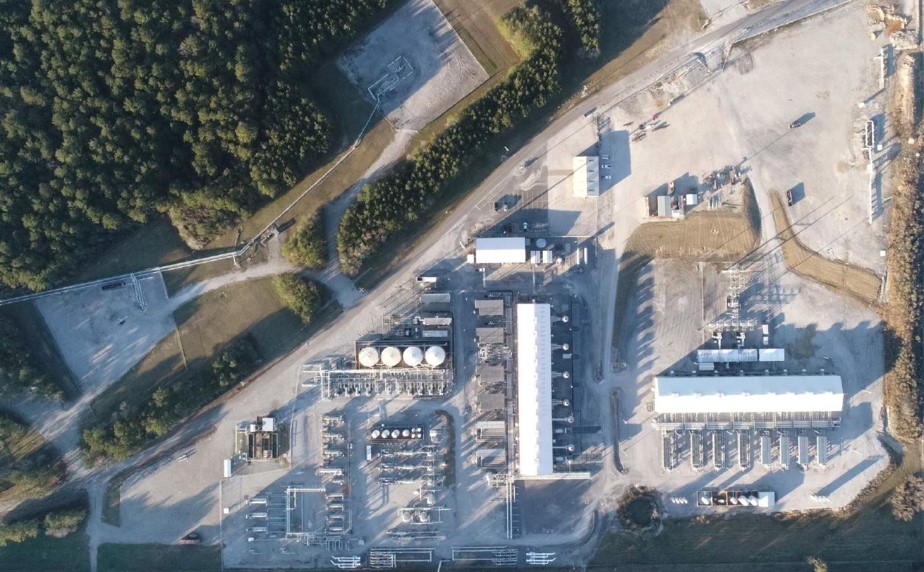
The Williams Companies (WMB) is exploring acquisitions of natural gas production assets in a potential return to upstream operations after more than a decade, as the $81 billion pipeline giant seeks to position itself as a single energy partner for hyperscalers and data center operators, according to a Reuters exclusive report.
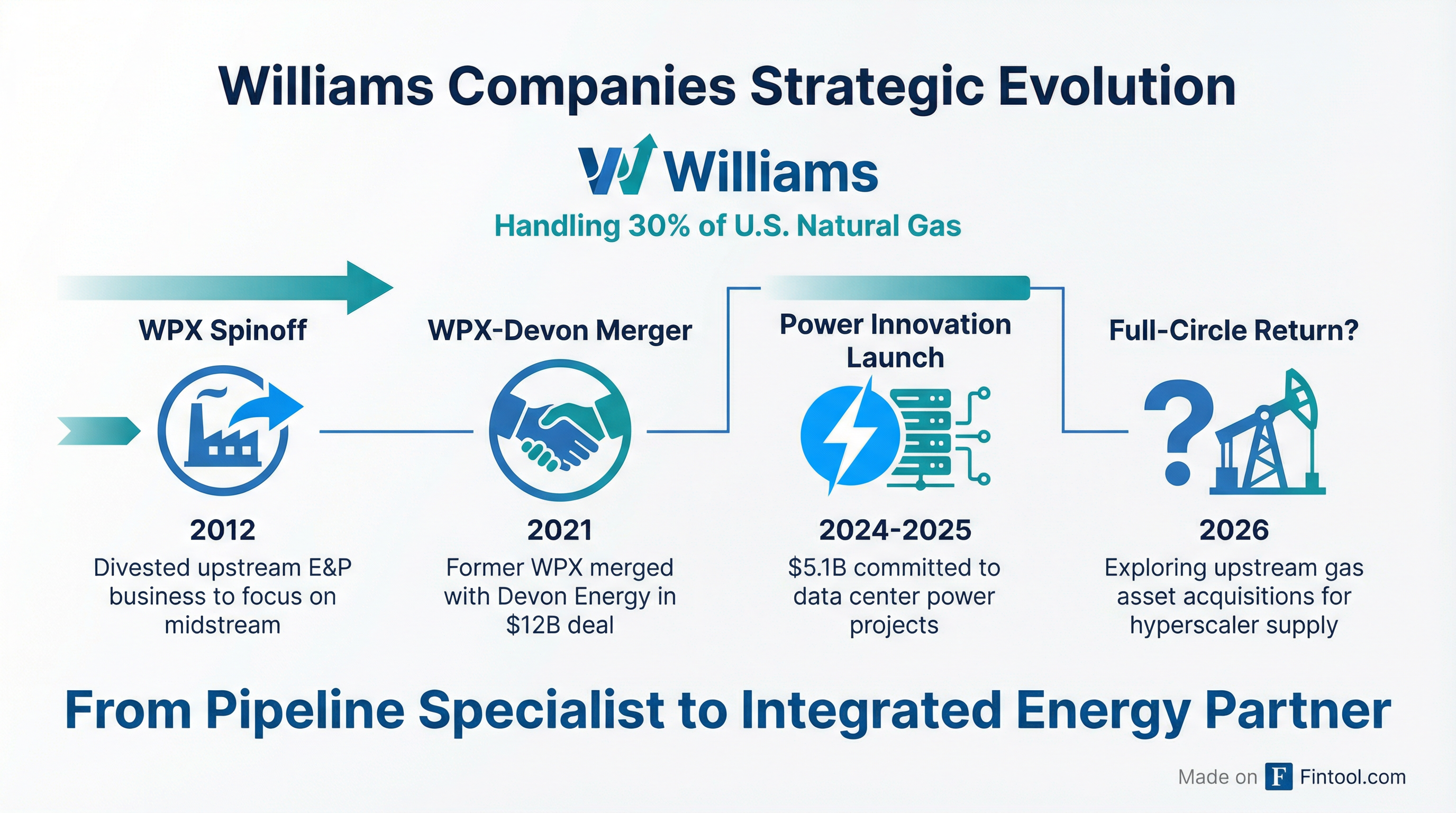
The Tulsa-based company spun off its exploration and production business as WPX Energy in January 2012—which later merged with Devon Energy in a $12 billion deal in 2021. Now, Williams appears ready to reverse course, driven by insatiable AI-related power demand that is reshaping the energy landscape.
Shares of Williams traded at $67.16, down 0.4%, near all-time highs and up 14% year-to-date.
The Strategic Rationale: One-Stop-Shop for AI Power
The logic is straightforward: hyperscalers building out AI infrastructure would otherwise need to negotiate with multiple parties—upstream producers, midstream operators, power generators. Williams wants to simplify that equation.
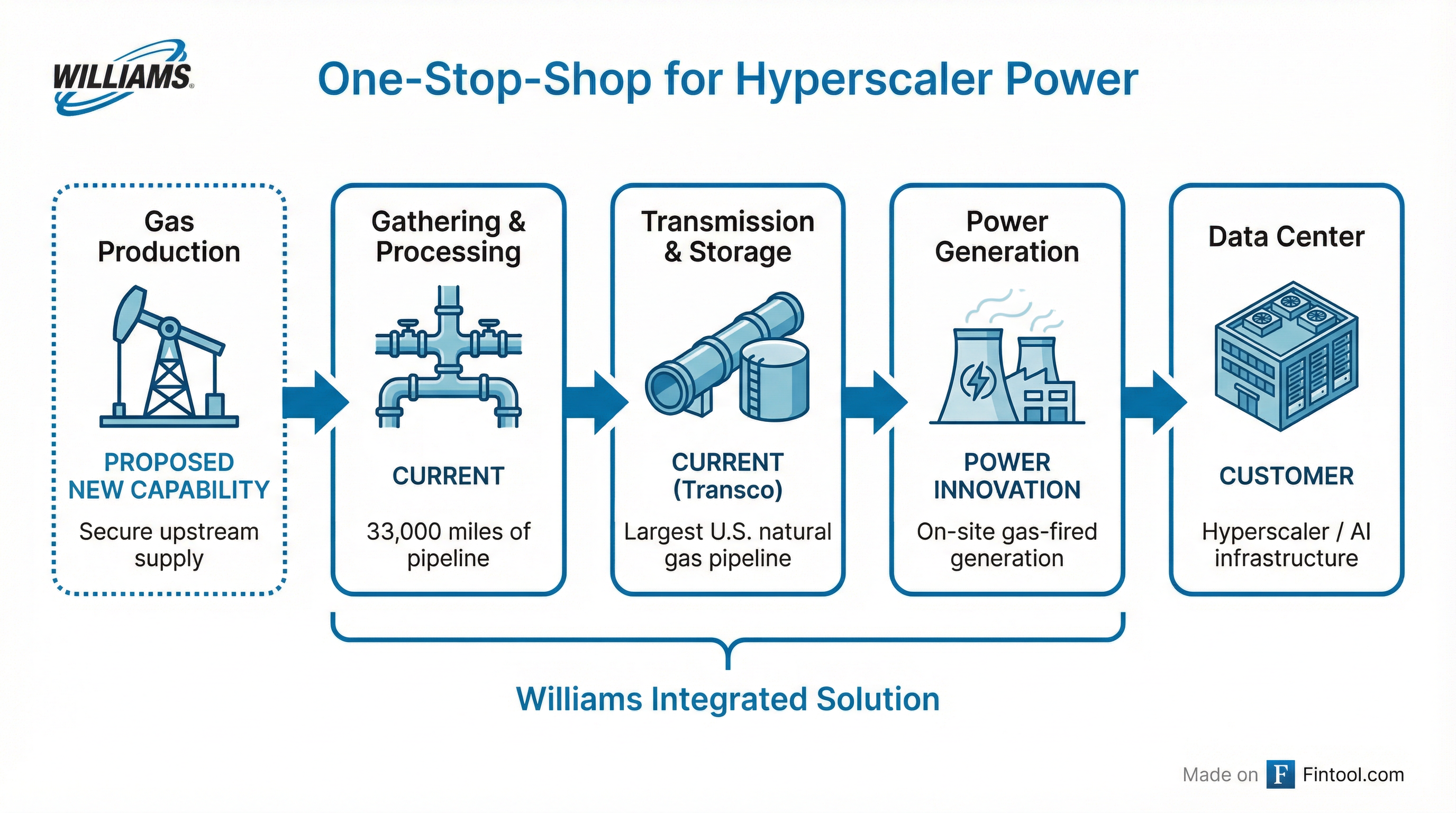
Williams already operates approximately 33,000 miles of pipelines, including Transco—the nation's largest natural gas transmission system. It has storage assets, gathering and processing operations, and now, through its "Power Innovation" initiative, is building on-site power generation facilities at data centers.
Adding upstream production would complete the value chain from wellhead to server rack.
"Williams continuously evaluates opportunities that align with and advance our natural gas-focused strategy," the company said in a statement, declining to comment further on specific acquisition plans.
 Ask Fintool AI Agent
Power Innovation: $5.1 Billion and Counting
Williams isn't starting from scratch in the AI energy race. The company has committed approximately $5.1 billion to its Power Innovation projects, targeting a five-times EBITDA build multiple.
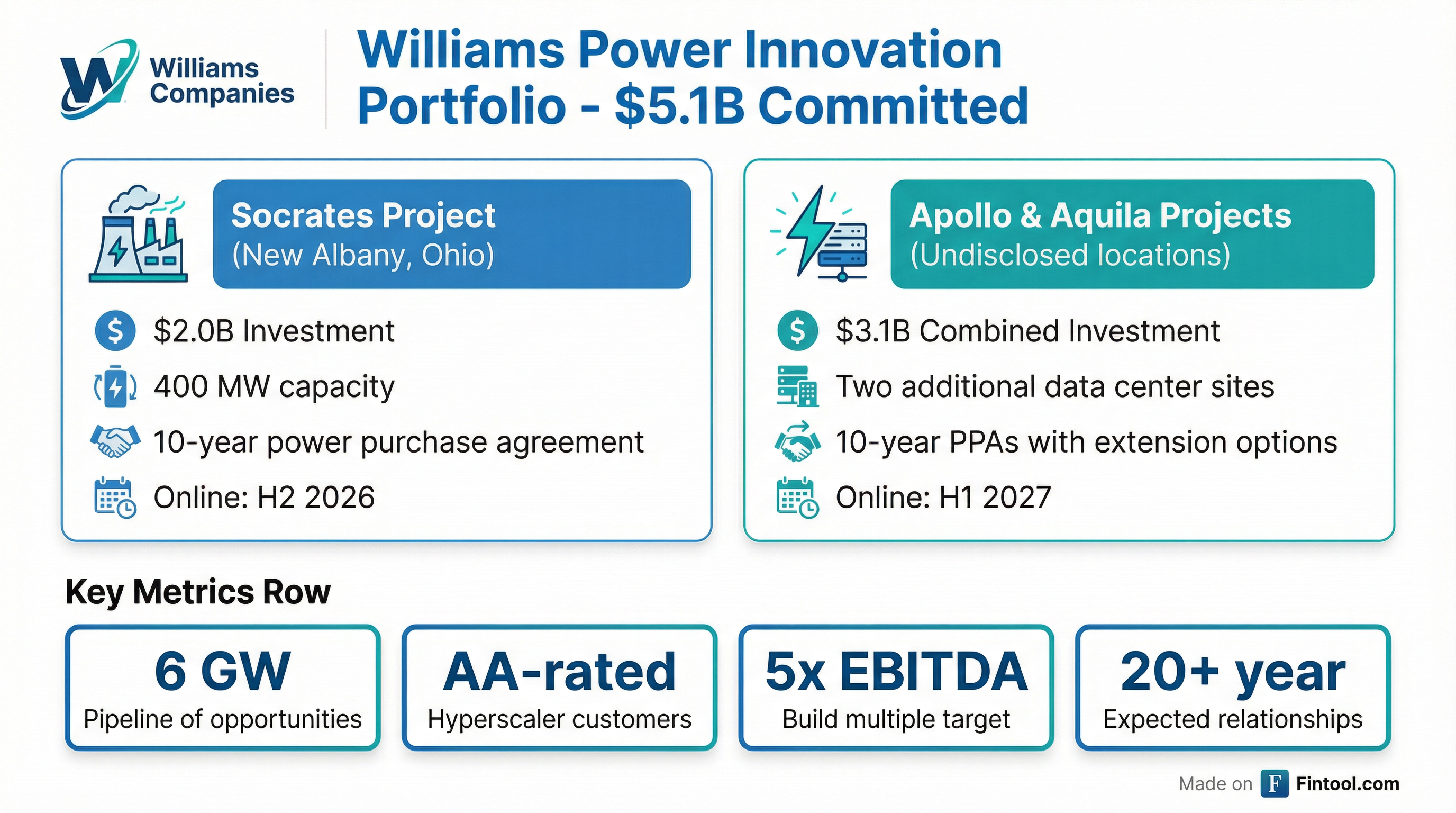
The flagship Socrates project in New Albany, Ohio involves construction of North and South power generation facilities providing 400 megawatts of committed onsite power generation capacity. The project is backed by a ten-year, primarily fixed-price power purchase agreement with an option to extend, and is expected to come online in the second half of 2026. Williams has agreed to invest approximately $2 billion in the project.
Two additional Power Innovation projects, announced in late September 2025, represent an additional $3.1 billion in committed capital and are expected to be completed in the first half of 2027.
CEO Chad Zamarin has emphasized the pipeline of opportunities extends to approximately 6 gigawatts of potential projects, with conversations ongoing "across the entire footprint."
"We continue to see very, very robust engagement and interest in both speed to market, but also just long-term need for power for data centers," Zamarin said on the Q3 2025 earnings call. "We see that backlog strengthen... it extends throughout the end of the decade and beyond."
Why Re-Enter Upstream Now?
The energy industry spent the early 2000s disaggregating—companies like Williams divested non-core operations to focus on their preferred segments. Integrated models remained the domain of supermajors like Exxon Mobil and Chevron.
But AI has changed the calculus. Securing power for data centers has become one of the biggest challenges for hyperscalers. Power providers are struggling to keep up with grid demand growth not seen in two decades. New projects face local opposition and multi-year wait times for key power-plant components.
For Williams, owning production assets would:
- Secure reliable supply for its pipeline and power generation infrastructure
- Create competitive differentiation against rivals who can only offer partial solutions
- Strengthen customer relationships with hyperscalers seeking long-term energy partners
- Capture margin across the full value chain
The company already demonstrated this playbook in October 2025 when it sold its Haynesville upstream interests to Japan's JERA for $398 million while simultaneously announcing a strategic partnership with Woodside Energy to build and operate Line 200, a 3.1 Bcf/d pipeline connecting to Louisiana LNG.
Ask Fintool AI AgentFinancial Position: Ready to Deploy Capital
Williams enters this potential expansion from a position of strength. The company has delivered a five-year EBITDA compound annual growth rate of approximately 9% and expects to beat its 2025 guidance of $7.75 billion in adjusted EBITDA.
| Metric | Q4 2023 | Q1 2024 | Q2 2024 | Q3 2024 | Q4 2024 | Q1 2025 | Q2 2025 | Q3 2025 |
|---|---|---|---|---|---|---|---|---|
| Revenue ($B) | $2.47 | $2.78 | $2.47 | $2.65 | $2.86 | $3.11 | $2.75 | $2.87 |
| EBITDA ($B) | $1.64 | $1.59 | $1.24 | $1.41 | $1.38 | $1.69 | $1.55 | $1.70 |
| EBITDA Margin | 66.2% | 57.2% | 50.1% | 53.1% | 48.3% | 54.4% | 56.5% | 59.2% |
| CapEx ($M) | $689 | $544 | $606 | $728 | $800 | $1,012 | $1,012 | $994 |
*Values retrieved from S&P Global
CFO John Porter noted the balance sheet is positioned for significant investment capacity. "We've seen now for a number of years a real inflection point coming after 2025 where the balance sheet deleveraging was going to slip below our targeted leverage range of three and a half to four times," Porter said. "The projects that are coming to us... look like they're going to fit very nicely with what's happening on the balance sheet."
Growth capital expenditures for 2025 are expected to range from $3.95 billion to $4.25 billion, excluding acquisitions—a significant step-up that includes the Power Innovation projects, Haynesville basin expansion, Transco projects, and the Louisiana LNG investments.
Analyst Day: Tuesday's Potential Catalyst
Williams reports Q4 2025 earnings and hosts its 2026 Analyst Day on Tuesday, February 11. The event could provide crucial clarity on:
-
Updated EBITDA growth targets: UBS analysts noted in a February 4 report they're watching for Williams to raise its 5-7% annual EBITDA growth target to above 7% compound annual growth through 2030.
-
Capital allocation strategy: Management has teased a "really exciting chapter ahead" with the balance sheet in better shape and the opportunity set "arguably even better than over the last five years."
-
Upstream acquisition details: Any specifics on target basins, size, or timeline could move the stock significantly.
Wall Street consensus sees Williams earning $2.12 per share in FY 2025 and $2.26 in FY 2026, with revenue expected to grow 7.5% to $12.8 billion next year.*
*Values retrieved from S&P Global
What to Watch
The potential return to upstream carries risks. Integration challenges, commodity price exposure, and capital allocation discipline will be critical. Williams emphasized there's no guarantee it will move forward with the plan.
But with hyperscalers increasingly seeking long-term, integrated energy solutions—and competitors unable to offer the same breadth—Williams' bet on vertical integration could prove prescient.
"Natural gas is our country's affordability superpower," Zamarin said on the last earnings call. "Any market in the U.S. that has been able to manage energy affordability... has done that by leveraging low-cost, abundant, reliable natural gas."
For data centers consuming megawatts by the hundreds, that message resonates.
Ask Fintool AI AgentRelated
- The Williams Companies — Company Profile
- Devon Energy — Company Profile