Alphabet Buys Intersect Power for $4.75 Billion in Bold Bet on AI Energy
December 22, 2025 · by Fintool Agent


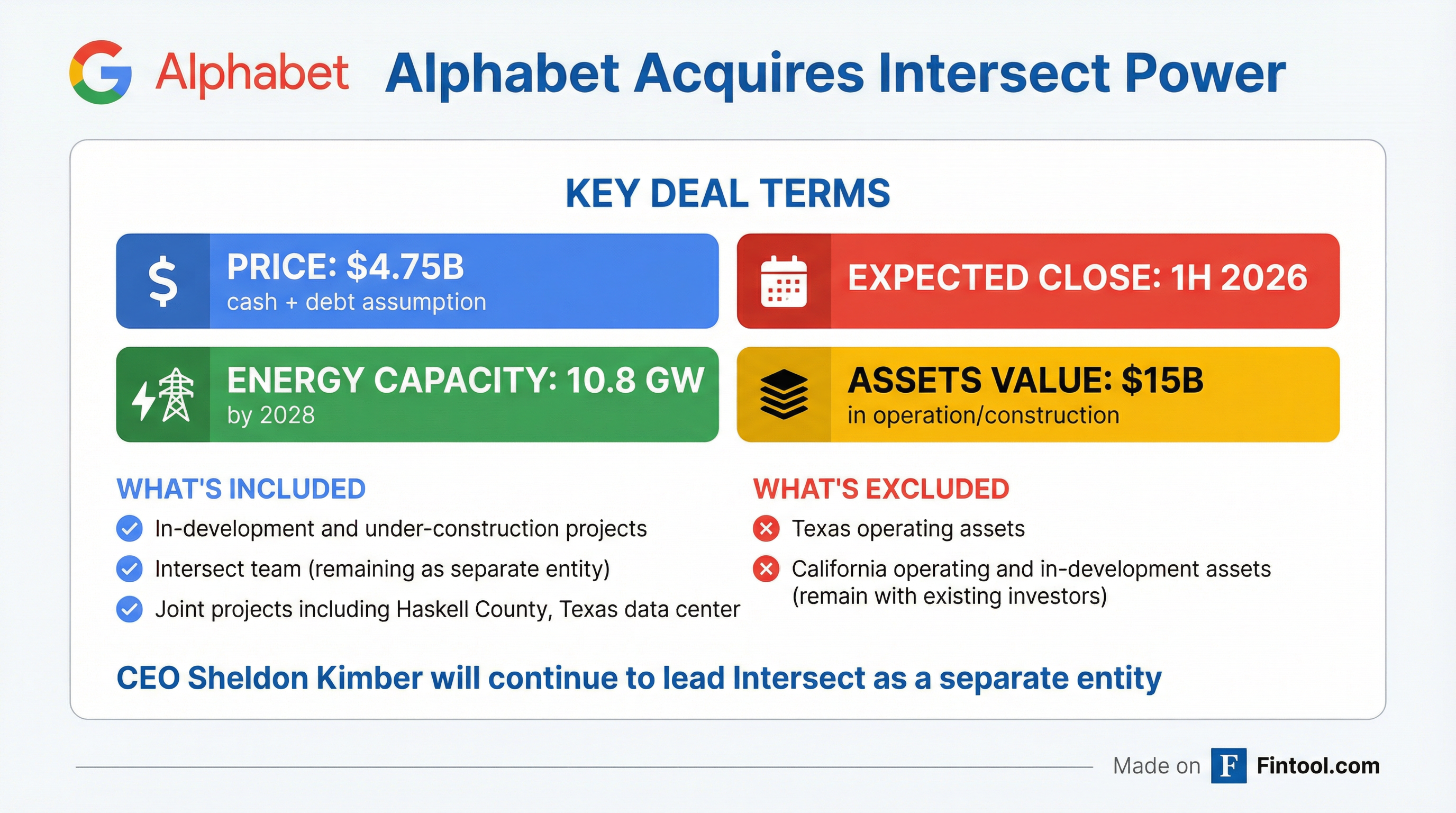
Alphabet-2.53% is acquiring Intersect Power, a clean energy and data center infrastructure developer, for $4.75 billion in cash plus the assumption of debt—the most aggressive move yet by a hyperscaler to vertically integrate the power generation needed to fuel AI.
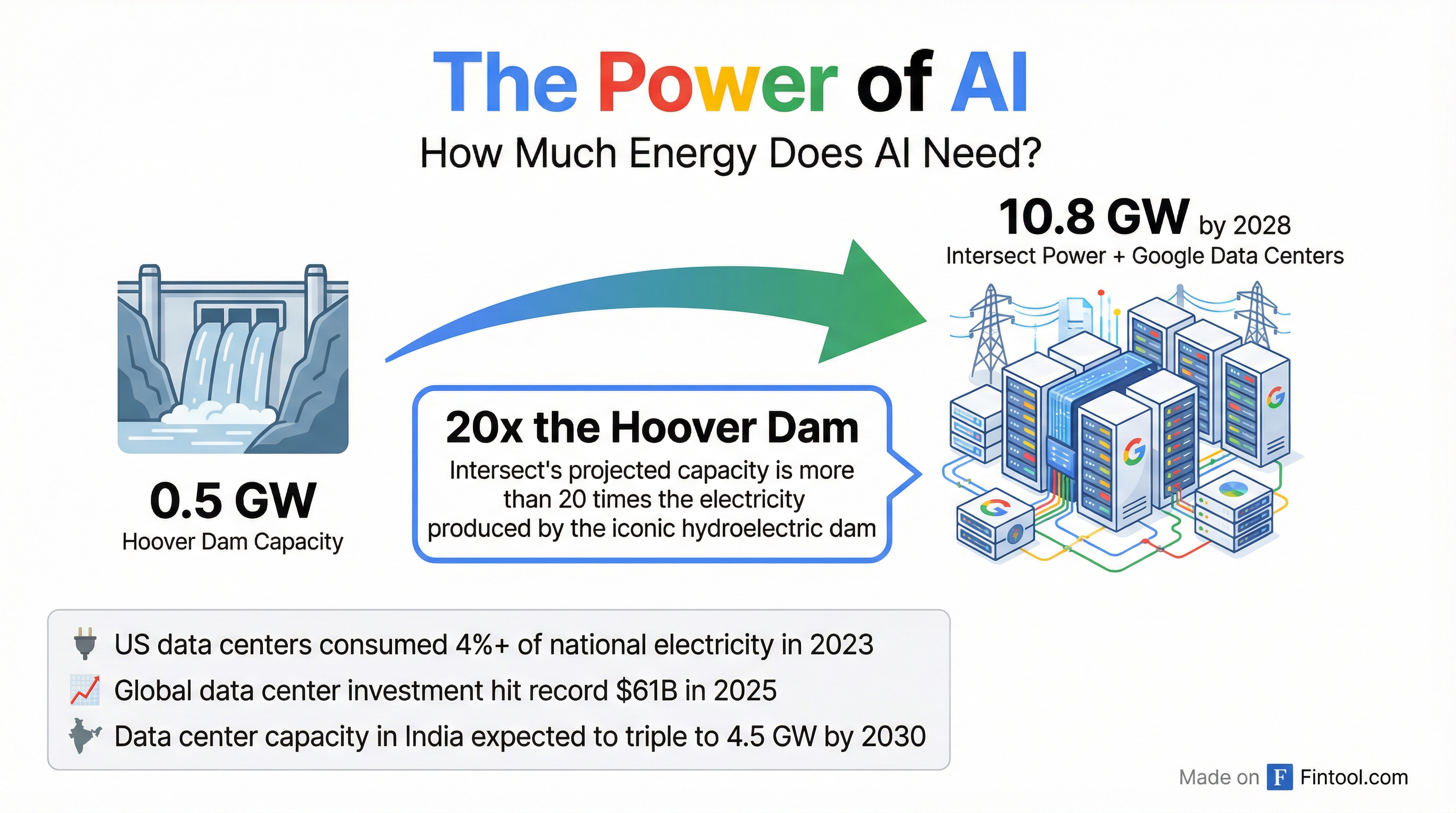
The deal, announced Monday and expected to close in the first half of 2026, gives Google access to several gigawatts of energy and data center projects currently under development or construction. By 2028, Intersect projects representing approximately 10.8 gigawatts of power are expected to be online or in development—more than 20 times the electricity produced by the Hoover Dam.
The Strategic Logic: Building Power in Lockstep With Data Centers
"Intersect will help us expand capacity, operate more nimbly in building new power generation in lockstep with new data center load, and reimagine energy solutions to drive US innovation and leadership," said Sundar Pichai, CEO of Google and Alphabet.
The acquisition represents a fundamental shift in how Big Tech is approaching the AI infrastructure challenge. Rather than simply signing power purchase agreements or waiting in line for grid connections, Alphabet is bringing the energy development capability in-house.
Intersect, founded by CEO Sheldon Kimber, has built a portfolio of 2.2 gigawatts of operating solar PV and 2.4 gigawatt-hours of battery storage across Texas and California. The company has $15 billion of assets either operating or under construction, including its Quantum project in Haskell County, Texas—an 840 MW solar and 1.3 GWh battery storage facility being built directly alongside a Google data center campus.
"Modern infrastructure is the linchpin of American competitiveness in AI," Kimber said. "We share Google's conviction that energy innovation and community investment are the pillars of what must come next."
What's In—And What's Out
The deal is carefully structured. Alphabet will acquire:
- All in-development and under-construction projects
- The Intersect team and brand (remaining a separate entity)
- Joint projects including the Haskell County, Texas co-located data center and power site
However, Intersect's existing operating assets in Texas and its operating and in-development assets in California will not be part of the acquisition. Those assets will continue operating as an independent company, supported by existing investors TPG Rise Climate, Climate Adaptive Infrastructure, and Greenbelt Capital Partners.
This structure allows Alphabet to focus on the development pipeline that will power future AI workloads while avoiding the complexity of taking over active generation facilities with existing offtake agreements.
The Capex Arms Race Intensifies
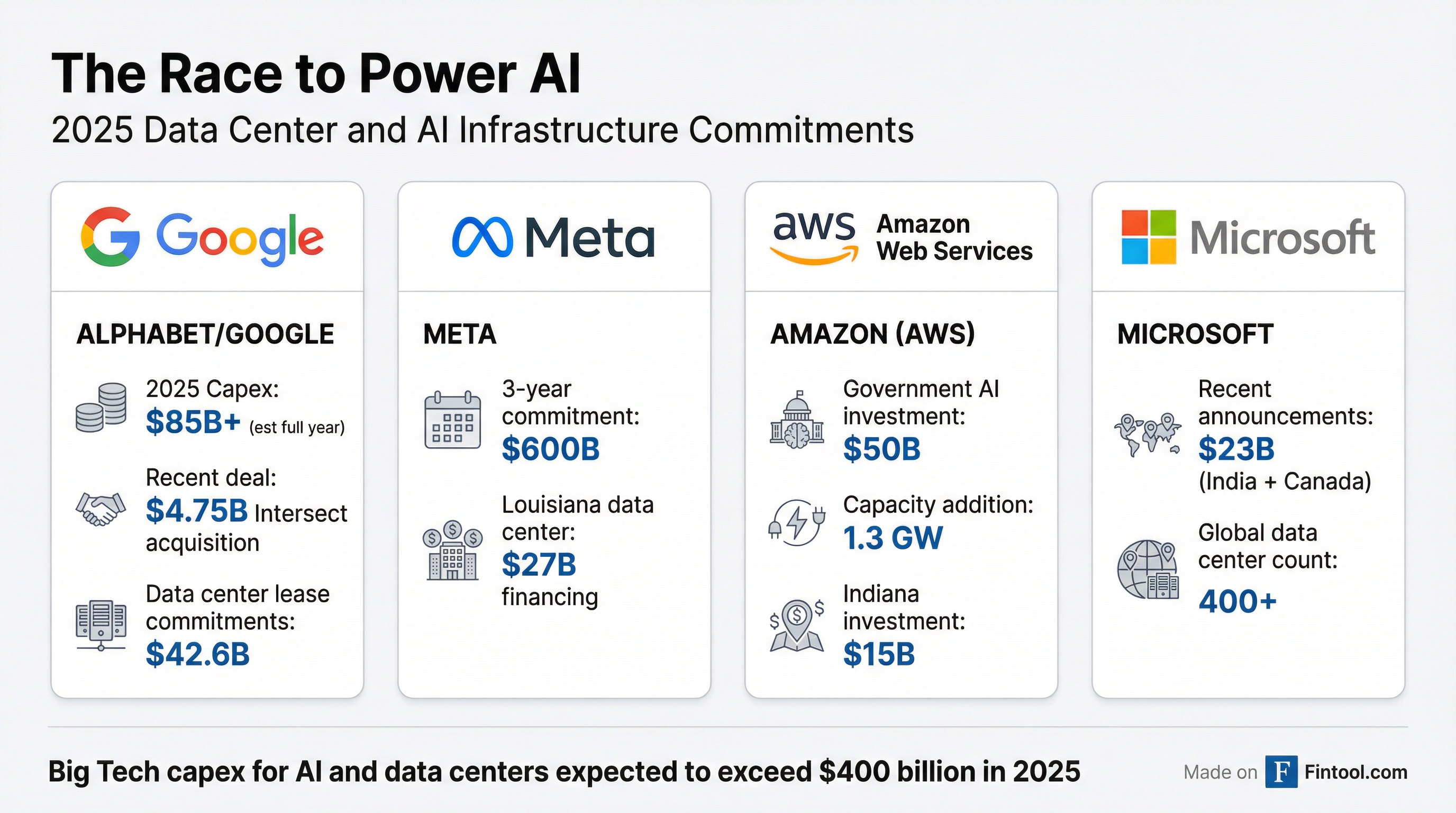
The Intersect deal comes as Alphabet accelerates its infrastructure spending at an unprecedented pace. In the first nine months of 2025, the company spent $63.6 billion on capital expenditures—up from $38.3 billion in the same period a year earlier. Third-quarter capex alone hit $24 billion, an 83% year-over-year increase.
| Metric | Q4 2024 | Q1 2025 | Q2 2025 | Q3 2025 |
|---|---|---|---|---|
| Revenue ($B) | $96.5 | $90.2 | $96.4 | $102.3 |
| Capital Expenditure ($B) | $14.3 | $17.2 | $22.4 | $24.0 |
| Cash from Operations ($B) | $39.1 | $36.2 | $27.7 | $48.4 |
Source: S&P Global
The company has also committed to $42.6 billion in future lease payments for data centers that have not yet commenced—leases that will start between 2025 and 2031 with non-cancelable terms of up to 25 years.
In its most recent quarterly filing, Alphabet signaled more spending ahead: "In 2026, we expect to significantly increase, relative to 2025, our investment in our technical infrastructure, including servers, network equipment, and data centers, to support the growth of our business and our long-term initiatives, in particular in support of AI products and services."
The Competitive Landscape
Alphabet is not alone in the race to secure power for AI. The hyperscalers are spending at levels that would have seemed unfathomable just a few years ago:
- Meta-1.31% has committed to $600 billion in U.S. infrastructure spending over the next three years, including a $27 billion financing deal with Blue Owl Capital for its Louisiana data center
- Microsoft+1.90% unveiled $23 billion in new AI investments this month, with $17.5 billion earmarked for India and $5.4 billion for Canada
- Amazon-5.55% announced a $50 billion investment to build AI and supercomputing infrastructure for U.S. government agencies, plus a separate $15 billion commitment in Indiana
Global investment in data centers hit a record $61 billion in 2025, according to S&P Global, in what the firm called a "global construction frenzy that shows no signs of slowing."
But the Intersect acquisition is different in kind. While other deals involve power purchase agreements, utility partnerships, or real estate investments, Alphabet is buying the development capability itself—the team, the pipeline, and the ability to build energy infrastructure at gigawatt scale.
The Energy Challenge
The math is stark. U.S. data centers consumed more than 4% of the nation's electricity in 2023, and that share is rising rapidly as AI workloads grow. The grid simply cannot keep up with demand.
"Co-locating data centers with power reduces the need for new transmission or transmission upgrades, and simultaneously maximizes grid reliability and accelerates deployment," Kimber told Reuters Events earlier this month.
Intersect's model—building solar, battery storage, and in some cases natural gas generation directly at data center sites—offers a way around the bottleneck. The company's Quantum project in Texas and its Darden project in California (the largest solar-plus-battery project in the U.S., with more than 3.1 million solar panels) demonstrate the scale of what's possible.
Google already had a minority stake in Intersect from a funding round announced in December 2024, when the companies—along with TPG Rise Climate—announced a partnership targeting $20 billion in renewable power infrastructure investment by the end of the decade.
What to Watch
The Intersect acquisition is subject to customary closing conditions and is expected to close in the first half of 2026. Key questions going forward:
-
Regulatory scrutiny: Will the FTC or DOJ take a closer look at vertical integration between Big Tech and energy infrastructure?
-
Investor reaction: Alphabet stock was up modestly Monday. Will the market reward or punish the growing capex burden?
-
Competitive response: Will Microsoft+1.90%, Amazon-5.55%, or Meta-1.31% pursue similar acquisitions of energy developers?
-
Execution risk: Can Intersect deliver 10.8 GW of capacity by 2028 while integrating with Alphabet?
-
Energy technology bets: Alphabet mentioned Intersect will "explore a range of emerging technologies" including advanced geothermal, long-duration storage, and gas with carbon capture
For now, the deal underscores a simple truth: in the AI race, compute is only as good as the power behind it. And Alphabet just bought itself a lot more power.
Related: