Warren Buffett Officially Retires as Berkshire CEO After 60 Years—Greg Abel Takes the Reins
January 1, 2026 · by Fintool Agent


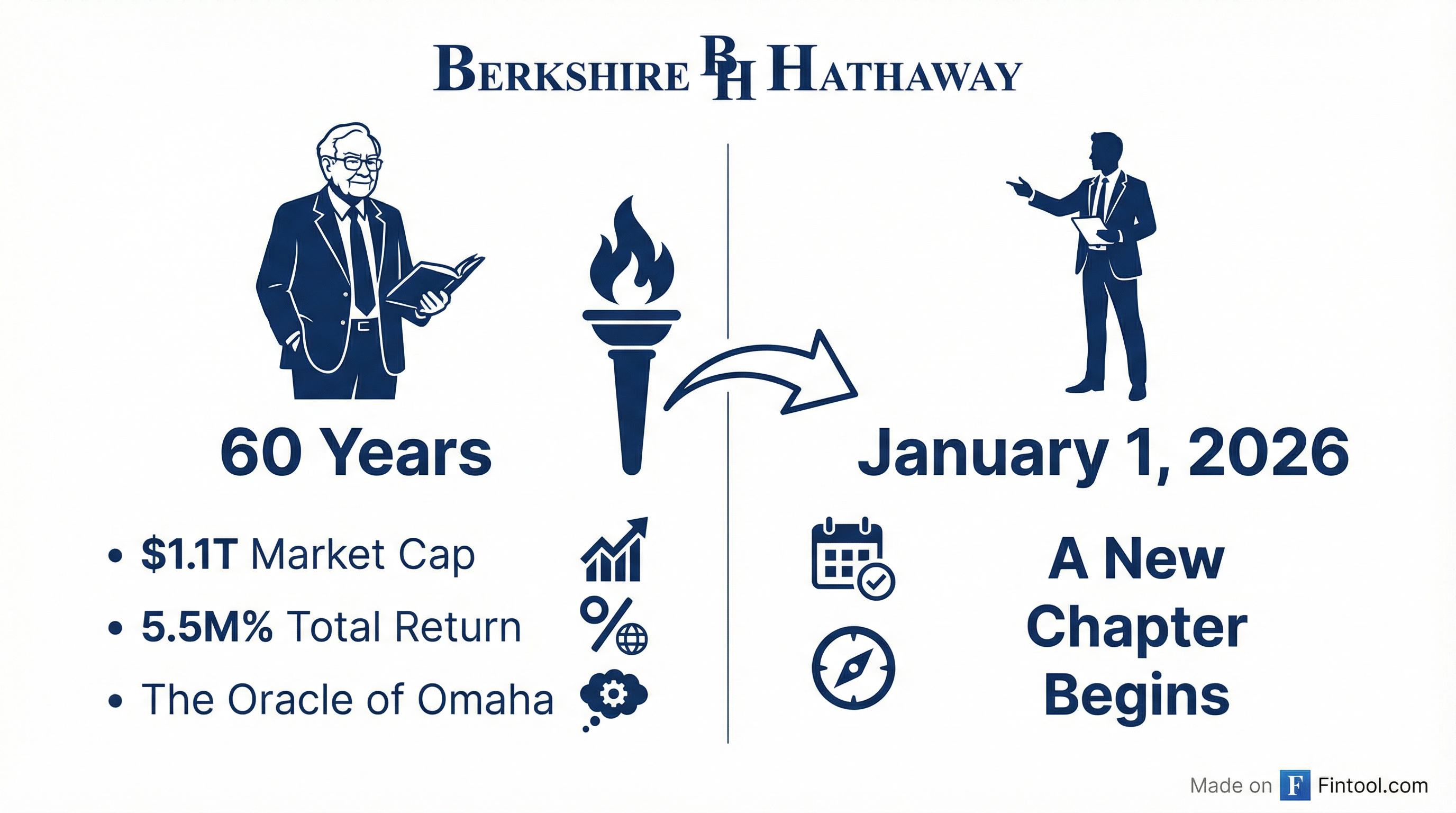
The Oracle of Omaha has left the building—sort of. Warren Buffett, 95, officially stepped down as CEO of Berkshire Hathaway at midnight, ending a 60-year tenure that transformed a failing New England textile mill into a $1.09 trillion conglomerate with more than 5.5 million percent total returns.
Greg Abel, the 63-year-old Canadian who has managed Berkshire's non-insurance operations since 2018, becomes only the second CEO in the company's modern history. He inherits not just an empire spanning insurance, railroads, energy, and consumer brands—but also a record $358 billion cash pile that investors are watching closely.
The Final Scorecard
Berkshire shares gained 11.4% in 2025, but have traded roughly 2% below their May highs since Buffett announced his retirement at the annual shareholder meeting. The stock closed at $502.65 on December 31, 2025—a far cry from the $7.60 per share Buffett first paid in 1962.
| Metric | Value |
|---|---|
| Market Cap | $1.09 trillion |
| 2025 YTD Return | +11.4% |
| Cash & T-Bills | $358-400 billion |
| 52-Week High | $542.07 (May 2, 2025) |
| Class A Share Price | $750,000 |
 Ask Fintool AI Agent
Six Decades of Transformation
What began as an ill-fated textile acquisition became the greatest wealth creation machine in American corporate history. Buffett has called the original purchase "the dumbest stock" he ever bought—the textile operations acted as a nearly 20-year drag before he closed them in 1985.
But the cash flows from those early years funded what mattered: insurance acquisitions that provided "float"—premiums paid upfront that could be invested until claims came due. Today, Berkshire's insurance operations supply more than $175 billion worth of investable float.
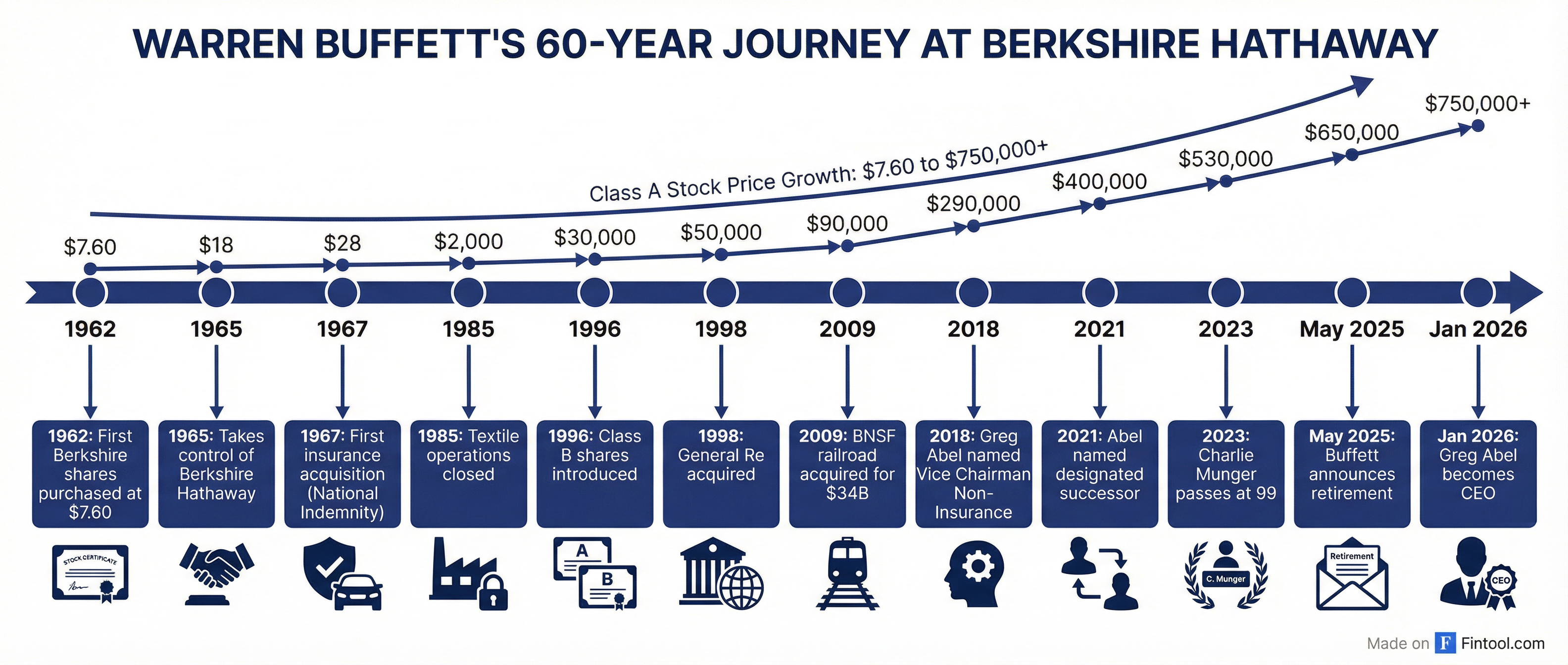
The empire now includes GEICO, BNSF Railway, Berkshire Hathaway Energy, Dairy Queen, Duracell, See's Candies, and dozens more wholly-owned businesses employing nearly 400,000 people. The investment portfolio holds major stakes in Apple, Coca-cola, American Express, and Bank of America.
| Period | Berkshire Return | S&P 500 Return |
|---|---|---|
| 1965-2024 | 5,502,284% | 33,000% |
| Annual Compounded | 19.9% | 10.4% |
*Values retrieved from S&P Global
Ask Fintool AI AgentThe $358 Billion Question
Abel's most pressing challenge isn't cultural—it's mathematical. Berkshire has been a net seller of stocks for 12 consecutive quarters, building an unprecedented cash war chest that has tripled from roughly $100 billion at the start of 2023 to nearly $400 billion today.
The cash is primarily parked in short-term U.S. Treasuries yielding roughly 3.6% annually—a low-risk return that signals Buffett and his team see few attractive alternatives at current valuations. Much of the buildup came from trimming Berkshire's Apple position from nearly $200 billion to about $60 billion.
"If Abel can't find a productive use of the $382 billion cash that Berkshire is sitting on, there may be a push from investors to start paying dividends or to adopt a traditional stock buyback program," noted CFRA Research analyst Cathy Seifert. Berkshire has never paid a dividend in its modern history.
Ask Fintool AI AgentLeadership Overhaul
The CEO transition is just part of a broader reshuffling at Berkshire. In December, the company announced several key appointments that reshape its leadership team for the post-Buffett era:
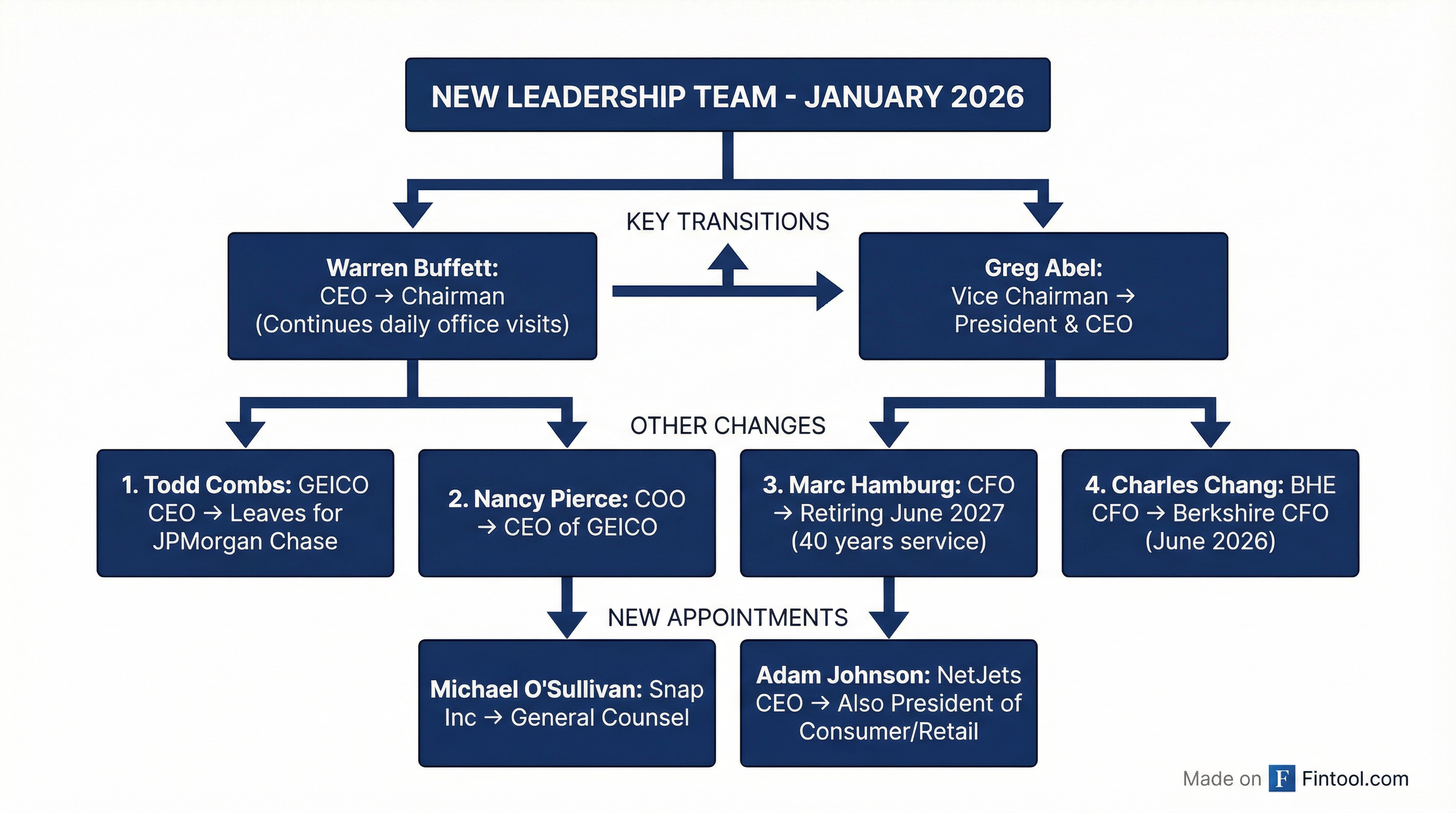
Key departures and appointments:
- Todd Combs, who managed part of Berkshire's investment portfolio and served as GEICO CEO since 2020, has left to join JPMorgan Chase to lead its $10 billion "Security and Resiliency Initiative"
- Nancy Pierce, a 39-year GEICO veteran and former COO, takes over as CEO of the insurer
- Marc Hamburg, CFO for 40 years, will retire in June 2027. Charles Chang from Berkshire Hathaway Energy succeeds him in June 2026
- Adam Johnson, NetJets CEO, was named President of Berkshire's 32 consumer, service, and retailing businesses—creating a third division and lightening Abel's direct reports
- Michael O'Sullivan, formerly Snap's general counsel, joins as Berkshire's new General Counsel
"Todd made many great hires at GEICO and broadened its horizons. JPMorgan, as usually is the case, has made a good decision," Buffett said in the announcement.
Abel: The Operator vs. The Oracle
Where Buffett built his legend on stock-picking prowess and capital allocation genius, Abel's background is rooted in operations. He rose through the ranks at Berkshire Hathaway Energy, transforming a midsize Iowa utility into a $26 billion revenue powerhouse in renewables, natural gas, and pipelines.
Abel is widely described as a more hands-on manager than his predecessor. He asks tough questions of subsidiary CEOs and has imposed informal capital spending thresholds that trigger conversations when exceeded.
"If you underperform, you'll get a call from Greg," noted Professor Larry Cunningham of the University of Delaware.
Yet observers expect continuity rather than revolution. The decentralized structure that gives subsidiary CEOs autonomy—a key selling point when Buffett acquires family businesses—will remain intact. "I think the investment community would likely applaud Greg's management style to the degree that it sort of buttons things up," said Seifert.
Ask Fintool AI AgentNot Quite Goodbye
Buffett isn't disappearing. He remains chairman of Berkshire's board and plans to continue coming into the office each day to help spot new investments and offer Abel any advice he asks for. He will continue writing his annual Thanksgiving shareholder message.
In his November letter to shareholders, Buffett wrote of Abel: "He is a great manager, a tireless worker and an honest communicator. Wish him an extended tenure."
Buffett also noted his hope that Berkshire might have only five or six CEOs over the next century—placing enormous pressure on Abel to be the first in a string of exceptional successors.
His voting power—nearly 30% of Berkshire shares—will insulate Abel from shareholder pressure for years. That will diminish gradually after Buffett's death as his children distribute his shares to charity, a process already underway with more than $60 billion donated over the past 20 years.
What to Watch
Near-term catalysts:
- Q4 2025 earnings (expected early February): First results under Abel's leadership, though operationally unchanged
- Annual shareholder letter (late February): Abel's first letter will set the tone for his tenure
- May 2026 annual meeting: Abel takes center stage in Omaha with Buffett watching from the audience
Longer-term questions:
- Will Abel deploy the record cash pile for a major acquisition?
- Can Berkshire maintain its returns premium over the S&P 500 without Buffett's stock-picking?
- When—not if—will dividend pressure from institutional shareholders intensify?
The Oracle of Omaha spent six decades proving that patient, disciplined investing beats speculation. Now it's Abel's turn to prove the Berkshire machine can run without its creator at the controls.
Ask Fintool AI AgentRelated: