A Viral Doomsday Scenario Sent Software Stocks Plunging. Here's What It Actually Says.
February 24, 2026 · by Fintool Agent


A hypothetical scenario published on Substack Sunday evening triggered billions of dollars in market value destruction Monday, as software stocks plunged on fears that artificial intelligence could hollow out the white-collar workforce faster than anyone anticipated.
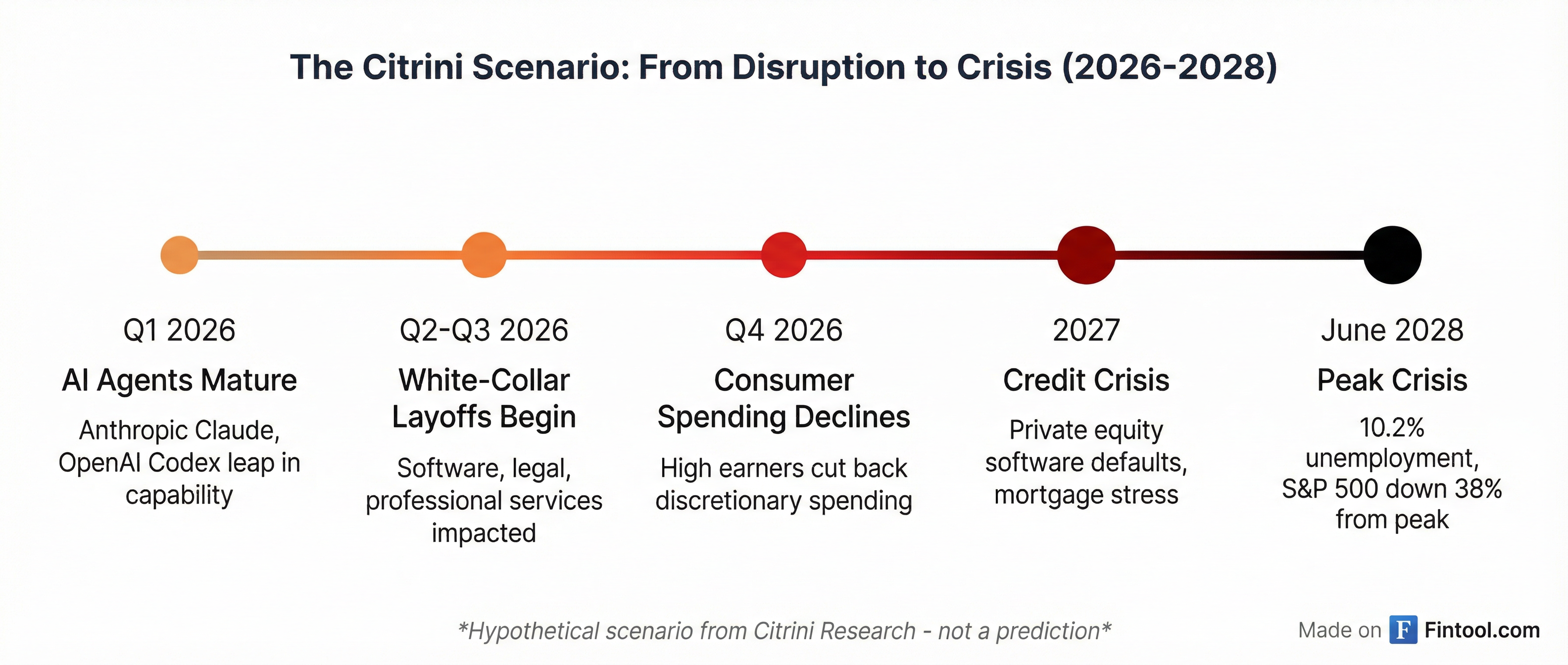
The culprit: a 4,000-word "thought exercise" from Citrini Research titled "The 2028 Global Intelligence Crisis"—a fictional memo written from the perspective of June 2028, describing how the U.S. economy spiraled into 10.2% unemployment and a 38% market crash after AI agents rendered millions of knowledge workers obsolete.
The report went viral when Michael Burry, the investor immortalized in "The Big Short" for predicting the 2008 housing collapse, amplified it to his millions of followers on X with the comment: "And you think I'm bearish."
That was enough to rattle an already nervous market. By Monday's close, Zscaler had cratered 9%, Asana dropped 6.1%, Applovin fell 5.2%, and payment giants Mastercard and Visa lost nearly 5% and 4% respectively—all companies specifically named in the report as vulnerable to AI disruption.
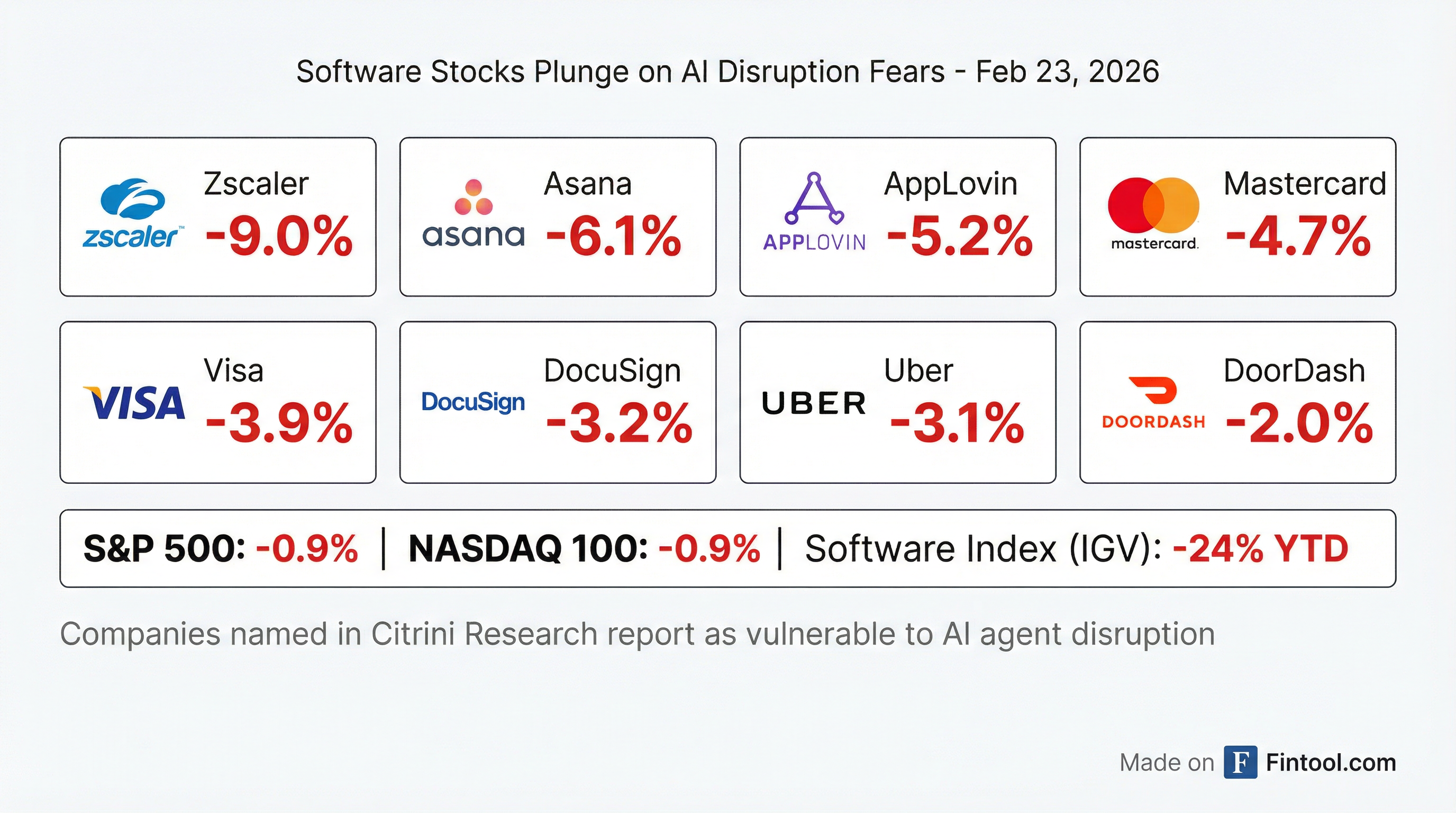
The S&P 500 fell 0.9% Monday, but the real carnage was concentrated in software. The iShares Expanded Tech-Software ETF (IGV) is now down approximately 24% year-to-date, trading near its lowest level since 2023.
 Ask Fintool AI Agent
What the Report Actually Says
The Citrini scenario isn't a prediction—the authors say so explicitly. It's a stress test for portfolios, imagining what happens if AI delivers on its most bullish promises and those promises turn out to be economically catastrophic.
The report, co-authored by James Van Geelen (Substack's top-ranked finance writer) and Alap Shah, traces a hypothetical path from the present to a crisis in June 2028:
Phase 1: AI agents mature. Claude, Codex, and other AI systems achieve a "jump in capability," handling multi-week research and development tasks autonomously. They write essentially all code. The highest-performing agents become "substantially smarter than almost all humans at almost all things."
Phase 2: White-collar layoffs accelerate. Companies deploy AI to cut costs, margins expand, earnings beat, and stocks rally—initially. But the layoffs that produce these results begin hollowing out the consumer base. For every new AI-related job created, dozens are eliminated. The new roles pay a fraction of what the old ones did.
Phase 3: "Ghost GDP" emerges. Economic output that shows up in national accounts but never circulates through the real economy—because "machines spend zero dollars on discretionary goods." The velocity of money flatlines. The human-centric consumer economy, 70% of GDP, withers.
Phase 4: The feedback loop accelerates. Companies suffering from weakening demand respond not by hiring but by deploying more AI—"a feedback loop with no natural brake." Unlike traditional recessions that self-correct when the Fed cuts rates, this disruption is structural: the jobs are gone permanently.
Phase 5: Financial contagion. Private credit firms that lent to software companies based on recurring revenue assumptions face defaults as AI coding agents allow enterprise customers to bypass expensive SaaS contracts. The mortgage market cracks as high-earning professionals lose income. By June 2028: 10.2% unemployment, S&P 500 down 38% from its October 2026 highs.
Why Markets Reacted
The Citrini report didn't land in a vacuum. It amplified anxiety that's been building for months as AI capabilities have advanced faster than expected.
Hedge funds have made $24 billion shorting software stocks so far in 2026, according to S3 Partners data cited by CNBC. Short interest in the IGV ETF stands at 19%—near the highest on record.
The timing was particularly brutal. Just hours before the Citrini report went viral, Anthropic published a blog post announcing that its Claude Code tool can modernize COBOL—the decades-old programming language that underpins global banking systems and runs primarily on IBM mainframes. IBM shares plunged 13% Monday.
"AI capabilities improved, companies needed fewer workers, white collar layoffs increased... it was a negative feedback loop with no natural brake," the report states. That sentence captured what many investors have been fearing but couldn't articulate.
Ask Fintool AI AgentThe Bulls Push Back
Not everyone is buying the doomsday narrative.
Michael Bloch, a partner at VC firm Quiet Capital, published a rebuttal titled "The 2028 Global Intelligence Boom," arguing that cheaper AI services could leave households and startups with more money to spend—not less. "What if our AI bullishness continues to be right... and what if that's actually bullish?" he wrote.
Claudia Sahm, the economist who created the Sahm Rule recession indicator, raised concerns about the report's framing. "The labor market crisis they describe would generate a forceful fiscal/monetary response. They downplay that," she wrote on X. "The more likely scenario of gradual, limited job losses will be the hard one to get policymakers to focus and act."
Jeff Dorman, chief investment officer at Arca, called the response "doom porn." "The biggest takeaway from the virality of this Citrini doom porn is that fear sells," he wrote. "There are thousands of successful macro newsletters that you pay money to subscribe to, and all of them tell you to buy gold, build a bunker, and short stocks."
Ed Yardeni of Yardeni Research offered perhaps the most measured response: "So far this year, the stock market has been discounting a scenario in which AI is our Frankenstein monster. We continue to believe that AI is augmenting workers' productivity rather than making them extinct."
The Fed Weighs In
The debate over AI's economic impact has now reached the Federal Reserve.
On Monday, Atlanta Fed President Raphael Bostic warned that rapid AI adoption could raise the structural unemployment rate to a level the Fed cannot offset with rate cuts. If AI permanently displaces workers at scale, "the policy toolkit we have—that's not something that we can fix," he said.
Fed Governor Lisa Cook echoed the concern, noting that AI could lead to a rise in unemployment that central bankers may not be able to counter with lower interest rates.
These are extraordinary statements. Central bankers rarely speculate publicly about structural economic shifts, let alone ones that could render their primary tool—interest rate adjustments—ineffective.
Ask Fintool AI AgentWhere Does This Leave Investors?
The Citrini report is explicitly not a prediction. But its viral spread reveals something important: the market is deeply uncertain about how to price AI's impact on the economy.
The traditional playbook says technological disruption creates new jobs to replace old ones. The concern embedded in the Citrini scenario is that AI is different—a general intelligence that improves at the exact tasks displaced workers would otherwise pivot toward.
Christopher Forbes, head of Asia and Middle East at CMC Markets, summarized the emerging consensus: "AI is real... the divergence is real and the sell off in [software] makes sense as AI will force software coding to go to zero. Those in the supply chain will win—chips, data centres, permanent energy."
The next test comes Wednesday, when Nvidia reports earnings. As the company most directly benefiting from AI infrastructure spending, its results and forward guidance will either validate or challenge the current market narrative.
Markets recovered modestly Tuesday, with the S&P 500 rising 0.5% and the Nasdaq adding 0.8%. But software stocks remain under pressure, with IGV still down sharply year-to-date.
As the Citrini authors themselves note in their conclusion: "As investors, we still have time to assess how much of our portfolios are built upon assumptions that won't survive the decade. As a society, we still have time to be proactive. The canary is still alive."
Ask Fintool AI AgentRelated