Defense Stocks Hit All-Time Highs as Iran Tensions and Security Supercycle Converge
February 19, 2026 · by Fintool Agent



Five major U.S. defense contractors closed at 52-week highs on Thursday as the largest American military buildup in the Middle East since Operation Midnight Hammer converged with record order backlogs and an $839 billion defense appropriation—crystallizing what analysts are calling the "Security Supercycle."
Lockheed Martin led the charge, surging to $666.51 (+34.1% YTD), followed by Huntington Ingalls at $443.14 (+26.7% YTD), Northrop Grumman at $736.87 (+25.8% YTD), RTX at $205.41 (+9.7% YTD), and Ge Aerospace at $334.74 (+4.4% YTD).
The sector's outperformance is stark: The S&P 500 is up just 0.2% year-to-date, while defense names have delivered returns ranging from 4% to 34%.
The Iran Catalyst
The immediate catalyst is President Trump's escalating pressure campaign against Iran. Two U.S. aircraft carrier strike groups—the USS Gerald R. Ford and USS Abraham Lincoln—are now positioned within striking distance of Iranian territory, accompanied by dozens of F-22, F-35, and F-15 fighter jets that have been flooding into European and Middle Eastern bases over the past week.
"The world will find out over the next, probably, 10 days whether the U.S. will reach a deal with Iran or take military action," Trump told reporters at his Board of Peace event Thursday.
The buildup mirrors—and exceeds—the positioning before Operation Midnight Hammer, the U.S. strikes on Iran's nuclear facilities last June. Pentagon officials signaled that all U.S. military forces required for possible action would be in place by mid-March.
 Ask Fintool AI Agent
Record Backlogs Drive Structural Support
Beyond geopolitics, the rally rests on record-breaking fundamentals. All three major prime contractors reported all-time high backlogs in their Q4 2025 earnings:
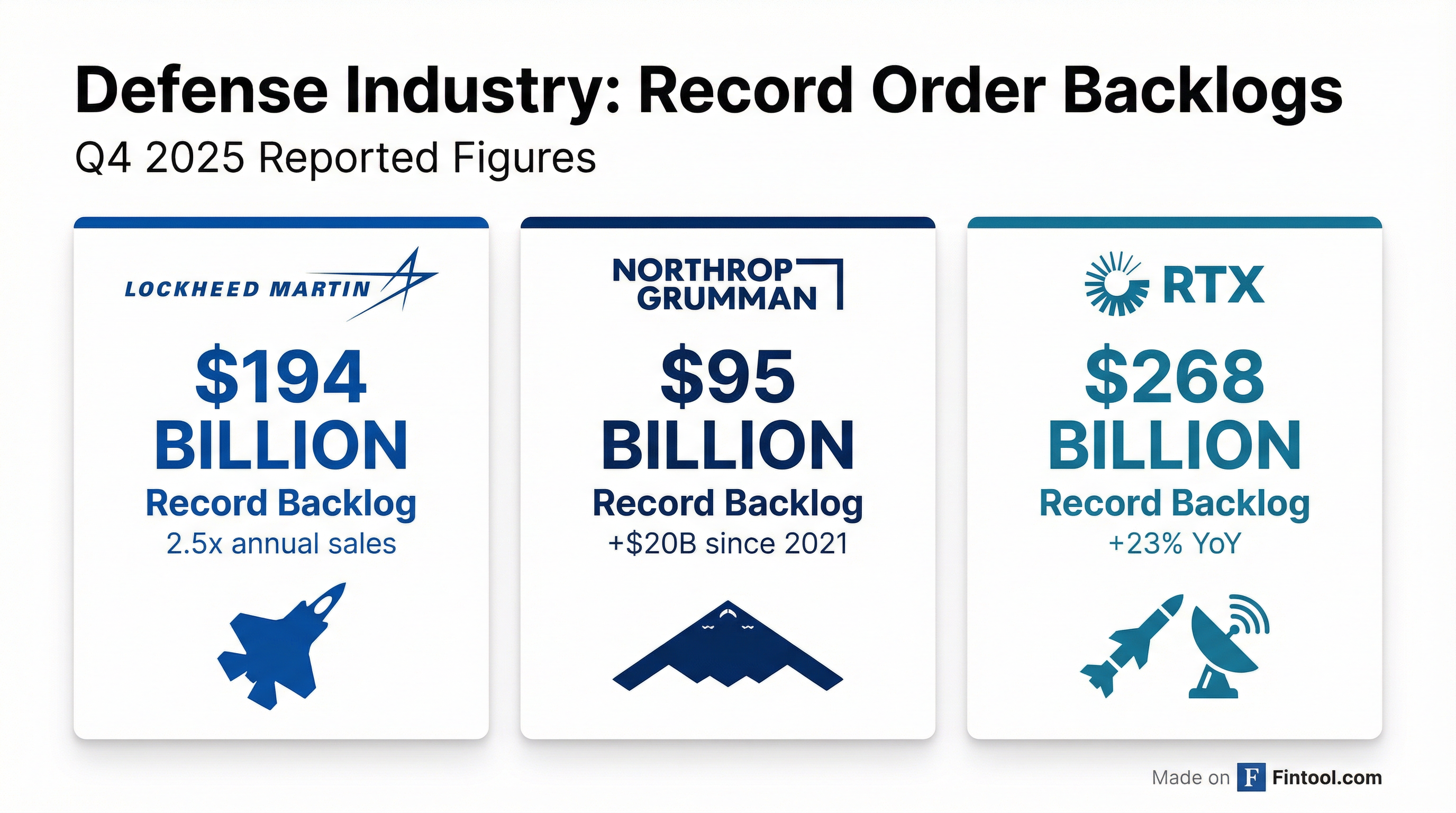
RTX reported a record backlog of $268 billion, up 23% year-over-year, with $107 billion in defense awards. The defense book-to-bill ratio came in at a robust 1.31x. CEO Chris Calio highlighted "a heightened need for munitions and integrated air and missile defense as the U.S. and partner countries work to replenish inventories, modernize existing systems, and invest in new capabilities."
Raytheon, RTX's missile and defense subsidiary, increased munitions output by 20% in 2025 across critical programs including GEM-T for Patriot, AMRAAM air-to-air missiles, and Coyote counter-UAS systems—and expects to "significantly increase output again" in 2026.
Lockheed Martin finished 2025 with "unprecedented demand" and a record backlog of $194 billion—approximately 2.5 times annual sales. CEO Jim Taiclet noted the company delivered 6% year-over-year sales growth and generated $6.9 billion of free cash flow.
Northrop Grumman ended the year with over $95 billion in backlog, a new company record driven by $46 billion in net awards. The company's five-year average book-to-bill has been 1.1x, and free cash flow of $3.3 billion represented the third consecutive year of at least 25% growth. "Protecting the homeland is a top priority for the Trump administration, as outlined in the recently released national defense strategy," management noted.
| Company | Ticker | Backlog | YoY Change | Book-to-Bill |
|---|---|---|---|---|
| RTX | RTX | $268B | +23% | 1.31x |
| Lockheed Martin | LMT | $194B | +17% | 1.2x |
| Northrop Grumman | NOC | $95B | Record | 1.1x (5yr avg) |
The Structural Tailwind: Global Rearmament
The near-term Iran tensions sit atop a longer-term structural shift that analysts have dubbed the "Security Supercycle." NATO allies have committed to increasing core defense spending from roughly 2% of GDP to approximately 3.5% of GDP by 2035—a massive capital infusion that supports multi-year growth visibility.
Defense budgets in Asia-Pacific and Middle East regions are projected to grow at 3%-4% annually over the next five years, with several countries at record spending levels.
The U.S. defense budget for FY2026 stands at $839 billion after Congress passed the appropriations bill on February 3—$8 billion above the Pentagon's request. The bill includes multiyear procurement authority for eight critical munitions programs and an additional $3 billion for munitions production and R&D.
The Pentagon's original budget request of $961.6 billion—representing a 13.4% increase—explicitly prioritized "strengthening homeland security, deterring Chinese aggression in the Indo-Pacific, revitalizing the U.S. defense industrial base."
Ask Fintool AI AgentWhat to Watch
Near-term catalysts:
- Iran nuclear talks outcome within the next 10 days
- Secretary of State Marco Rubio's Israel visit on February 28
- Potential U.S. military action if diplomacy fails
Longer-term dynamics:
- NATO spending trajectory toward 3.5% GDP target
- Munitions production ramp across multiple programs
- F-47 next-generation fighter development
- Golden Dome missile defense initiative ($23 billion allocated)
The convergence of immediate geopolitical risk and structural defense spending growth has created a rare alignment for the sector. Whether Iran tensions de-escalate or intensify, the multi-year backlog positions these companies for sustained growth—while any military action could accelerate near-term demand for precision munitions and air defense systems.
Ask Fintool AI AgentRelated Companies: Lockheed Martin · Northrop Grumman · RTX · Ge Aerospace · Huntington Ingalls · General Dynamics · Leidos · Howmet Aerospace