Devon and Coterra Explore $44 Billion Shale Mega-Merger
January 15, 2026 · by Fintool Agent


Devon Energy and Coterra Energy are exploring a potential merger that would create one of the largest independent U.S. shale producers, according to people familiar with the matter.
A combination—potentially structured as an all-stock transaction—would rank among the biggest oil and gas deals in years and continue the relentless consolidation reshaping America's energy landscape.
Devon shares fell nearly 5% on the news to $36.10, while Coterra gained 1.7% to $25.80. The talks are in early stages with no guarantee of a deal, sources cautioned.
The Numbers
| Metric | Devon Energy | Coterra Energy | Combined (Pro Forma) |
|---|---|---|---|
| Market Cap | $23.1B | $19.2B | $44B |
| LTM Revenue | $16.5B* | $6.6B* | $23B |
| LTM EBITDA | $7.6B* | $4.4B* | $12B |
| Total Debt | $8.6B | $4.1B | $12.7B |
| Q3 2025 Oil Production | 388 MBOD | 150 MBOD | 540 MBOD |
| Primary Basins | Delaware, Eagle Ford, Williston | Permian, Marcellus, Anadarko | Multi-basin |
*Values retrieved from S&P Global
 Ask Fintool AI Agent
Why Now? Oil Under Pressure
The talks come as U.S. crude prices remain pressured by a near-term global oil glut and the prospect of higher supplies from Venezuela re-entering markets.
Both companies have been laser-focused on capital discipline and shareholder returns:
Devon's position: The company has emphasized its $45 WTI corporate breakeven and $1 billion business optimization plan targeting additional free cash flow by year-end 2026. Management recently raised oil production guidance while cutting capital spending, demonstrating operational leverage.
Coterra's fortress balance sheet: CEO Tom Jorden has prioritized deleveraging, fully repaying $1 billion in term loans during 2025 to return leverage to ~0.5x net debt/EBITDA. The company targets 50%+ of free cash flow returned to shareholders and maintains one of the highest base dividend yields in the sector at over 3.5%.
| Financial Health | Devon (Q3 2025) | Coterra (Q3 2025) |
|---|---|---|
| Net Income | $687M | $322M |
| Operating Cash Flow | $1.69B | $971M |
| EBITDA Margin | 45.8%* | 65.0%* |
| Total Equity | $15.4B | $14.7B |
*Values retrieved from S&P Global
The Permian Consolidation Wave Continues
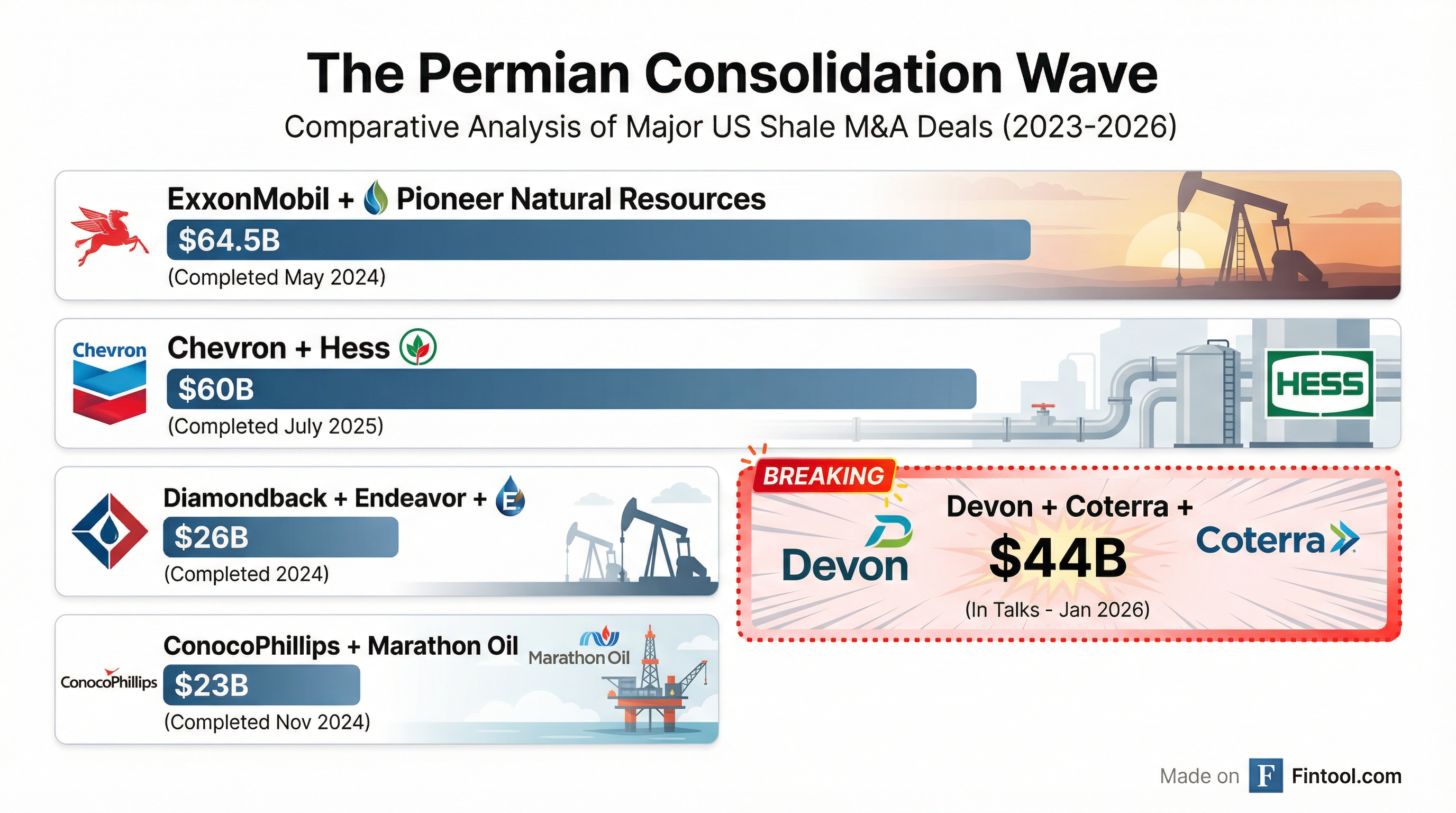
A Devon-Coterra tie-up would extend the historic consolidation wave that has reshaped U.S. shale since 2023. The sector has seen over $150 billion in announced deals as companies scramble to secure prime drilling inventory before it runs out:
| Deal | Value | Status |
|---|---|---|
| Exxonmobil + Pioneer | $64.5B | Completed May 2024 |
| Chevron + Hess | $60B | Completed July 2025 |
| Diamondback + Endeavor | $26B | Completed 2024 |
| Conocophillips + Marathon Oil | $23B | Completed Nov 2024 |
| Devon + Coterra | ~$44B | In Talks |
The drivers remain consistent: secure high-quality drilling inventory, achieve cost synergies across larger acreage positions, and build scale to compete with the supermajors now dominating the Permian.
Devon itself was identified as a likely "takeout" target after ExxonMobil announced the Pioneer deal.
Ask Fintool AI AgentStrategic Fit: A Multi-Basin Powerhouse
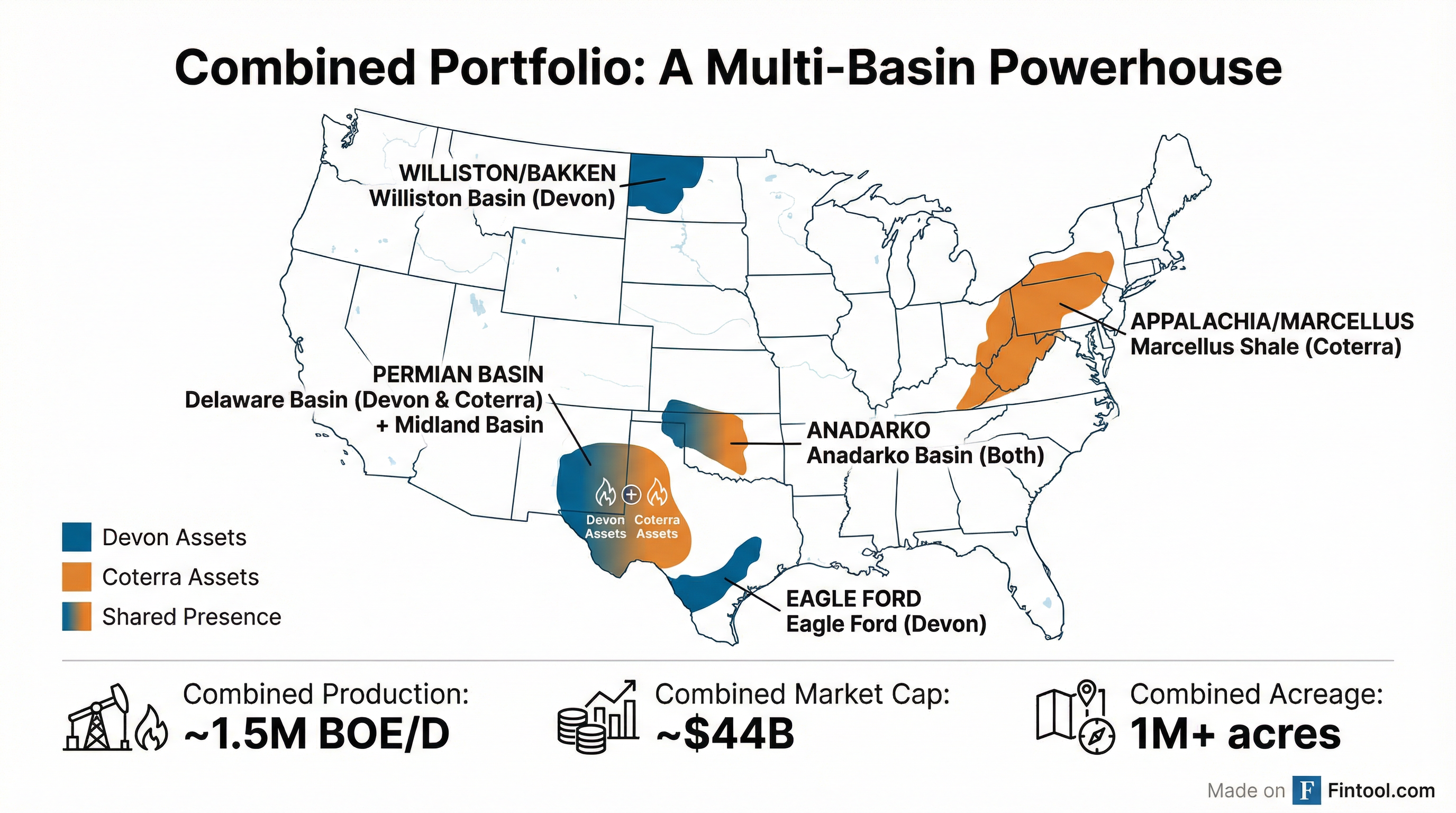
The combination would create a diversified multi-basin portfolio:
Permian Basin (Core): Both companies have significant Delaware Basin exposure. Devon operates across the Delaware, while Coterra expanded aggressively via the $2.5 billion FME and $1.5 billion Avant acquisitions in January 2025. Coterra now allocates ~70% of capital to the Permian.
Appalachian Gas (Coterra): Coterra's Marcellus Shale position provides natural gas optionality, delivering over 1 TCF annually and providing leverage to improving gas fundamentals.
Eagle Ford & Williston (Devon): Devon's diversification beyond the Permian includes South Texas and North Dakota assets, providing geographic risk mitigation.
Anadarko Basin (Both): Overlapping positions in Oklahoma could yield immediate synergies.
This portfolio mix offers both oil-weighted production (Devon's strength) and gas exposure (Coterra's Marcellus), potentially creating a more balanced commodity profile.
What Remains Uncertain
Several critical questions remain unanswered:
-
Deal structure: While sources indicate an all-stock transaction is being discussed, premium allocation and exchange ratios are unknown.
-
Leadership: No details have emerged about who would run the combined company. Devon recently underwent leadership changes that CEO Clay Gaspar said brought "fresh perspectives" to accelerate optimization efforts.
-
Regulatory scrutiny: While less concentrated than supermajor deals, the FTC has been active in reviewing energy M&A for competitive impacts.
-
Synergy targets: Neither company has disclosed potential cost savings, though Permian consolidation typically yields 10-15% per-unit cost reductions through shared infrastructure and optimized drilling programs.
Market Reaction: Skepticism on Devon
The divergent stock reactions—Devon down nearly 5%, Coterra up 1.7%—reflect typical M&A dynamics where acquirer shares fall on dilution concerns while target shares rise on takeout premiums. The magnitude of Devon's decline, however, suggests investors may be questioning the strategic rationale or pricing.
Devon traded at $36.10, down from an intraday high of $38.24, testing support near its 50-day moving average of $35.98. Coterra touched $28.44 intraday before settling at $25.80.
Ask Fintool AI AgentWhat to Watch
Near-term catalysts:
- Any official confirmation or denial from either company
- Q4 2025 earnings releases (Devon and Coterra typically report in late February)
- Additional details on deal structure or timeline
Longer-term considerations:
- FTC review timeline if a deal is announced
- Integration planning for overlapping Permian operations
- Impact on shareholder return programs (both companies have active buybacks)
The consolidation wave that began with Exxon-Pioneer shows no signs of stopping. In a world of pressured oil prices and dwindling prime inventory, scale increasingly equals survival.