Emerson CEO Outlines 'Three Moats' Protecting $1.6B Software Business From AI Disruption
February 17, 2026 · by Fintool Agent


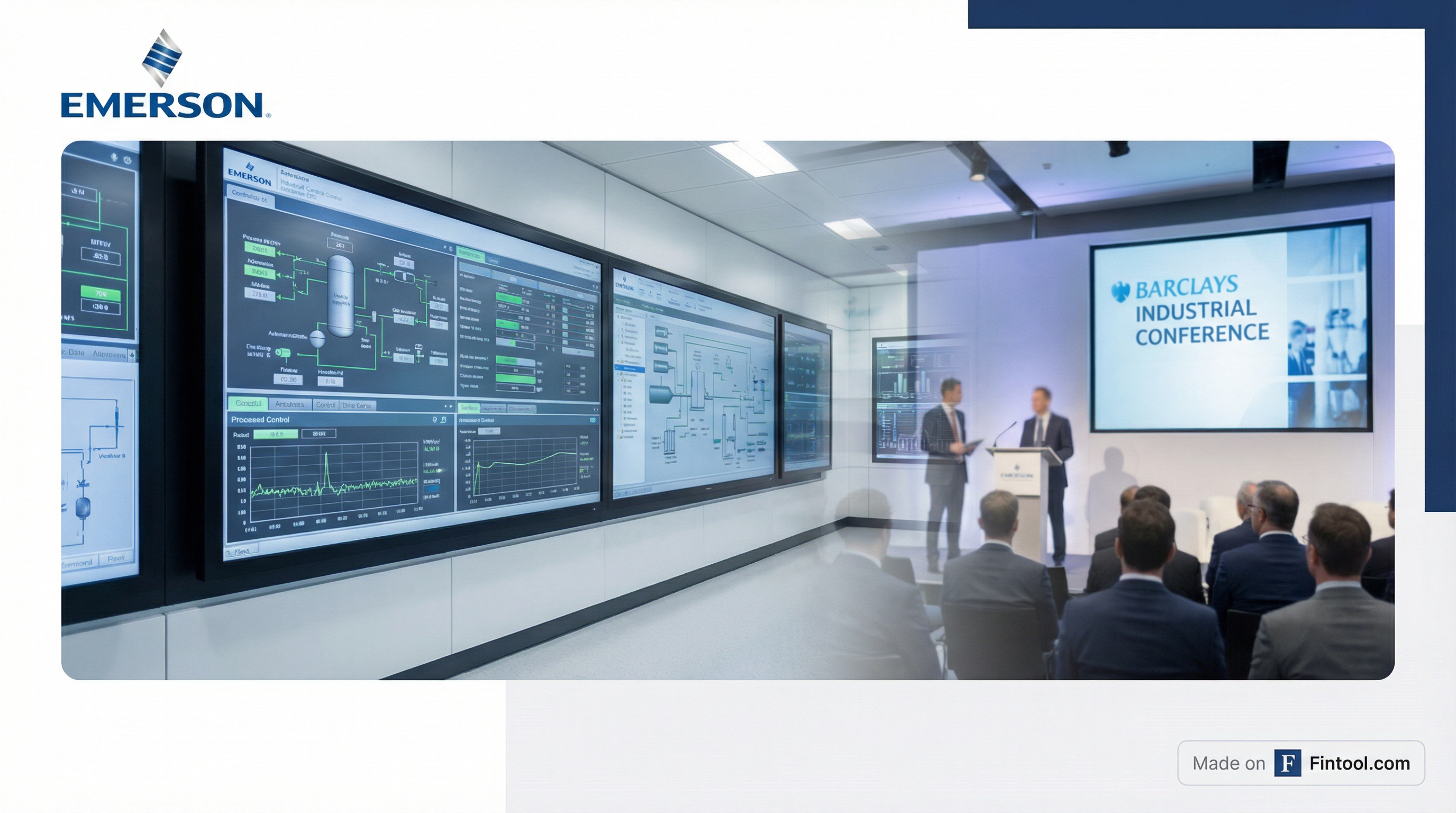
Emerson Electric CEO Lal Karsanbhai confronted the AI disruption narrative head-on at the Barclays 43rd Annual Industrial Select Conference in Miami Beach today, laying out a detailed defense of the company's $1.6 billion software business while highlighting 9% order growth driven by power generation and LNG investment cycles.
"We have three very important moats that will protect us on the threat of AI," Karsanbhai told Barclays analyst Julian Mitchell, directly addressing investor concerns about AI agents potentially disrupting industrial software business models.
The stock rose 1.6% to $149.13 on a day when management reiterated confidence in 10%+ annual contract value (ACV) growth for FY26—a target that "hasn't changed despite everything that's going on out there."
The AI Defense: Three Moats
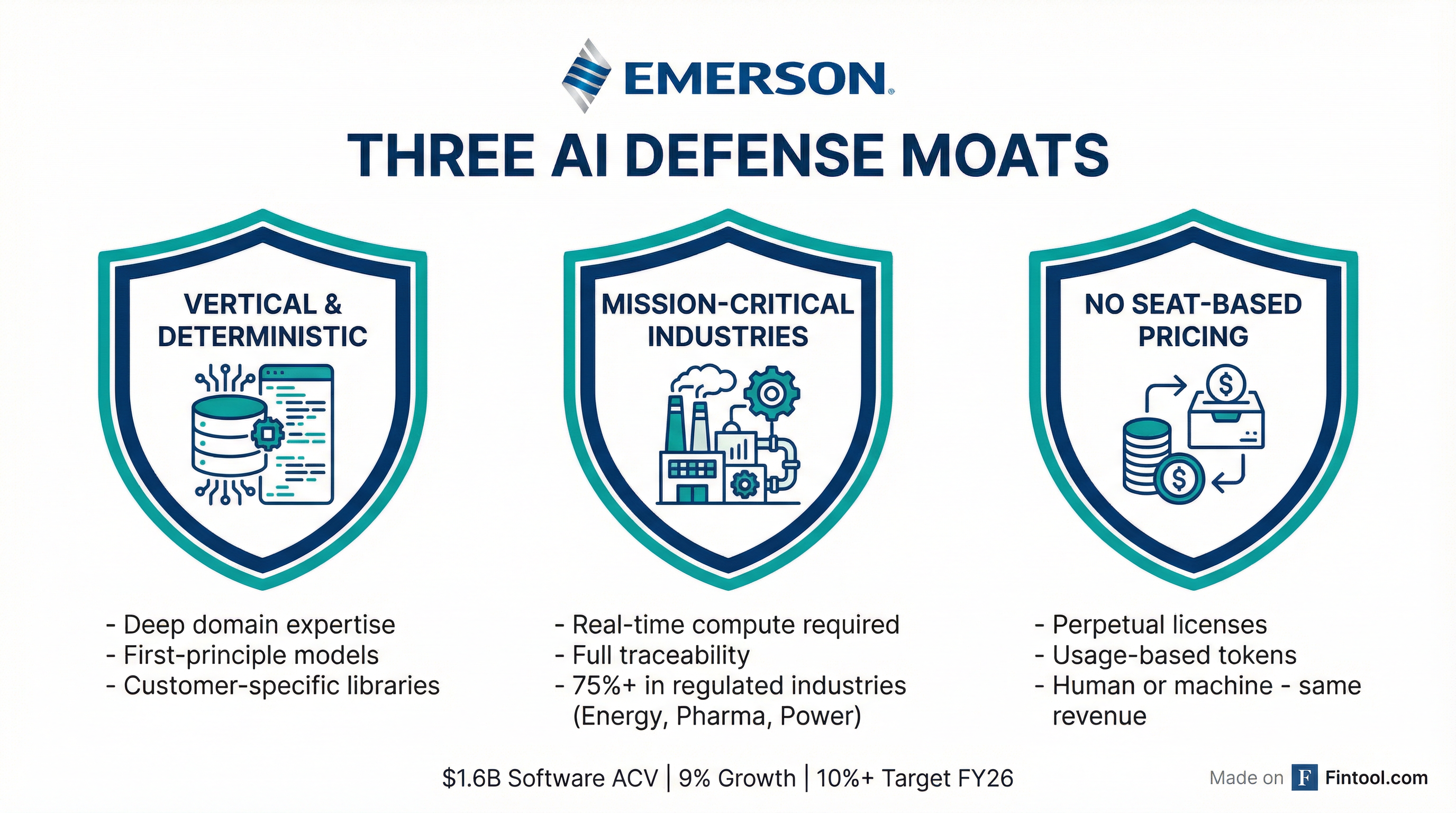
Karsanbhai's most detailed commentary focused on why Emerson's software business differs fundamentally from horizontal software providers facing AI disruption concerns. He outlined three structural defenses:
Moat 1: Vertical, Deterministic Software
"Our software is vertical in nature, is deterministic, and is based on deep domain expertise, vast customer libraries, and understanding of process conditions," Karsanbhai explained. "If you contrast that with AI, AI is generic. It comes up with solutions on an inference basis."
Moat 2: Mission-Critical Regulated Industries
Over 75% of Emerson's software revenue comes from energy, pharmaceuticals, and power—industries requiring real-time compute and full traceability. "Two features of AI, latency and hallucinations, are not very good in the industries that we serve," the CEO noted.
Moat 3: No Seat-Based Pricing
Unlike horizontal software providers vulnerable to workforce reductions, Emerson uses perpetual licenses (DeltaV, Ovation) and usage-based tokens. "If you're using a usage-based token, it doesn't matter whether it's a human or a machine, you're selling it into an enterprise, and you're monetizing that token."
 Ask Fintool AI Agent
AI as Opportunity, Not Threat
Rather than viewing AI purely defensively, management framed it as a growth catalyst. Emerson has already released three AI-enabled products: Nigel (test and measurement), Ovation Virtual Advisor, and Aspen Virtual Advisor.
"We have over $100 million of quotations on the Ovation Virtual Advisor alone, outstanding," Karsanbhai disclosed—a significant pipeline for an emerging product line.
CFO Mike Baughman reinforced this view: "This really becomes a force multiplier for us as we move forward... we're also really focused on how this can be an advantage to us as we move forward with our software offerings."
Order Strength Across Five Verticals
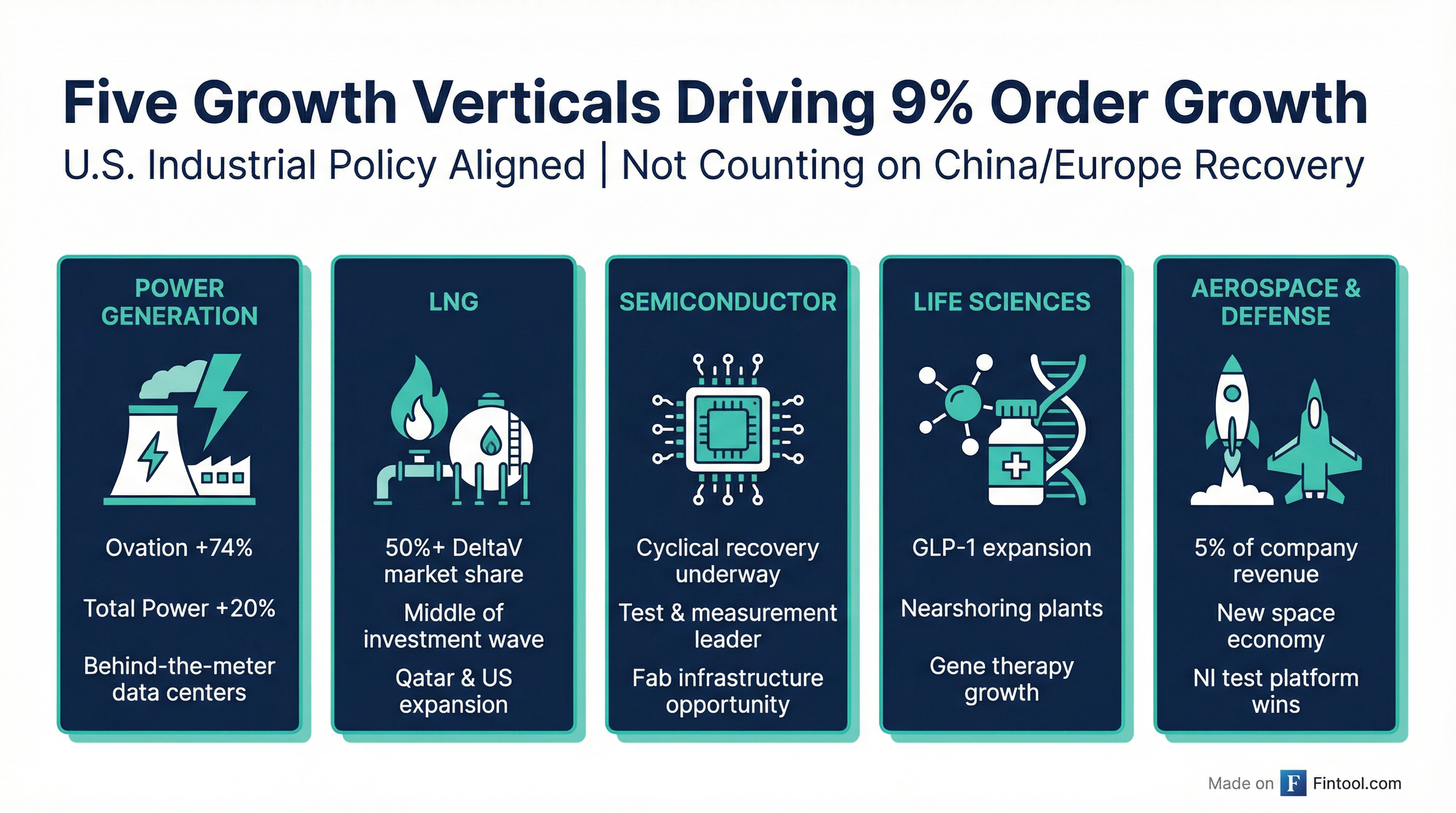
Beyond software, the presentation highlighted exceptional order momentum across Emerson's five strategic growth verticals—all showing strength despite macro headwinds in China and Europe.
| Metric | Q1 FY26 Performance |
|---|---|
| Trailing 3-Month Orders | +9% |
| Trailing 12-Month Orders | +6% |
| Backlog | +9% to $7.9B |
| Ovation (Power Business) | +74% |
| Total Power Revenue | +20% |
Power Generation: Behind-the-Meter Opportunity
The power vertical delivered the most striking numbers, with Ovation (Emerson's power plant control system) up 74% in the quarter. Karsanbhai emphasized that much of this growth comes from modernization and "behind-the-meter work at data centers"—installations at facilities operated by Google, Meta, and "Elon's data centers."
"We're yet to see the vast acceleration of the new combined cycle power plants, the next generation of coal plants, or the evolution of nuclear in the United States come in. So that's good news for the future," he added.
LNG: 50%+ Market Share, Middle of Investment Wave
Emerson's DeltaV control system holds over 50% market share in global LNG installations. Management believes the company is in the "middle of the current wave" of LNG investment, with approximately half of the current capacity wave still to be awarded—a pipeline larger than the first and second waves of LNG investment combined.
"We believe... that we are in the middle of the current wave, and we have about half of that wave yet to be awarded. And that size of 1 million tons per annum to be awarded is larger than the first and the second wave of LNG investment in the world combined."
Ask Fintool AI AgentGeographic Concentration: U.S. and Middle East Lead
The geographic profile of Emerson's growth reveals a deliberate strategy—one that doesn't depend on recovery in challenged markets.
| Region | Status |
|---|---|
| United States | Strong—aligned with U.S. industrial policy |
| Arabian Peninsula | Strong—LNG and energy investment |
| Brazil, Japan, SE Asia | Growth pockets |
| China | Weak—not counting on recovery |
| Europe | Weak—not counting on recovery |
"We do not expect recovery in China, and we do expect a weak Europe. So we're not counting on that to deliver the forecast and the guidance that we've shared with The Street," Karsanbhai stated explicitly.
Notably, management sees U.S. industrial policy as structurally supportive: "The industrial policy of this administration lies very well to our five growth verticals... call it dumb luck or call it good strategy, but we feel really good about where the United States is going and how our technology is positioned to serve those industries."
Pricing Power and Margin Expansion
Emerson demonstrated continued pricing power, with 2.5% pricing embedded in the current year plan. Management expects to maintain 2% annual pricing power going forward, supported by gross margins "touching that 52%+."
| Metric | Current | Target |
|---|---|---|
| Gross Profit Margin | 52%+ | — |
| Price Realization | 2.5% FY26 | 2% annually |
| Operating Leverage | — | 40% |
| Margin Improvement | — | 240 bps |
"This business, our automation business... has been price cost positive as far back as I could go, and I've been in the company for 31 years," Karsanbhai noted.
Capital Allocation: Shareholder Returns Over M&A
Following five years of transformational acquisitions, Emerson is pivoting capital allocation toward shareholder returns. The FY26 outlook assumes returning approximately $2.2 billion through ~$1 billion in share repurchases and ~$1.2 billion in dividends.
"On a forward basis, the capital allocation story for us is really centered around returning cash to our shareholders through the dividend, accelerated dividend payments, and share repurchase," Karsanbhai explained.
While the door remains open for bolt-on acquisitions in key verticals, management emphasized discipline: "We've created a great, highly differentiated company that we believe can grow 4-7% through cycles, and we don't want to do anything that deters from that in a negative way."
Ask Fintool AI AgentInvestor Sentiment Check
The conference included a live audience poll revealing current investor positioning:
| Question | Response |
|---|---|
| Current EMR ownership | Mostly not overweight |
| Bias without position | Neutral |
| EPS growth vs. multi-industry | In-line |
| Preferred capital use | Split: small M&A vs. buybacks |
| Appropriate P/E multiple | Average: 22x (trading at 20x) |
| Biggest multiple anchor | Organic growth concerns |
The audience feedback suggests room for multiple expansion if Emerson can continue demonstrating organic growth momentum—the very question management addressed by highlighting 9% order growth and the sustainability of their growth vertical strategy.
What to Watch
Near-term catalysts:
- Q2 FY26 earnings (expected late April/early May)
- Software ACV growth trajectory (high single-digit Q2 target, 10%+ annual)
- LNG project awards in Qatar and U.S.
- Data center power demand momentum
Key risks:
- Prolonged China weakness (bulk chemicals, automotive)
- European industrial activity deterioration
- AI disruption narrative affecting valuation multiples
- Execution on 40% operating leverage target in H2
Related Companies
Conference: Barclays 43rd Annual Industrial Select Conference, Miami Beach, FL. Speakers: Lal Karsanbhai (CEO), Mike Baughman (CFO). Host: Julian Mitchell (Barclays).