Supreme Court to Decide Fate of Billions in Climate Lawsuits Against Big Oil
February 23, 2026 · by Fintool Agent


The Supreme Court agreed Monday to hear Exxon Mobil and Suncor Energy's bid to block a climate lawsuit from Boulder, Colorado—a decision that could determine the fate of more than three dozen similar cases seeking billions of dollars in damages from the oil industry.
The case represents the oil industry's best chance yet to shut down a wave of litigation that has been building for nearly a decade. For investors in Exxon, Chevron, Shell, and BP, the outcome could remove a cloud of legal uncertainty that companies have characterized as an "unprecedented" threat in their SEC filings.
The Stakes
Cities and states across America have sued oil companies claiming they knowingly misled the public about climate risks while profiting from fossil fuel sales. The lawsuits seek monetary damages for costs associated with mitigating climate change impacts—infrastructure repairs, environmental damage, emergency management, and public health harms.
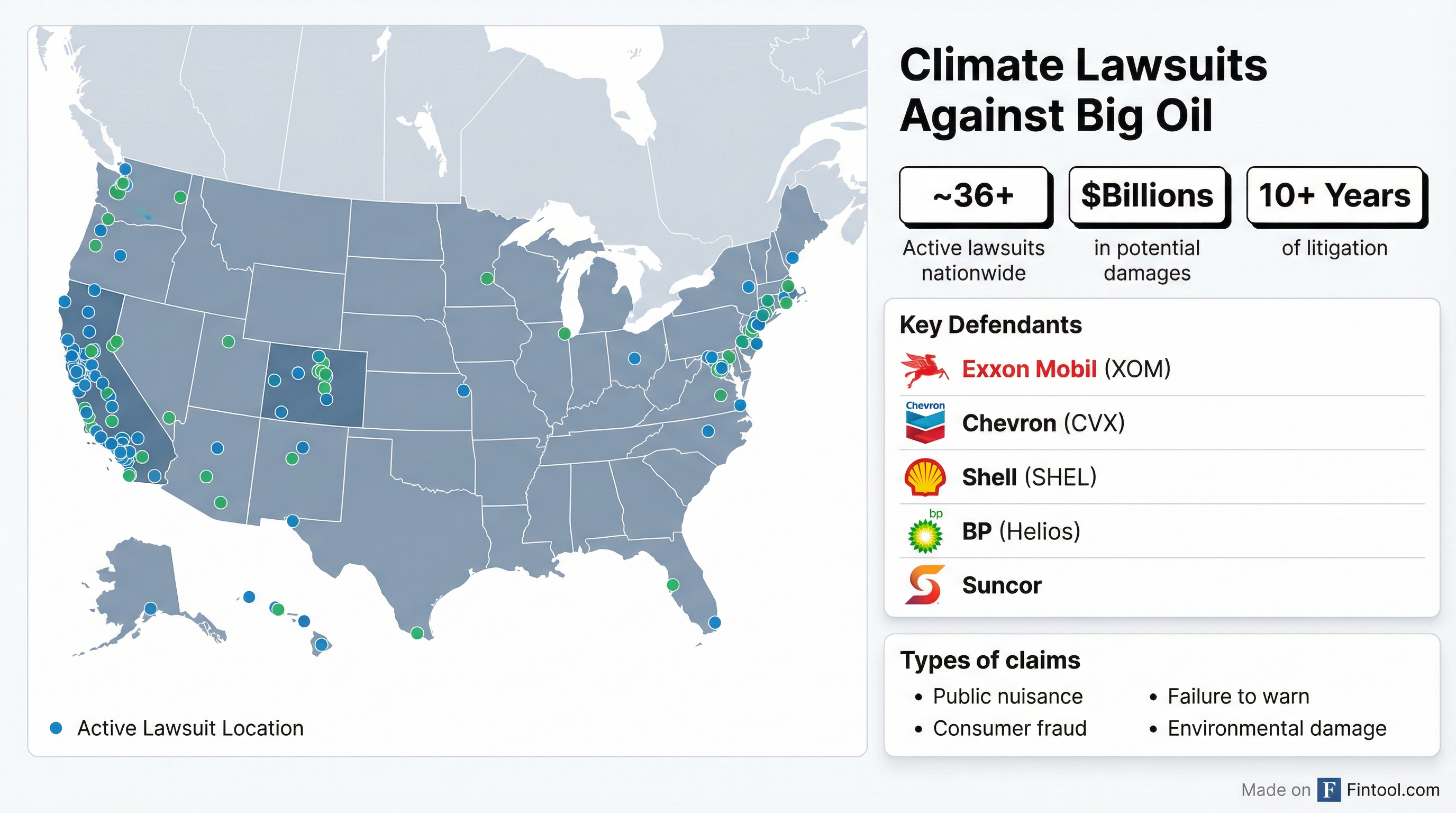
The scope of potential liability is substantial. Chevron alone discloses in its SEC filings that it faces 33 separate lawsuits filed by various U.S. cities, counties, states, the District of Columbia, Puerto Rico, and Native American tribes. The company warns that "given the uncertainty of litigation there can be no assurance that the cases will not have a material adverse effect on the company's results of operations and financial condition."
 Ask Fintool AI Agent
The Legal Battle
The case centers on a fundamental question: Can state and local governments use state law to hold energy companies liable for global climate change, or does federal law preempt such claims?
Boulder and Boulder County filed their lawsuit in 2018, accusing Exxon and Suncor of violating state laws including consumer protection provisions. They allege the companies knowingly concealed climate risks while profiting from unchecked fossil fuel sales.
The oil companies argue that climate policy is inherently a federal issue because pollution crosses state lines and cannot be addressed on a piecemeal basis. "Boulder, Colorado, cannot make energy policy for the entire country," Exxon's attorneys told the Supreme Court.
Exxon's 10-K filing makes the company's position clear: "We believe the legal and factual theories set forth in these proceedings are meritless and represent an inappropriate attempt to use the court system to usurp the proper role of policymakers in addressing the societal challenges of climate change."
A Long Road to the Supreme Court
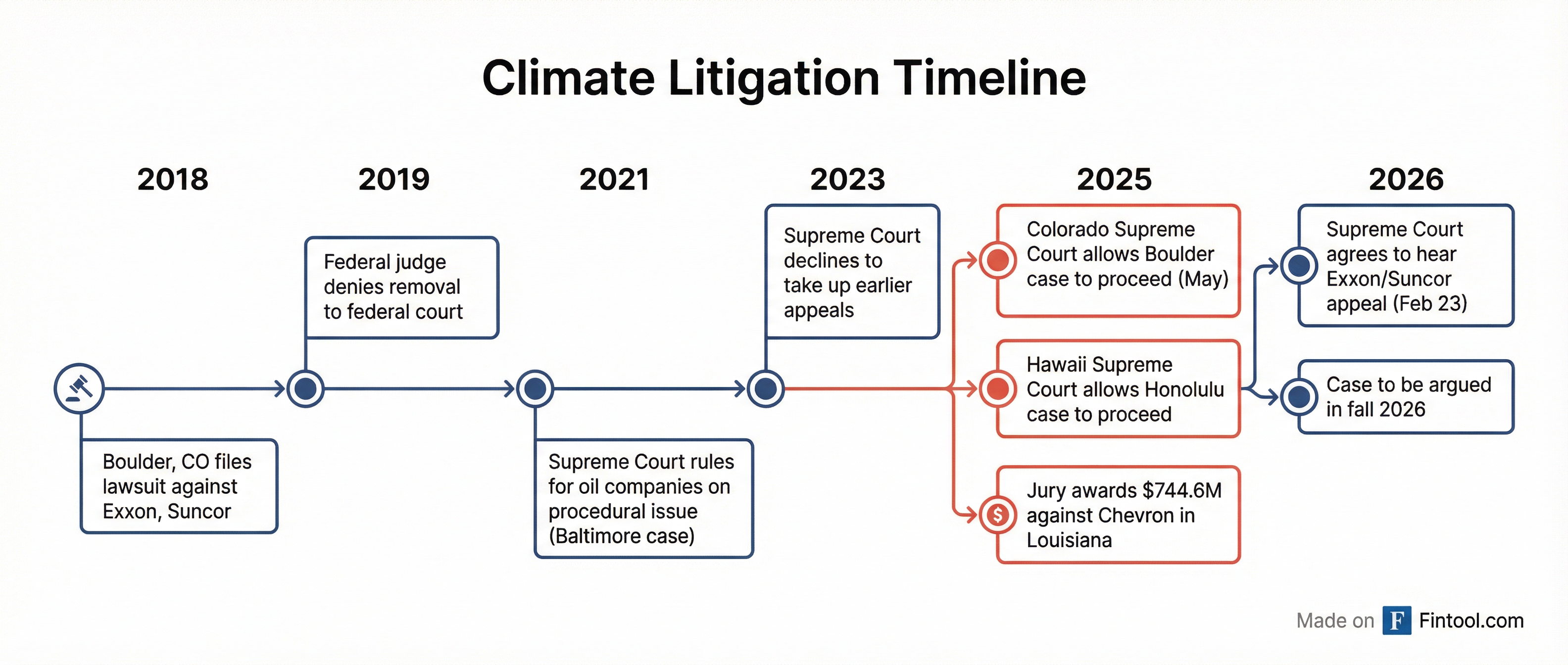
The Boulder case has been winding through courts for years. In 2019, a federal judge denied Exxon and Suncor's request to move the case from state court to federal court. In May 2025, the Colorado Supreme Court ruled that the lawsuit could proceed to trial, prompting the appeal to the U.S. Supreme Court.
The court previously turned away a similar bid by Sunoco and other oil companies to throw out a climate lawsuit by Honolulu after Hawaii's Supreme Court allowed it to proceed. But the court has also shown some willingness to intervene—in 2021, it ruled in favor of oil companies on a procedural issue in a related lawsuit brought by Baltimore.
Ask Fintool AI AgentTrump Administration Backs Big Oil
The Trump administration took the rare step of filing a brief urging the court to take the Boulder case—even though the federal government is not directly involved in the litigation. The administration argued that if Colorado is allowed to pursue its case, "energy companies across the globe will be subject not only to billions of dollars in damages, but also to a multiplicity of rules governing their conduct in any given location."
This marks a stark reversal from the Biden administration, which opposed the companies' appeal.
Market Implications
The oil majors have enjoyed a strong run, with the European oil and gas stocks index hitting a record high this week, surpassing the previous peak set in 2007.
Despite the litigation overhang, Exxon generated $324 billion in revenue and $29 billion in net income in fiscal 2025. The company maintains that the likelihood of a material adverse effect from climate lawsuits is "remote."
| Company | Market Cap | FY 2025 Revenue | Climate Lawsuits Disclosed |
|---|---|---|---|
| Exxon Mobil | $614B | $324B | "Multiple" |
| Chevron | $369B | See 10-K | 33 |
| Shell | $225B | See 10-K | Not disclosed |
| BP | $101B | See 10-K | Not disclosed |
Market cap data as of February 23, 2026
However, not all litigation has gone the industry's way. In April 2025, a Louisiana state court jury awarded Plaquemines Parish $744.6 million in a trial against Chevron entities related to coastal erosion—though that case was stayed pending a separate Supreme Court decision on whether such cases belong in federal court.
Ask Fintool AI AgentWhat to Watch
The Supreme Court case is expected to be argued in fall 2026, with a decision likely by early 2027. The key questions the court will address:
-
Federal preemption: Does the Clean Air Act preempt state law claims seeking to hold energy companies liable for climate change?
-
Constitutional limits: Does the Constitution's grant of power to Congress over interstate commerce limit states' ability to regulate activities with global impacts?
-
Scope of relief: Can one municipality seek damages from global energy companies for worldwide emissions?
A ruling in favor of the oil companies could effectively end most of the pending climate lawsuits. A ruling for Boulder could open the floodgates to additional litigation—and potentially billions in damages.
For now, the companies maintain their stance. As Exxon stated in its most recent 10-K: "We will continue to defend vigorously against these claims."