Walmart Joins Nasdaq-100 on January 20, Triggering $19 Billion in Passive Fund Inflows
January 11, 2026 · by Fintool Agent


Walmart will join the Nasdaq-100 Index on January 20, replacing Astrazeneca in what analysts estimate will trigger approximately $19 billion in passive fund inflows—the largest rebalancing event since the index's December reconstitution.
The inclusion caps a strategic two-month journey that saw America's largest retailer execute the biggest exchange transfer in history, moving its 53-year NYSE listing to Nasdaq in December 2025 to gain eligibility for the benchmark index.
The Mechanics: Why $19 Billion Will Move
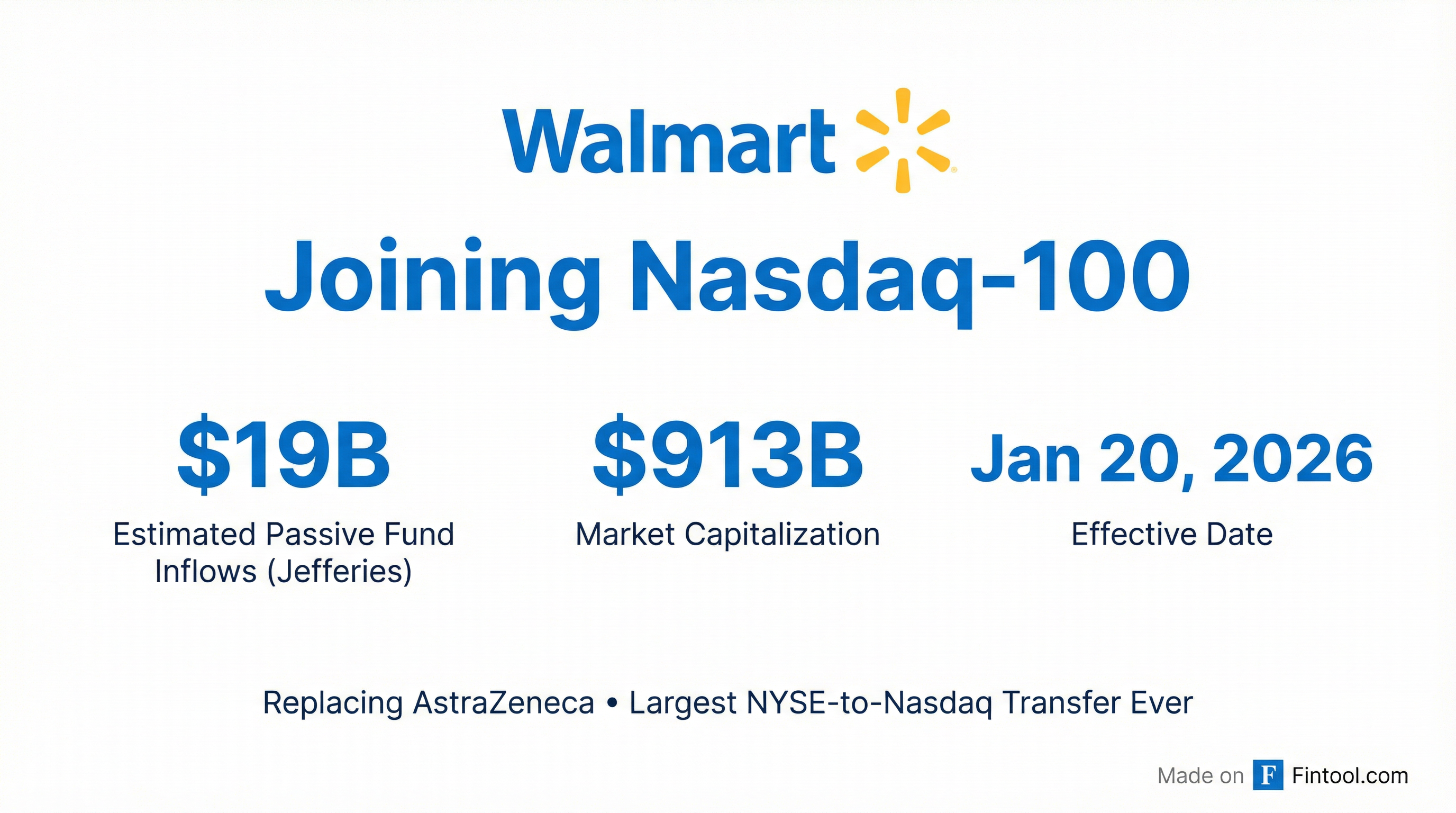
The Nasdaq-100 tracks the 100 largest non-financial companies listed on Nasdaq and serves as the benchmark for over $600 billion in ETF assets, including the $408 billion Invesco QQQ Trust. When the index rebalances, every fund tracking it must buy Walmart shares and sell AstraZeneca.
Jefferies Financial Group analysts estimated in December that Walmart's size—with a market cap approaching $913 billion—would require roughly $19 billion of purchases from passive vehicles to achieve proper index weighting.
The timing matters: Walmart was widely expected to enter during the annual December reconstitution, but its listing switch occurred too late to meet the data cutoff. This special addition catches up to that expectation.
| Factor | Detail |
|---|---|
| Effective Date | January 20, 2026 (pre-market) |
| Assets Tracking NDX | $600+ billion in ETFs |
| Estimated Inflows | $19 billion (Jefferies) |
| WMT Market Cap | $913 billion |
| AZN Market Cap | $293 billion |
 Ask Fintool AI Agent
The Switch: From NYSE to Nasdaq
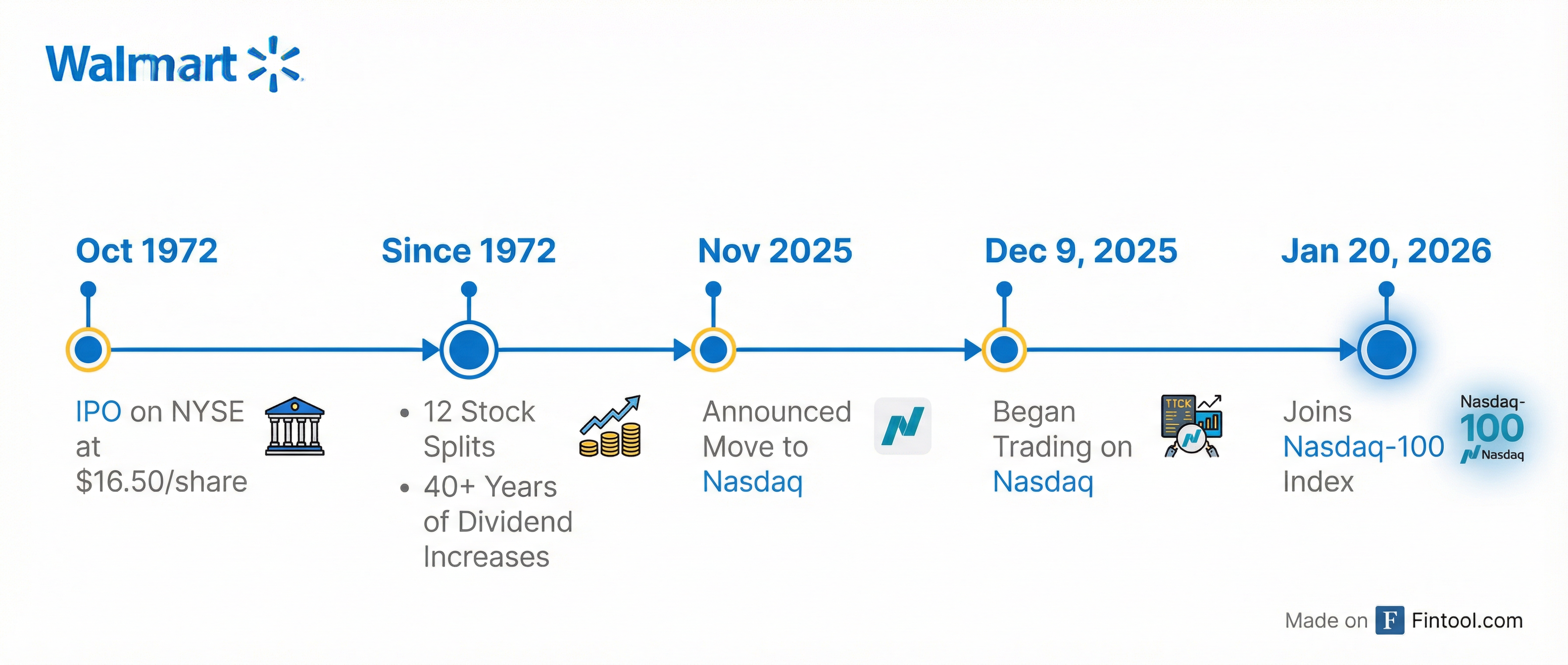
Walmart's board authorized the exchange transfer in November 2025, ending a 53-year relationship with the New York Stock Exchange that began with the company's IPO on October 1, 1972 at $16.50 per share.
CFO John David Rainey framed the move as strategic alignment: "Moving to Nasdaq aligns with the people-led, tech-powered approach to our long-term strategy. Walmart is setting a new standard for omnichannel retail by integrating automation and AI to build smarter, faster, and more connected experiences."
The listing transferred on December 9, 2025, along with nine corporate bonds.
The Performance Gap: WMT vs. AZN
AstraZeneca's exit marks the end of a pandemic-era run. The Anglo-Swedish drugmaker joined the Nasdaq-100 when COVID-19 vaccine revenues propelled its stock higher, but has since underperformed as vaccine demand faded and investors pivoted to GLP-1 obesity drugs from competitors like Novo Nordisk and Eli Lilly.
The divergence is stark: Walmart shares have returned 116% since January 2024, while AstraZeneca gained just 38% over the same period.
Walmart's Transformation Story
The index inclusion arrives as Walmart hits several strategic milestones that reinforce its tech-forward narrative:
E-commerce profitability achieved. In Q1 FY2026, Walmart reached global e-commerce profitability for the first time—a milestone for a company that has invested billions in fulfillment infrastructure. The U.S. e-commerce segment grew 21% year-over-year, with losses improving 80% from the prior year.
Advertising becomes a profit engine. Walmart Connect advertising grew 31% (50% including Vizio), with the combined advertising and membership businesses now contributing over a quarter of total operating income.
AI investments accelerating. Just days before the Nasdaq-100 inclusion, Walmart appointed Shishir Mehrotra—former YouTube CTO and Coda CEO—to its board, explicitly citing the company's push into "agentic AI." The retailer has partnered with OpenAI to deploy AI-powered shopping tools.
| Metric | Q4 2025 | Q1 2026 | Q2 2026 | Q3 2026 |
|---|---|---|---|---|
| Revenue ($B) | $180.6 | $165.6 | $177.4 | $179.5 |
| Net Income ($B) | $5.3 | $4.5 | $7.0 | $6.1 |
| Gross Margin % | 24.6% | 24.9% | 25.2% | 25.0% |
Ask Fintool AI AgentForward Estimates
Analysts project continued momentum, with consensus expecting FY2026 revenue of $708 billion (up 4% from FY2025's $681 billion) and EPS of $2.64. The average price target sits at $122, implying 7% upside from current levels.*
| Metric | FY 2023 | FY 2024 | FY 2025 | FY 2026E | FY 2027E |
|---|---|---|---|---|---|
| Revenue ($B) | $611.3 | $648.1 | $681.0 | $708.4* | $742.0* |
| Net Income ($B) | $11.7 | $15.5 | $19.4 | — | — |
| Gross Margin % | 24.1% | 24.4% | 24.9% | — | — |
*Values retrieved from S&P Global
What to Watch
January 20 rebalancing flows. The inclusion takes effect before market open. Watch for elevated volume as passive funds execute their buys.
Q4 FY2026 earnings (February 19). Walmart's first results as a Nasdaq-100 component will draw added scrutiny, particularly on e-commerce profitability sustainability and tariff impacts.
Broader index eligibility trends. Several other large-cap companies have switched from NYSE to Nasdaq to gain Nasdaq-100 eligibility. This trend could accelerate if Walmart's experience proves positive for shareholder returns.
Ask Fintool AI AgentThe Bottom Line
Walmart's Nasdaq-100 inclusion is more than a corporate action—it's validation of the company's successful transformation from brick-and-mortar giant to tech-powered omnichannel leader. The estimated $19 billion in forced buying creates a near-term technical catalyst, while the underlying business momentum in e-commerce, advertising, and AI positions Walmart as a legitimate member of the innovation-focused index.
For AstraZeneca shareholders, the removal is a reminder that index membership is earned through sustained outperformance, not past achievements.
Related