Earnings summaries and quarterly performance for OCULAR THERAPEUTIX.
Executive leadership at OCULAR THERAPEUTIX.
Donald Notman
Chief Financial Officer and Chief Operating Officer
Jeffrey Heier
Chief Scientific Officer
Nadia Waheed
Chief Medical Officer
Peter Kaiser
Chief Development Officer
Pravin Dugel
Executive Chairman
Sanjay Nayak
Chief Strategy Officer
Todd Anderman
Chief Legal Officer and Secretary
Board of directors at OCULAR THERAPEUTIX.
Research analysts who have asked questions during OCULAR THERAPEUTIX earnings calls.

Sean McCutcheon
Raymond James
6 questions for OCUL
Tazeen Ahmad
Bank of America
6 questions for OCUL
Tara Bancroft
TD Cowen
5 questions for OCUL
Yi Chen
H.C. Wainwright & Co.
5 questions for OCUL

Biren Amin
Piper Sandler Companies
4 questions for OCUL
Colleen Hanley
Baird
2 questions for OCUL
Colleen Kusy
Robert W. Baird & Co.
2 questions for OCUL
Dingding Shi
Jefferies
2 questions for OCUL

Gregory Harrison
Scotiabank
2 questions for OCUL
Jon Wolleben
Citizen JMP
2 questions for OCUL
Bill Maughan
Clear Street
1 question for OCUL
Catherine
Citizens
1 question for OCUL
Catherine Okoukoni
Citizens JMP Securities, LLC
1 question for OCUL

Catherine Okoukoni
Citizens JMP
1 question for OCUL
Colleen Coozy
Baird
1 question for OCUL

Joe Thomas
Scotiabank
1 question for OCUL
Jonathan Wolleben
JMP Securities, a Citizens Company
1 question for OCUL

Kelly Shi
Jefferies
1 question for OCUL
Lachlan Hanbury-Brown
William Blair & Company
1 question for OCUL
Lisa Walter
RBC Capital Markets
1 question for OCUL
Ye Chen
HC Wainwright
1 question for OCUL
Yuxi Dong
Mizuho Securities
1 question for OCUL
Recent press releases and 8-K filings for OCUL.
- Ocular Therapeutix announced positive top-line results from the Phase 3 SOL-1 trial for AXPAXLI in wet AMD, demonstrating superiority over aflibercept. This makes AXPAXLI the first and only investigational product in wet AMD with a novel mechanism of action to successfully achieve this milestone against an approved anti-VEGF agent.
- At the week 36 primary endpoint, 74.1% of AXPAXLI subjects maintained vision, compared to 55.8% in the aflibercept arm, with a statistically significant risk difference of 17.5% (p-value 0.0006).
- AXPAXLI also demonstrated sustained durability and anatomic control, with 65.9% of subjects maintaining vision and 44.1% maintaining central subfield thickness within 30 microns of baseline through week 52. The drug was generally well-tolerated, with no observed treatment-related ocular or systemic serious adverse events.
- The company plans to pursue FDA approval via the accelerated 505(b)(2) pathway, aiming for a superiority label that could bypass payer step edits and potentially redefine wet AMD treatment.
- Ocular Therapeutix announced positive top-line results from the SOL-1 Phase 3 trial for AXPAXLI in wet AMD, demonstrating superiority to aflibercept 2 mg.
- AXPAXLI showed superiority in maintaining vision, with 74.1% of subjects maintaining vision at week 36 (vs. 55.8% for aflibercept, p=0.0006) and 65.9% at week 52.
- The trial also demonstrated sustained anatomic control, with 55.9% of AXPAXLI subjects maintaining central subfield thickness within 30 microns of baseline through week 36 and 44.1% through week 52.
- AXPAXLI was generally well-tolerated, with no observed treatment-related ocular or systemic serious adverse events.
- Ocular Therapeutix plans to pursue regulatory approval via the accelerated 505(b)(2) pathway for AXPAXLI.
- Ocular Therapeutix announced positive top-line results from the SOL-1 Phase 3 registrational trial for AXPAXLI in wet AMD.
- AXPAXLI demonstrated superiority to an approved anti-VEGF agent (aflibercept 2 mg), a significant achievement as no other novel mechanism of action product has done so in over two decades.
- The trial met its primary endpoint, with 74.1% of AXPAXLI subjects maintaining vision through week 36, compared to 55.8% for aflibercept, showing high statistical significance (p-value of 0.0006).
- AXPAXLI exhibited sustained efficacy and a well-tolerated safety profile, with 65.9% of subjects maintaining vision and 44.1% maintaining central subfield thickness within 30 microns of baseline at week 52, and no observed treatment-related ocular or systemic serious adverse events.
- The company plans to pursue regulatory submission through the accelerated 505(b)(2) pathway based on the SOL-1 data.
- Ocular Therapeutix, Inc. announced positive topline results from the SOL-1 Phase 3 superiority trial of AXPAXLI (OTX-TKI) for the treatment of wet age-related macular degeneration (AMD).
- The trial met its superiority primary endpoint at Week 36, with 74.1% of subjects in the AXPAXLI arm maintaining vision, a 17.5% risk difference (p=0.0006) compared to the aflibercept (2 mg) arm.
- At Week 52, 65.9% of AXPAXLI subjects maintained vision, representing a 21.1% risk difference (p <0.0001) compared to the aflibercept (2 mg) arm.
- AXPAXLI was generally well-tolerated in SOL-1, with no treatment-related ocular serious adverse events (SAEs) observed.
- Ocular Therapeutix plans to submit a New Drug Application (NDA) based on the SOL-1 data, subject to planned formal discussions with the U.S. FDA.
- Ocular Therapeutix, Inc. will host a webcast on Tuesday, February 17, 2026, to review the topline results of the SOL-1 Phase 3 superiority clinical trial for AXPAXLI™ (OTX-TKI).
- AXPAXLI™ is an investigational product candidate for the treatment of wet age-related macular degeneration (wet AMD).
- Detailed data from the trial will be presented at the 49th Macula Society Annual Meeting between February 25 \u2013 28, 2026.
- AXPAXLI™ utilizes the company's ELUTYX™ proprietary bioresorbable hydrogel-based formulation technology.
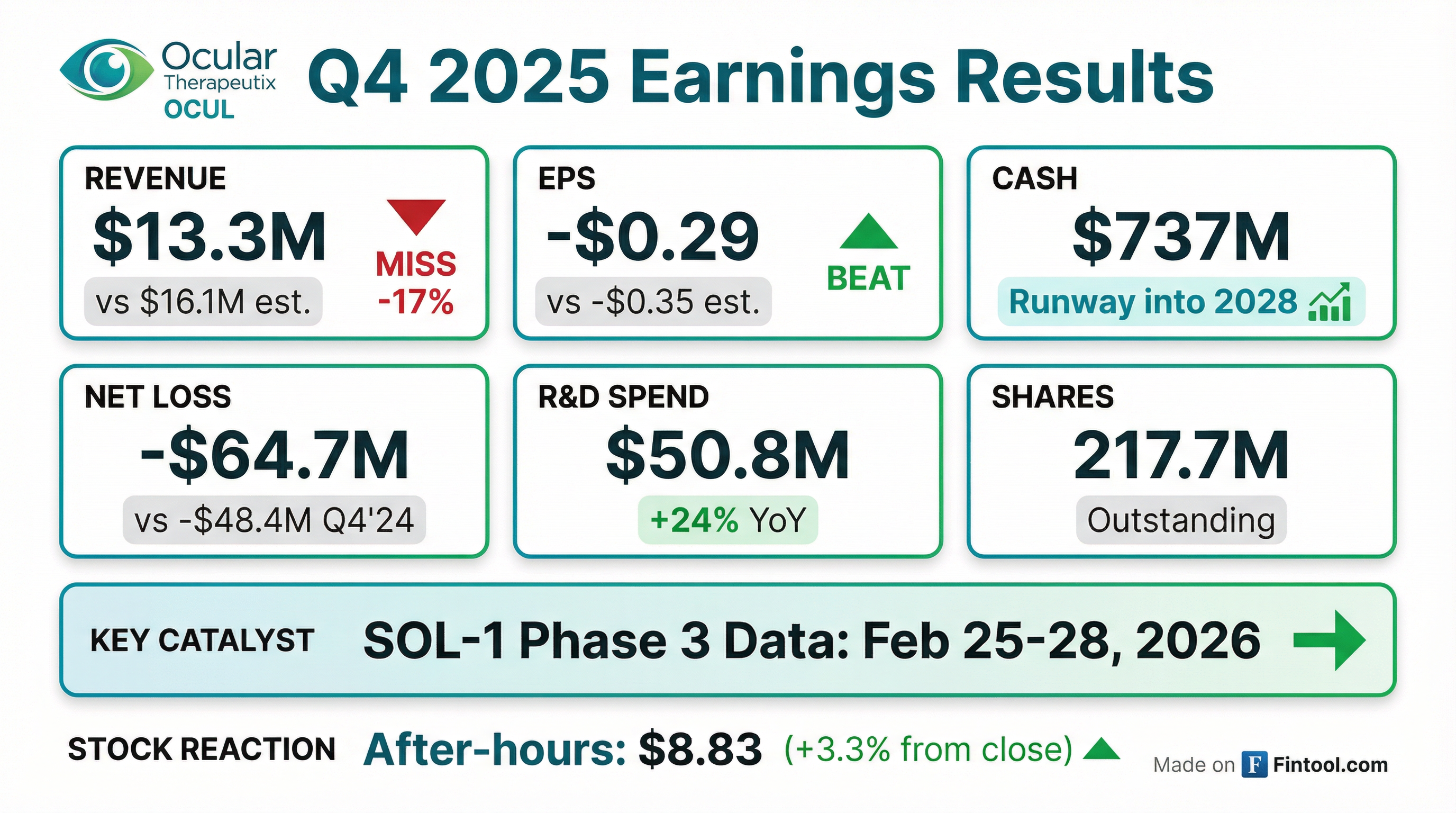
- Ocular Therapeutix reported a cash balance of $737.1 million as of December 31, 2025, with an expected runway into 2028.
- Total net revenue for Q4 2025 was $13.3 million, representing a 22.4% decrease compared to Q4 2024, and full year 2025 total net revenue was $52.0 million, an 18.5% decrease from 2024, primarily due to a challenging reimbursement environment for DEXTENZA.
- The company reported a net loss of $(64.7) million, or $(0.29) per share, for Q4 2025, and a full year 2025 net loss of $(265.9) million, or $(1.42) per share.
- Key clinical updates include the expected presentation of Week 52 results for the SOL-1 Phase 3 superiority trial for AXPAXLI in wet AMD between February 25-28, 2026, with plans to submit an NDA based on positive results. Randomization for the SOL-R Phase 3 non-inferiority trial was completed in December 2025, accelerating topline results to 1Q 2027, and the HELIOS-3 Phase 3 trial in diabetic retinopathy is underway.
- Ocular Therapeutix reported a cash balance of $737.1 million as of December 31, 2025, with an expected cash runway into 2028.
- Total net revenue for the fourth quarter of 2025 was $13.3 million, a 22.4% decrease compared to the same period in 2024, and full year 2025 total net revenue was $52.0 million, an 18.5% decrease from 2024. This reduction was primarily due to a more challenging reimbursement environment for DEXTENZA.
- The company expects to present topline results for the SOL-1 Phase 3 superiority trial of AXPAXLI in wet AMD at the 49th Macula Society Annual Meeting between February 25-28, 2026. Pending positive results, Ocular plans to submit a New Drug Application (NDA) for AXPAXLI based on SOL-1 52 Week data.
- Randomization for the SOL-R Phase 3 non-inferiority trial in wet AMD was completed in December 2025, with topline results now anticipated in Q1 2027.
- Research and development expenses increased to $50.8 million for Q4 2025 and $197.1 million for the full year 2025, reflecting increased clinical expenses for ongoing Phase 3 trials (SOL-1, SOL-R, HELIOS-3).
- Ocular Therapeutix, Inc. has appointed David W. Robinson as its Global Chief Commercial Officer.
- Mr. Robinson is an accomplished global commercial leader, notably serving as the primary architect for the launch of EYLEA® at Regeneron and most recently as Chief Marketing Officer, Global Ophthalmology at Merck.
- This appointment strategically positions the company for the global launch of AXPAXLI™ (OTX-TKI), if approved, for wet age-related macular degeneration (wet AMD) and non-proliferative diabetic retinopathy (NPDR).
- OCULAR THERAPEUTIX, INC. (OCUL) intends to submit a new drug application (NDA) for its product candidate AXPAXLI (OTX-TKI) for the treatment of wet age-related macular degeneration (wet AMD).
- This submission will be based on year 1 data from the SOL-1 Phase 3 clinical trial, departing from the historical FDA requirement of two clinical trials for such ophthalmic product candidates.
- The company expects to report top-line data from year 1 of the SOL-1 clinical trial during the first quarter of 2026.
- Ocular Therapeutix expects the readout of its first Phase III study, SOL-1, for AXPAXLI in the first quarter of 2026, with the goal of obtaining a superiority label.
- The second Phase III study, SOLAR, is anticipated to read out in the first half of 2027 , and together with SOL-1, aims to provide a label with dosing flexibility of every six to twelve months with repeatability.
- The company has secured an IP extension for AXPAXLI until 2044.
- Ocular Therapeutix is also pursuing the NPDR opportunity, where AXPAXLI could potentially offer an injection once a year.
Fintool News
In-depth analysis and coverage of OCULAR THERAPEUTIX.

Quarterly earnings call transcripts for OCULAR THERAPEUTIX.

Ask Fintool AI Agent
Get instant answers from SEC filings, earnings calls & more