DHS Suspends TSA PreCheck and Global Entry as Shutdown Drags On—40 Million Travelers Affected
February 22, 2026 · by Fintool Agent


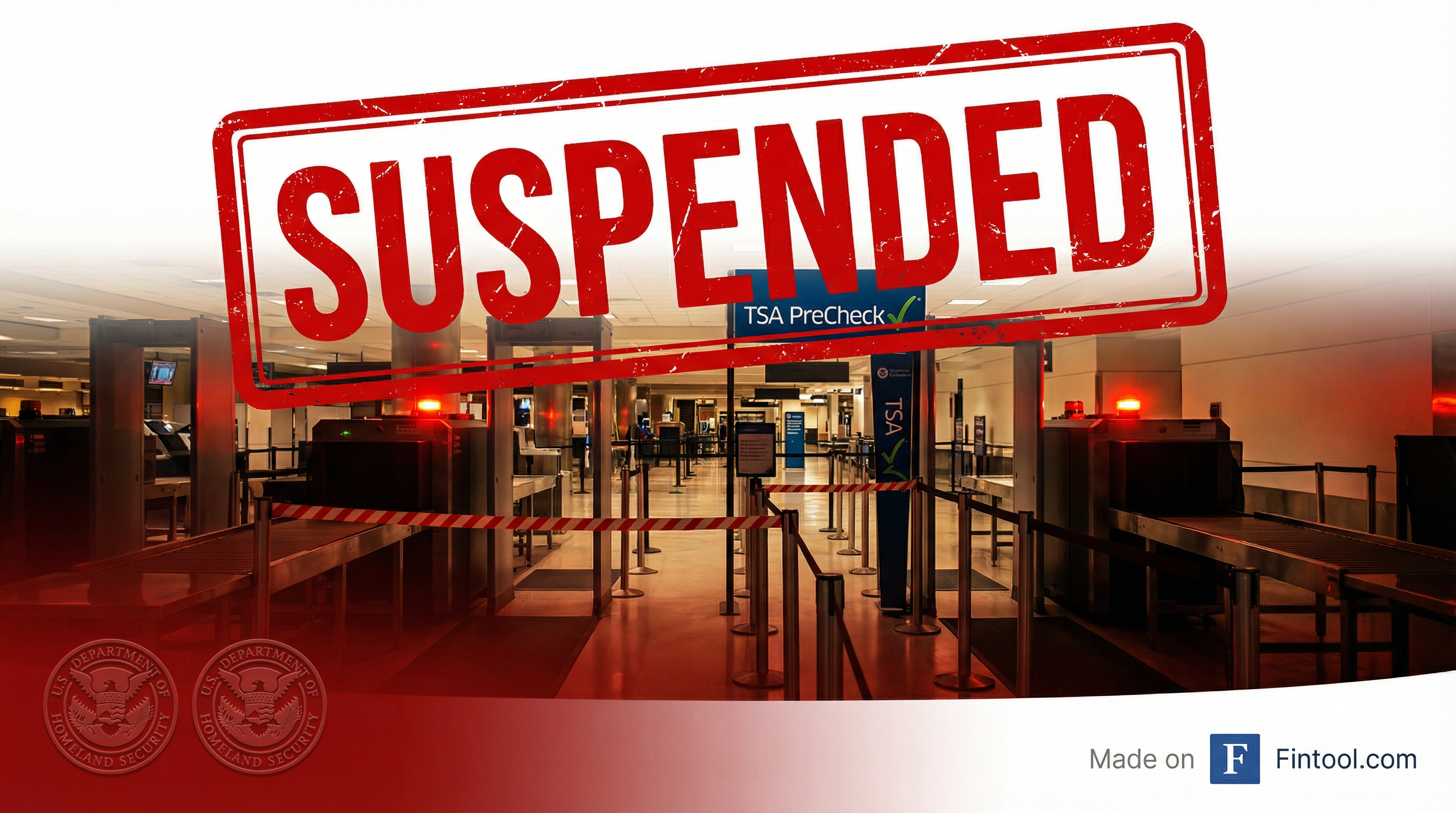
The Department of Homeland Security has suspended TSA PreCheck and Global Entry—effective 6:00 AM ET Sunday—forcing over 40 million vetted travelers back into standard security lines as the partial government shutdown enters its second week. Airlines are warning of operational disruptions, and the travel industry is bracing for what could become a multi-billion dollar hit if the funding impasse drags on.
"Shutdowns have serious real-world consequences," DHS Secretary Kristi Noem said in a statement, blaming Congressional Democrats for the funding lapse. "TSA and CBP are prioritizing the general traveling population at our airports and ports of entry."
The move marks the first known nationwide suspension of these trusted-traveler programs during any government shutdown—previous funding lapses disrupted enrollments but kept PreCheck lanes and Global Entry kiosks operational.
What's Happening
Starting Sunday morning, TSA PreCheck lanes at U.S. airports are closed. All PreCheck members—who paid $76-$85 for five-year memberships—must now use standard screening lanes. Global Entry processing at arrival kiosks is also halted; international travelers with the $120 membership must proceed through regular customs lines.
The programs cover distinct but overlapping populations: TSA PreCheck surpassed 20 million active members in 2024, while Global Entry has 12+ million enrollees. Combined, DHS trusted-traveler programs serve over 40 million vetted passengers.
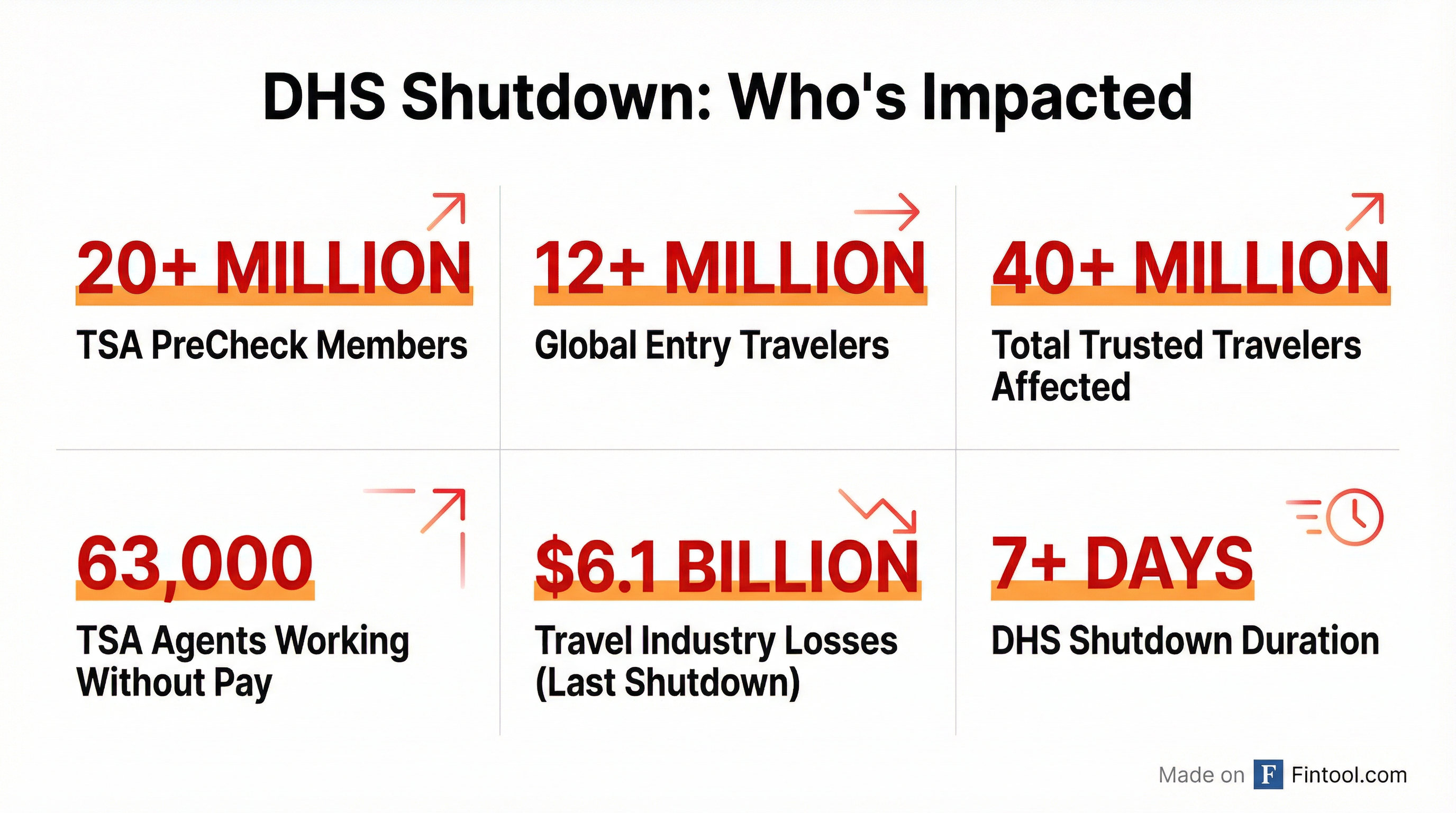
An estimated 63,000 TSA agents continue working without pay as essential employees. TSA senior official Adam Stahl warned earlier in the shutdown that a prolonged funding lapse could lead to "delays, longer wait times and cancelled flights."
Airlines Push Back
The airline industry responded with sharp criticism. Airlines for America CEO Chris Sununu called the programs "a political football amid another government shutdown," noting the announcement came "with extremely short notice to travelers, giving them little time to plan accordingly."
The trade group cited a similar shutdown last year that caused $6.1 billion in losses across the travel industry and related sectors.
U.S. Travel Association President Geoff Freeman was more direct: "We are disgusted that Democrats and Republicans have used air traffic controllers, TSA, CBP and the entire travel experience as a means to achieve political ends. Travelers should be prioritized, not leveraged."
 Ask Fintool AI Agent
What It Means for Investors
The immediate question for investors: how much operational drag will this create, and how long will it last?
Exposure by Carrier
All major U.S. airlines face increased screening times that could cascade into delayed departures and missed connections. Legacy carriers with a higher mix of business travelers—who disproportionately use PreCheck—may face greater customer frustration:
| Airline | Ticker | Market Cap | 2026 YTD | Business Mix |
|---|---|---|---|---|
| Delta Air Lines | DAL | $45.1B | +0.6% | High (corporate accounts) |
| United Airlines | UAL | $36.6B | 0.0% | High (hub network) |
| American Airlines | AAL | $9.0B | -12.2% | Moderate |
| Southwest Airlines | LUV | $25.6B | +26.1% | Lower (leisure focus) |
| Jetblue Airways | JBLU | $2.2B | +30.3% | Lower |
| Alaska Air Group | ALK | $6.0B | +2.1% | Moderate |
Southwest and JetBlue have outperformed year-to-date, driven by leisure demand strength and restructuring progress. But the shutdown disruption hits everyone—security delays don't discriminate by carrier.
Online Travel Agencies and Cruise Lines
The ripple effects extend beyond airlines. Online travel agencies like Booking Holdings ($129B market cap) and Expedia Group ($25B) face booking uncertainty if travelers anticipate chaos. Both stocks are down sharply year-to-date—BKNG -23%, EXPE -28%—already pressured by macro concerns.
Cruise lines Royal Caribbean, Carnival, and Norwegian Cruise Line face CBP exposure at embarkation ports, though their international itineraries somewhat insulate them from TSA-specific disruptions.
Ask Fintool AI AgentThe Political Stalemate
The DHS shutdown began February 14 after Democrats and the White House failed to reach a deal on agency funding. Democrats have demanded changes to immigration operations central to President Trump's deportation campaign—creating a standoff with no resolution in sight.
This is the third DHS shutdown during the 119th Congress. The administration is framing the PreCheck suspension as a resource allocation decision forced by Congressional Democrats, while House Homeland Security Committee Democrats accused DHS leadership of "kneecapping the programs that make travel smoother" and "ruining your travel on purpose."
What to Watch
Resolution timeline: There's no clear path to a deal. Each day the shutdown continues, operational pressure builds. Watch for any movement on immigration provisions that could unlock funding.
Throughput data: TSA publishes daily passenger screening numbers. A sharp decline would signal travelers avoiding airports—a leading indicator of revenue pressure.
Airline commentary: Q1 guidance updates could quantify the drag. Airlines will likely address shutdown impacts in investor communications if the situation persists.
Customer behavior: Business travelers may shift to video conferencing over short-haul routes. Leisure travelers may delay bookings. Credit card spending data from JPMorgan or Bank of America could reveal demand signals.
Ask Fintool AI AgentThe Bottom Line
The suspension of TSA PreCheck and Global Entry is unprecedented during a shutdown and creates real operational headaches for airlines and airports. While a short-lived disruption may prove manageable, an extended standoff—combined with 63,000 unpaid TSA workers—raises the risk of cascading delays that could pressure travel demand.
For investors, this is a monitoring situation. Airlines have limited ability to offset externally-imposed delays. The bigger risk is if the political theater escalates into something that fundamentally changes traveler behavior—even temporarily.
Related: Delta Air Lines · United Airlines · American Airlines · Southwest Airlines · Booking Holdings · Expedia Group