Honeywell CEO Reveals Org Separation 'This Week' at Barclays Conference, Eyes Industrial M&A Post-Spin
February 17, 2026 · by Fintool Agent


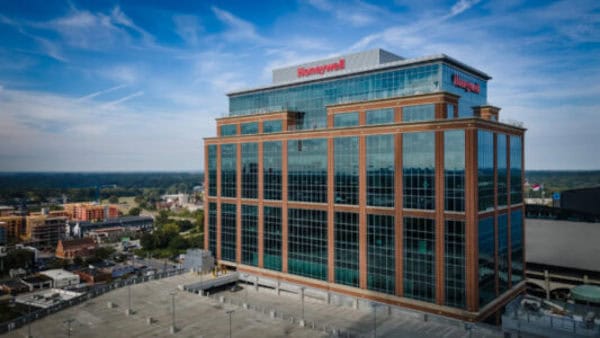
Honeywell CEO Vimal Kapur disclosed at the Barclays Industrial Select Conference in Miami that the company is rolling out its organizational separation between Aerospace and Automation "this week"—a critical milestone as the industrial conglomerate sprints toward its Q3 2026 spin-off deadline.
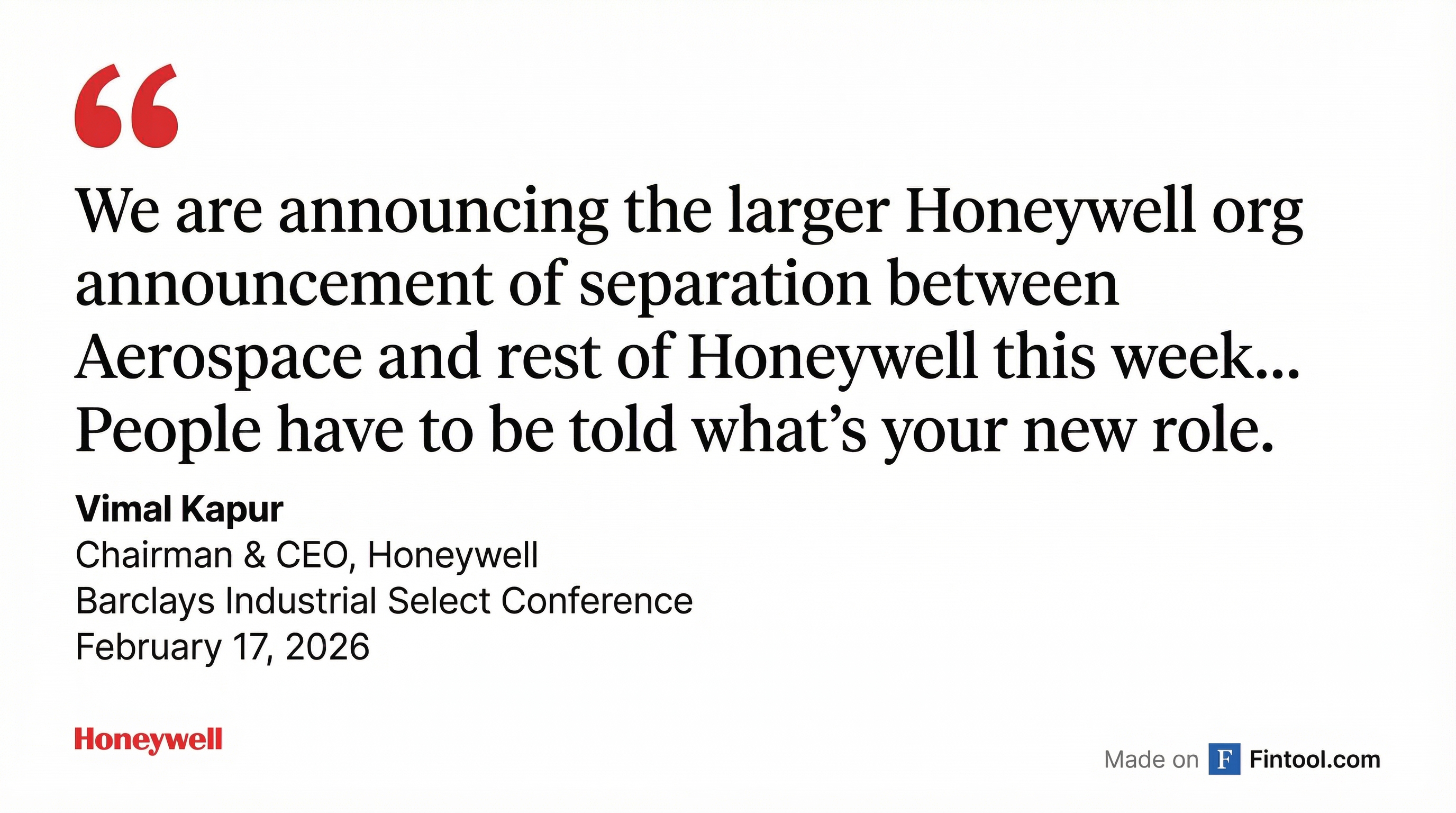
"We are actually doing, this week, the larger Honeywell org announcement of separation between Aerospace and rest of Honeywell," Kapur told investors. "People have to be told what's your new role."
Shares traded at $240.95, up 14% year-to-date and hovering near their 52-week high of $245.63.
The Split: Two Pure-Play Giants
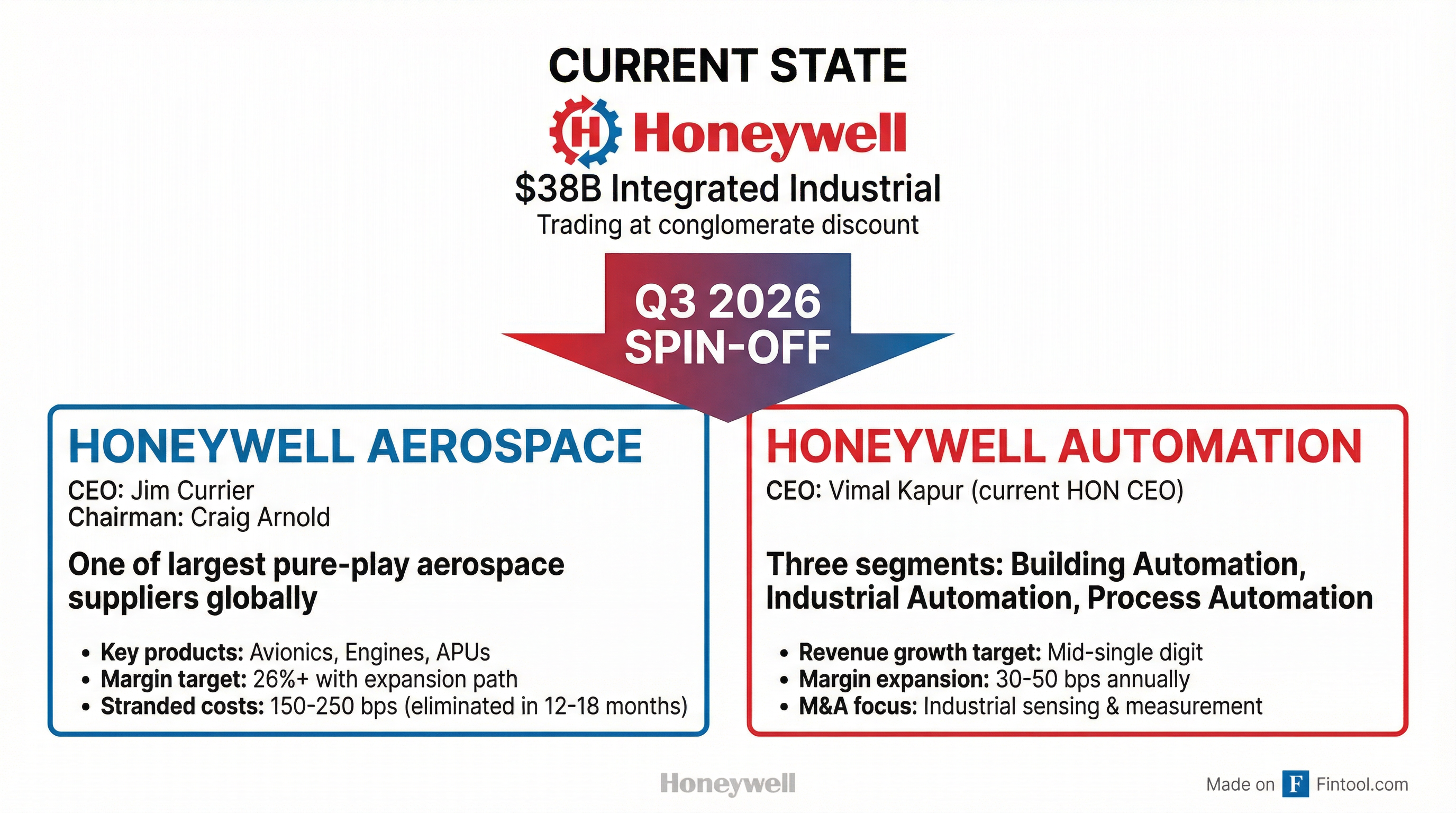
The Q3 2026 separation will create two distinct investment vehicles:
Honeywell Aerospace will emerge as one of the largest publicly traded pure-play aerospace suppliers globally, led by CEO Jim Currier and Non-Executive Chairman Craig Arnold (former Eaton CEO). The company supplies avionics, engines, and auxiliary power units used on virtually every commercial and defense aircraft platform worldwide.
Honeywell Automation will retain current CEO Vimal Kapur and concentrate on three core segments: Building Automation, Industrial Automation (sensing and measurement), and Process Automation and Technology.
 Ask Fintool AI Agent
Stranded Costs: The Key Variable
Kapur addressed investor concerns about separation costs head-on. For Aerospace, stranded costs will run 150-250 basis points, with the company targeting the lower end.
"We are confident that the cost basis will be in parity with the market. It will not be either tailwind or a headwind," Kapur said.
For RemainCo (Honeywell Automation), corporate costs as a percentage of revenue will remain unchanged from current levels. Stranded cost elimination is targeted for completion within 12-18 months of separation.
Aerospace: Supply-Constrained, Not Demand-Constrained
The aerospace business faces what Kapur called a "massive challenge"—but one any company would envy: overwhelming demand against supply constraints.
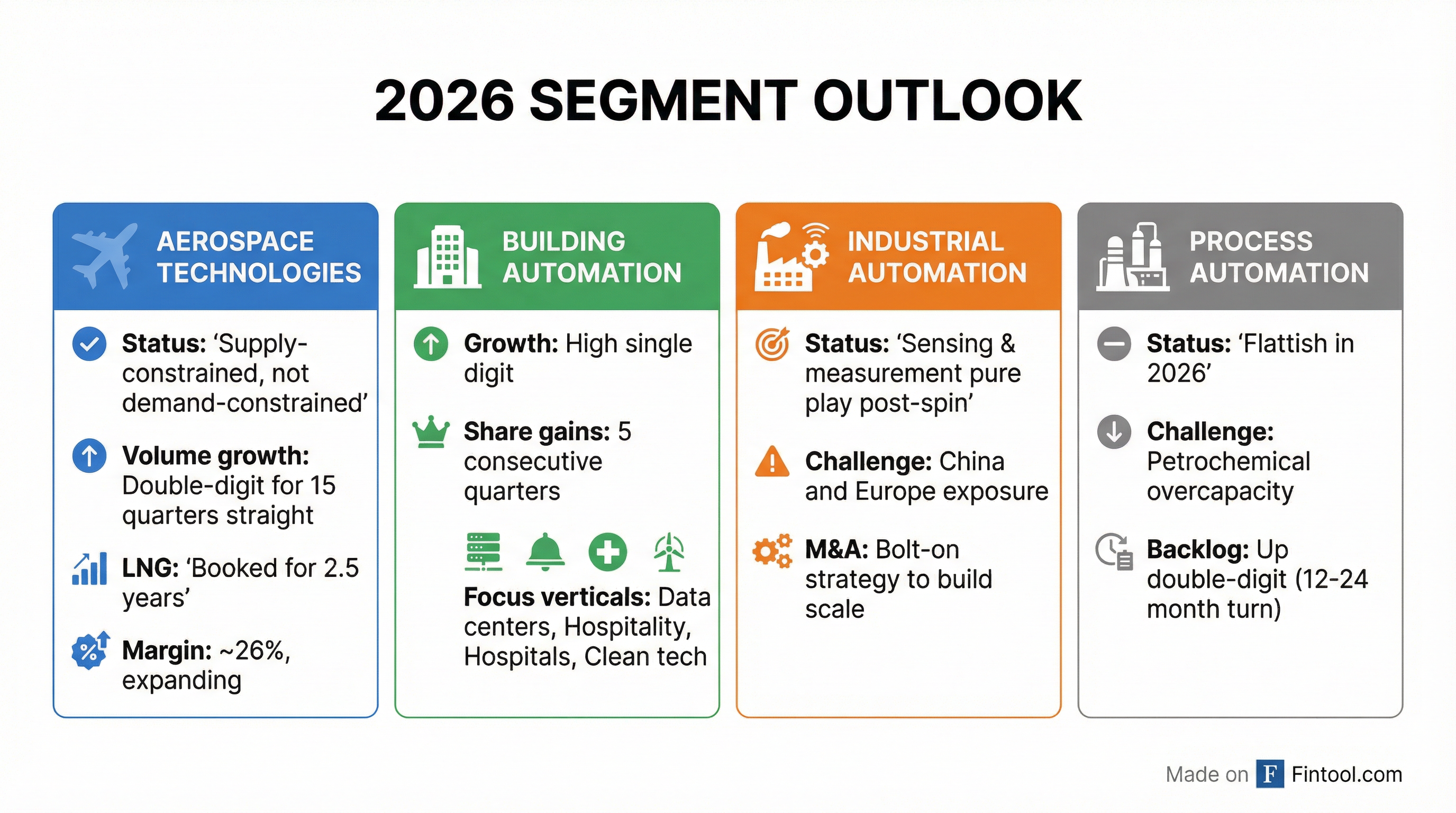
"We have been growing our volume by double-digit for, like, 15 quarters in a row. But so that's the good news. The bad news, we have to do for 15 more quarters in a row," Kapur said. "These are large APUs and engines and avionics. These are not easy-to-make products."
LNG systems are booked for 2.5 years, with new orders simply pushing delivery further to the right.
Aerospace margins have stabilized around 26% after years of headwinds, with expansion expected in both 2026 and 2027 as:
- OE mix normalizes (no longer growing 15-20% vs. high single digits)
- Integration costs from prior acquisitions are behind
- Supply chain costs have peaked and volume leverage returns
- OE contract renewals enable tariff pass-through starting 2027
Ask Fintool AI AgentBuilding Automation: Five Quarters of Share Gains
Honeywell's Building Automation segment has delivered high-single-digit growth and share gains for five consecutive quarters—outpacing management's own mid-single-digit guidance.
Kapur attributed the outperformance to two strategic shifts:
-
Vertical mix optimization toward faster-growing end markets: data centers, hospitality (hotel room growth is at "staggering, never-seen kind of numbers"), hospitals, and clean tech (battery and semiconductor manufacturing requiring controlled environments)
-
New product launches enabling share gains against geographically fragmented competition
"If we have been growing high single for five quarters in a row, why you guide mid-single? Because you cannot be assuming you'll keep gaining share," Kapur explained the conservative outlook.
Industrial Automation: The M&A Opportunity
Perhaps the most forward-looking disclosure came around Honeywell's industrial automation ambitions post-spin.
After completing the separation of currently marketed businesses (PSS and WWS, with signed deals expected Q2 2026), Industrial Automation will become a "pure play sensing and measurement business" starting from a $4 billion base.
"I truly believe that there's an opportunity to create a new category of sensing and measurement in industrials because there's no one large player who exists," Kapur said. "It's a fragmented market, and we have already proven in building automation that we can create scale in fragmented market."
The M&A thesis: bolt-on acquisitions in sensing, gas detection, and metering to build category leadership similar to what Honeywell achieved in building automation.
However, 2026 will be "more dormant" on M&A as the company prioritizes protecting its A2 investment-grade credit rating through debt paydown.
Process Segment: The Weak Spot
Process Automation and Technology remains the portfolio's laggard, guided flat for 2026 despite double-digit backlog growth.
The disconnect: petrochemical overcapacity is suppressing investment even as LNG and refining (outside the U.S.) show strength. The 12-24 month turn cycle on process projects means even strong order trends take time to materialize in revenue.
"How long will overcapacity remain? You know, our guide suggests it will remain for all of 2026," Kapur acknowledged, though he noted improvement would flow to the upper end of guidance.
Inflation: The New Normal
Kapur delivered a stark message on industrial inflation: it's structural, not cyclical.
"2026 will be the third year in a row in which we are talking of the price of the order of 3%, maybe even 4%," he said. "I have no data point to tell you in 2027, it won't be another 3%-4%."
The drivers are foundational:
- Electronics: Semiconductor and memory shortages driving input costs higher
- Commodities: Copper, zinc, rare earth, and precious metals (catalyst manufacturing costs up 75-100%)
- Labor: Persistent wage inflation
Honeywell's response involves three pillars: making inflation a "constant dialogue" with customers and channel partners, productivity offsets to maintain pricing elasticity and protect volume, and new product development that creates economic value beyond price discussions.
Ask Fintool AI AgentFinancial Outlook
For 2026, Honeywell guided:
| Metric | 2026 Guidance |
|---|---|
| Sales Growth | 3-6% |
| Adjusted EPS | $10.20-$10.50 |
| EPS Growth | 6-9% |
| Free Cash Flow Conversion | 90%+ (both entities post-spin) |
Values from company guidance
Both Honeywell Aerospace and Honeywell Automation are positioned for 90%+ free cash flow conversion net of pension income.
Notably, the pension is overfunded by approximately 40% and will be "equitably split" between the two entities.
What to Watch
Near-term catalysts:
- Organizational separation announcement (this week)
- Q1 2026 earnings (April 2026)
- PSS and WWS sale announcements (Q2 2026)
- Honeywell Aerospace Investor Day (Phoenix, June 2-3, 2026)
- Honeywell Automation Investor Day (New York City, June 11, 2026)
- Aerospace spin-off completion (Q3 2026)
Key questions:
- Will stranded costs come in at the low end (150 bps) or high end (250 bps) for Aerospace?
- How quickly can Industrial Automation execute the "category creation" M&A thesis?
- Can Building Automation sustain share gains beyond management's conservative guidance?
- Will process segment overcapacity ease faster than expected, driving upside to the 3-6% sales range?
With the organizational separation now rolling out, Honeywell enters the final stretch of its transformation from industrial conglomerate to two focused pure-plays. The market's judgment on sum-of-the-parts value will come soon enough.