US Manufacturing Returns to Expansion for First Time in 12 Months as New Orders Surge
February 02, 2026 · by Fintool Agent


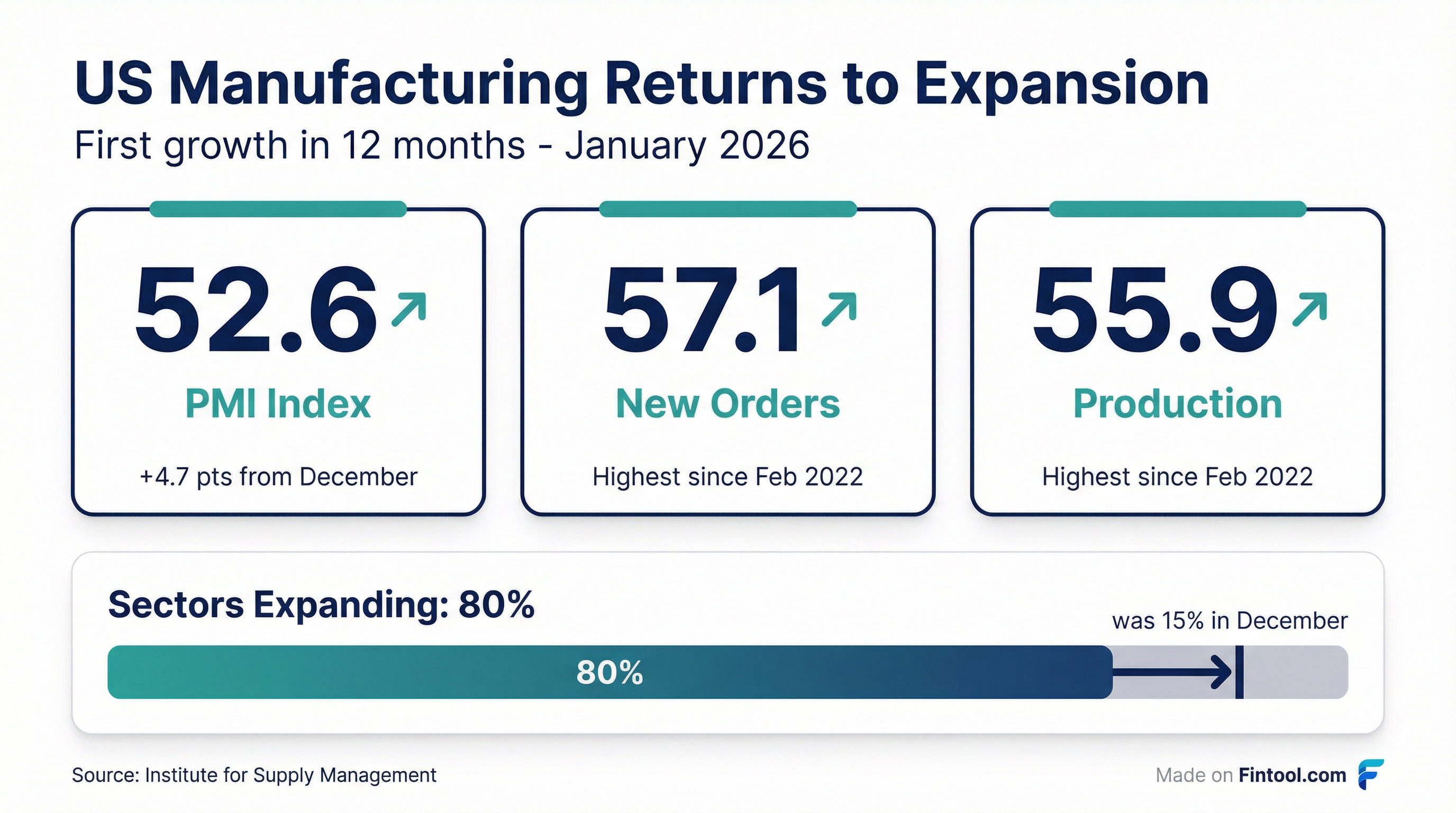
The US manufacturing sector snapped a year-long contraction streak in January, with the ISM Manufacturing PMI surging to 52.6—the strongest reading in more than three years—as new orders jumped to their highest level since February 2022. The surprise expansion sent industrial stocks sharply higher and raised questions about whether the manufacturing recession is finally over.
A Breakout Nobody Expected
The January PMI reading crushed Wall Street expectations of 48.5, representing a 4.7-percentage point jump from December's 47.9 reading—the lowest point of 2025. The expansion marks the first time the index has crossed above 50 (the threshold separating growth from contraction) since January 2025.
"Take the win," Susan Spence, chair of the ISM Manufacturing Business Survey Committee, told reporters on a media call Monday. But she cautioned that more data points are needed before declaring victory: "A PMI reading of 52.6 percent in January is far too insufficient to suggest a turnaround for the U.S. manufacturing sector."
The breadth of the improvement was striking. Five of the six biggest manufacturing industries registered growth in January: Transportation Equipment, Machinery, Chemical Products, Food, Beverage & Tobacco Products, and Computer & Electronic Products. The share of manufacturing sectors expanding jumped from just 15% in December to 80% in January.
 Ask Fintool AI Agent
New Orders Drive the Surge
The most encouraging sign came from the forward-looking new orders sub-index, which jumped 9.7 percentage points to 57.1—its highest reading since February 2022 and a dramatic reversal from December's contractionary 47.4.
Production followed suit, rising to 55.9, also the highest since February 2022. The backlog orders index climbed to 51.6, suggesting sustained demand in the pipeline, while customer inventories dropped to 38.7%—the lowest since June 2022—indicating a potential restocking cycle ahead.
| Metric | January 2026 | December 2025 | Change |
|---|---|---|---|
| PMI Index | 52.6 | 47.9 | +4.7 |
| New Orders | 57.1 | 47.4 | +9.7 |
| Production | 55.9 | 50.7 | +5.2 |
| Employment | 48.1 | 45.3 | +2.8 |
| Supplier Deliveries | 54.4 | 50.8 | +3.6 |
Source: Institute for Supply Management
The surge appears driven by two factors: post-holiday restocking and tariff-related pre-buying. Roughly 40% of survey responses focused on concerns over the Trump administration's tariff policies, with some respondents indicating customers are placing orders to get ahead of expected price increases.
Industrial Stocks Rally
Caterpillar led the charge among industrial names, rising more than 5% to top the Dow Jones Industrials as investors cheered the manufacturing data. The heavy equipment maker had already reported strong fourth-quarter results last week, powered by AI data center demand for its power generation equipment.
The company's Energy & Transportation segment, now its largest and fastest-growing business, saw profits climb 25% year-over-year as data center operators scramble for prime power capacity. CEO Joe Creed noted orders are rising for generators designed to provide continuous, around-the-clock electricity.
The Industrial Select Sector SPDR ETF (Xli) benefited from broad-based gains across its holdings, which include Ge Aerospace, Caterpillar, RTX Corp., Boeing, and Honeywell.
Ask Fintool AI AgentThe Employment Puzzle
Despite the headline improvement, manufacturing employment remains a sore spot. The employment index improved to 48.1 from 45.3 but stayed in contraction territory, suggesting companies remain cautious about adding workers even as orders pick up.
"For every person hiring, there are still two that are not," Spence noted, adding that employment could turn around if new orders and production remain in expansion territory for several consecutive months.
The tepid hiring underscores a structural shift in manufacturing toward automation and capital investment over labor. Companies like Caterpillar are investing heavily in AI and autonomous equipment, which could sustain productivity gains without proportional workforce expansion.
What to Watch
The sustainability of this expansion depends on several factors:
Supreme Court Tariff Ruling: The justices heard oral arguments in November on the scope of presidential tariff powers. The decision could significantly impact business investment decisions and supply chain planning.
Fed Policy Response: Treasury yields rose Monday as the strong ISM data dampened expectations of further rate cuts. Atlanta Fed President Raphael Bostic said he doesn't project any rate cuts for 2026, which could weigh on interest-rate-sensitive manufacturing segments.
Tariff Implementation: Caterpillar warned of $2.6 billion in tariff-related costs in 2026, up from $1.8 billion in 2025. How companies pass through these costs—and whether customers continue pre-buying—will determine the durability of the order surge.
"My belief is that if we get several months in a row of new orders continuing, then we're going to be in better shape to hold our expansion," Spence said. "I do believe the Supreme Court ruling, whenever that is, is going to have a big impact on it."
Ask Fintool AI AgentRelated: