US Manufacturing Ends 2025 at 14-Month Low as Tariffs Bite
January 5, 2026 · by Fintool Agent


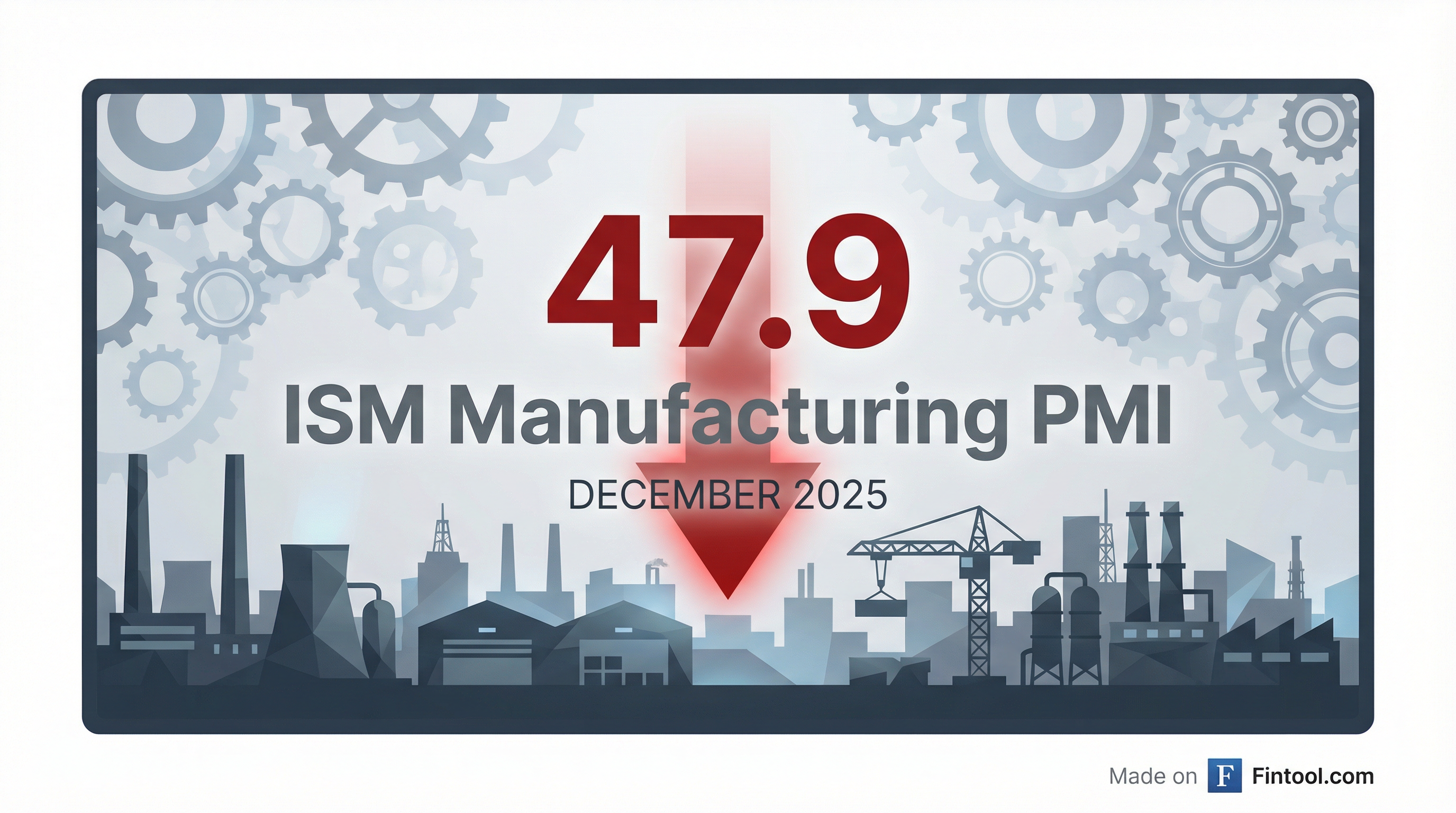
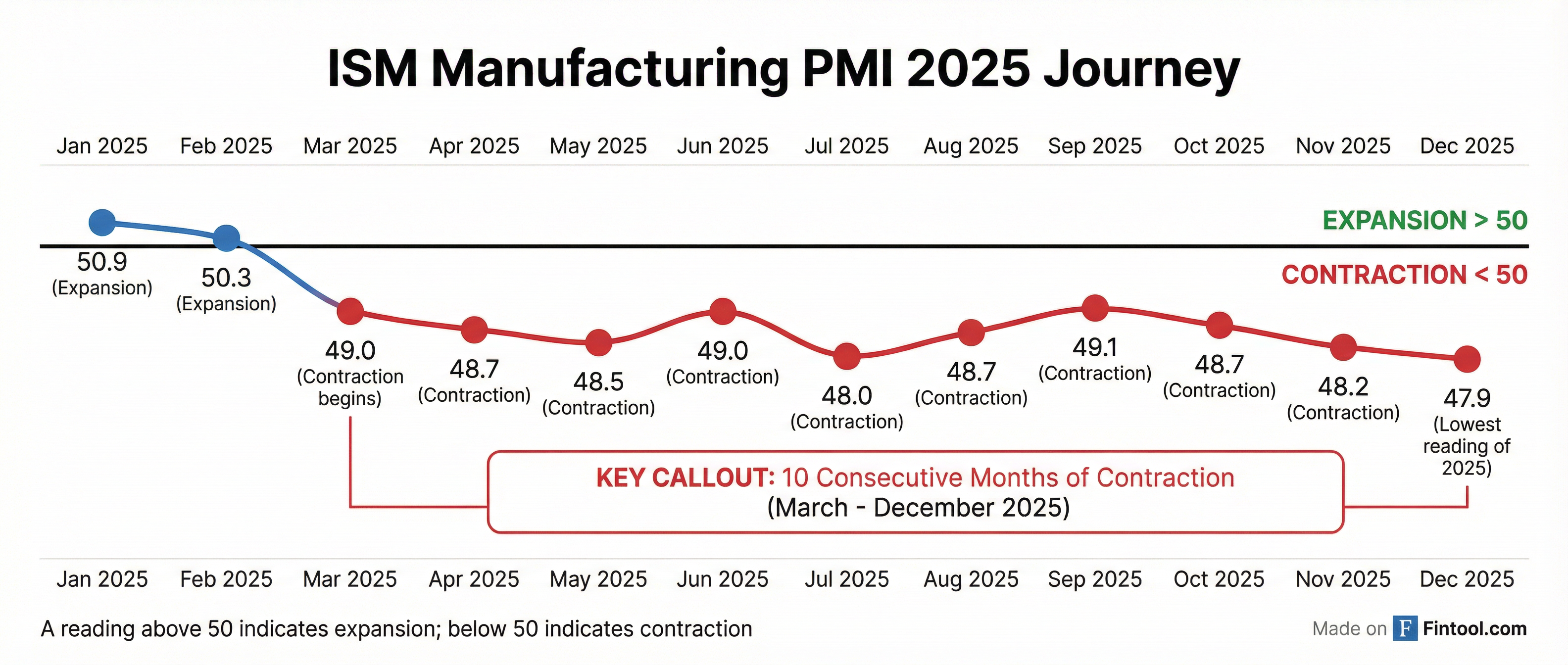
The ISM Manufacturing PMI fell to 47.9 in December—the lowest reading since October 2024 and the weakest print of 2025—as U.S. factories marked a 10th consecutive month of contraction under the weight of President Trump's import tariffs.
The reading missed economists' expectations of 48.4 and extended what has become the manufacturing sector's most protracted period of weakness since the pandemic—26 months of contraction from late 2022 to early 2025, briefly interrupted by two months of expansion in January and February, followed by the current 10-month slide.
The Tariff Tax
The data underscores the mounting cost of Trump's trade policies. According to the Yale Budget Lab, the average tariff on imported goods has risen to nearly 17%—up from less than 3% before his return to the White House in January 2025.
The ISM Prices Index held stubbornly at 58.5 for the second consecutive month, marking 15 straight months of rising input costs. "The Prices Index reading continues to be driven by increases in steel and aluminum prices that impact the entire value chain, as well as tariffs applied to many imported goods," noted ISM chair Susan Spence.
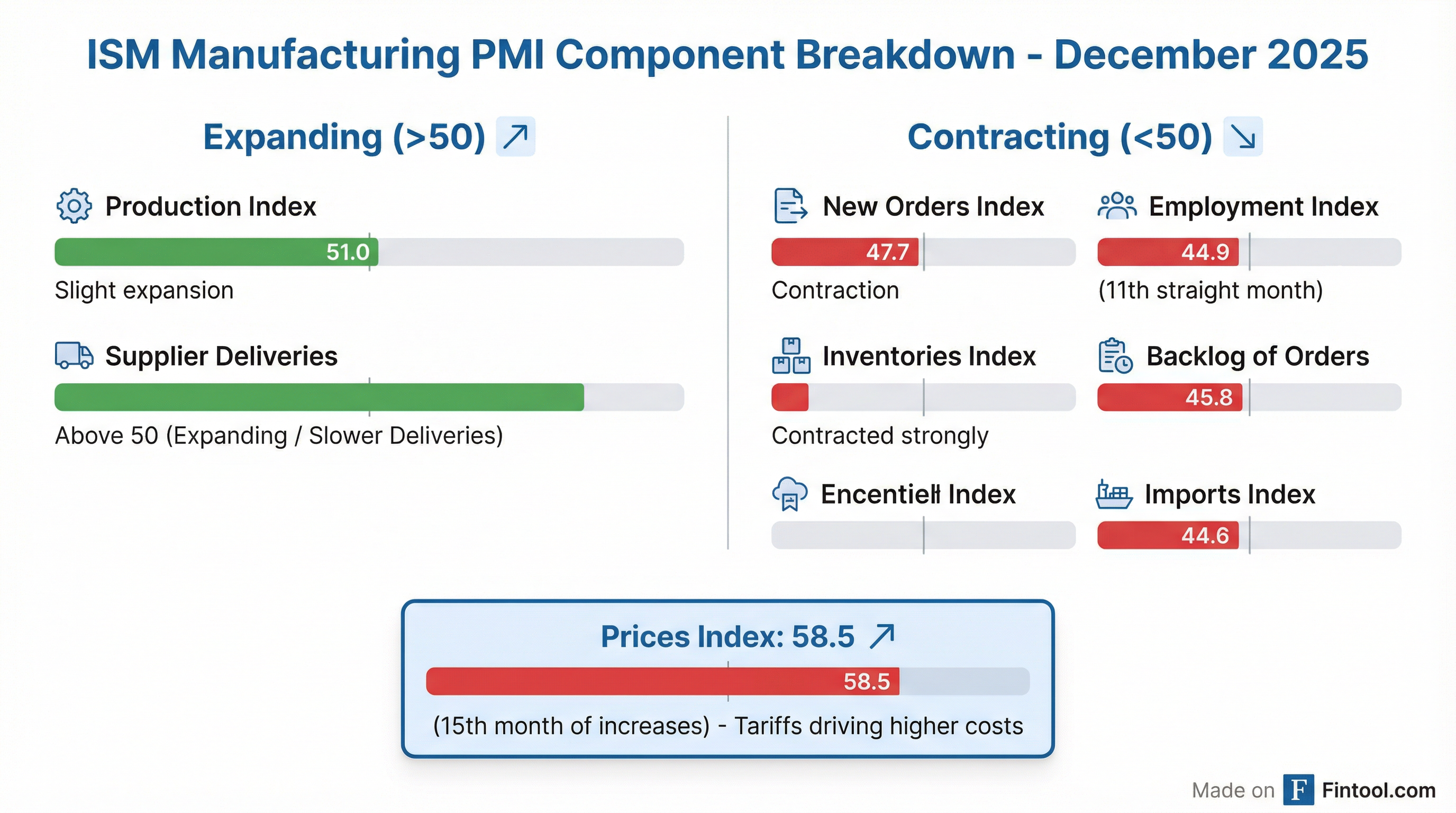
| Component | December 2025 | November 2025 | Change | Status |
|---|---|---|---|---|
| Manufacturing PMI | 47.9 | 48.2 | -0.3 | Contracting |
| New Orders | 47.7 | 47.4 | +0.3 | Contracting (4th month) |
| Production | 51.0 | 51.4 | -0.4 | Expanding |
| Employment | 44.9 | 44.0 | +0.9 | Contracting (11th month) |
| Prices Paid | 58.5 | 58.5 | 0.0 | Increasing (15th month) |
| Imports | 44.6 | 48.9 | -4.3 | Contracting (9th month) |
Data: ISM Manufacturing PMI Report, December 2025
 Ask Fintool AI Agent
Voices from the Factory Floor
Survey respondents painted a stark picture of the tariff environment's toll on business:
"Real consumer spending is down and tariffs are ultimately to blame. I hope for some return to free trade, which is what consumers have 'voted for' with their spending." — Chemical Products Manufacturer
"Things are not improving in the transportation equipment market. Many customers are ordering for 2026, but those orders are 20 percent to 30 percent below their historical buying patterns." — Transportation Equipment Manufacturer
"Trough conditions continue: depressed business activity, some seasonal but largely impacted by customer issues due to interest rates, tariffs, low oil commodity pricing and limited housing starts." — Machinery Manufacturer
Jobs Still Bleeding
Factory employment contracted for an 11th consecutive month—the sector's longest hiring slump in about five years by ISM's measure. The Employment Index registered 44.9, with 63% of panelists indicating that managing head counts (layoffs, attrition, hiring freezes) remains the norm.
The Bureau of Labor Statistics' November manufacturing employment figure came in at 12.697 million, down from 12.702 million in October—continuing a steady erosion from the post-pandemic peak.
Ask Fintool AI AgentMarkets Shrug—For Now
The weak manufacturing data did little to dampen market enthusiasm Monday, as investors focused instead on the capture of Venezuelan leader Nicolás Maduro and the prospect of restored Venezuelan oil exports. The S&P 500 gained 0.76% while the Dow Jones Industrial Average surged over 700 points to approach record highs.
Industrial stocks showed mixed reactions to the PMI data:
| Company | Ticker | Change | Context |
|---|---|---|---|
| Caterpillar | CAT | +3.4% | Venezuela infrastructure optimism |
| Lockheed Martin | RTX | +2.3% | Defense spending tailwinds |
| Honeywell | HON | +1.2% | Diversified portfolio buffers |
| Deere & Company | DE | -0.5% | Agricultural equipment demand concerns |
The disconnect between headline market strength and underlying manufacturing weakness reflects the dual economy thesis: AI-driven tech sectors continue booming while traditional manufacturing struggles under tariff pressure.
Ask Fintool AI AgentThe Supreme Court Wild Card
A potential inflection point looms. The U.S. Supreme Court is expected to rule sometime in early 2026 on the legality of Trump's tariff authority—the broadest test of executive trade power in decades.
During arguments in November, several justices raised doubts about the constitutional basis for Trump's tariff regime, fueling speculation the duties could be struck down. Such a ruling would inject fresh uncertainty into already fragile supply chains—manufacturers who have spent two years adjusting to tariffs may face yet another structural shift.
The Broader Picture
Despite manufacturing's prolonged contraction, the overall economy continues expanding—marking 68 consecutive months of growth since April 2020's pandemic-driven contraction. The ISM notes that a PMI reading of 47.9 historically corresponds to about 1.6% annualized GDP growth.
The economy expanded at an above-trend 4.3% annualized rate in Q3 2025, driven by consumer spending and AI-related investment. Economists broadly expect growth to rebound in 2026, supported by Trump's tax cuts and continued tech sector momentum.
But the manufacturing sector's struggles raise structural questions that economists argue tariffs cannot solve—including persistent worker shortages and global supply chain reconfigurations that may take years to fully materialize.
What to Watch
- ISM Services PMI (January 7): The services sector, which accounts for ~77% of GDP, remains the key bellwether for overall economic health
- December Jobs Report (January 10): Manufacturing payrolls and overall employment trends
- Supreme Court Tariff Ruling: Expected Q1 2026; could fundamentally reshape trade policy
- Q4 2025 Earnings Season: Industrial companies' commentary on 2026 demand outlook and tariff cost pass-through
Ask Fintool AI Agent