Trump Orders GSEs to Buy $200 Billion in Mortgage Bonds in Bid to Lower Rates
January 08, 2026 · by Fintool Agent



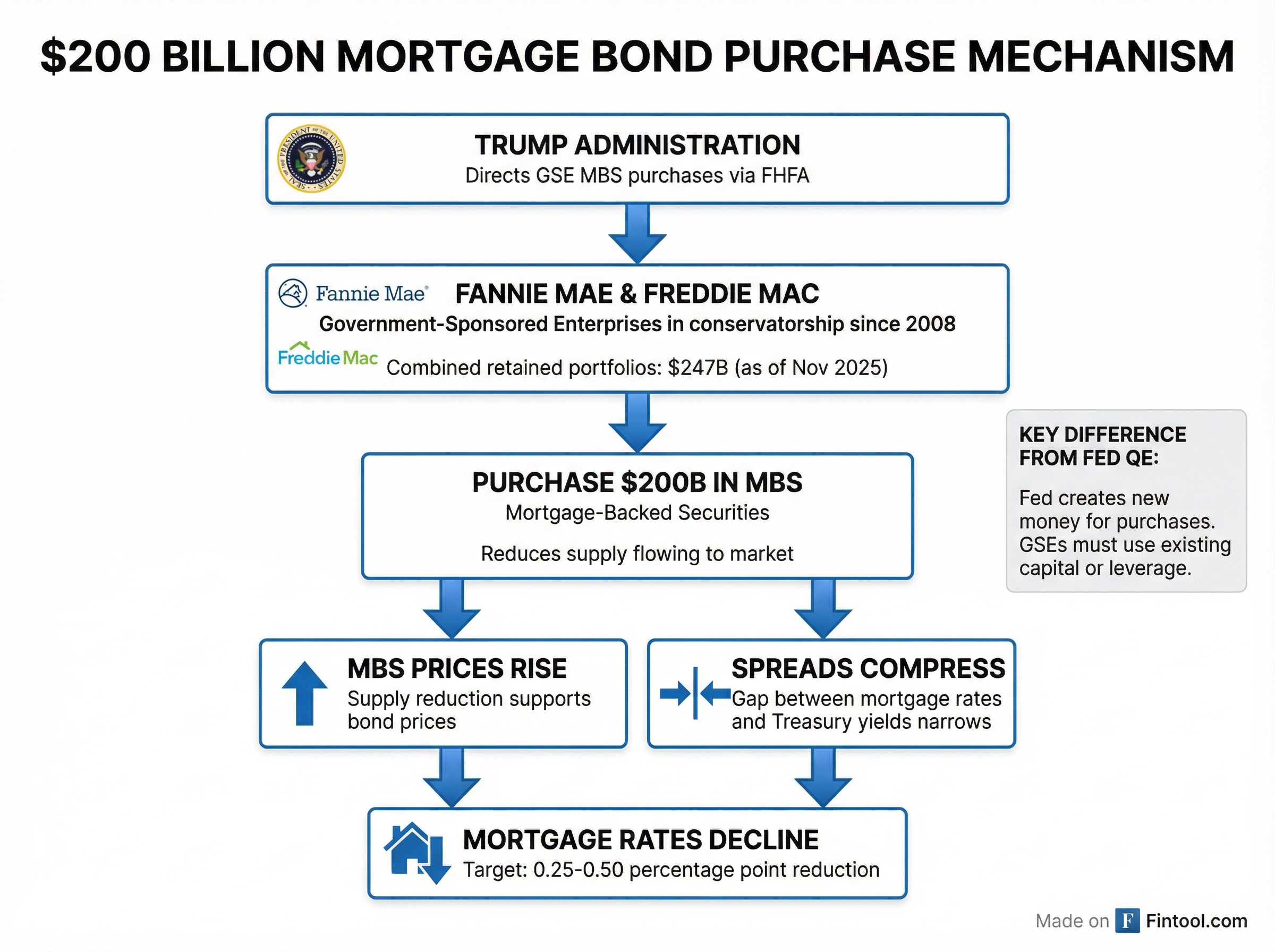
President Trump announced Thursday that he is directing Fannie Mae and Freddie Mac to purchase $200 billion in mortgage-backed securities—a quasi-QE maneuver that sent homebuilder stocks surging and mortgage bonds rallying as the administration escalates its housing affordability push ahead of midterm elections.
Lennar jumped 5.4%, Pultegroup rose 5.0%, and D.R. Horton gained 4.7% on the news. Mortgage bond spreads tightened by roughly 10 basis points, according to Bloomberg data.
 Ask Fintool AI Agent
The Announcement
"Because I chose not to sell Fannie Mae and Freddie Mac in my First Term, a truly great decision, and against the advice of the 'experts,' it is now worth many times that amount—AN ABSOLUTE FORTUNE—and has $200 BILLION DOLLARS IN CASH," Trump wrote on Truth Social. "I am instructing my Representatives to BUY $200 BILLION DOLLARS IN MORTGAGE BONDS. This will drive Mortgage Rates DOWN, monthly payments DOWN, and make the cost of owning a home more affordable."
Federal Housing Finance Agency Director Bill Pulte confirmed on X that Fannie Mae and Freddie Mac would execute the purchases "very quickly."
The move comes one day after Trump proposed banning large institutional investors from purchasing single-family homes, signaling an aggressive multi-pronged approach to the housing affordability crisis that helped cost his party support among younger voters.
The Math Doesn't Add Up
There's a significant disconnect between Trump's claim and the GSEs' actual balance sheets. The combined cash and cash equivalents listed on Fannie Mae's and Freddie Mac's third-quarter earnings reports totaled less than $17 billion as of September 30, 2025—nowhere near the $200 billion Trump cited.
| Metric | Fannie Mae | Freddie Mac | Combined |
|---|---|---|---|
| Cash & Cash Equivalents (Q3 2025) | $5.2B | $4.6B | $9.8B |
| Net Worth | $105.5B | $68B | $173.5B |
| Total Assets | $4.1T | $3.5T | $7.6T |
| Current Retained Portfolio | $123.5B | $123.6B | $247.1B |
Sources: Fannie Mae Q3 2025 Earnings, Freddie Mac Q3 2025 Earnings
The White House did not immediately respond to requests clarifying the funding source for such a massive purchase program.
The GSEs have already been aggressively expanding their retained portfolios. Combined holdings rose more than 25% in the five months through October 2025, bringing total positions to approximately $234 billion—the highest level since 2021. Analysts have projected they could add as much as $100 billion more in 2026 before hitting regulatory caps.
Ask Fintool AI AgentQE Without the Fed
The policy parallels the Federal Reserve's quantitative easing programs but with a crucial distinction: the Fed can create unlimited money to fund purchases, while the GSEs cannot.
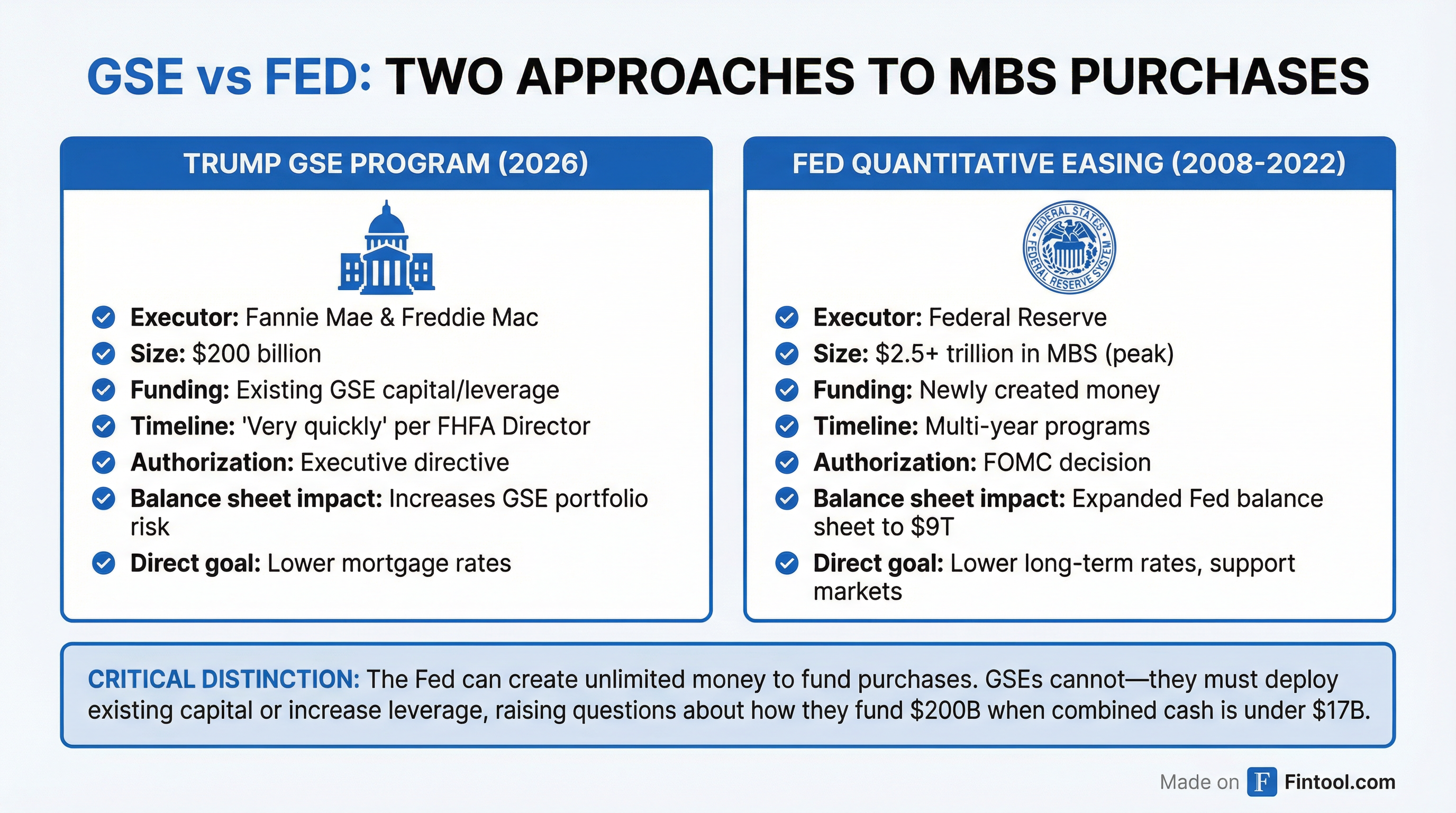
During QE1 (2008-2010), the Fed purchased $1.25 trillion in agency MBS to stabilize mortgage markets during the financial crisis. Research from the Federal Reserve Board suggests this reduced mortgage rates by approximately 85 basis points.
The Fed's QE programs eventually grew to hold roughly 30% of the entire MBS market at their peak, with total Fed balance sheet assets reaching nearly $9 trillion in 2022.
Economists surveyed by financial media estimate that a $200 billion GSE purchase program would likely shave about 25 to 50 basis points off mortgage rates in the short term—meaningful but modest relief for homebuyers facing rates still well above pre-pandemic levels.
Market Reaction
Housing-related equities responded enthusiastically to the announcement:
Homebuilders led the rally, with Lennar (+5.4%), Pultegroup (+5.0%), D.R. Horton (+4.7%), NVR (+3.3%), and Meritage Homes (+3.3%) posting strong gains on optimism that lower mortgage rates could unlock demand.
Mortgage REITs Agnc Investment (+1.2%) and Annaly Capital (+1.0%) advanced as MBS spreads compressed.
The GSEs themselves saw mixed trading, with Fannie Mae up 1.5% while Freddie Mac slipped 0.1%. Investors in the OTC-traded shares continue to speculate on the administration's plans for potentially releasing the companies from conservatorship.
The 10-year Treasury yield ticked slightly lower after hours amid the announcement. Risk premiums on mortgage bonds being issued now narrowed by as much as about 10 basis points from earlier in the session.
Ask Fintool AI AgentHistorical Precedent and Risks
The GSEs' pre-crisis portfolio expansion offers a cautionary tale. In the 1990s and 2000s, Fannie and Freddie dramatically increased earnings by borrowing cheaply and investing in higher-yielding mortgage bonds. By 2008, their combined portfolios had swelled to over $1.5 trillion.
When the housing market collapsed, those concentrated portfolios produced massive losses that helped push both companies into government conservatorship—where they remain 17 years later. The 2008 crisis ultimately cost taxpayers $190 billion in bailout funds, though the GSEs have since returned more than that amount to the Treasury through dividend payments.
Critics argue that dramatically expanding the GSEs' portfolios again raises systemic risks, particularly if interest rates move sharply or the housing market deteriorates. Supporters counter that current capital levels are far stronger and that the program addresses a genuine affordability crisis affecting millions of Americans.
What to Watch
Funding mechanism details. How will the GSEs finance $200 billion in purchases when they have less than $17 billion in cash? Will they issue debt, leverage existing capital, or receive some form of Treasury support?
Implementation timeline. Director Pulte said the purchases would happen "very quickly," but the mechanics of deploying $200 billion into the MBS market without disrupting pricing remain unclear.
Fed coordination. The Federal Reserve has been allowing its MBS holdings to run off as part of quantitative tightening. Will the administration coordinate with the Fed to avoid working at cross purposes?
Political sustainability. With midterm elections in November, the administration has strong incentives to show results on affordability. But major policy shifts could be challenged by Congress or future administrations.
GSE conservatorship status. The administration has signaled interest in releasing Fannie and Freddie from conservatorship. A massive portfolio expansion could either accelerate or complicate that process.
Related: Fannie Mae · Freddie Mac · Lennar · D.R. Horton · Pultegroup · Agnc Investment · Annaly Capital