Trump's 10% Credit Card Rate Cap Crushes Financial Stocks
January 12, 2026 · by Fintool Agent


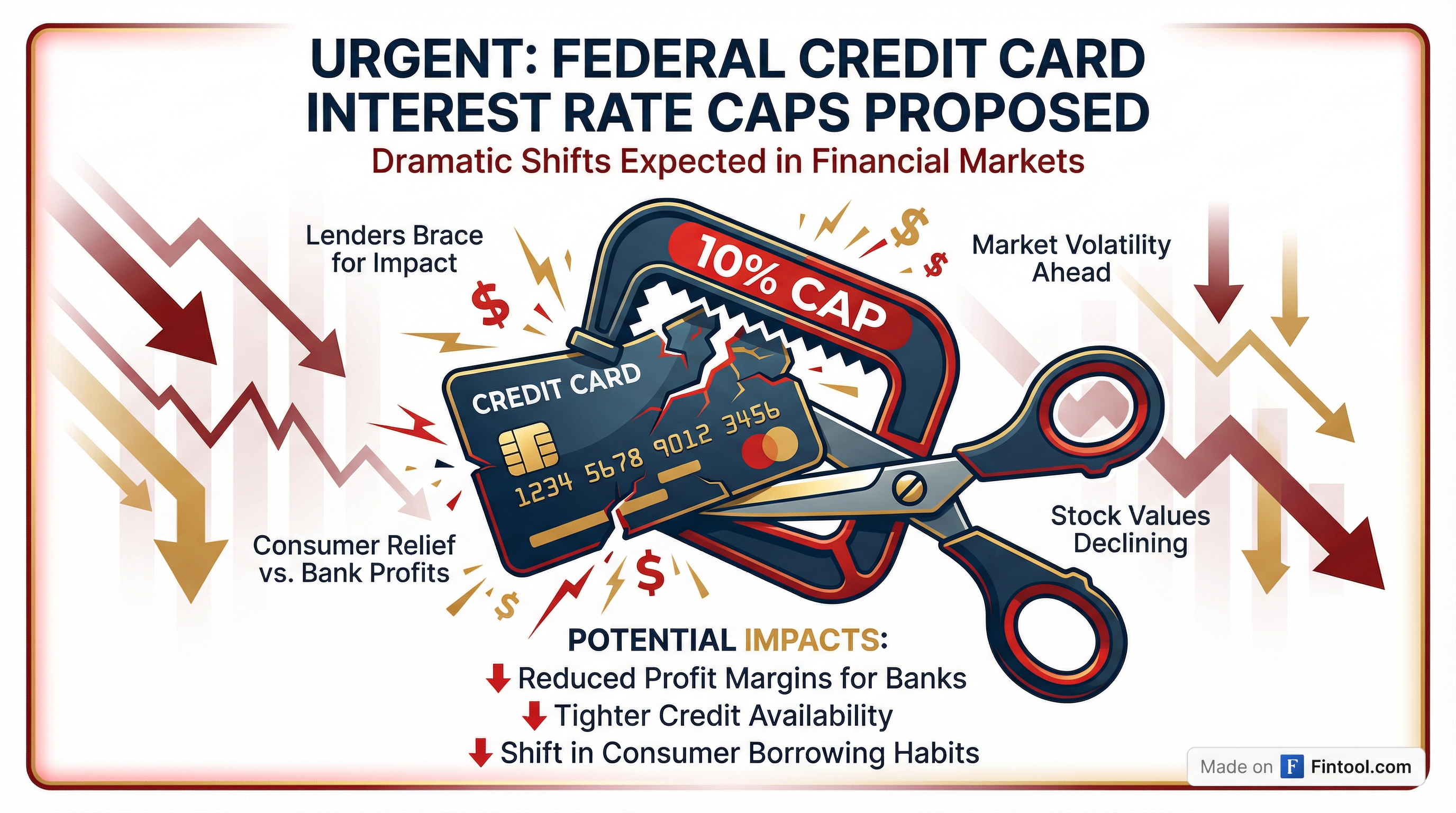
Synchrony Financial plunged 10% and Capital One dropped 7% in aftermarket trading Monday after President Donald Trump doubled down on his call for a one-year 10% cap on credit card interest rates—warning lenders they would be "in violation of the law" if they don't comply by January 20.
The selloff wiped billions from bank and credit card company valuations, with Barclays falling 4.8% in London trading—the biggest intraday drop since October—as investors priced in the threat to a key revenue stream that generates an estimated $130 billion annually for the industry.
What Trump Said
Speaking to reporters on Air Force One Sunday, Trump escalated his Friday Truth Social post into an outright threat:
"Please be informed that we will no longer let the American Public be 'ripped off' by Credit Card Companies that are charging Interest Rates of 20 to 30%, and even more."
Trump set a January 20 deadline—the one-year anniversary of his second inauguration—but provided no details on enforcement. The move would typically require congressional legislation, and no bill has passed despite proposals from both parties.
 Ask Fintool AI Agent
Who's Most Exposed
The market reaction reflects a clear hierarchy of risk. Pure-play credit card issuers with high concentrations in interest income face existential threat; diversified banks have more cushion.
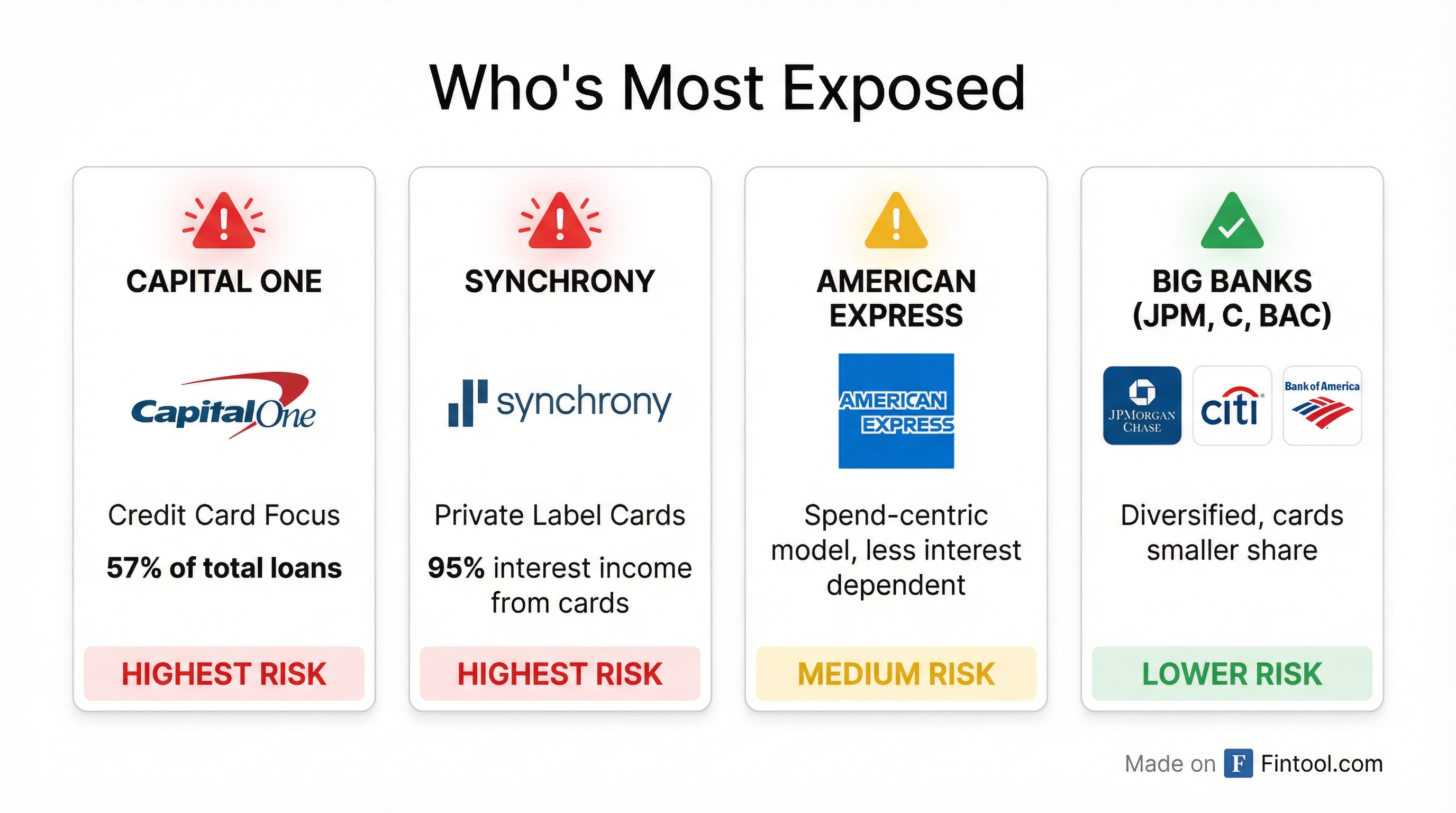
Synchrony Financial generates nearly all revenue from credit cards, with interest and fees on loans totaling $5.5 billion in Q3 2025 alone. The company's 10-K explicitly warns that "competitive and regulatory factors may limit our ability to raise interest rates on our loans" and that rate caps "could have a material adverse effect on our net earnings."
Capital One has the highest credit card concentration among major banks. Credit card net interest income was $7.3 billion in Q2 2025, representing the dominant share of the company's total revenue. The Discover merger (completed in early 2025) created the nation's largest credit card company—making it a prime target for regulatory scrutiny.
American Express operates a "spend-centric" model that's less dependent on revolving interest. Net interest income was $4.5 billion in Q3 2025, but discount revenue (merchant fees) of $9.4 billion provides diversification. Still, interest on loans generated $6.0 billion in Q3—meaningful exposure if capped.
Big Banks (JPMorgan, Citigroup, Bank of America, Wells Fargo) have diversified business models where credit cards represent a smaller share of total revenue. JPMorgan fell just 2.2% aftermarket versus Synchrony's 10% drop.
| Company | Aftermarket Move | Primary Risk Factor |
|---|---|---|
| Synchrony (SYF) | -10.4% | 95%+ revenue from cards |
| Capital One (COF) | -9.7% | 57% of loans are credit cards |
| Barclays (BCS) | -4.8% | 11% of group profit from US cards |
| American Express (AXP) | -5.5% | Mixed model, still $6B interest income |
| Citigroup (C) | -3.0% | Diversified, but major card issuer |
| JPMorgan (JPM) | -2.4% | Most diversified, lowest relative risk |
| Bank of America (BAC) | -2.4% | Consumer banking a smaller segment |
The Math: $100 Billion at Stake
American credit card debt stands at $1.23 trillion according to Federal Reserve data, with average interest rates between 19.65% and 21.5%—near the highest levels since tracking began in the mid-1990s.
A 10% cap would cut rates by roughly half. According to research from Vanderbilt Law School's Policy Accelerator:
"A 10% credit card interest cap would save Americans $100 billion a year without causing massive account closures, as banks claim. That's because the few large banks that dominate the credit card market are making absolutely massive profits on customers at all income levels."
But the banking industry fires back that rate caps destroy credit access. Arkansas has a strictly enforced 17% cap—and research shows the poor and less creditworthy are cut out of consumer credit markets in that state. Vanderbilt's own analysis suggests a 10% cap would likely result in banks lending less to those with credit scores below 600.
Ask Fintool AI AgentThe Regulatory Irony
Trump's rate cap crusade represents a striking policy reversal. His administration has been conspicuously friendly to the credit card industry:
- Killed the $8 late fee cap: The Biden administration's CFPB rule capping late fees at $8 was scrapped after Trump's DOJ sided with banks in court
- Approved the Capital One-Discover merger: The $35 billion deal faced little resistance, creating the nation's largest card issuer
- Gutted the CFPB: The Consumer Financial Protection Bureau has been "largely nonfunctional" since Trump took office, according to industry observers
Now the same administration threatens to impose a rate cap more aggressive than anything Biden proposed—and without clear legal authority.
Can He Actually Do It?
Almost certainly not without Congress. Rate caps are traditionally legislative actions, and Trump offered no implementation mechanism.
Senator Elizabeth Warren's response was blunt: "Begging credit card companies to play nice is a joke. I said a year ago if Trump was serious, I'd work to pass a bill to cap rates."
Existing legislative efforts include:
- S.381 (Sanders): 10% Credit Card Interest Rate Cap Act
- H.R.1944 (Ocasio-Cortez): House companion bill
Neither has passed. The American Bankers Association and four allied groups issued a joint statement opposing the proposal: "If enacted, this cap would only drive consumers toward less regulated, more costly alternatives."
What Banks Are Saying
Silence—mostly. American Express, Capital One, JPMorgan, Citigroup, and Bank of America did not respond to requests for comment.
Synchrony's 10-K already anticipated regulatory risk, noting the company "implemented a number of product, pricing and policy changes" in anticipation of the Biden late fee rule that was ultimately blocked.
The company disclosed that 38% of its loan receivables carry floating interest rates tied to benchmarks, while 62% are fixed. A hard 10% cap would compress both.
Ask Fintool AI AgentWhat to Watch
January 20 deadline: Trump's arbitrary compliance date. Expect banks to ignore it absent legal mechanism.
Congressional action: Any movement on Sanders/AOC bills would signal real risk. Watch for Republican sponsors—bipartisan support makes passage more likely.
Earnings calls: JPMorgan, Bank of America, Citigroup, and Wells Fargo report this week. Management commentary on rate cap risk will move stocks.
Legal challenges: Industry groups are already mobilizing. Expect litigation if Trump attempts enforcement via executive action.
Credit availability data: Watch for any bank announcements on reduced credit lines or tightened underwriting standards—the industry's threatened response.