Trump Orders Fannie, Freddie to Buy $200B in Mortgage Bonds—Rates Fall Below 6%
January 9, 2026 · by Fintool Agent



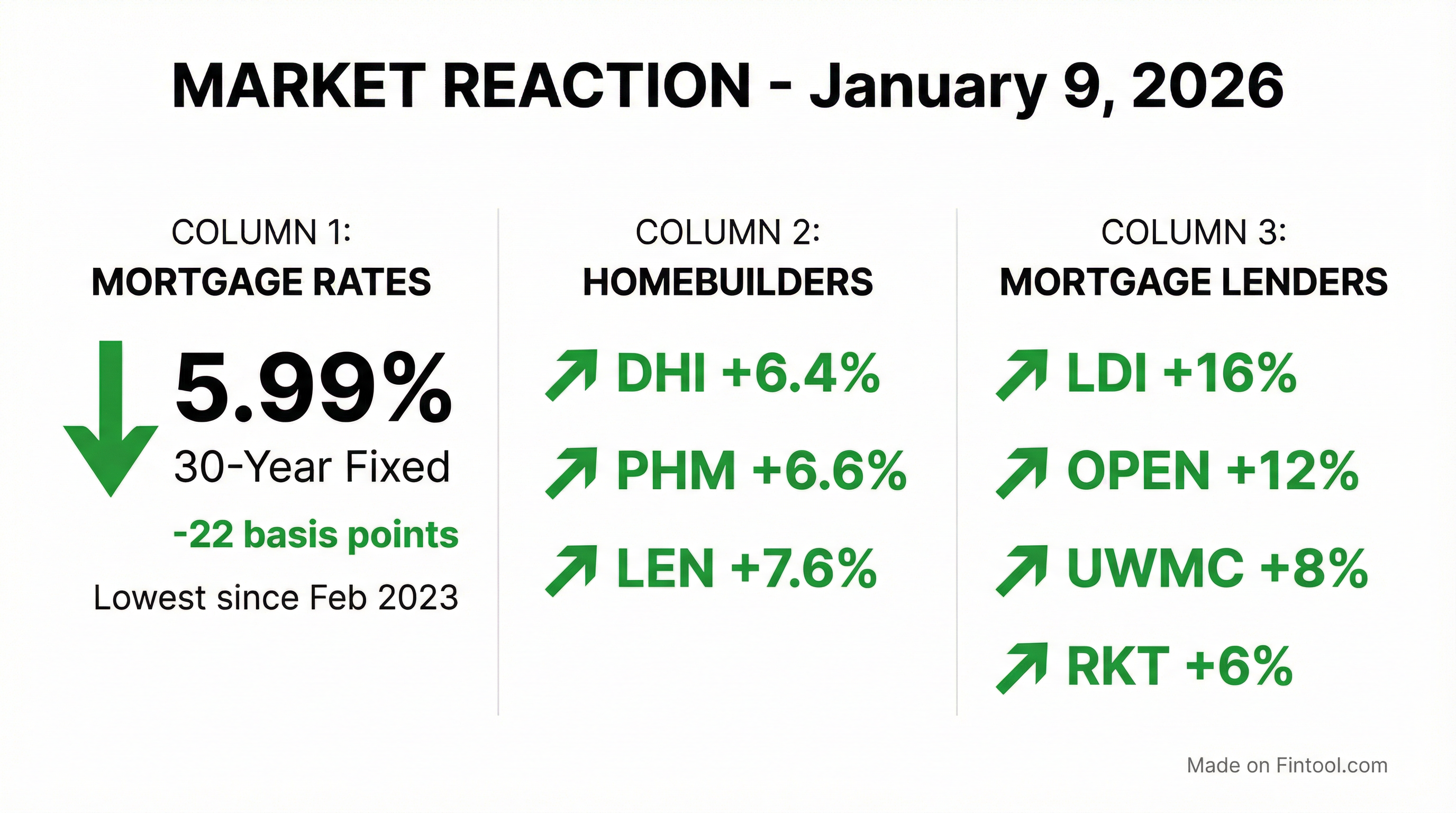
The 30-year mortgage rate fell below 6% for the first time since February 2023 after President Trump directed Fannie Mae and Freddie Mac to purchase $200 billion in mortgage bonds—a government intervention in housing markets not seen since the post-financial-crisis era.
Homebuilder stocks surged more than 6% as traders priced in stronger demand from lower borrowing costs. D.R. Horton climbed 6.4%, Pultegroup rose 6.6%, and Lennar jumped 7.6%. Mortgage lenders rallied even harder, with loanDepot soaring 16% and Uwm Holdings adding 8%.
The directive—announced via Truth Social on Thursday and confirmed by FHFA Director Bill Pulte on Friday—represents the administration's most aggressive housing affordability measure to date, deployed with midterm elections looming in November.
The Directive
"Because I chose not to sell Fannie Mae and Freddie Mac in my First Term, a truly great decision, and against the advice of the 'experts,' it is now worth many times that amount—AN ABSOLUTE FORTUNE—and has $200 BILLION DOLLARS IN CASH," Trump posted on Truth Social. "Because of this, I am instructing my Representatives to BUY $200 BILLION DOLLARS IN MORTGAGE BONDS. This will drive Mortgage Rates DOWN, monthly payments DOWN, and make the cost of owning a home more affordable."
Pulte responded on X within hours: "We are on it, Mr. President!" He later confirmed in interviews that Fannie and Freddie are "the entities that will do the purchases" using balance sheet liquidity—with nearly $100 billion available at each entity.
The combined mortgage-backed securities holdings of the two government-sponsored enterprises stood at $247 billion as of November. Each is currently capped at $225 billion in MBS holdings, making the $200 billion purchase program technically feasible within existing constraints.
 Ask Fintool AI Agent
How GSE QE Works
The mechanics mirror the Federal Reserve's quantitative easing playbook—but with crucial differences.
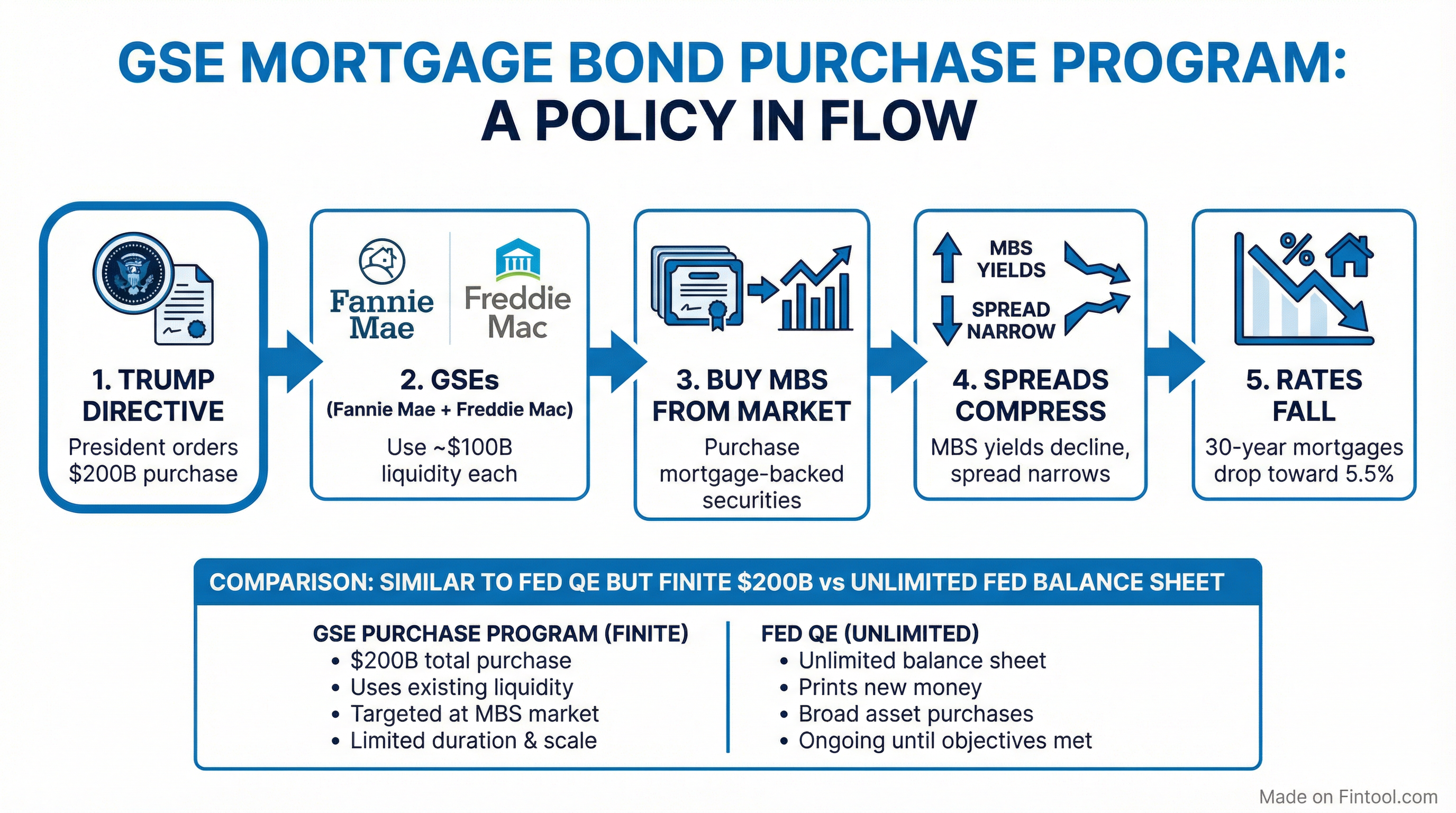
When Fannie and Freddie buy mortgage-backed securities from the secondary market, they increase demand for those bonds, pushing prices up and yields down. The spread between MBS yields and Treasury yields compresses, which feeds through to lower mortgage rates for homebuyers.
Mortgage spreads have already narrowed substantially. After reaching as high as 2.65 percentage points above Treasuries in April 2025, spreads had compressed to just under 2 percentage points before Trump's announcement. The 30-year mortgage rate fell 22 basis points on Friday to 5.99%—matching its February 2023 low.
"If the market tightens by 50-70 basis points from here, that would put primary mortgage rates in the mid-5.00% handle range, which would be low enough to spark significantly more refi and probably purchase activity," wrote Walt Schmidt, senior vice president of mortgage rate strategies at FHN Financial.
TD Cowen projects mortgage rates could finish 2026 at 5-5.25% if the purchases happen quickly.
The key difference from Fed QE: the central bank has an unlimited balance sheet courtesy of its money-printing authority. Fannie and Freddie have finite liquidity. The $200 billion program is large but fixed—compared to the Fed's pandemic-era purchases that exceeded $1 trillion in MBS.
Immediate Market Impact
The housing sector's response was emphatic.
| Stock | Friday Move | Description |
|---|---|---|
| Ldi | +16% | loanDepot, consumer mortgage lender |
| Open | +12% | Opendoor, iBuyer platform |
| Uwmc | +8% | UWM Holdings, wholesale lender |
| RKT | +6% | Rocket Companies, mortgage lender |
| Len | +7.6% | Lennar, homebuilder |
| PHM | +6.6% | PulteGroup, homebuilder |
| Dhi | +6.4% | D.R. Horton, homebuilder |
The S&P 500 hit an intraday record, helped by the housing rally offsetting a 3.3% decline in General Motors following its EV writedown announcement.
For homebuyers, the math is meaningful. At a 30-year rate of 5.9% versus 6.2%, the monthly payment on a $340,000 loan (the median home with 20% down) drops by roughly $70 per month, or $840 annually. For first-time buyers on the margin of affordability, that could unlock purchasing power.
Ask Fintool AI AgentThe Bulls and Bears
Housing analysts are split on the ultimate impact.
The bull case: Lower mortgage rates directly improve affordability and should accelerate purchase activity. Homebuilders have already been buying down rates into the 5% range to move inventory—this policy amplifies that tailwind. Rick Palacios Jr., director of research at John Burns Research and Consulting, noted that Fannie and Freddie have already added $50 billion in mortgage bonds since late 2024, "actually moving the needle in terms of for-sale housing affordability."
Ivy Zelman, executive vice president at Zelman & Associates, told CNBC: "I think psychologically it will help."
The bear case: Stimulating demand without addressing supply could backfire. The U.S. housing market suffers from chronic underbuilding—a problem federal policy cannot easily solve when local zoning restrictions are the binding constraint.
"The biggest problem with housing is supply, not demand, and the way to fix supply is at the local level with zoning and regulations, not at the federal level," said Brian Jacobsen, chief economic strategist at Annex Wealth Management.
Christopher Maloney, mortgage strategist at BOK Financial, warned that lower rates could simply enable larger mortgages and higher bidding: "That, in turn, will make it possible for borrowers to obtain bigger mortgages and bid up the prices of houses that much more."
Privatization in Doubt
Perhaps more consequential for GSE shareholders: the directive appears to push privatization further into the future.
Fannie Mae and Freddie Mac have been in government conservatorship since their 2008 bailout—the longest government takeover in U.S. financial history. Investors have long speculated that privatization via IPO could unlock significant value, particularly for junior preferred shareholders.
But Trump's comments suggest different priorities.
"Trump praised his decision not to IPO the companies in his first term... This does not sound like a President who is in a rush to IPO the enterprises," wrote TD Cowen analyst Jaret Seiberg.
JonesTrading analyst Mike O'Rourke was blunter: "If the GSEs can serve as a funding arm for Presidential policy, we shouldn't ever expect them to be re-privatized again."
Pulte had earlier in the day said Trump would likely decide on a possible IPO "in the next month or two." By evening, that timeline felt optimistic.
Ask Fintool AI AgentThe 2008 Echo
Critics also raised systemic risk concerns.
Michael Bright, CEO of the Structured Finance Association, warned the large MBS portfolio "exposes them to the exact same risks that got them blown up" in 2008.
The GSEs required a $187 billion government bailout during the financial crisis after their mortgage portfolios suffered catastrophic losses. While they have since repaid that amount many times over in dividends, the conservatorship was never formally ended.
Concentrating $200 billion in additional interest rate risk on the GSE balance sheets—at a time when the Fed is still battling inflation and Treasury yields remain elevated—is not without danger. A sharp rise in rates would cause significant mark-to-market losses.
But Pulte expressed confidence, telling Reuters that both entities have "ample liquidity" and that no Fed or Treasury involvement would be needed.
Housing Policy Blitz
The mortgage bond directive follows another housing-focused announcement earlier this week: Trump said his administration is moving to ban institutional investors from buying single-family homes.
Pulte hinted that more is coming. "More to come" regarding plans to incentivize homebuilding, he posted on X Thursday evening. Trump is expected to announce additional housing initiatives at Davos in two weeks.
The administration has also floated 50-year mortgages and assumable/portable loan structures as potential affordability tools—though neither has progressed beyond the concept stage.
What to Watch
Rate trajectory: The 30-year mortgage fell to 5.99% on Friday. Sustained levels below 6% could meaningfully boost refinancing activity and housing demand.
GSE balance sheets: Watch for Fannie and Freddie to begin ramping purchases. The speed of deployment will determine how quickly spreads compress.
Privatization talk: Any IPO timeline comments from Pulte or Treasury Secretary Bessent will move FNMA and FMCC significantly.
Supply response: Whether lower rates stimulate new construction or simply inflate prices will determine the policy's ultimate success.
Midterm politics: With housing affordability a key voter concern, expect the administration to highlight any improvement aggressively through November.
Ask Fintool AI AgentRelated: Fannie Mae · Freddie Mac · D.R. Horton · Pultegroup · Lennar · Rocket Companies · Uwm Holdings