TSMC's $56 Billion Bet: Record Profit and Massive CapEx Signal AI Boom Has Legs
January 15, 2026 · by Fintool Agent


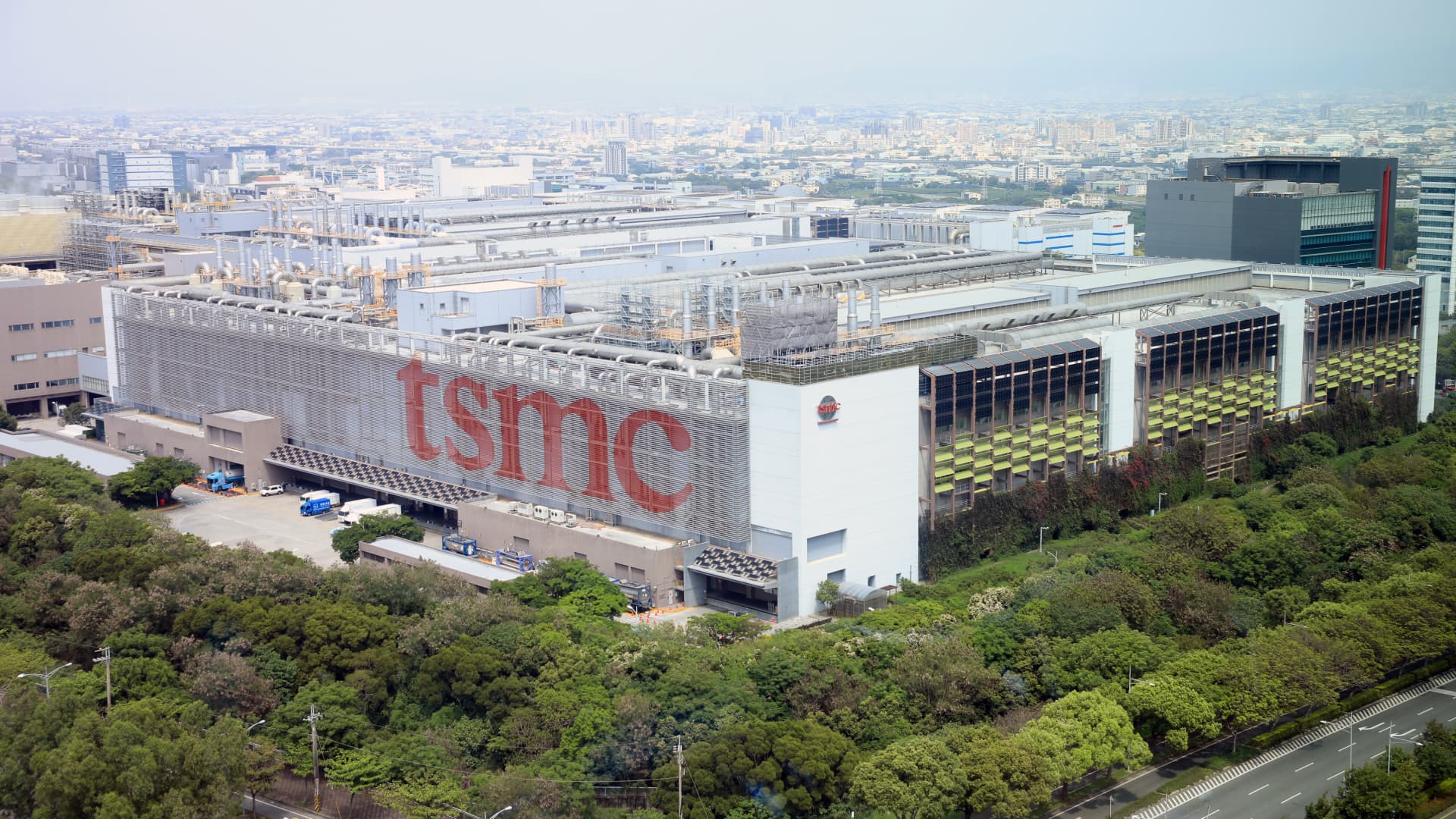
Taiwan Semiconductor Manufacturing Company delivered a message to anyone doubting the AI infrastructure buildout: it's just getting started. The world's most important chipmaker reported record quarterly profit and raised 2026 capital spending guidance to as much as $56 billion—a 35% increase from 2025 and far above what analysts expected.
The results sent key chip equipment supplier Asml to a record high, pushing its market cap above $500 billion for the first time and making it only the third European company ever to reach that milestone.
"The demand for AI remains very strong," Counterpoint Research senior analyst Jake Lai told CNBC, predicting 2026 will be another "breakout year" for AI server demand.
 Ask Fintool AI Agent
The Numbers: An Eighth Consecutive Record
TSMC's Q4 2025 results marked the company's eighth straight quarter of profit growth—a streak that began as the AI boom accelerated in early 2024.
| Metric | Q4 2025 | vs. Estimates | YoY Change |
|---|---|---|---|
| Revenue | $33.73B | Beat (est. $33.3B) | +25.5% |
| Net Income | $16.01B | Beat (est. $15.0B) | +35.0% |
| EPS (ADR) | $3.14 | Beat (est. $2.92) | +35.0% |
| Gross Margin | 62.3% | — | +330 bps |
| Operating Margin | 54.0% | — | +400 bps |
Source: TSMC earnings release, LSEG SmartEstimates
The company's gross margin expansion has been remarkable. From 53% in Q4 2023, gross margins have climbed to over 62%—a testament to TSMC's pricing power as customers scramble for capacity at the leading edge.
The CapEx Signal: $52-56 Billion for 2026
The headline number that moved markets wasn't the earnings beat—it was the capital spending guidance.
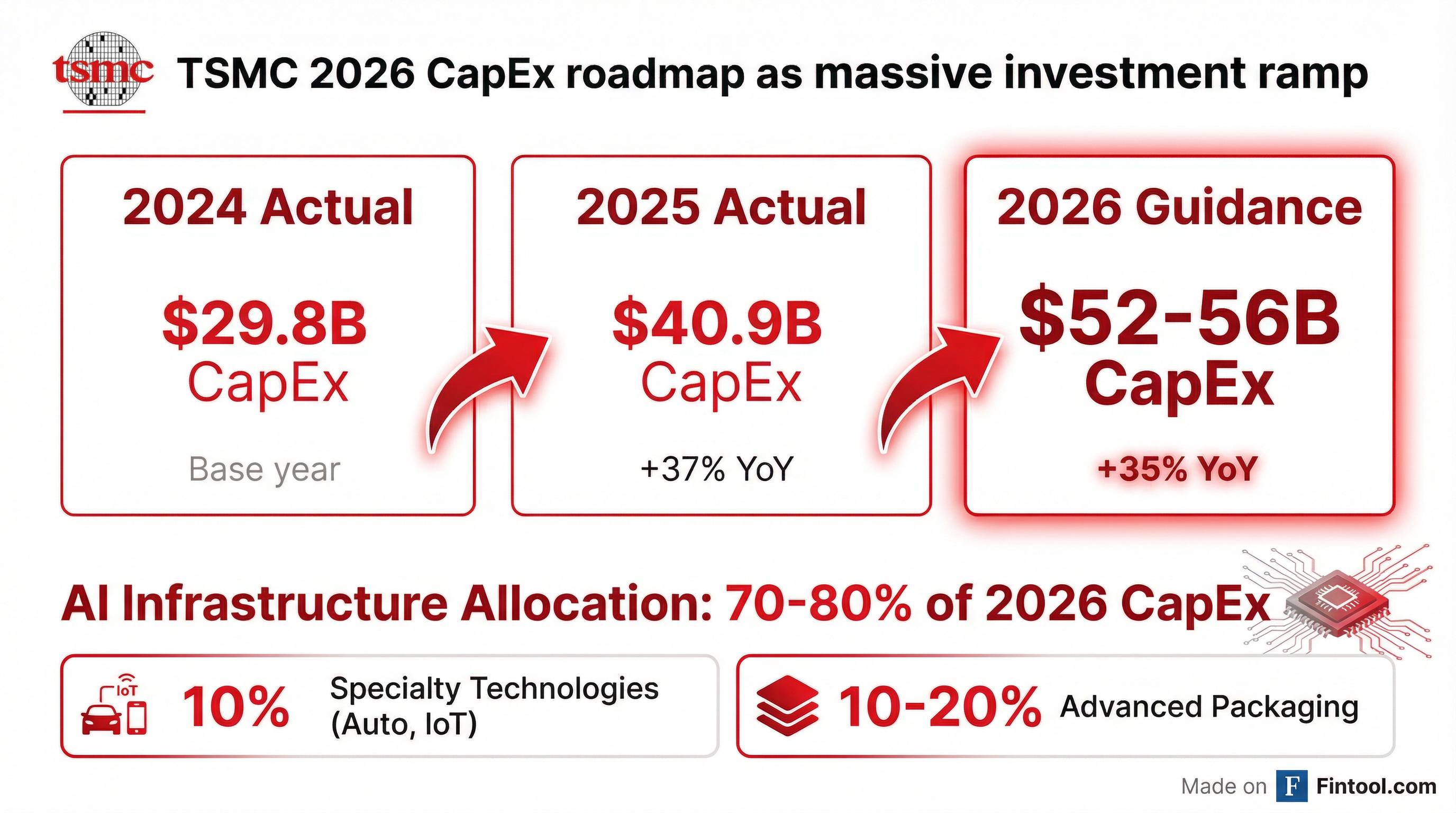
TSMC's planned CapEx trajectory tells the story of AI infrastructure demand:
| Year | CapEx | YoY Growth |
|---|---|---|
| 2024 | $29.8B | — |
| 2025 | $40.9B | +37% |
| 2026E | $52-56B | +27-37% |
The allocation breakdown reveals where the money is going:
- 70-80% → Advanced process technologies (3nm, 2nm ramps)
- 10% → Specialty technologies (automotive, IoT)
- 10-20% → Advanced packaging, testing, mask making
"We're investing $52 billion to $56 billion in capex, right? If we don't do it carefully, that'd be a big disaster for TSMC," CEO C.C. Wei acknowledged on the earnings call, underscoring that this isn't speculative spending—it's responding to booked customer demand.
Ask Fintool AI AgentAI Dominance: 77% from Advanced Nodes
TSMC's technology mix illustrates why the company has become irreplaceable for AI infrastructure.
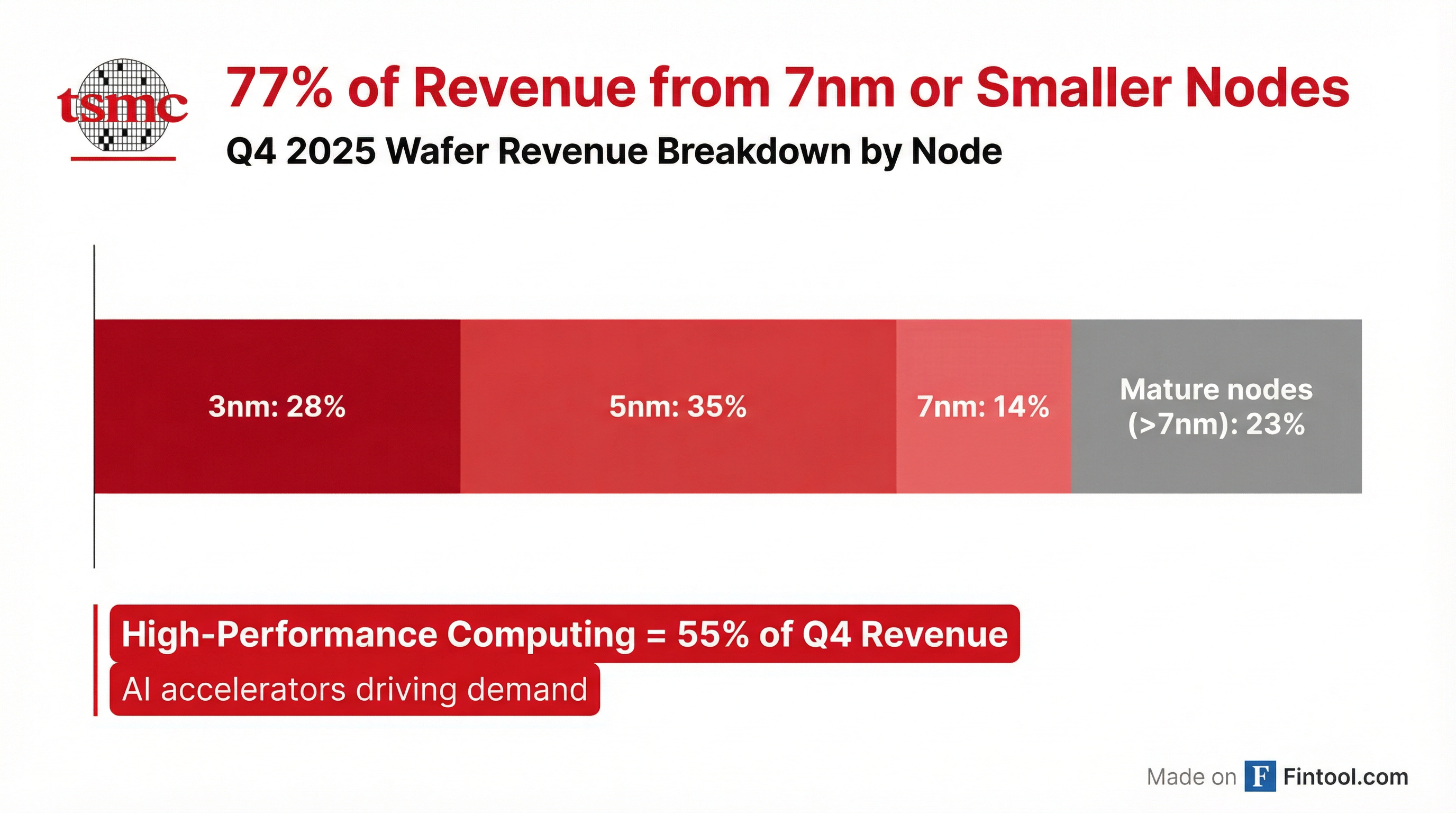
In Q4 2025, advanced chips measuring 7-nanometer or smaller accounted for 77% of wafer revenue—up from 69% in full-year 2024. The breakdown:
| Node | Q4 2025 Revenue Share |
|---|---|
| 3nm | 28% |
| 5nm | 35% |
| 7nm | 14% |
| Mature (>7nm) | 23% |
High-performance computing—the segment that includes AI accelerators—represented 55% of total sales, up from the low-40s% range just two years ago. Smartphone demand, while still meaningful at 32%, has become secondary to the AI-driven data center boom.
CEO Wei raised the company's AI accelerator revenue forecast: growth is now expected to approach a mid- to high-50s% CAGR from 2024 to 2029, up from prior guidance of ~50%.
Hyperscaler Context: TSMC at the Center of $600B in Spending
TSMC's bullish outlook must be understood in the context of who's buying its chips. The Big Five hyperscalers—Amazon, Microsoft, Google, Meta, and Oracle—are projected to spend approximately $600 billion on infrastructure in 2026, a 36% increase from 2025.
Roughly 75% of that spending—or about $450 billion—targets AI infrastructure. And virtually all of the AI accelerators powering that buildout flow through TSMC's fabs.
| Company | 2026 CapEx Projection |
|---|---|
| Amazon | >$125B |
| Microsoft | >$100B |
| >$100B | |
| Meta | $100B |
| Oracle | $20B |
Source: CreditSights, hyperscaler guidance
TSMC's capacity is the critical constraint. As Microsoft CFO Amy Hood noted in recent earnings calls, Azure remains "capacity-constrained" through at least fiscal 2026. The hyperscalers can write the checks—the question is whether TSMC can build the fabs fast enough.
Market Reaction: Chip Stocks Rally
The results ignited a broad rally across the semiconductor supply chain.
| Stock | One-Year Return | Reaction |
|---|---|---|
| TSM | +62% | +5.8% premarket |
| ASML | +80% | +7.6% (record high) |
| AMD | +85% | +1.2% |
| NVDA | +32% | -1.4% (tariff concerns) |
Goldman Sachs analysts summarized the sentiment: "Anyone hoping for a pullback will get disappointed."
Nvidia shares traded lower despite the positive TSMC read-through, weighed down by ongoing concerns about Trump administration tariffs on AI chips and China's tightening restrictions on U.S. technology.
Ask Fintool AI AgentForward Guidance: 30% Revenue Growth Expected
For 2026, TSMC guided to:
- Q1 2026 revenue: $34.6-35.8 billion (+38% YoY at midpoint, +4% sequential)
- Q1 2026 gross margin: 63-65% (further expansion)
- Full-year 2026 revenue growth: ~30% in USD terms
- Long-term revenue CAGR: ~25% from 2024-2029
CFO Wendell Huang warned that margins face some near-term pressure from overseas fab ramps (Arizona, Japan) and the 2nm transition, but emphasized these are investments in long-term positioning.
Risks to Watch
Geopolitics: Taiwan's proximity to China remains the elephant in the room. Warren Buffett famously reversed a Berkshire Hathaway position in TSMC over these concerns. The company is hedging by expanding in Arizona and Japan, but the core of its manufacturing remains in Taiwan.
Tariffs: CEO Wei flagged global tariff policies as a potential risk factor. The Trump administration has imposed 25% tariffs on certain AI chips, and further escalation could disrupt the supply chain.
Customer Concentration: With hyperscalers representing an outsized share of advanced chip demand, any pullback in cloud capex spending could quickly impact TSMC's revenue trajectory.
Margin Compression: The $52-56 billion capex program will drive depreciation higher by a "high-teens percentage" in 2026, creating headwinds for operating margins even as revenue grows.
The Bottom Line
TSMC's Q4 results answer the question that has haunted AI investors: Is the infrastructure buildout sustainable, or is it a bubble waiting to pop?
The company's answer—a 35% increase in capital spending, a 30% revenue growth forecast, and an acceleration in AI chip demand projections—suggests the buildout has years to run. With hyperscalers committing $600 billion to AI infrastructure in 2026 alone, TSMC sits at the nexus of the most important technology transition since the internet.
"AI is real... it is starting to grow into our daily life," CEO Wei said on the earnings call. For TSMC shareholders, that reality is translating into record profits and an unparalleled position in the global technology supply chain.