US Delays China Chip Tariffs to 2027, Giving Legacy Chipmakers an 18-Month Reprieve
December 23, 2025 · by Fintool Agent


The Trump administration on Tuesday concluded that China's targeting of the semiconductor industry is "unreasonable" and "burdens U.S. commerce"—then promptly delayed doing anything about it until June 2027.
The decision caps a year-long Section 301 investigation into China's exports of "legacy chips"—older semiconductors used in everything from cars to medical devices to military systems—while preserving Trump's tariff leverage for future negotiations with Beijing. For now, American companies competing against subsidized Chinese competitors will wait another 18 months for relief.
The Trade-Off at the Heart of the Truce
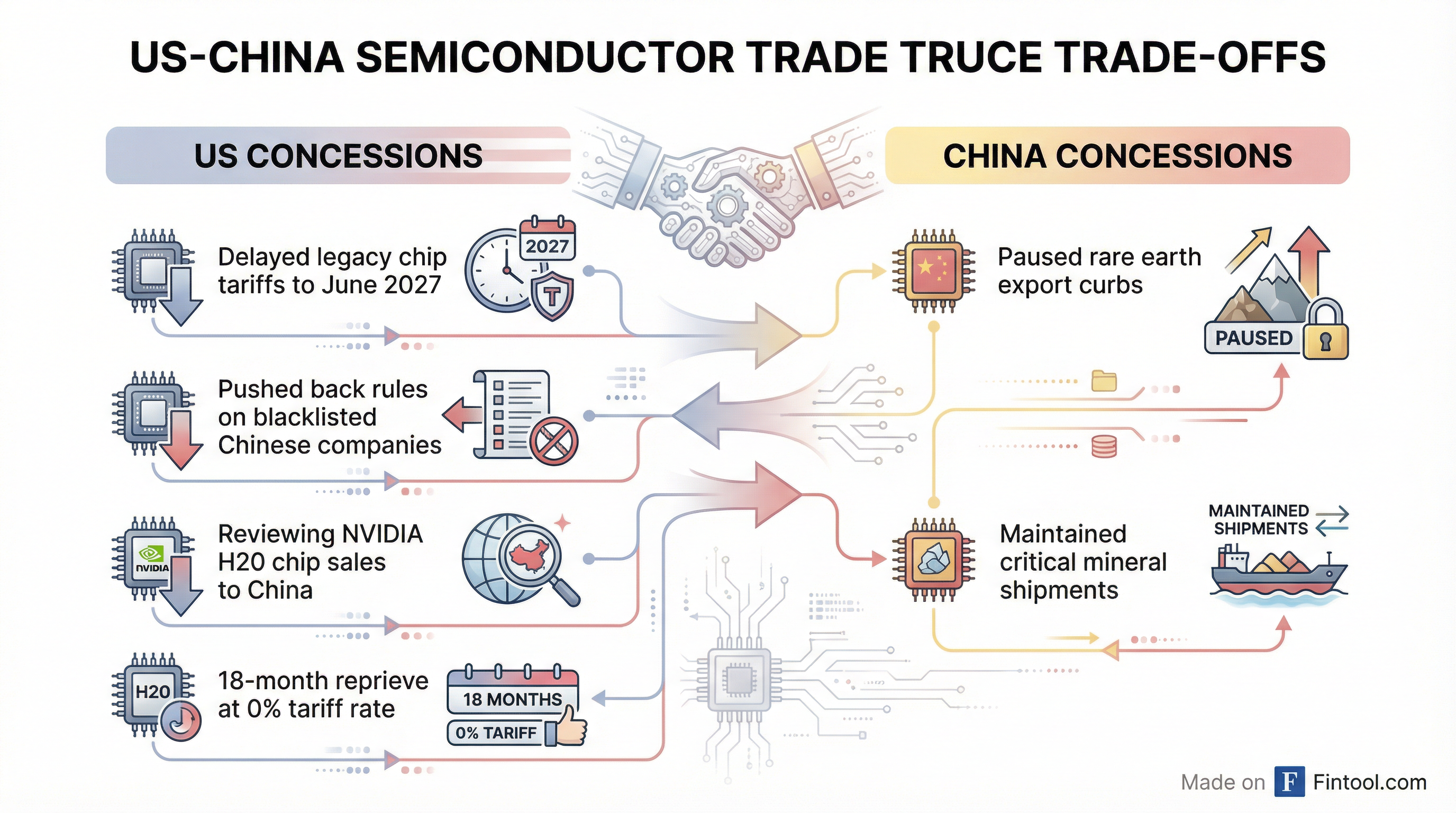
The timing is no coincidence. The tariff delay is a direct consequence of the Trump-Xi truce struck in October, which saw Washington and Beijing step back from the brink of all-out trade war.
In exchange for China pausing export curbs on rare earth metals—critical materials that Beijing controls and that power everything from EVs to F-35 fighter jets—the US has:
- Pushed back rules restricting tech exports to blacklisted Chinese companies
- Launched a review that could allow Nvidia's H20 chips to ship to China
- Now delayed legacy chip tariffs by 18 months
The administration's gambit: keep the tariff gun loaded while extracting concessions through negotiation. The USTR filing sets tariffs at 0% initially, with the rate to be announced at least 30 days before June 23, 2027.
Why Legacy Chips Matter More Than You Think
Legacy chips—semiconductors produced at 28 nanometers and above—aren't the AI-enabling bleeding-edge processors that grab headlines. But they're the workhorses of the modern economy.
They power:
- Automotive systems: Engine control, safety sensors, infotainment
- Medical devices: Pacemakers, imaging equipment, diagnostic tools
- Aerospace and defense: Avionics, guidance systems, communications
- Industrial equipment: Robotics, manufacturing controls, power management
- Consumer electronics: Appliances, smart home devices, IoT sensors
Despite the name, legacy chips aren't obsolete technology. They accounted for approximately 76% of global foundry production in 2024 and will still constitute about 70% of production in 2027.
 Ask Fintool AI Agent
China's Inexorable Rise
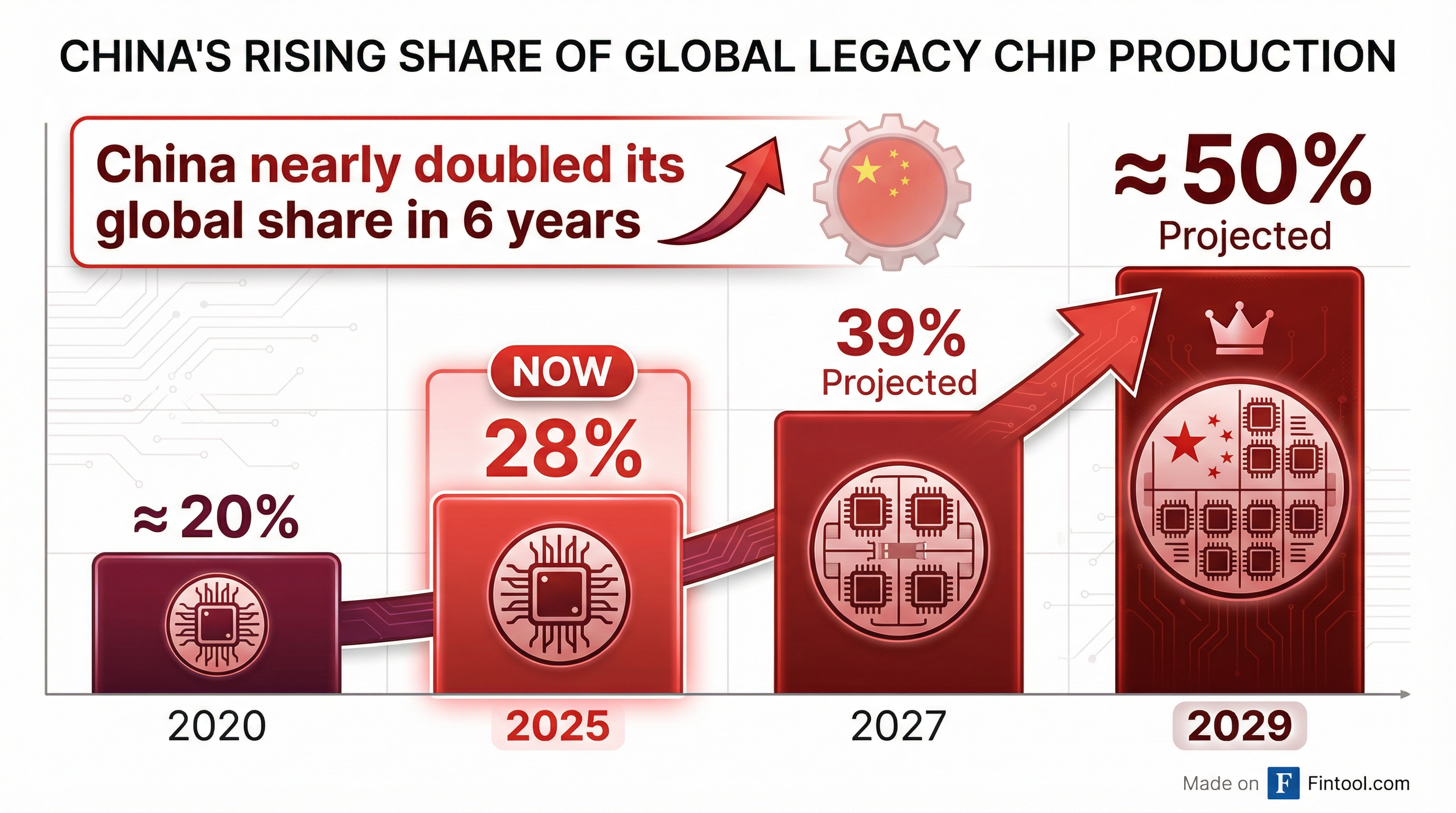
China's share of global legacy chip production has exploded—and the trajectory is alarming for Western competitors.
| Year | China Share of Legacy Chips | Status |
|---|---|---|
| 2020 | 20% | Actual |
| 2025 | 28% | Current |
| 2027 | 39% (projected) | Forecast |
| 2029 | 50% (projected) | Forecast |
"In just six years, China has nearly doubled its global share of foundational logic semiconductors production capacity," the USTR noted in its investigation findings. "Based on announced new fabrication plants, China's share is projected to reach approximately half of the world's capacity by 2029."
The growth is powered by massive state subsidies. China's "Big Fund" for semiconductor production has raised ¥688 billion ($95 billion) over three rounds, with the latest $48 billion injection in May 2024. Local governments pile on additional support for regional champions.
The Collateral Damage: US Legacy Chipmakers
American companies focused on legacy semiconductors are already bleeding.
Wolfspeed (WOLF), once the world leader in silicon carbide wafers, has seen its stock collapse 96% over three years. The company filed for Chapter 11 bankruptcy protection in late 2025 and laid off 20% of its workforce.
The price destruction is brutal. A mainstream 6-inch silicon carbide wafer from Wolfspeed that sold for $1,500 two years ago is now available from Chinese producers for $500.
Onsemi (ON) announced 9% workforce reductions and is actively exiting legacy product lines. The company stated that approximately 5% of its 2025 revenue "will not repeat" in 2026, driven by "end of life of certain legacy products" and "ongoing non-core exits."
"We expect many Chinese players as well as foreign players will get hurt," a German chipmaker sales director told Nikkei Asia. "Many of them already have, and eventually many will have to exit these bloody games."
Ask Fintool AI AgentThe Two-Front Tariff War
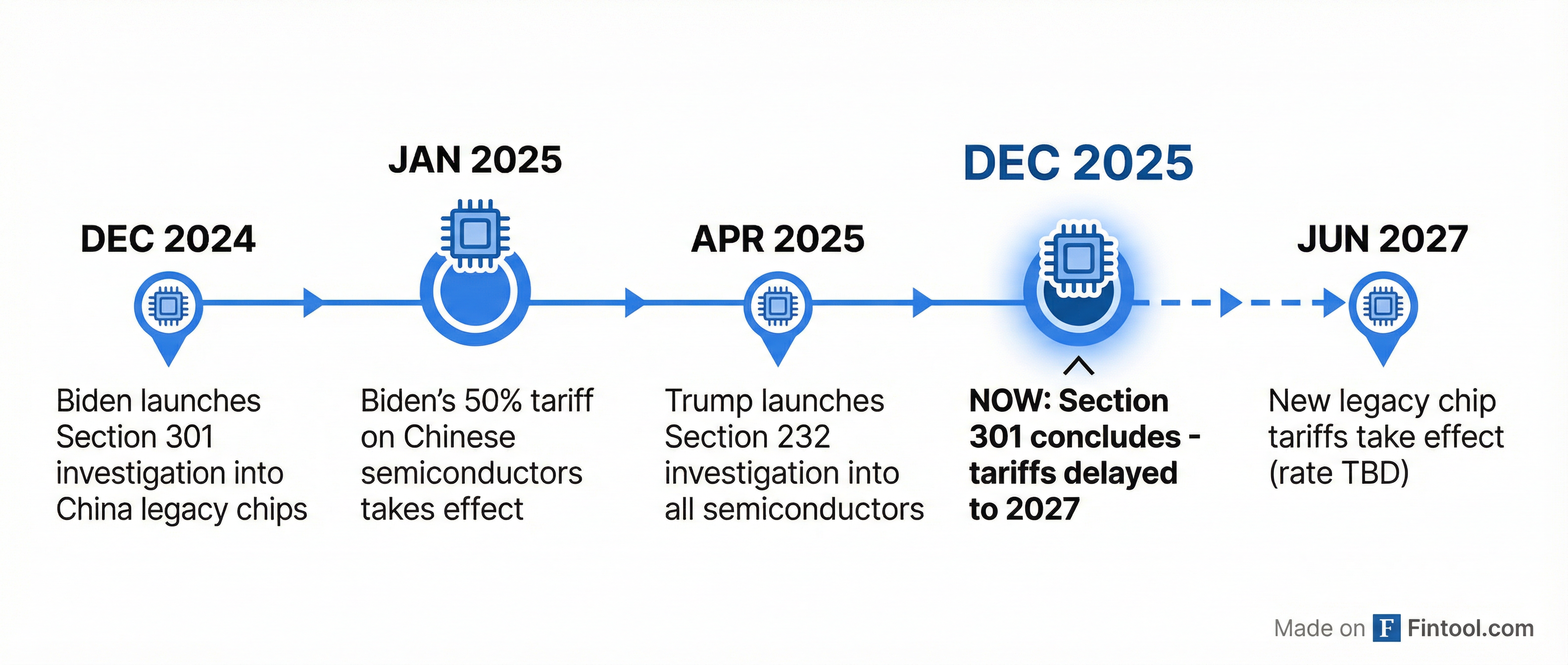
The Section 301 investigation into legacy chips is just one front. A separate Section 232 national security investigation—launched in April 2025—is examining the broader semiconductor supply chain, including:
- Semiconductor substrates and bare wafers
- Legacy chips AND leading-edge chips
- Semiconductor manufacturing equipment
- Downstream products containing semiconductors
President Trump suggested a potential 100% tariff rate under Section 232 in August 2025. However, US officials have privately indicated they may not levy these tariffs anytime soon—another sign the administration prefers negotiating leverage over immediate action.
| Investigation | Authority | Target | Current Status |
|---|---|---|---|
| Section 301 | Trade Act of 1974 | Legacy chips from China | Tariffs delayed to June 2027 |
| Section 232 | Trade Expansion Act | All semiconductors globally | Under investigation |
Meanwhile, the Biden administration's 50% tariff on Chinese semiconductors—which took effect January 1, 2025—remains in place.
The Supply Chain Risk
The strategic concern extends beyond economics. As Analog Devices noted in its latest 10-K, export restrictions have caused customers to "amass large inventories of our products, replace our products with products from another supplier that is not subject to the export restrictions or focus on building indigenous semiconductor capacity to reduce reliance on U.S. suppliers."
The company warned that if export restrictions cause customers to "view U.S. companies as unreliable, we could suffer reputational damage or lose business to foreign competitors who are not subject to such export restrictions."
Texas Instruments similarly flagged "global trade policies" and "changes in tax law and accounting standards that impact the tax rate applicable to us" as key risk factors, alongside the intensely competitive and cyclical nature of the semiconductor industry.
Ask Fintool AI AgentWhat to Watch
June 2027: The new tariff rate on Chinese legacy chips takes effect—unless another truce intervenes. The rate will be announced at least 30 days in advance.
Section 232 Decision: The Commerce Department's semiconductor investigation could result in tariffs on chips from all countries, not just China. The administration has 270 days from initiation to submit findings to the president.
China's Rare Earth Card: Beijing can reimpose export curbs on critical minerals at any time. If negotiations sour, expect this leverage to resurface.
NVIDIA's H20 Review: The administration's decision on allowing NVIDIA's second-most powerful AI chips into China will signal how far it's willing to go to maintain the truce—despite concerns the chips could "supercharge China's military."
For legacy chipmakers caught in China's "bloody knockout match," the 18-month delay offers little comfort. The overcapacity wave is coming regardless. The only question is whether Washington will have the political will to respond when it arrives.
Ask Fintool AI Agent