US and Taiwan Seal Historic $500 Billion Chip Deal to Reshape Global Semiconductor Map
January 15, 2026 · by Fintool Agent


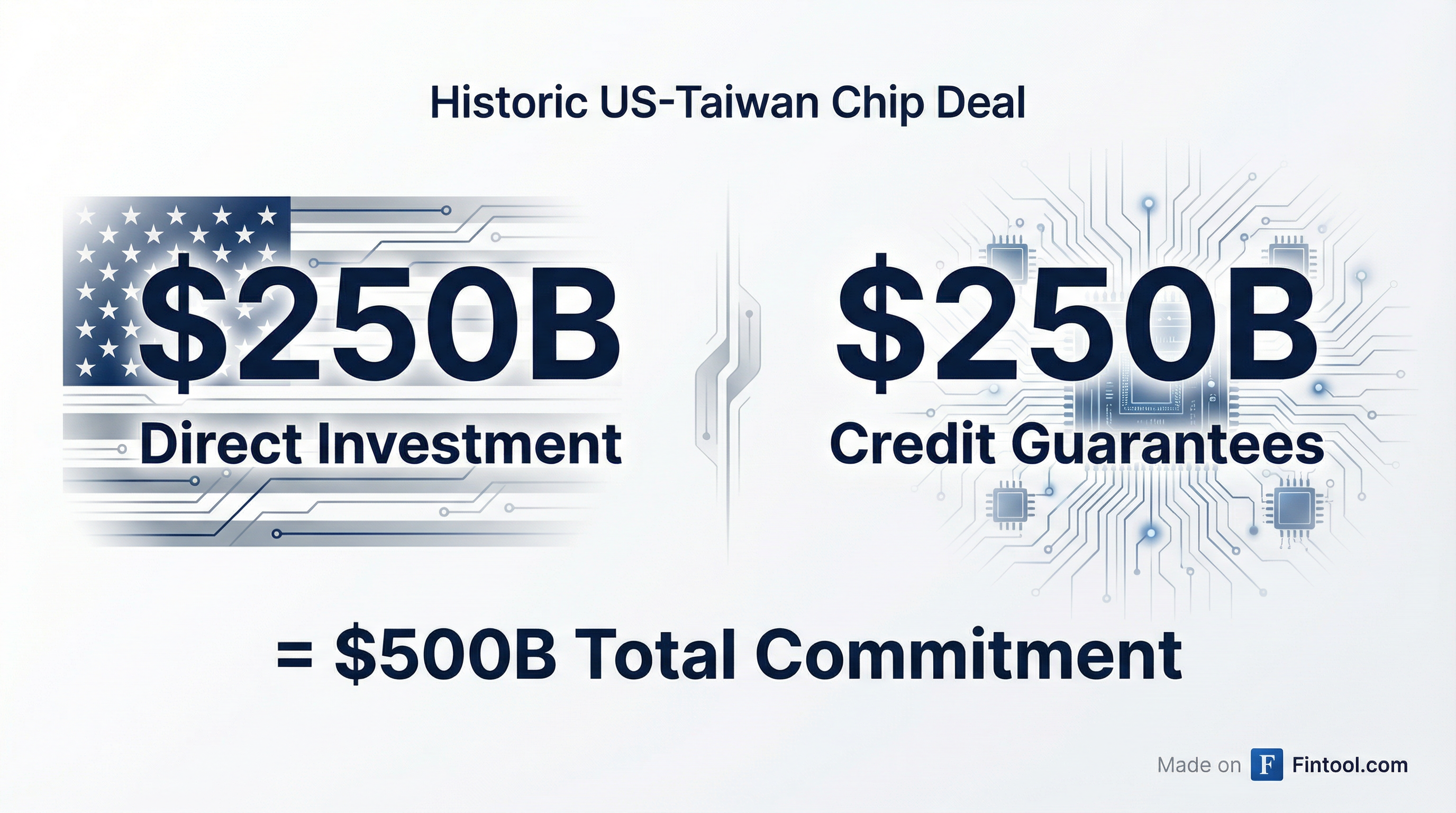
Taiwan just made a $500 billion bet on American manufacturing.
The United States and Taiwan announced a sweeping trade agreement Thursday that commits Taiwanese semiconductor companies to at least $250 billion in direct US investment, backed by another $250 billion in credit guarantees—the largest foreign manufacturing commitment in American history and a dramatic escalation of the global chip war.
The deal caps US tariffs on Taiwanese goods at 15%—down from 20%—while eliminating duties entirely on pharmaceuticals, aircraft components, and select natural resources. In return, Commerce Secretary Howard Lutnick secured what the department calls a framework to drive "a massive reshoring of America's semiconductor sector."
"If they don't build in America, the tariff's likely to be 100%," Lutnick told CNBC after the agreement was reported.
The Mechanics of a Half-Trillion Dollar Deal
The agreement divides Taiwan's commitment into two buckets:
Direct Investment ($250B): Taiwan Semiconductor Manufacturing Company and other chipmakers will fund new advanced semiconductor, energy, and artificial intelligence production facilities across the United States. TSMC, which manufactures over 60% of the world's chips and more than 90% of the most advanced processors, will lead this effort.
Credit Guarantees ($250B): Taiwan's government will backstop an additional quarter-trillion in financing to support smaller and medium-sized Taiwanese firms building US operations. Lutnick indicated this concession addressed concerns that only giants like TSMC could afford the capital requirements.
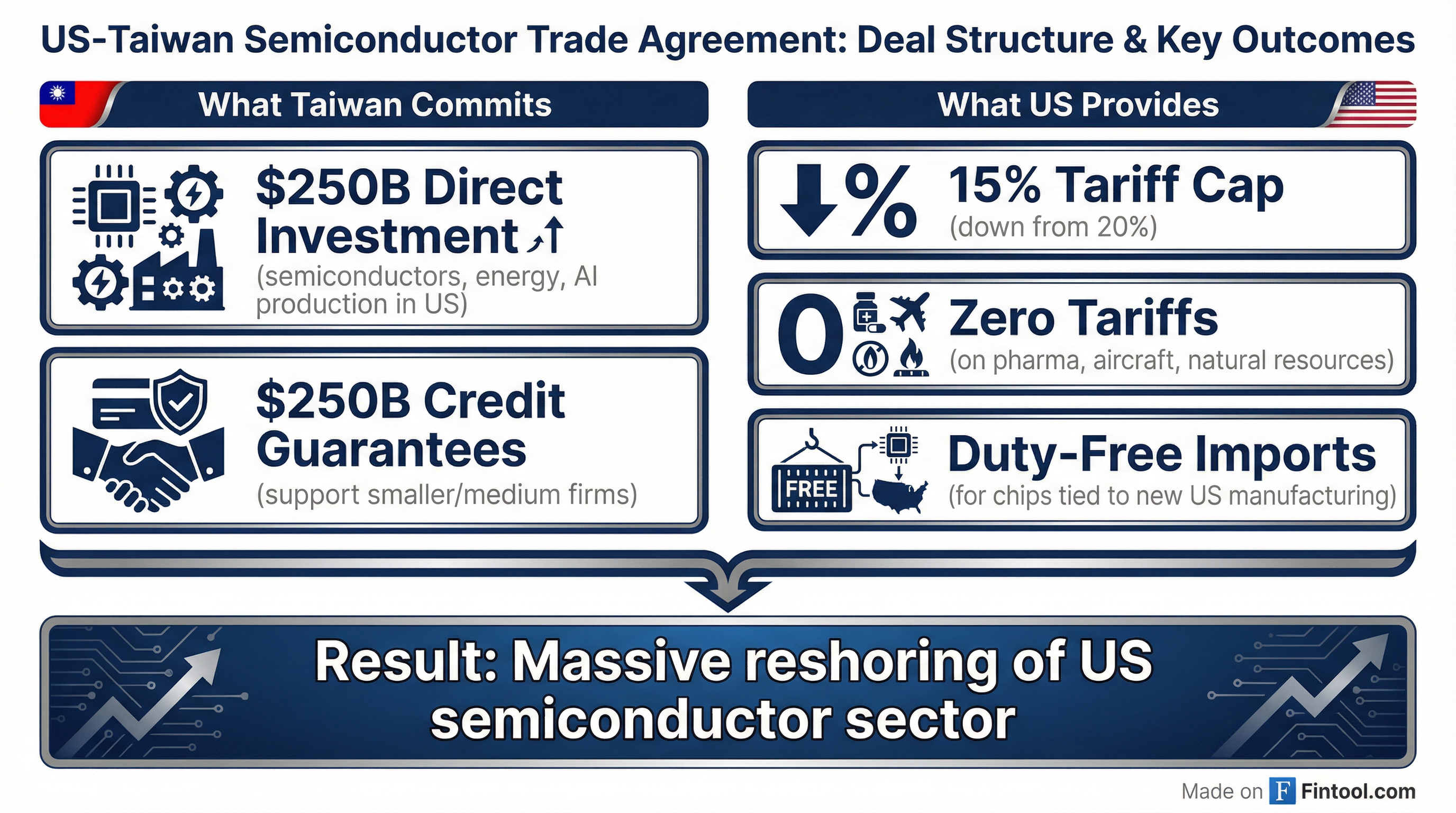
Future US semiconductor tariffs will reward companies that build domestic production, allowing duty-free imports of chips tied directly to new American manufacturing capacity.
 Ask Fintool AI Agent
TSMC's Arizona Empire Expands
The world's most valuable chipmaker is doubling down on the desert.
Commerce Secretary Lutnick revealed that TSMC "just bought hundreds of acres near Arizona plant" and expects the company to "come in huge, bigger—you've seen reports on possibly doubling in size." The Commerce Department envisions TSMC building "giant semiconductor industrial parks" across the United States.
Bloomberg reported earlier this week that the accord calls for TSMC to construct at least four additional chip manufacturing plants in Arizona, adding to the six factories and two advanced packaging facilities the company has already committed to the Phoenix region.
TSMC Financial Performance
| Metric | Q4 2024 | Q1 2025 | Q2 2025 | Q3 2025 |
|---|---|---|---|---|
| Revenue ($B) | $26.5* | $25.2* | $31.9* | $32.5* |
| Net Income ($B) | $11.0* | $10.9* | $13.6* | $14.8* |
| Gross Margin (%) | 59.0%* | 58.8% | 58.6% | 59.5%* |
| Capex ($B) | $11.0* | $9.9* | $10.2* | $9.4* |
*Values retrieved from S&P Global
The chipmaker announced Thursday it plans $52-56 billion in capital expenditures for 2026—a staggering increase from $40.9 billion in 2025—as artificial intelligence demand shows no signs of slowing.
Reversing Three Decades of Decline
American officials framed the agreement as an inflection point in a long decline.
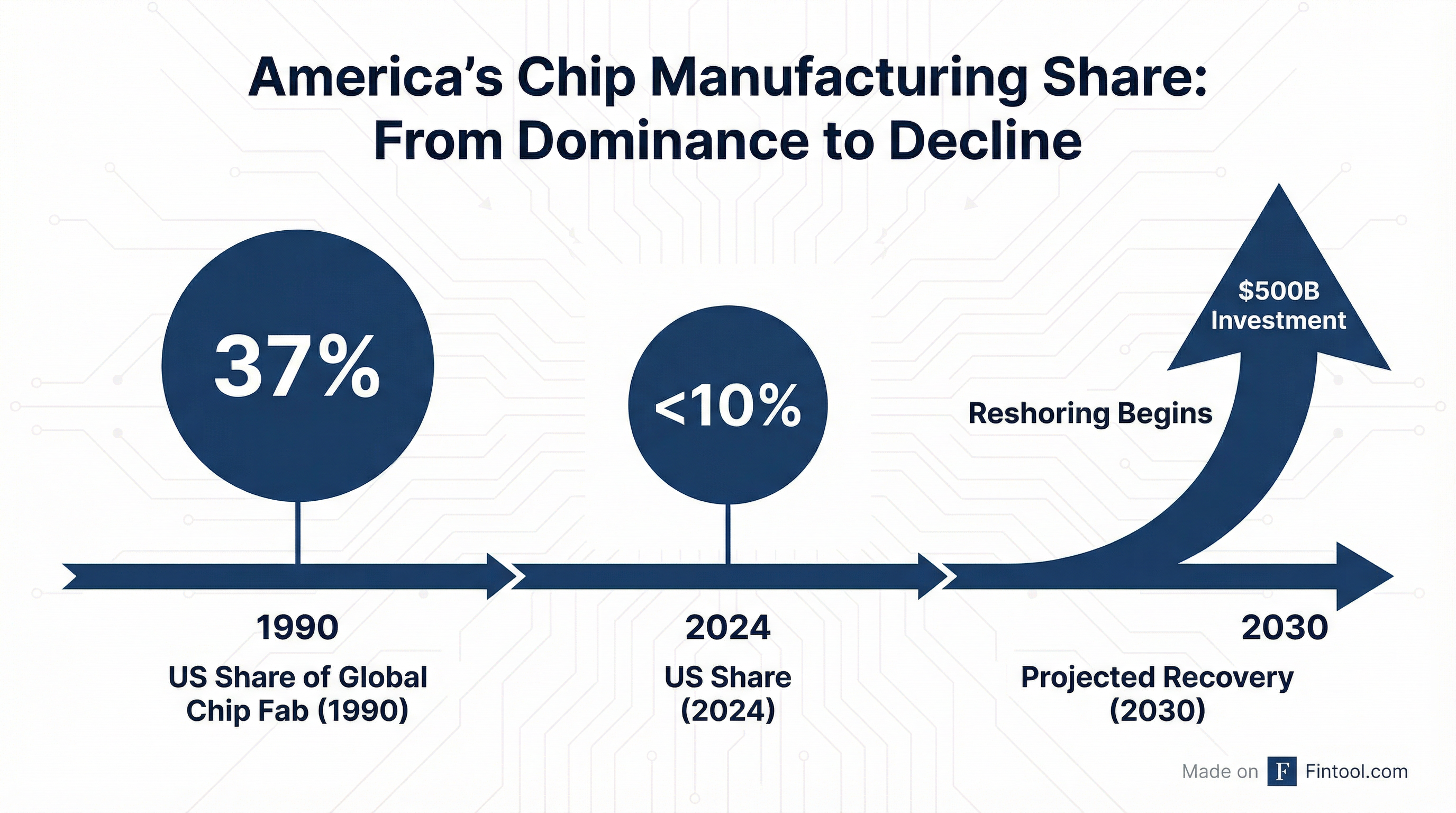
The Commerce Department emphasized that US semiconductor fabrication capacity fell from 37% of global production in 1990 to under 10% by 2024—a hollowing out that left the world's largest economy dependent on geopolitically sensitive supply chains.
"This agreement is designed to reverse decades of offshoring," the department stated in its announcement.
The deal structure creates powerful incentives for Taiwan's tech industry. Companies that build US production capacity can import their Taiwan-made chips duty-free—a carrot paired with Lutnick's explicit stick: non-participants face potential 100% tariffs.
Ask Fintool AI AgentTiming and Geopolitical Context
The agreement lands at a delicate moment in US-China relations.
Taipei has pushed aggressively to conclude a deal before President Trump's expected visit to China in April, Bloomberg News reported. The trade framework provides Taiwan with tariff certainty ahead of what could be contentious discussions between Washington and Beijing over technology, Taiwan, and trade imbalances.
The urgency reflects Taiwan's economic exposure. The island's GDP growth forecast was recently revised to 7.3% for 2025—its highest since 2010—driven largely by booming tech exports. That success, however, generated a record $150 billion trade surplus with the United States in 2025, creating political pressure Washington has now leveraged into investment commitments.
Market Reaction
Semiconductor stocks surged Thursday as investors digested both TSMC's record quarterly results and the trade deal announcement.
US-listed shares of TSMC jumped 7%, while chip equipment makers that stand to benefit from the Arizona buildout rallied sharply. Applied Materials (Amat) and KLA (Klac) each gained over 8.5%, while Lam Research (LRCX) rose 6.3%.
Nvidia advanced 2.5%, while Broadcom and Micron added 2.3% and 3%, respectively. The broader info-tech sector rose 1.5%.
What to Watch
TSMC Guidance: Watch for management commentary on Arizona capacity expansion timelines and whether the new acreage acquisition signals acceleration beyond previously disclosed plans.
Equipment Orders: Applied Materials, Lam Research, and KLA should see order book expansion as TSMC scales Arizona operations. Monitor quarterly bookings for leading indicators.
Intel Response: The deal potentially disadvantages Intel, which has positioned domestic manufacturing as a competitive advantage. Watch for strategic responses as TSMC's US footprint approaches parity.
China Retaliation: Beijing has not yet responded to the agreement. Any countermeasures targeting Taiwan's tech sector or US semiconductor firms could introduce volatility.
Implementation Timeline: The $250 billion direct investment will flow over multiple years. Track groundbreaking announcements, permitting progress, and equipment installation schedules for execution risk signals.
Ask Fintool AI Agent