Trump's Venezuela Raid Sends Gold Surging, Defense Stocks Soaring—and Uncovers a $60 Billion Bitcoin Mystery
January 5, 2026 · by Fintool Agent



U.S. forces captured Venezuelan President Nicolás Maduro in a daring overnight raid on Saturday—and markets are still processing the implications. Gold jumped 2.7% to $4,420 an ounce, defense stocks across Europe and the U.S. surged as much as 7%, and intelligence reports surfaced alleging Venezuela secretly accumulated up to $60 billion in Bitcoin. Oil, meanwhile, barely moved.
This is the most consequential U.S. military intervention in Latin America in decades—and the market reaction tells a complex story about geopolitical risk, commodity fundamentals, and the emerging role of cryptocurrency in state-level finance.
The Raid: Two Hours That Changed Hemispheric Politics
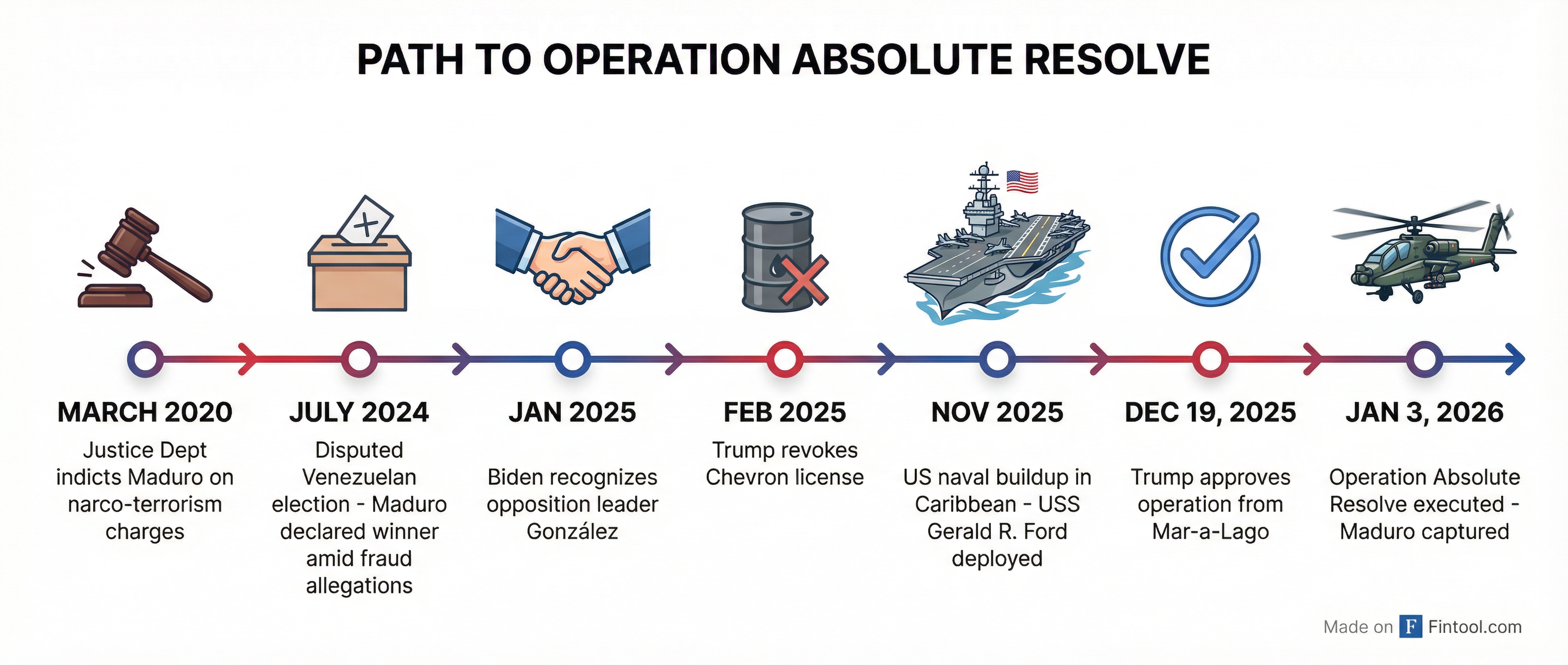
"Operation Absolute Resolve" launched at 10:46 p.m. ET on Friday, January 2, after President Donald Trump gave the final order from Mar-a-Lago. By 1 a.m. Saturday, more than 150 aircraft—including bombers, fighters, and reconnaissance craft—had disabled Venezuelan air defenses and cleared a path for special forces helicopters to reach Caracas.
Maduro and his wife, Cilia Flores, surrendered from a safe house after U.S. soldiers breached reinforced steel doors. Both were transported to a Navy ship offshore before being flown to New York's Stewart International Airport on Saturday evening to face federal drug-trafficking charges dating to a 2020 indictment.
"We will run the country until such time as we can do a safe, proper and judicious transition," Trump declared at a press conference. "We can't take a chance that someone else takes over Venezuela who doesn't have the interests of Venezuelans in mind."
 Ask Fintool AI Agent
Market Reaction: Calm in Oil, Chaos in Safe Havens
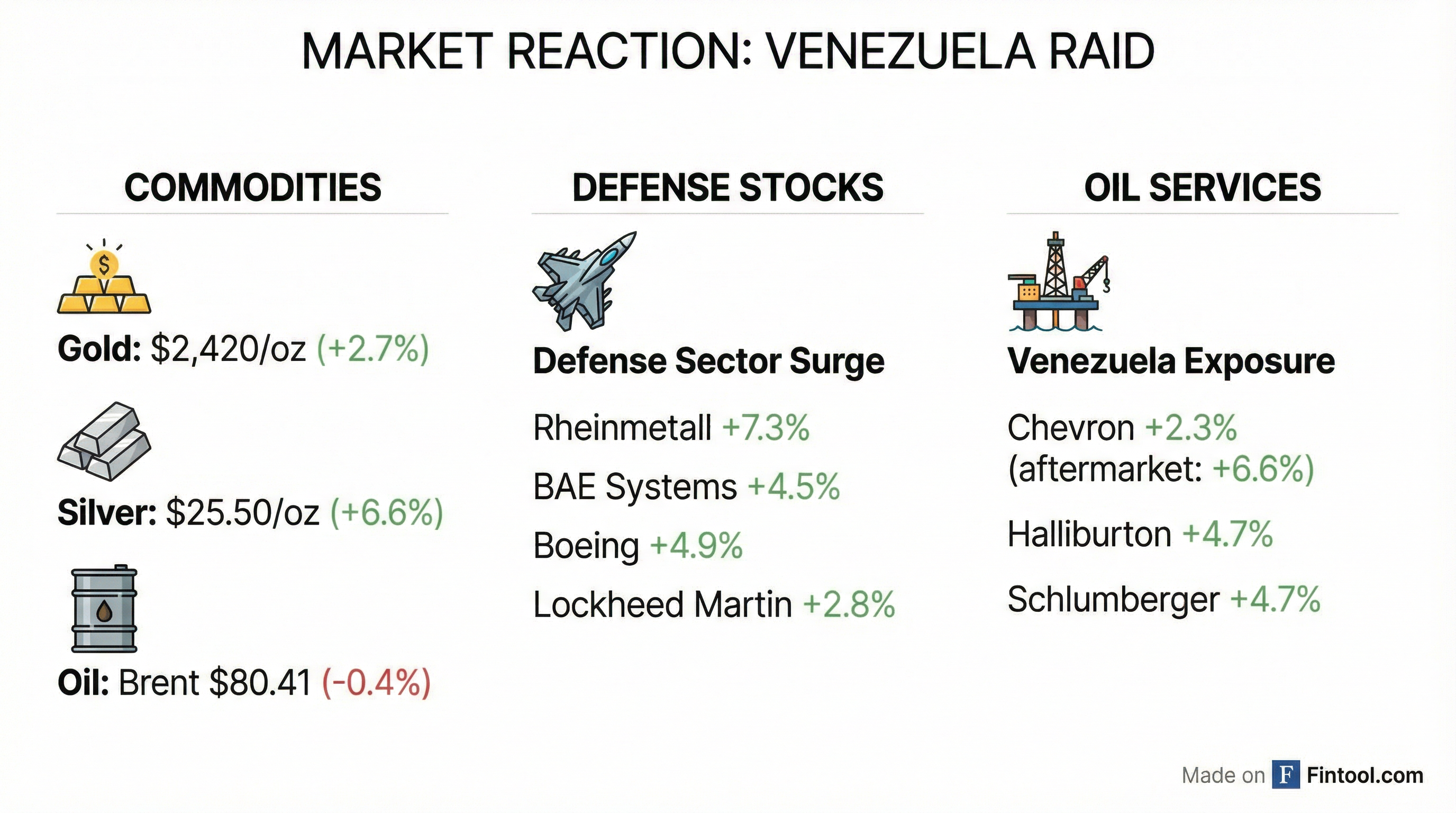
The first full trading day since the raid produced a bifurcated market response. Oil prices, which might have been expected to spike given Venezuela's status as home to the world's largest proven crude reserves, instead slipped modestly. Brent crude fell 0.4% to $60.41 a barrel, while WTI dipped to $56.96.
The muted oil reaction reflects fundamentals: Venezuela's production has collapsed from 3 million barrels per day at its peak to just 1.1 million bpd—barely 1% of global supply. Years of underinvestment, sanctions, and mismanagement have left the country's oil infrastructure in disrepair.
"While the capture of Venezuelan president Maduro by American forces has dominated headlines, financial markets seem unperturbed," noted Thomas Mathews of Capital Economics. "We agree with the implicit view that the near-term economic and financial implications are minor."
Safe-haven assets told a different story. Gold surged 2.7% to $4,420 an ounce, approaching record highs set at the end of 2025. Silver jumped 6.6% to $75.50. The GLD ETF rose 2% in aftermarket trading to $406.29.*
Defense Sector: The Clear Winners
European defense stocks led the global rally as investors processed the geopolitical implications of U.S. willingness to conduct military operations in the Western Hemisphere.
German arms manufacturer Rheinmetall surged 7.3%, while RENK Group—which makes propulsion systems for military vehicles—matched those gains. France's Thales rose 4.3%, and Italy's Leonardo jumped 6%. In London, Bae Systems gained 4.5%.
U.S. defense contractors posted solid gains as well:
| Company | Ticker | Close (Jan 2) | After-Hours (Jan 5) | Change |
|---|---|---|---|---|
| Boeing | BA | $227.77 | $228.40 | +4.9%* |
| Lockheed Martin | LMT | $497.07 | $501.50 | +2.8%* |
| Northrop Grumman | NOC | $585.66 | $593.27 | +2.7%* |
| Raytheon (rtx) | RTX | $187.25 | $188.02 | +2.1%* |
| General Dynamics | GD | $343.40 | $346.26 | +2.0%* |
*Values retrieved from S&P Global
Ask Fintool AI AgentOil Services: Positioned for Venezuelan Recovery
While integrated oil majors showed modest gains, oilfield services companies with potential Venezuelan exposure rallied sharply. Halliburton gained 4.7% to $29.60, with aftermarket trades pushing to $31.87. Schlumberger rose 4.7% to $40.20, jumping to $43.65 after hours.*
Chevron—the only major U.S. oil company still operating in Venezuela—climbed 2.3% to $155.87 in regular trading before surging to $166.12 in aftermarket activity, representing a 6.6% gain from the prior close.*
Chevron's position is unique. The company operates four joint ventures with PDVSA, Venezuela's state oil company, under a special license from the U.S. Treasury that has been repeatedly modified and restricted. As of early 2025, Chevron was managing roughly 25% of Venezuela's oil production.
The company disclosed in its Q3 2025 filing that "current geopolitical tensions relating to Venezuela could have an impact on the company's operations in Venezuela and, as a result, impact the company's future results of operations."
Trump said at his press conference that U.S. oil companies will spend "billions of dollars" to fix Venezuela's energy infrastructure, though the existing embargo on Venezuelan oil remains in place.
Ask Fintool AI AgentThe $60 Billion Bitcoin Question
Perhaps the most startling development to emerge from the weekend's events involves cryptocurrency. Multiple intelligence reports, cited by crypto researchers and media outlets, allege that Venezuela secretly accumulated a "shadow reserve" of 600,000 to 660,000 BTC—worth between $60 billion and $67 billion at current prices.
If true, this would place Venezuela among the largest Bitcoin holders on the planet, rivaling institutional giants like BlackRock's iShares Bitcoin Trust (770,000 BTC) and MicroStrategy (672,000 BTC).
The alleged accumulation reportedly began in 2018 through gold swaps, with approximately $2 billion in gold revenue converted to Bitcoin at an average price around $5,000—implying roughly 400,000 BTC acquired before the 2021 bull run. Additional holdings allegedly came from requiring some oil exports to be settled in USDT (Tether), which was then converted to Bitcoin to avoid freezing risk.
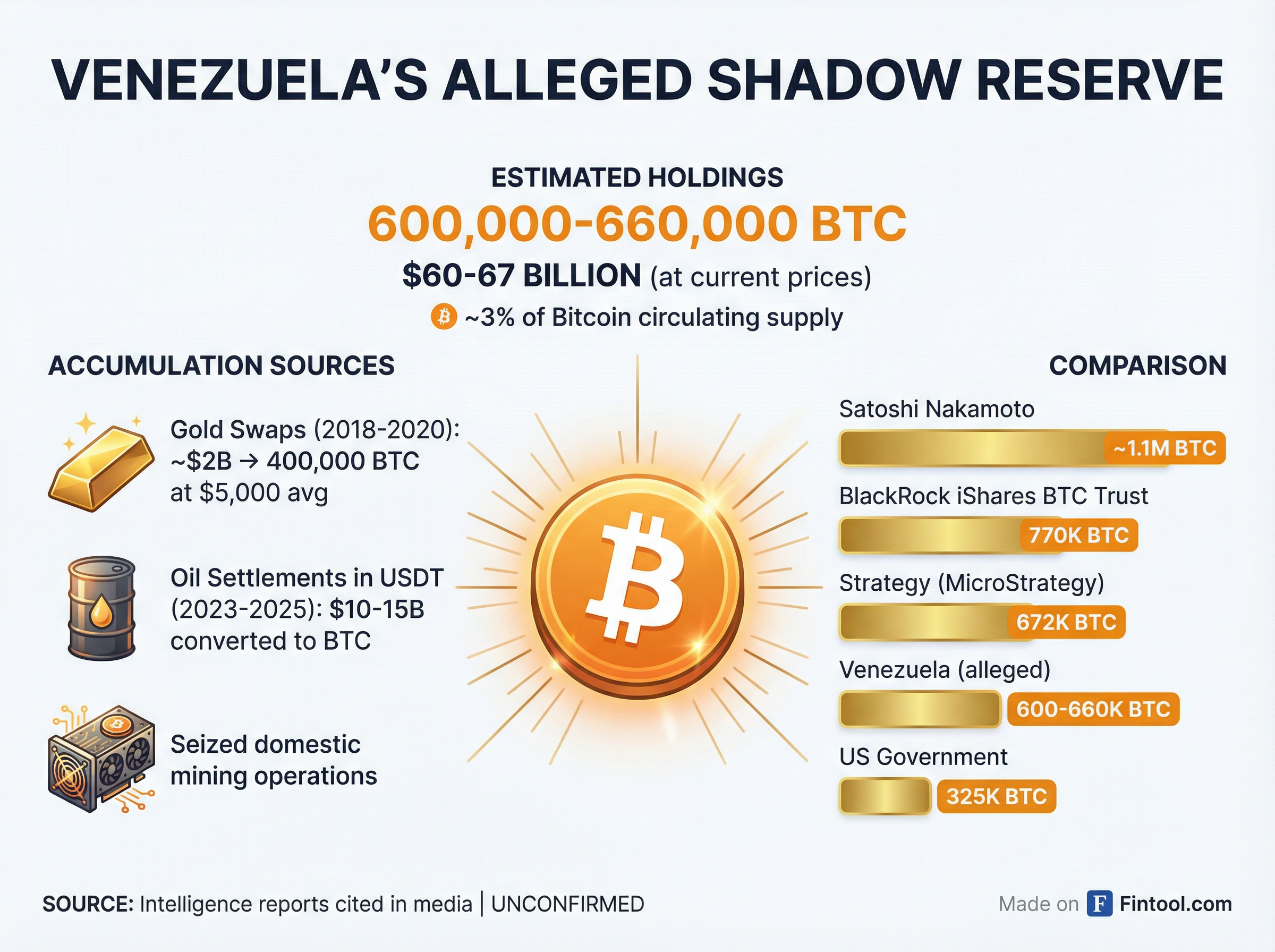
The claims remain unverified, but the implications are significant. If the U.S. manages to seize or freeze these assets, it could remove up to 3% of Bitcoin's circulating supply from active trading—creating potential supply shock dynamics. Alternatively, the holdings could become part of a U.S. strategic Bitcoin reserve.
Bitcoin traded at approximately $92,500 on Monday, up modestly after briefly touching $93,000. The cryptocurrency fell roughly 35% from its cycle highs during Q4 2025, and sentiment had plunged toward "extreme fear" before stabilizing.
Ask Fintool AI AgentWhat's Next: Venezuela's Oil Potential and Geopolitical Risk
Franklin Templeton's Stephen Dover outlined the investment implications:
Limited short-term oil impact: "Given the uncertainties about how Venezuela will be governed and given the checkered US history of 'regime change' in petro-countries (e.g., Iraq or Libya), oil markets are unlikely to anticipate a rapid increase in crude oil supply from Venezuela."
Potential long-term supply: Venezuela holds 300 billion barrels of proven crude reserves—the largest in the world. If political stability can be achieved and infrastructure rebuilt, production could eventually reach 2-3 million bpd from current levels of 1.1 million. Goldman Sachs noted that higher recovery rates "will likely require financial and time investments in oil-processing upgraders and improvements in operational efficiencies."
Heightened defense spending: "This development will likely reinforce a theme we have highlighted for years: higher government spending on national security," Dover added.
China has already asked its policy banks to report lending exposure to Venezuela, suggesting growing concern among regulators about potential shocks as geopolitical risks intensify.
Trump has also raised the possibility of further interventions, suggesting Colombia and Mexico could face military action if they don't reduce illicit drug flows. He threatened Iran over its crackdown on protests and has continued pushing for U.S. acquisition of Greenland.
"Investors are happy to own risk, but they want insurance in the drawer," observed Stephen Innes of SPI Asset Management. "This is confidence with a hedge, not euphoria."