The AI Memory Crisis: Musk and Cook Sound the Alarm as Chip Prices Go 'Parabolic'
February 16, 2026 · by Fintool Agent



DRAM prices have surged 75% in a single month. Micron can only meet half to two-thirds of customer demand. Apple is warning of margin compression on iPhones. And Tesla CEO Elon Musk just announced the company will need to build its own massive chip fabrication plant.
Welcome to the AI memory crisis—the moment when insatiable demand from artificial intelligence data centers collided with the physical limits of global semiconductor manufacturing.
"We've got two choices: hit the chip wall or make a fab," Musk declared on Tesla's Q4 earnings call in late January.
The warning from Musk is just one in a growing chorus of tech industry leaders signaling that a shortage of memory chips is hammering profits, derailing corporate plans, and threatening to inflate price tags on everything from laptops and smartphones to automobiles and gaming consoles.
A Structural Shift, Not a Cycle
This is not a typical semiconductor cycle. The root cause is a fundamental reallocation of the world's silicon wafer capacity away from consumer electronics and toward AI infrastructure.
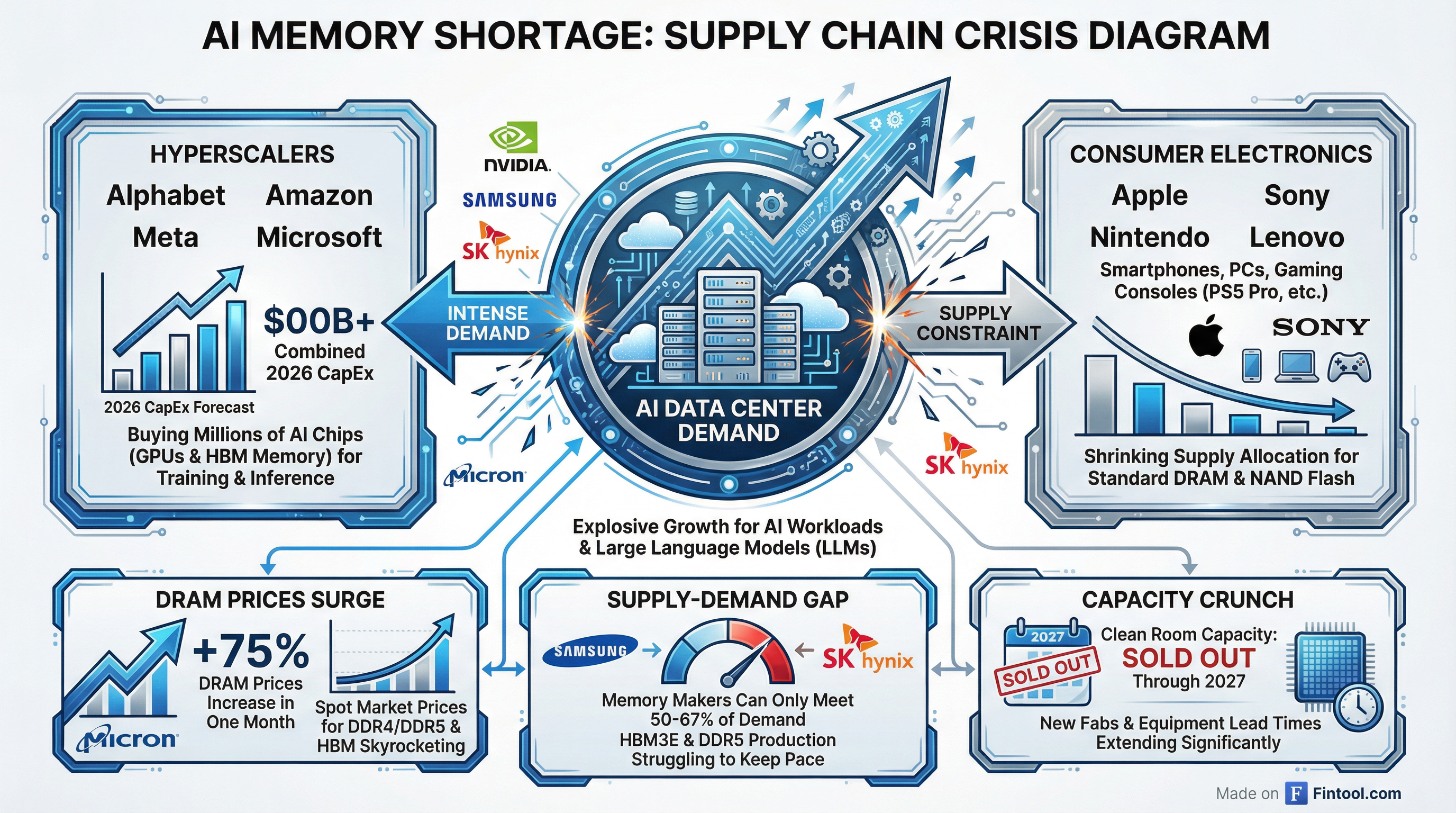
The numbers are staggering. Alphabet and Amazon have unveiled plans for capital spending surges that could reach roughly $185 billion and $200 billion respectively this year—levels that rank among the largest single-year capital expenditure outlays ever undertaken by any company.
This hyperscale demand has forced Samsung Electronics, SK Hynix, and Micron Technology to pivot their limited cleanroom space toward high-margin enterprise-grade components. Every wafer allocated to an HBM stack for an Nvidia GPU is a wafer denied to the LPDDR5X module of a smartphone or the SSD of a consumer laptop.
"This structural imbalance between supply and demand is not simply a short-term fluctuation," said Lenovo Group CEO Yang Yuanqing, warning that the chip crunch will last at least through the rest of the year.
 Ask Fintool AI Agent
Micron: 'Unprecedented' Shortage
Micron, the only U.S.-based major memory manufacturer, is at the epicenter of the crisis—and profiting handsomely from it.
| Metric | Q2 2025 | Q3 2025 | Q4 2025 | Q1 2026 |
|---|---|---|---|---|
| Revenue ($B) | $8.1 | $9.3 | $11.3 | $13.6 |
| Gross Margin (%) | 36.8% | 37.7% | 44.7% | 56.0% |
| Net Income ($B) | $1.6 | $1.9 | $3.2 | $5.2 |
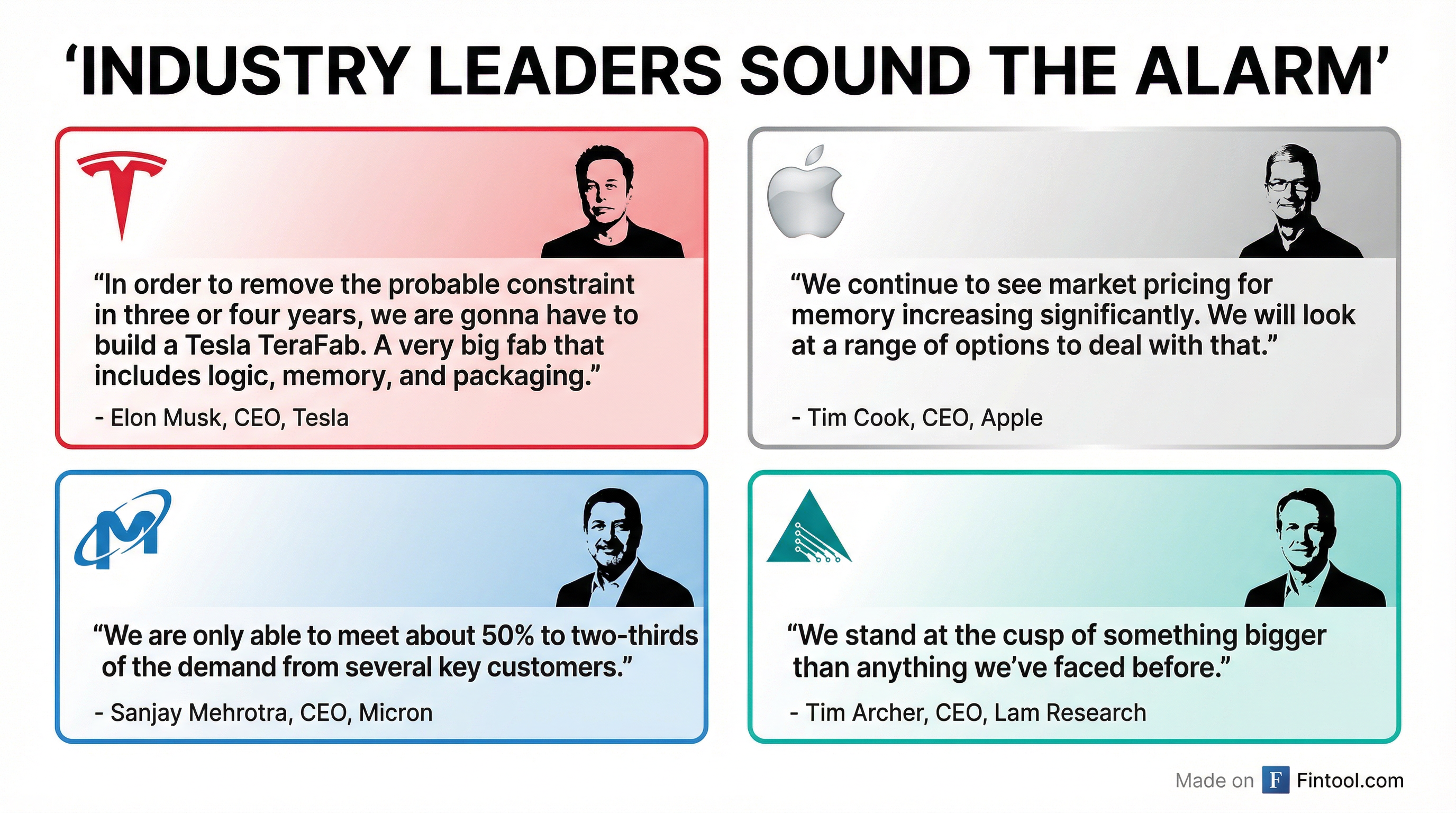
Micron CEO Sanjay Mehrotra described the situation in stark terms on the December earnings call: "In the medium term, we are only able to meet about 50% to two-thirds of our demand from several key customers."
The company's HBM production for 2026 is completely sold out, with both volume and pricing already locked in. "We believe that the aggregate industry supply will remain substantially short of the demand for the foreseeable future," Mehrotra said.
CFO Mark Murphy added that "there's no near-term solution" to the supply crunch. "Cleanroom space takes time, and the HBM growth, which has only picked up with AI-driven demand, has further pressured supply."
Equipment Makers See 'Unprecedented' Demand
The constraint is now physical: there simply aren't enough semiconductor fabrication facilities to meet demand, and building new ones takes years.
Lam Research CEO Tim Archer called it "unprecedented" on the company's Q2 2026 earnings call: "As we look out over a multiyear period, the unprecedented AI ramp demands greater speed and agility across the ecosystem."
Applied Materials CEO Gary Dickerson noted that capacity is "metered by clean room this year, in leading edge and DRAM. And so that is putting a cap on what can be done this year."
The equipment makers are benefiting from the shortage. Lam Research now expects wafer fab equipment spending to hit $135 billion in 2026, up from $110 billion in 2025, "with the growth in spending remaining constrained by a shortage of available clean room space."
 Ask Fintool AI Agent
Apple: Supply Constrained, Margins Under Pressure
Apple CEO Tim Cook addressed the memory situation directly on the company's Q1 2026 earnings call, noting that iPhone demand far outstripped supply.
"We are currently constrained, and at this point, it's difficult to predict when supply and demand will balance," Cook said. "From a memory point of view, we do expect it to be a bit more of an impact to the Q2 gross margin... Beyond Q2, we do continue to see market pricing for memory increasing significantly. As always, we'll look at a range of options to deal with that."
When asked whether Apple's purchasing power could help it gain market share against competitors facing worse supply constraints, Cook was measured: "We do believe, as I had shared, that iPhone gained share in the December quarter. If you look at Mac for the full calendar year of 2025, we also believe we gained share. So we feel very good about our position."
Tesla's Bold Gambit: The TeraFab
Perhaps the most dramatic response came from Elon Musk, who announced Tesla is planning to build its own massive fabrication facility to secure chip supply for its vehicles and AI infrastructure.
"Even when we look at the best case output of all of our key suppliers—and I'd say even they're beyond suppliers, they're like strategic partners, like Samsung, TSMC, and Micron—and we say, 'What's the most you could possibly make?' Then it's not enough," Musk said.
"In order to remove the probable constraint in three or four years, we are gonna have to build a Tesla TeraFab—a very big fab that includes logic, memory, and packaging, domestically. And that's actually also gonna be very important to ensure that we are protected against any geopolitical risks."
Musk noted that memory may be an even bigger constraint than logic chips: "Currently there are no advanced memory fabs at scale in the United States. There are zero, literally zero."
Consumer Electronics: Collateral Damage
The ripple effects are hitting consumer electronics hard.
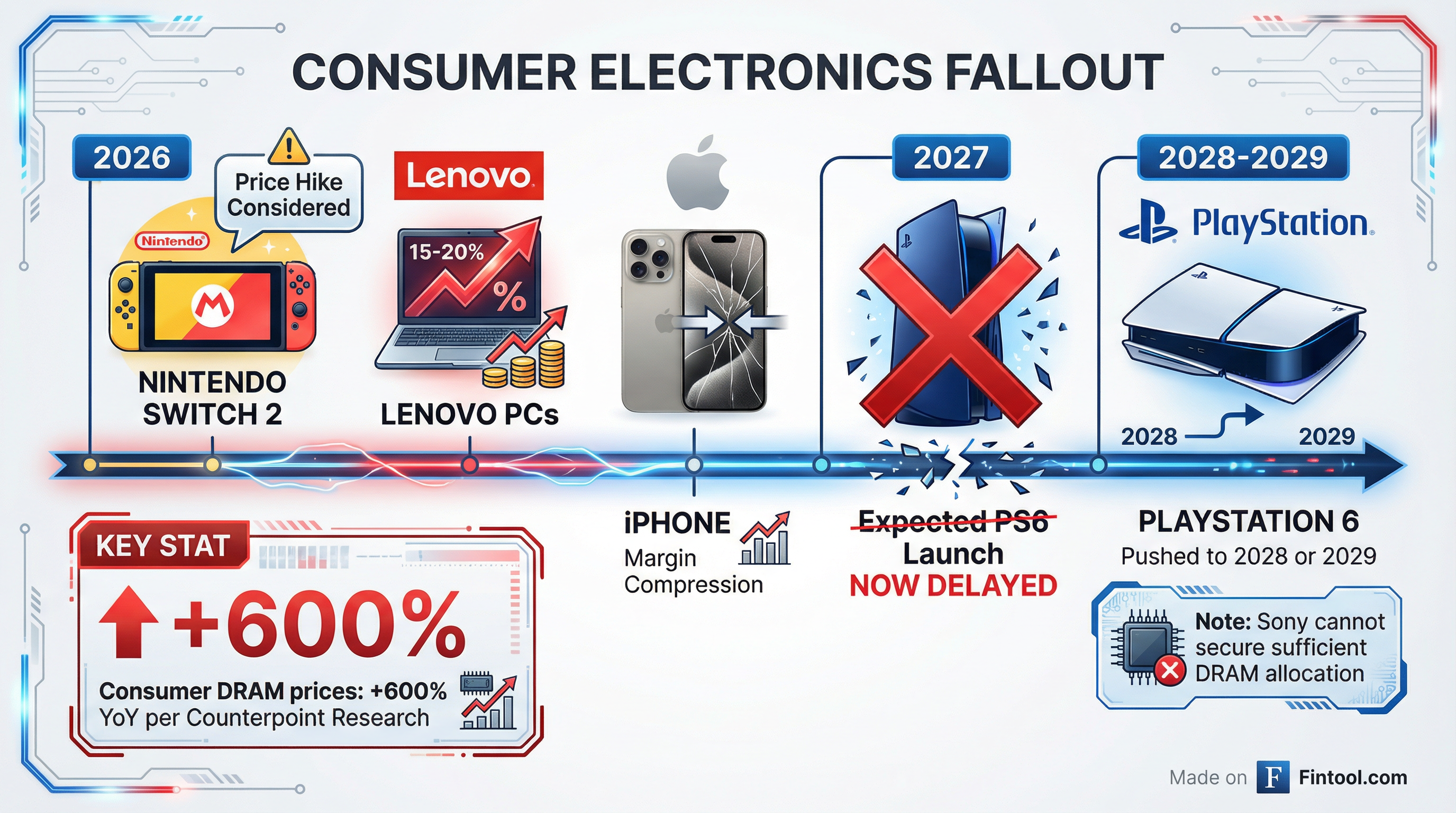
Sony PlayStation 6: Bloomberg reports Sony is considering pushing back the PS6 launch from 2027 to 2028 or even 2029, as the company struggles to secure sufficient DRAM allocation. Analysts at Sandstone Insights Japan said the new PlayStation is "likely to be delayed longer than many expected."
Nintendo Switch 2: Nintendo is reportedly considering price increases for the Switch 2 in response to surging RAM costs.
PC Market: Lenovo, Dell, HP, Acer, and ASUS have warned clients of 15-20% price hikes on PCs, according to IDC. The research firm warns of a "moderate downside scenario" where the PC market could contract by 4.9% in 2026, with a "pessimistic scenario" showing an 8.9% decline.
"The year 2026 is shaping up to be one in which technology becomes more expensive, driven by supply constraints rather than demand growth," IDC concluded.
Ask Fintool AI AgentWhat to Watch
Near-term catalysts:
- Micron's next earnings call for updated supply/demand outlook
- Memory pricing data from TrendForce and Counterpoint Research
- NVIDIA's quarterly results for AI accelerator demand signals
- Any capacity announcements from Samsung, SK Hynix, or TSMC
Longer-term resolution:
- New cleanroom capacity coming online in 2027 and beyond
- Whether Tesla actually breaks ground on its TeraFab
- Potential demand destruction if consumer electronics prices rise too far
- Any geopolitical developments affecting Taiwan-based production
Analysts at CCS Insight estimate new supply won't "materially address constraints until well into 2027 and potentially into early 2028."
For investors, the immediate beneficiaries are clear: memory makers like Micron and equipment suppliers like Lam Research, Applied Materials, and Kla. The losers are consumer electronics companies facing margin compression and potential demand destruction from higher prices.
As Bernstein analyst Mark Li put it, memory chip prices are going "parabolic."
The AI boom has created a zero-sum game for silicon—and right now, the hyperscalers are winning.
Related Companies: