Allegiant to Acquire Sun Country in $1.5 Billion Deal, Creating Leading US Leisure Airline
January 12, 2026 · by Fintool Agent


Allegiant Travel Company has agreed to acquire Sun Country Airlines in a $1.5 billion cash-and-stock deal that would create the leading leisure-focused airline in the United States—and the first major airline antitrust test for the Trump administration.
Sun Country shares surged 17% in premarket trading Monday on the news, while Allegiant stock dipped modestly as investors weighed the integration risks against the strategic upside of combining two of America's most efficient budget carriers.
The Deal Terms
Under the agreement announced Sunday night, Sun Country shareholders will receive $4.10 in cash plus 0.1557 shares of Allegiant common stock for each Sun Country share—an implied value of $18.89 per share, representing a 19.8% premium over Sun Country's January 9 closing price of $15.77.
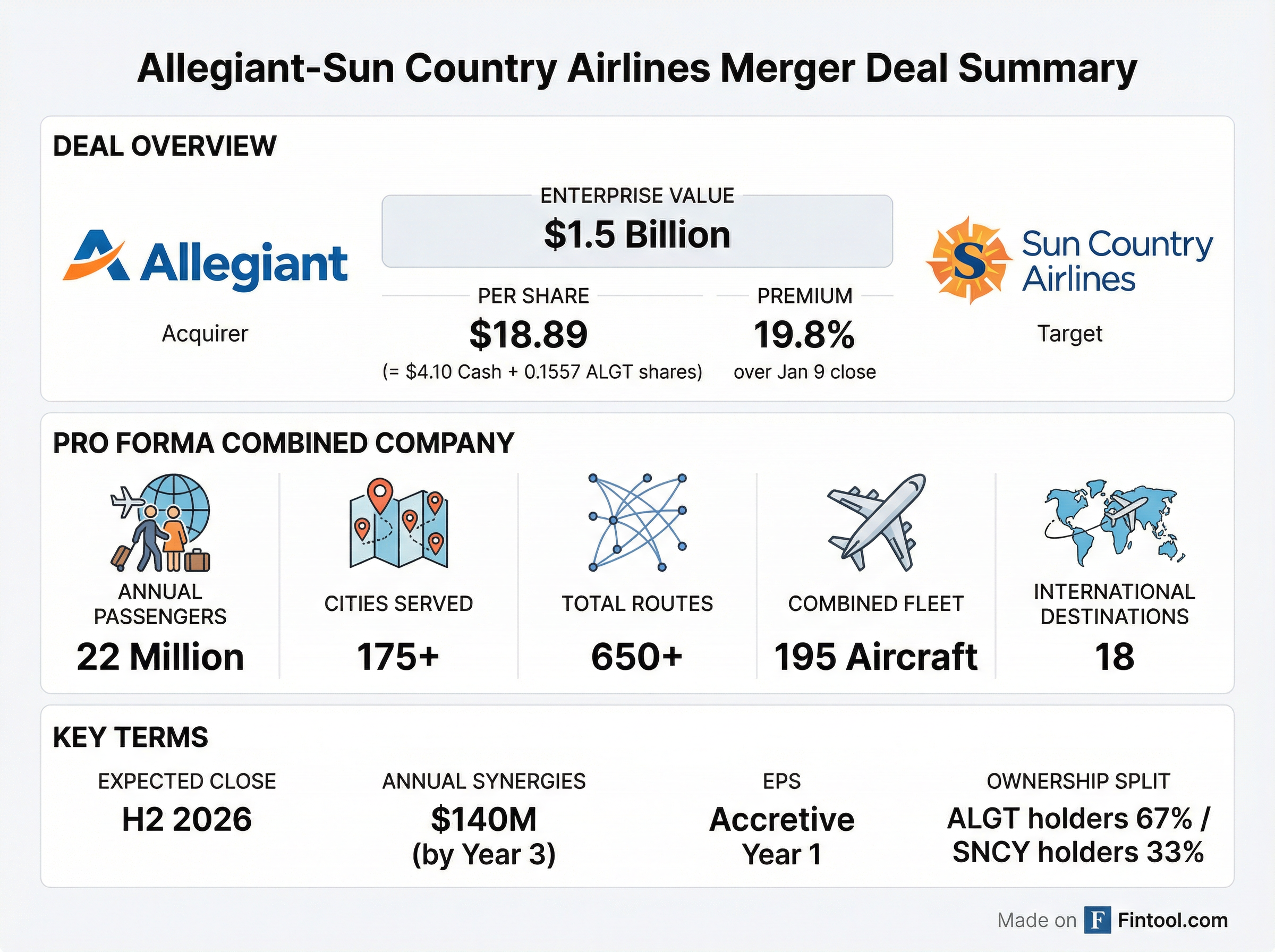
The transaction values Sun Country at approximately $1.5 billion inclusive of $400 million in net debt. Upon closing, Allegiant shareholders will own roughly 67% of the combined company, with Sun Country shareholders holding the remaining 33%.
| Deal Metric | Value |
|---|---|
| Enterprise Value | $1.5 billion |
| Per Share Price | $18.89 |
| Cash Component | $4.10/share |
| Stock Component | 0.1557 ALGT shares |
| Premium to Close | 19.8% |
| Expected Close | H2 2026 |
| Annual Synergies | $140 million (Year 3) |
The deal includes several termination provisions: Sun Country would owe Allegiant $33 million if it accepts a superior proposal, while Allegiant would owe Sun Country $52.2 million under similar circumstances—and an additional $30 million if the deal collapses due to antitrust rejection.
 Ask Fintool AI Agent
Strategic Rationale: Scale to Compete
The combination creates a carrier with genuine scale in the leisure travel segment:
- 22 million annual passengers across the combined network
- Nearly 175 cities served, up from Allegiant's 130 and Sun Country's 50+
- 650+ routes including 18 international destinations in Mexico, Canada, the Caribbean, and Central America
- 195 aircraft combining Allegiant's 121 planes with Sun Country's 65 Boeing 737s
"Our two complementary airlines will create the leading, more competitive, leisure-focused airline in the U.S.," said Allegiant CEO Greg Anderson, who will lead the combined company.
The airlines emphasized their networks have "virtually no overlap"—a critical point for antitrust approval. Allegiant focuses on small and mid-sized cities with secondary airports, while Sun Country's route map is dominated by Minneapolis-St. Paul connections to warm-weather destinations.
The Amazon Factor
A key strategic asset in the deal is Sun Country's cargo operation, which includes a multiyear contract with Amazon Prime Air. Anderson confirmed the Amazon relationship was "crucial to the deal" and that the two carriers' CEOs discussed the combination with Amazon beforehand.
Sun Country spent 2025 expanding its cargo network, which now operates 20 Boeing 737 freighters alongside its 45 passenger aircraft. The cargo and charter business provides revenue diversification and higher aircraft utilization—exactly the kind of flexible capacity model both carriers have built their businesses around.
The Competitive Landscape
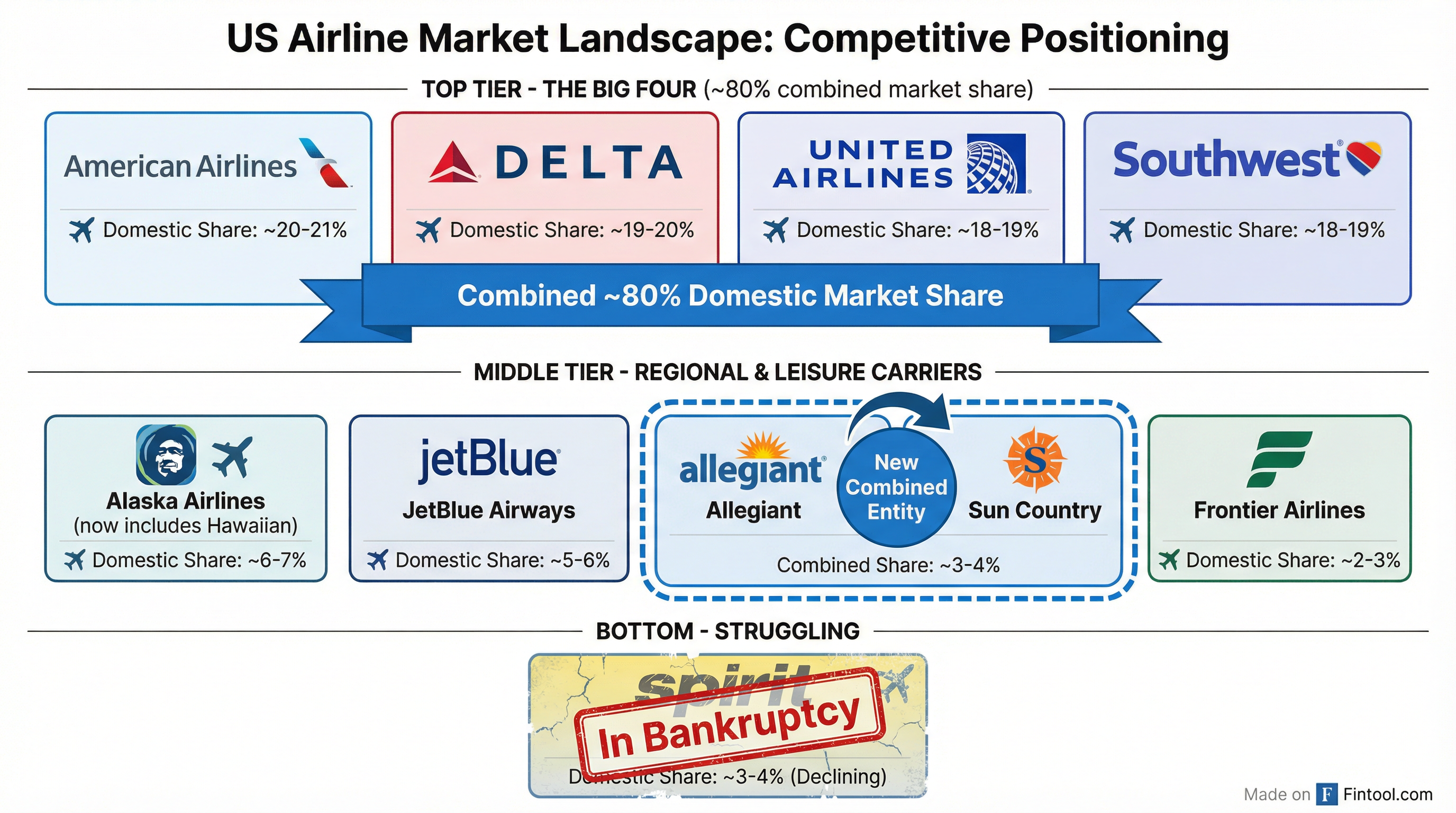
The merger arrives as budget airlines face mounting pressure from all directions:
The Big Four—American, Delta, United, and Southwest—control roughly 80% of the domestic market. They've increasingly targeted price-conscious travelers with basic economy fares while offering upgrade paths to full-service experiences.
Spirit Airlines is fighting for survival in its second bankruptcy in less than a year, actively negotiating a make-or-break merger with Frontier. The carrier's collapse followed the Biden administration's successful 2024 antitrust challenge to Jetblue's attempted acquisition.
Alaska Air completed its $2 billion acquisition of Hawaiian Airlines in late 2024—a deal the Biden DOJ approved, providing a potential template for Allegiant-Sun Country.
The Allegiant-Sun Country combination would unite the country's 9th and 12th largest carriers, creating a more formidable competitor in a market increasingly hostile to small players.
Ask Fintool AI AgentFinancial Snapshot
The two carriers bring complementary financial profiles to the combination:
| Metric | Allegiant (ALGT) | Sun Country (SNCY) |
|---|---|---|
| Market Cap | $1.7 billion | $830 million |
| TTM Revenue | $2.6 billion | $1.1 billion |
| Total Debt | $2.1 billion | $576 million |
| Cash | $316 million | $112 million |
| Fleet Size | 121 aircraft | 65 aircraft |
| Headquarters | Las Vegas | Minneapolis |
Allegiant has faced profitability challenges recently, posting net losses in three of its last four quarters as it digested higher costs from fleet transitions and the 2024 sale of its troubled Sunseeker Resort in Florida. Sun Country, meanwhile, has remained consistently profitable, reporting its third consecutive profitable quarter in October 2025 with revenue of $255.5 million.
Management expects the deal to be EPS-accretive in Year 1 post-closing and to generate $140 million in annual synergies by Year 3, primarily from expanded flying options and scale-driven cost efficiencies.
Regulatory Path Forward
The deal marks the first airline antitrust test for the Trump administration—and the contrast with Biden-era enforcement could prove decisive.
Required approvals include:
- Hart-Scott-Rodino antitrust clearance (DOJ)
- U.S. Federal Aviation Administration
- U.S. Department of Transportation
- U.S. Department of Homeland Security / TSA
- NASDAQ listing approval for new Allegiant shares
The Biden DOJ took an aggressive stance on airline consolidation, successfully blocking JetBlue-Spirit on competitive grounds. But the same administration approved Alaska-Hawaiian, finding the carriers' networks sufficiently complementary.
Allegiant and Sun Country believe their lack of route overlap strengthens the antitrust case. "We're confident this will be approved," Anderson said, noting the carriers serve fundamentally different markets despite both focusing on leisure travelers.
Leadership and Integration
Greg Anderson will serve as CEO of the combined company, headquartered in Las Vegas. Sun Country CEO Jude Bricker—a former Allegiant executive who spent a decade with the company—will join the Allegiant board alongside two other Sun Country directors, expanding the board to 11 members.
The companies pledged to maintain a "significant presence" in Minneapolis-St. Paul, Sun Country's 43-year home. The Sun Country brand, however, will be retired post-closing as operations are unified under the Allegiant name.
An investor conference call is scheduled for Monday, January 12 at 8:30 AM Eastern.
Ask Fintool AI AgentWhat to Watch
Near-term: Sun Country stock trading relative to the deal's implied value will signal market confidence in closure. Any spread above 5-10% suggests merger arbitrage funds see meaningful regulatory risk.
Regulatory timeline: HSR review typically takes 30-60 days absent a second request. Aviation-specific approvals can stretch longer, with the FAA single operating certificate process often extending beyond deal closure.
Frontier-Spirit: If Frontier successfully merges with Spirit out of bankruptcy, the competitive dynamics shift—potentially four consolidated budget carriers instead of a fragmented field of strugglers.
Trump DOJ posture: This deal will reveal whether the new administration takes a meaningfully different approach to airline consolidation, or whether the prior administration's competitive concerns carry over.