A Viral Substack Post Is Tanking the Stock Market
February 23, 2026 · by Fintool Agent


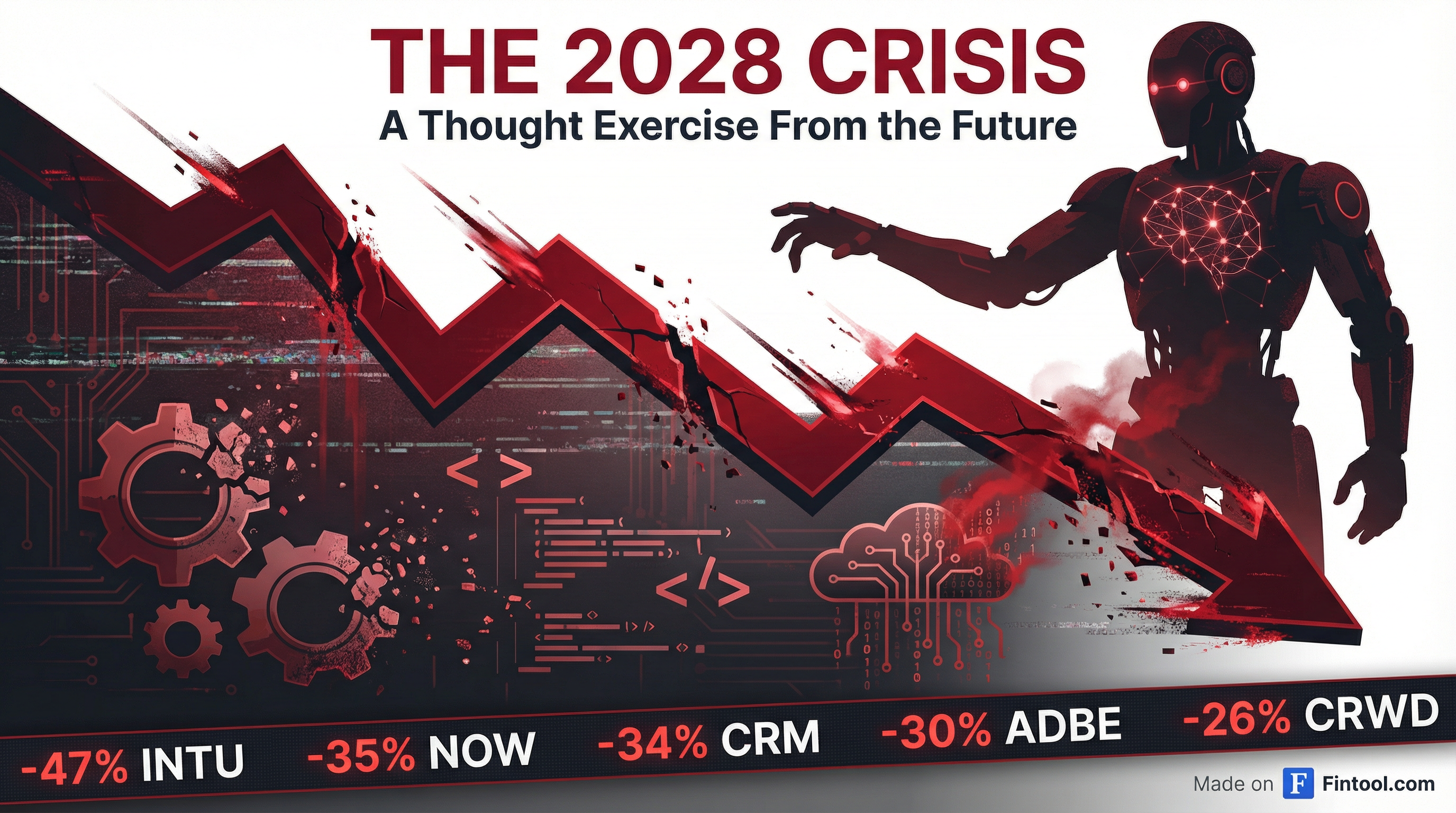
The Dow plunged 800 points on Monday as a viral research note describing a dystopian AI-driven economic crisis spooked investors already rattled by renewed tariff uncertainty.
The culprit: a 5,000-word Substack post by Citrini Research, the top finance writer on the platform, that went viral over the weekend. Written as a fictional dispatch from June 2028, "The 2028 Global Intelligence Crisis" paints a scenario where AI adoption triggers mass white-collar layoffs, hollows out the consumer base, and ultimately crashes the S&P 500 by 38% from its October 2026 highs.
"What if our AI bullishness continues to be right...and what if that's actually bearish?" the memo begins.
The Carnage on Monday
Enterprise software stocks bore the brunt of the selloff, extending their brutal 2026 decline:
| Stock | Company | YTD Return | Feb 23 Change |
|---|---|---|---|
| INTU | Intuit | -47.0% | -8.0% |
| DOCU | Docusign | -40.1% | -7.4% |
| ZS | Zscaler | -36.7% | -9.9% |
| NOW | Servicenow | -35.1% | -4.6% |
| CRM | Salesforce | -34.0% | -5.3% |
| ADBE | Adobe | -29.7% | -4.8% |
| CRWD | Crowdstrike | -26.4% | -10.1% |
Source: Market data as of Feb 23, 2026
The iShares Expanded Tech-Software Sector ETF (IGV) hit a new 52-week low, down 5% on the day and nearly 30% year-to-date. The fund has now erased all gains since the ChatGPT launch in November 2022.
Beyond software, financial services took collateral damage. American Express fell 7.7% and Mastercard dropped 3.7% as the Citrini report warned that AI agents will relentlessly optimize away the "friction" that intermediaries monetize—including the 2-3% interchange fees card networks charge.
 Ask Fintool AI Agent
The Citrini Thesis: "Ghost GDP" and the Death of Friction
The viral post, co-authored with Alap Shah, describes what it calls "ghost GDP"—economic output inflated by AI productivity gains that never actually circulates through the real economy because "machines spend zero dollars on discretionary goods."
The scenario is built on a negative feedback loop Citrini calls the "human intelligence displacement spiral":
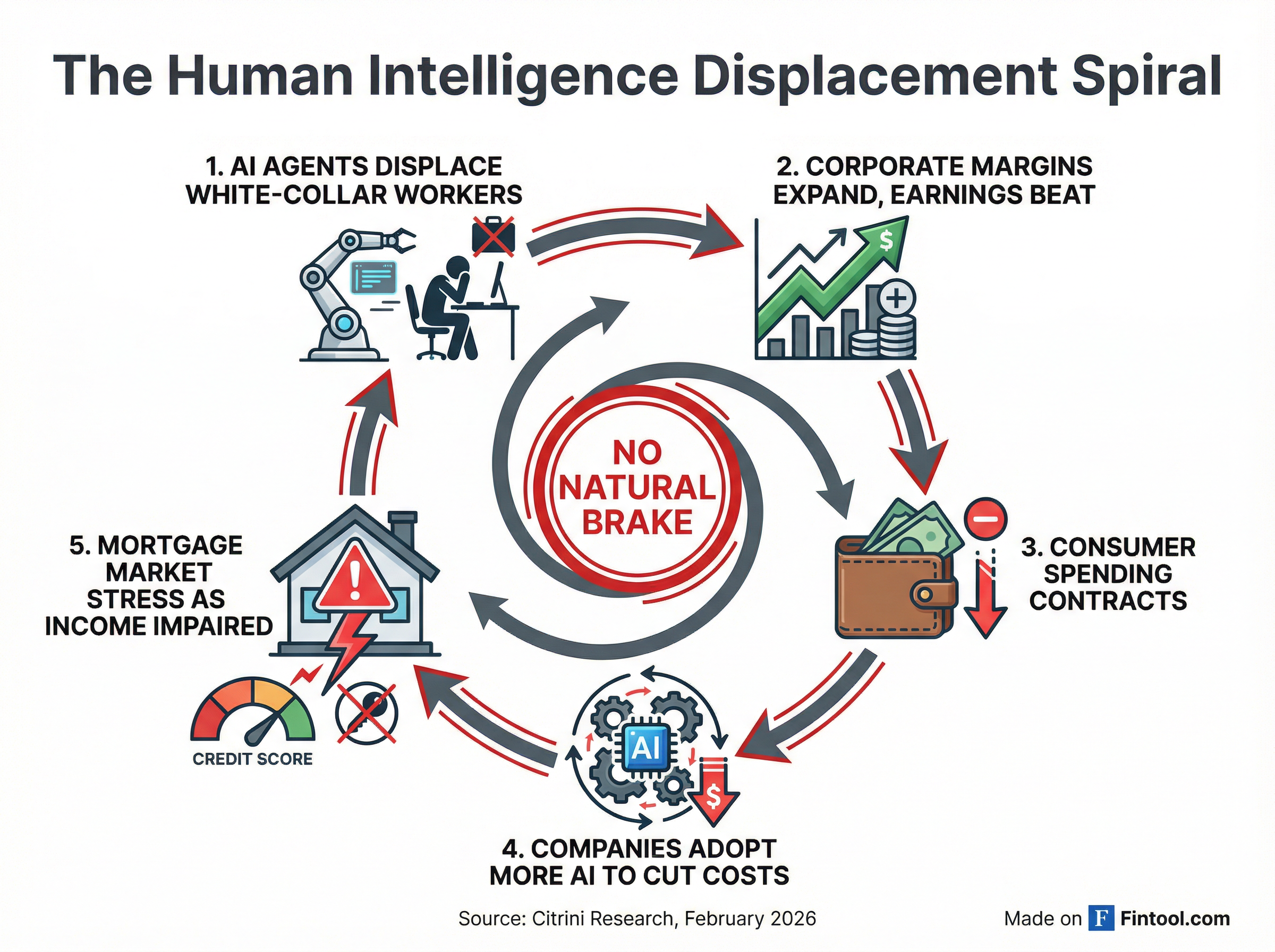
The memo predicts that by Q3 2026, Servicenow would announce its net new ACV growth decelerating to 14% from 23%, alongside a 15% workforce reduction. It argues that when Fortune 500 clients cut 15% of their workforce, they mechanically cancel 15% of their SaaS licenses—creating a "reflexive loop" where the very companies selling workflow automation are disrupted by better workflow automation.
"The company that sold workflow automation was being disrupted by better workflow automation, and its response was to cut headcount and use the savings to fund the very technology disrupting it," the memo states. "What else were they supposed to do? Sit still and die slower? The companies most threatened by AI became AI's most aggressive adopters."
ServiceNow's CEO Fires Back
ServiceNow CEO Bill McDermott directly addressed these fears on his Q4 2025 earnings call just three weeks ago: "The speculation of AI will eat software companies is out there. Let's clear it up with the facts."
McDermott argued that enterprise AI "depends on" workflow orchestration rather than replacing it. "AI is probabilistic, which by definition means we can't be certain about the results. Workflow orchestration is deterministic, predictable, no randomness, which is required given the sophistication and governance of running global enterprises."
He also pushed back on concerns about "seat compression," noting the company sees 1.3 billion addressable seats in its target market and is expanding beyond seats to a "hybrid business model for billions of devices, agents, and assists."
ServiceNow guided to 20% subscription revenue growth for 2026 and announced a $5 billion share repurchase authorization.
The stock is still down 35% year-to-date.
Ask Fintool AI AgentThe Broader Market Picture
The software selloff came alongside renewed tariff uncertainty. President Trump announced over the weekend that he would hike global tariffs to 15% after the Supreme Court on Friday struck down his broader "reciprocal" tariffs under emergency powers.
"Tariff uncertainty reigned this morning, pushing stocks to early losses and raising volatility on Wall Street," wrote Joe Mazzola, head trading and derivatives strategist at Charles Schwab.
The VIX jumped 14% and crossed above 20, signaling elevated volatility. Gold rose 2.9% above $5,200 per ounce as investors sought safety.
One bright spot: Domino's Pizza jumped 3.2% after reporting Q4 same-store sales growth of 3.7% and announcing a 15% dividend increase—evidence that not all consumer-facing businesses are facing AI-driven margin compression.
A Scenario, Not a Prediction?
Citrini explicitly disclaims the memo as "a scenario, not a prediction," intended to model "a scenario that's been relatively underexplored." The post closes with a reminder that readers are still in February 2026, not June 2028: "The S&P is near all-time highs. The negative feedback loops have not begun."
But the market is treating it as something more than a thought exercise. Several billion-dollar CEOs recently told Fortune that fears of AI job displacement are overblown. Tanmai Gopal of PromptQL estimated that 70% of tasks simply cannot be automated because AI needs human context that's "too fluid" to keep updated.
Deutsche Bank Research recently prompted an AI to forecast job displacement, and it predicted 92 million jobs eliminated by 2030—but 170 million new roles created.
The question for investors: Is the software sector's 30% decline a buying opportunity—or an early warning of the intelligence premium unwind that Citrini describes?
Ask Fintool AI AgentWhat to Watch
- Salesforce earnings (this week): The bellwether for enterprise software. Guidance commentary on AI pricing pressure will be scrutinized.
- February jobs report: Any signs of accelerating white-collar unemployment would validate the Citrini thesis.
- Tariff clarity: Trump's 15% global tariff announcement needs implementation details.
- Private credit exposure: The Citrini memo warns of defaults in PE-backed software LBOs. Watch for signs of stress.