Elliott Takes $1 Billion Activist Stake in Lululemon, Pushes Turnaround Specialist as CEO
December 18, 2025 · by Fintool Agent



Activist investor Elliott Investment Management has amassed a stake exceeding $1 billion in Lululemon Athletica—making it one of the athleisure giant's largest shareholders—and is aggressively pushing for former Ralph Lauren executive Jane Nielsen to take the CEO job, just days after incumbent Calvin McDonald announced his departure.
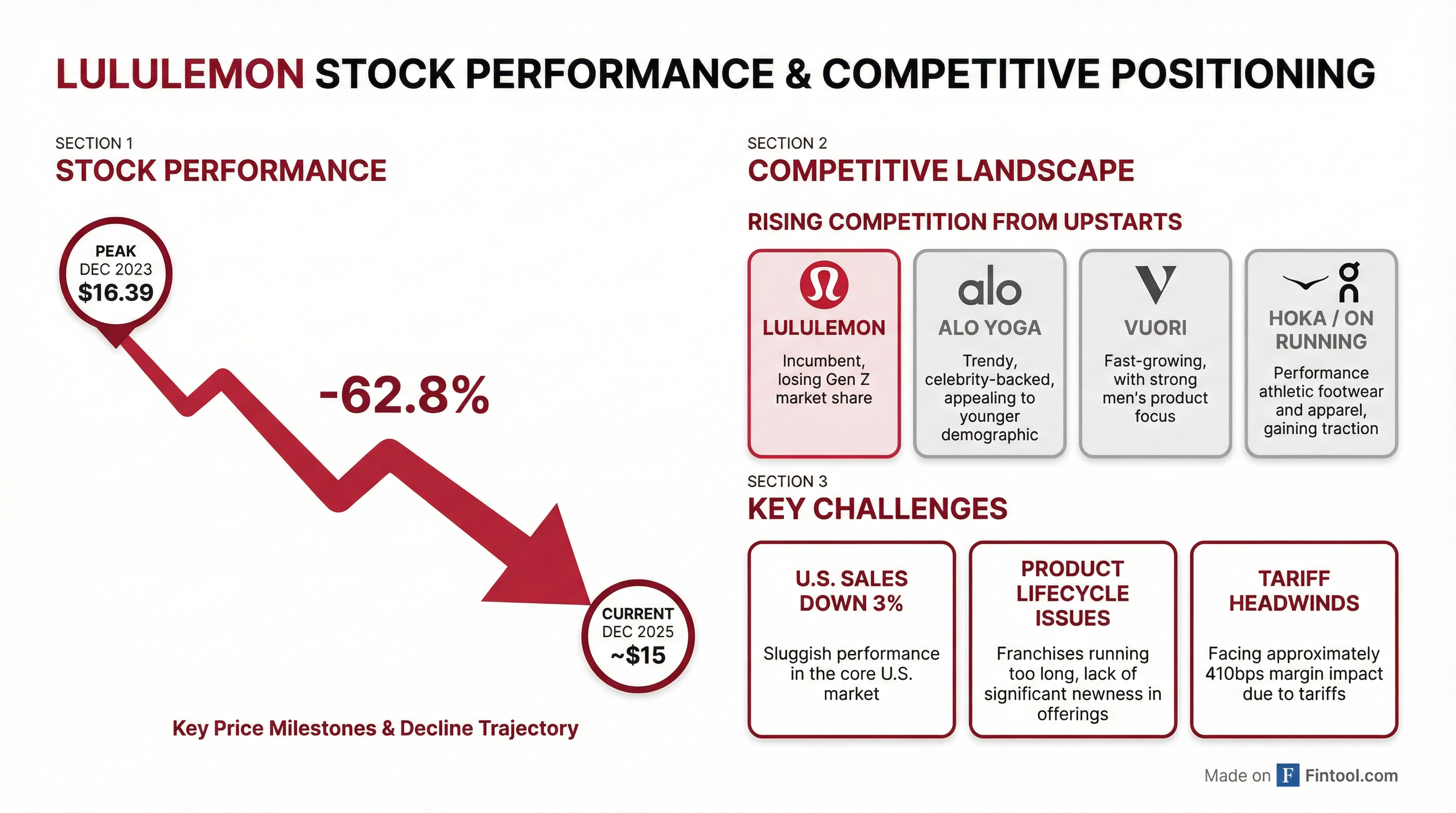
The move sent Lululemon shares surging as much as 9% Thursday before settling around $215, a 3.5% gain. But even with today's pop, the stock remains down more than 60% from its December 2023 peak of $516.39—a collapse that has intensified pressure on the board and emboldened activist investors to demand change.
Elliott's intervention transforms what was already a high-stakes CEO succession into a potential proxy battle, with the company's founder and largest individual shareholder Chip Wilson also publicly demanding new leadership and board refreshment.
The Setup: A CEO Exit, A Stock in Freefall, A Founder on the Warpath
Lululemon announced on December 11 that McDonald would step down effective January 31, 2026, after nearly seven years at the helm. The company appointed Board Chair Marti Morfitt as Executive Chair and named CFO Meghan Frank and Chief Commercial Officer André Maestrini as interim co-CEOs while a search firm conducts a "comprehensive" hunt for McDonald's replacement.
McDonald's tenure was a tale of two halves. He tripled Lululemon's revenue from roughly $3.3 billion in 2018 to an expected $11 billion this fiscal year, expanded into 30+ geographies, and built China into the company's second-largest market. The stock hit all-time highs above $500 in late 2023.
But the second half brought a reckoning. U.S. sales growth stalled, product innovation lagged, and trendier upstarts like Alo Yoga and Vuori began stealing market share—particularly with Gen Z consumers who increasingly view Lululemon as their mother's yoga brand, not theirs.
Founder Chip Wilson—who holds a 4.3% stake valued at nearly $1 billion—has been merciless in his criticism. In a statement the day after McDonald's departure was announced, Wilson called the CEO transition "a tremendous failure by the Board to competently plan for the future" and demanded the CEO search be led by "new, independent directors with real experience."
Wilson's assessment of McDonald's tenure: "The Board's praise for Calvin McDonald, a CEO who has overseen massive value destruction over the past two years, with a 62.8% drop in LULU's share price, shows blatant disregard for its shareholders."
Enter Elliott—And Jane Nielsen
Elliott's $1 billion stake—roughly 4% of Lululemon's shares outstanding—gives the activist serious leverage. But unlike many Elliott campaigns that start with aggressive public letters demanding board seats or strategic changes, this one opened with a constructive move: a CEO candidate.
That candidate is Jane Nielsen, a Harvard MBA with three decades of experience at blue-chip consumer companies—and a reputation as a turnaround specialist who knows how to stop the bleeding at struggling retailers.
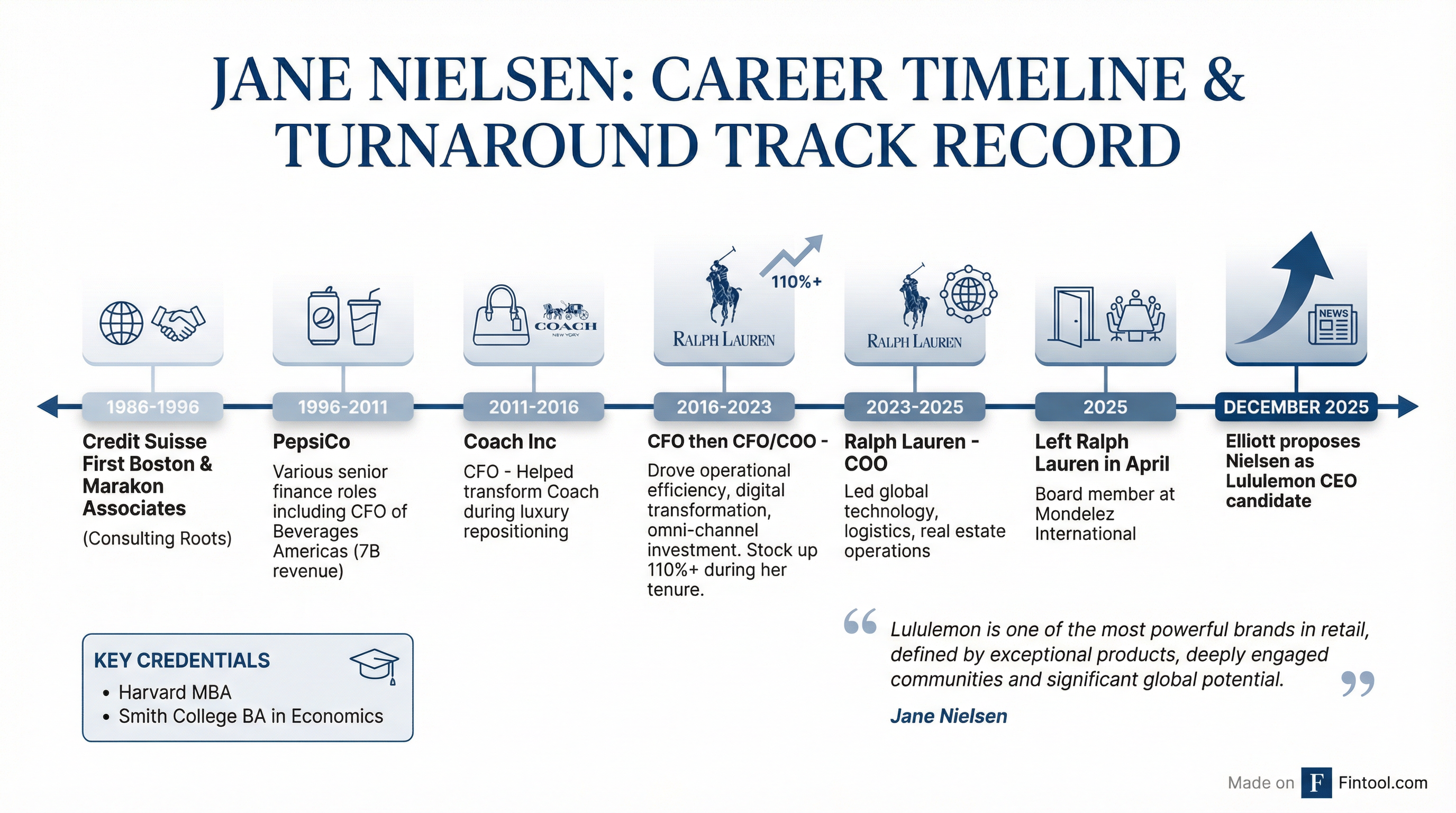
Nielsen's resume reads like a playbook for retail reinvention:
| Company | Role | Years | Key Accomplishments |
|---|---|---|---|
| Coach (now Tapestry) | CFO | 2011-2016 | Led financial strategy during Coach's luxury repositioning |
| Ralph Lauren | CFO, then CFO & COO | 2016-2023 | Drove digital transformation, omni-channel investment, operational efficiency |
| Ralph Lauren | COO | 2023-2025 | Led global technology, logistics, real estate operations |
| Mondelez | Board Member | Current | Audit Committee; designated financial expert |
Nielsen left Ralph Lauren in April 2025—about the time sources say she and Elliott began discussions about Lululemon.
In a statement to The Wall Street Journal Wednesday, Nielsen made clear she wants the job: "Lululemon is one of the most powerful brands in retail, defined by exceptional products, deeply engaged communities and significant global potential. I would welcome the chance to discuss this opportunity with the Lululemon board."
BNP Paribas analyst Laurent Vasilescu called Nielsen a top candidate even before Elliott's move: "We would applaud if the board ultimately chooses Jane as we have deep respect for her leadership and her experience in turning Tapestry and Ralph Lauren around."
What's Wrong With Lululemon?
The numbers tell the story. In its most recent quarter (Q3 fiscal 2026), Lululemon reported:
| Metric | Q3 2026 | Q3 2025 | Change |
|---|---|---|---|
| Total Revenue | $2.57B | $2.40B | +7% |
| Americas Revenue | Down 2% | — | Weak |
| U.S. Revenue | Down 3% | — | Weak |
| China Revenue | +46% | — | Strong |
| Gross Margin | 55.6% | 58.5% | -290 bps |
| Net Income | $307M | $352M | -13% |
| EPS | $2.59 | $2.87 | -10% |
The core U.S. business—Lululemon's home market and still its largest—is contracting while China drives all the growth. Management has acknowledged they "let product lifecycles run too long" and failed to inspire high-value guests with enough newness.
CFO Meghan Frank outlined a three-pillar turnaround plan on the Q3 call:
- Product Creation: Increase new style penetration to 35% by Spring 2026; reduce product development cycle from 18-24 months to 12-14 months
- Product Activation: Curate store assortments by local market; improve digital experience; re-engage high-value guests
- Enterprise Efficiency: Mitigate $190 million net tariff impact this year (originally projected at $220 million)
But the turnaround faces headwinds. Tariffs and the removal of de minimis exemptions will cost approximately 410 basis points of gross margin in Q4. And post-Thanksgiving traffic "slowed a bit," according to McDonald, suggesting the holiday season may disappoint.
The Competitive Threat
Lululemon isn't just fighting its own execution problems—it's fighting a shift in consumer preference.
Alo Yoga and Vuori have emerged as the brands Gen Z actually wants to wear. Both have leaned into celebrity partnerships, fresher designs, and faster product cycles. As Morningstar analyst David Swartz told Reuters: "They have not been able to come up with anything new, and at the same time, their competition—same issue that's affecting Nike and the others—has only increased."
Strategy consultant Brittain Ladd put it bluntly: "Lululemon should implement fast fashions and introduce an assortment that will pull customers from Alo and Vuori—especially Gen Z customers. Fast fashion requires a much better supply chain than is currently in use at Lululemon."
The Starbucks Playbook
Elliott's approach to Lululemon mirrors its successful 2024 campaign at Starbucks. There, Elliott built a major stake amid slowing same-store sales and public criticism of management, then advocated for CEO change. The result: Starbucks replaced CEO Laxman Narasimhan with Brian Niccol, the turnaround architect who revived Chipotle.
"Elliott is famous for agitating for change. These positions aren't built overnight, so Lululemon's board probably saw this coming," said Brian Jacobsen, chief economic strategist at Annex Wealth Management.
The firm has been on a tear in 2025, taking positions in Pepsico (pushing for price reductions), Workday ($2+ billion stake), and Phillips 66 (proxy fight).
What Happens Next?
Three scenarios seem plausible:
1. Board Accepts Nielsen (Most Likely) Given Elliott's track record and Nielsen's qualifications, the path of least resistance is for Lululemon's board to include Nielsen in the CEO search—and likely select her. The company hasn't commented on Elliott's involvement, but it would be unusual to ignore a shareholder with a $1 billion stake and a credible candidate.
2. Proxy Battle If the board dismisses Elliott's involvement, the activist could launch a formal campaign for board seats at the 2026 annual meeting. With founder Chip Wilson already demanding board changes (though not coordinating with Elliott), the company could face pressure from multiple directions.
3. Alternative CEO Emerges The board's search firm may surface candidates that satisfy both Elliott and the existing directors. BNP Paribas noted there were "four individuals consistently discussed with investors" as potential CEOs before Elliott's move went public.
The Investment Case
At $215, Lululemon trades at roughly 16x forward earnings—cheap by historical standards but not distressed. The company has $1 billion in cash, no debt, and still generates strong cash flow.
| Metric | LULU | Nike | Gap |
|---|---|---|---|
| Forward P/E | 16.4x | 25x | 12x |
| Market Cap | $24.1B* | $97.0B* | $10.1B* |
| YTD Stock Performance | Down 40% | Down 13% | Up 50% |
*Values retrieved from S&P Global
For bulls, the Elliott involvement signals that serious capital believes Lululemon can be fixed. For bears, the depth of the product and competitive problems may take years to address—if they can be addressed at all.
What's clear: the status quo is over. With Elliott pushing Nielsen, Chip Wilson demanding board changes, and management in transition, Lululemon's next chapter will look very different from the McDonald era.
The question is whether a turnaround specialist can restore the brand's cool—or whether Lululemon, like many beloved retail names before it, has already ceded that ground to the next generation.
Related Companies